A bench at the foot of a king-size bed is one of those finishing touches that can completely transform a room. It provides seating, storage, and visual balance to your personal sanctuary. This single piece can be a spot for seating, a place for storage, and the design anchor that pulls your whole look together.
Finding the Perfect Finishing Touch for Your King Bed
A standard king mattress is 76 inches wide, and a bench usually works best at roughly 60–68 inches long, 15–20 inches deep, and the same height as or slightly lower than the top of the mattress. In the United States, a king mattress runs 76 inches wide by 80 inches long (about 193 by 203 centimeters), so that bench length leaves 4–8 inches of breathing room on each side. Keeping the bench narrower than the mattress is what makes the arrangement look intentional rather than oversized. For the underlying bed dimensions, see this breakdown of standard bed size dimensions.
At a glance, before you shop you need four measurements and one judgment call:
- Bed width: 76 inches for a standard king drives the bench-length range.
- Room clearance: how much walkway remains at the foot of the bed after the bench is placed.
- Mattress height: your bench should sit level with or slightly below the mattress top.
- Storage needs: decide now whether the bench must hold linens, because it changes the depth.
In our showroom, a common oversight is forgetting the clearance measurement. We often see shoppers fall for a beautiful upholstered bench only to realize later they are turning sideways to squeeze past it. Solve the clearance problem before the fabric decision.
A well-chosen bench also earns its spot in daily use—a place to sit while putting on shoes, a surface to lay out an outfit, a spot to neatly stow extra bedding. And because a king bed is such a large piece of furniture on its own, a bench helps ground it so the bed doesn't overpower the room.
One of the most common mistakes we see is treating the bench as an afterthought. Instead, you should think of it as a key component that helps define the room's character and enhance its usability. Our non-commission Design Experts always advise thinking about how you'll use the bench first.
For more ideas on furniture fabrics, colors, and patterns, check out our guide on accessorizing the bed of your dreams.
How We Determine the Right Bench Size for a King Bed
We don't guess at these ranges—every number here comes from the same six-step method our Design Experts use with clients:
- Start with standard king dimensions: a 76-inch-wide, 80-inch-long mattress sets the scale.
- Set proportion to bed width: the bench should be shorter than the mattress, not flush with it, so the bed stays the focal point.
- Compare mattress height: a bench at or slightly below mattress top height reads visually clean and doubles as stable seating.
- Test walkway clearance: measure from the foot of the bed to the nearest obstruction after the bench is placed, not to the wall before furniture goes in.
- Account for room layout: door swings, nightstand reach, and any desk or seating at the foot of the room all shrink usable space.
- Weigh storage access: a lift-top bench needs lid-clearance room to open, which changes where and how deep it can be.
It's the same process we apply on the showroom floor, just documented so you can run it at home with a tape measure.
Getting the Proportions Right for Your Bed Bench
Getting the proportions right is the secret that separates a bedroom that looks nice from one that feels professionally designed and balanced. Here are the working numbers, all sized against a standard king:
| Measurement | Recommended range for a king bed |
|---|---|
| Standard king bed width | 76 inches (80 inches long) |
| Bench length | 60–68 inches |
| Bench depth | 15–20 inches |
| Bench height | Equal to or slightly below mattress top |
| Minimum walking clearance | 24–30 inches |
Getting the Length Just Right
The sweet spot for a bench is usually between 60 and 68 inches long. That leaves a little breathing room—about 4 to 8 inches of space on each side. That negative space matters more than you'd think: it keeps the bench from looking crammed in and lets your comforter or duvet drape naturally without bunching up. Interior design standards for furniture spacing and traffic flow confirm that leaving proportional negative space around large pieces prevents a crowded feel.
If your bedroom is on the smaller side, a bench closer to 60 inches can still work, especially when the piece has substantial arms or a tall back that visually adds bulk.
Nailing the Height and Depth
Height is just as critical as length. A bench that's too tall feels like a barrier, interrupting the clean line of your bed; too low, and it feels disconnected.

Your bench should be the same height as or slightly lower than the top of your mattress. This creates a graceful, waterfall-like transition from the bed to the bench.
Most bedroom benches run 15 to 20 inches deep, aligning with standard seating depth guidelines for comfortable perching. But depth interacts with clearance, so practical bedroom furniture planning guidance gives a useful rule: aim for roughly 24 to 30 inches of open space for comfortable movement. Because the bench occupies part of that zone, the measurement must be taken from the foot of the bed to the nearest obstruction after the bench is placed. If your room has 48 inches between the bed and an opposite wall, for example, a 16-inch bench leaves you just over the comfortable minimum—doable, but snug.
A Word on Storage Benches
Storage changes the depth math. If your room is tight, stay closer to 15–18 inches deep; a deep storage trunk at the foot of a king bed eats the same walkway as a chair would. If your room has room to spare—a primary suite with 48 inches or more between bed and opposite wall—a deeper storage piece (20 inches or slightly more) can work, as long as the clear zone beyond it still hits the 24–30 inch target.
Don't forget the lid. Lift-top storage benches need the arc of the lid to swing open freely, so check that nothing sits directly above or behind it—wall art, a footboard overhang, or curtains can all block it. In our showroom, we frequently remind shoppers to test lid clearance before finalizing a placement plan.
Placement: How Far From the Bed?
Keep the bench close to the bed—a few inches of gap is enough for duvet overhang. After you make the bed each morning, the covers shouldn't catch on the bench every time you walk past. Measure for:
- Duvet drape: 3–6 inches between mattress edge and bench keeps covers from bunching.
- Drawer clearance: if your bed frame or nearby dresser has drawers that pull out, confirm each drawer clears both the bed and the bench.
- Main pathway: the walk from the door to the bed's sides should stay unobstructed.
Real-World Scenarios
Putting the numbers to work in three common room sizes:
- Small bedroom (~10×10 ft): a backless, armless bench around 60 inches long and 15–17 inches deep, with tall open legs. Lighter visual footprint, and the open floor beneath it keeps the room feeling airy.
- Average primary bedroom (~12×14 ft): a 62–66 inch bench at 15–18 inches deep, upholstered or wood, placed snug to the bed so you keep a full walkway behind it.
- Large suite (14×16 ft or bigger): a deeper, more substantial piece—up to 20 inches deep and closer to 68 inches—is welcome because you have clearance to spare.
Custom sizing makes all the difference when "standard" doesn't fit your frame, as made-to-order dimensions can solve the problem. If you have an oversized or custom bed, this Ultimate Guide To Super King Bedding is a useful resource for getting the bedding scaled correctly too.
If you're still unsure what depth would feel right in your space, Giorgi Bros. Furniture's design team can help. We also have a dedicated article on how to choose the right bench seat depth.
Choosing a Bench Style That Suits Your Life
Once you have the right measurements, this becomes a use-case decision more than a style one. Think about how you'll use it: Will it be a place to toss extra pillows at night? A spot to sit and put on your shoes? A beautiful anchor that completes the look? Your daily habits are the best guide to the right style.
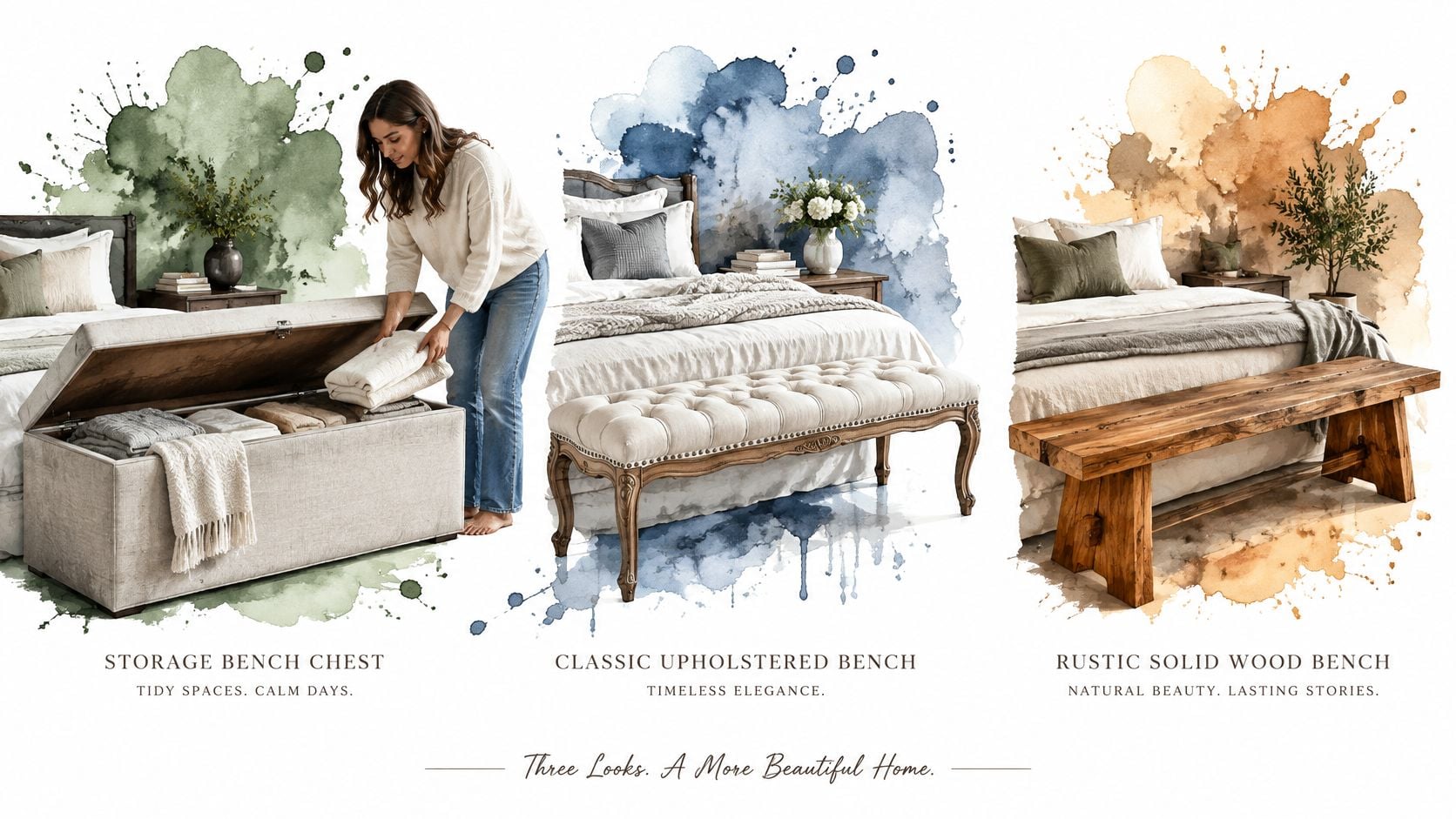
Four Styles, Four Jobs
- The Storage Bench, best for linen overflow. A lift-top bench is the easiest way to add significant storage without adding another bulky piece of furniture, which is why it's the answer when blankets and off-season bedding have nowhere else to go. Size it 15–18 inches deep in tighter rooms (see the storage section above), and remember the lid needs clearance to open.
- The Upholstered Bench, best for seating comfort. If sitting down to put on shoes is the primary job, fabric padding beats every other option. It also adds texture and color that can pull the whole room together. Plan for the standard 15–20 inch depth so it stays comfortable to sit on without crowding the walkway.
- The Wood Bench, best for a lighter visual footprint. A solid wood bench works beautifully in rustic, minimalist, or modern rooms, bringing natural warmth and clean lines. Because it reads visually lighter than an upholstered piece at the same dimensions, it's the smarter pick for smaller king bedrooms.
- The Ottoman, best for softness, not stable seating. A large-scale ottoman offers a soft surface to rest your feet, and a tray on top turns it into a surface for books or a cup of tea. Its plush top is less steady for firm sitting, so choose it only if footrest duty comes first and seating is occasional.
Quick tradeoff comparison:
| Style | Seating support | Storage | Visual weight | Ideal room size |
|---|---|---|---|---|
| Storage bench | Firm | High | Heavy | Average to large |
| Upholstered bench | Firm, cushioned | Usually none | Medium | Any |
| Wood bench | Firm | None (unless box-style) | Light | Small to any |
| Ottoman | Soft, less stable | Rarely | Medium | Average to large |
The "best" bench for a king bed is really the intersection of the two: the right dimensions from the section above, and the right job from this one. A perfectly sized bench that can't do the daily task you bought it for is still the wrong bench.
The first question I always ask clients is: "What job do you need this bench to do?" If your closets are overflowing, the storage bench is a no-brainer. If you just need a comfortable perch to tie your shoes, an upholstered style is the clear winner.
Matching Wood Tones to Existing Furniture
If you opt for a wood bench, matching it to your existing bedroom set doesn't require an exact match. Look for complementary wood tones within the same color family—a warm walnut bench pairs naturally with a cherry bed frame, while a light oak finish suits ash or maple. Staying within the same undertone (warm or cool) keeps the room cohesive even when the species differ.
The Power of Making It Your Own
Furniture should feel tailored to you. Many of our furniture lines, especially our Simply Amish collections, are available for custom order, so you can select the wood species, stain, fabric, or leather that matches your room exactly.
Imagine you've found the perfect bench shape, but the finish doesn't quite match your bedroom set, or you need a very specific fabric to coordinate with your headboard. Custom ordering solves both. For ideas on mixing and matching, our guide on how to choose your style for bedrooms with every personality is a great place to start.
Selecting Materials and Finishes That Last a Lifetime
A bench at the end of your bed isn't just for looks—it’s a piece that works hard every single day. It’s where you’ll sit to put on your shoes, where you’ll toss your clothes after a long day, and where you might even enjoy a quiet morning coffee. Because it sees so much action, the materials you choose are everything.
This isn't a temporary fix; it’s an investment piece. Reflecting our family’s commitment to quality since 1933, we always guide our clients toward choices that promise to stand the test of time, both in style and in durability.
The Enduring Beauty of Solid Wood
There’s a good reason why solid wood furniture gets passed down through generations. Unlike particleboard or veneers that can chip and peel over time, solid woods like the oak, cherry, and maple used in our Simply Amish collections offer incredible strength and character. The grain tells a story, and the durability is undeniable.
A solid wood bench gracefully handles the knocks and bumps of daily life. Small scratches can often be buffed out, and the finish can be restored down the road, ensuring the piece looks beautiful for decades. It’s the very definition of an investment piece—something that grows with your family, not something you’ll have to replace in a few years.
We often tell clients to think about a wood bench as a future heirloom. The craftsmanship you invest in today, especially with hand-finished pieces from trusted artisans, becomes part of your family's story.
Choosing the right kind of wood for your home is a big decision, and each type has its own unique charm and benefits.
The Timeless Appeal of Premium Upholstery and Leather
While solid wood provides classic structure, an upholstered or leather bench brings a welcome softness, texture, and comfort to the bedroom. But not all upholstery is created equal. Quality often depends on what you can't see right away, including the sturdiness of the frame, the density of the foam, and the durability of the fabric itself.
For a blend of pure luxury and resilience, nothing really compares to top-grain leather. A quality leather bench is surprisingly easy to maintain and stands up beautifully to wear and tear, making it a smart pick for a high-traffic spot as it develops a rich, beautiful patina over time.
If you’re leaning toward fabric, look for options with a high double-rub count—this number indicates how well the textile will resist abrasion over time. Performance fabrics rated for heavy-duty upholstery use are another fantastic choice, offering built-in stain and fade resistance that’s perfect for a piece that will see daily use.
Customization Options at Giorgi Bros.
What if you have a cherished family heirloom—a bench with sentimental value that just doesn't quite work with your new king bed? Our custom reupholstery services can breathe new life into an old favorite.
- Fabric and Leather Selection: Our Design Experts will help you choose from our huge library of materials to find the perfect new fabric or leather that coordinates with your existing décor.
- Frame Restoration: Our skilled craftsmen can reinforce the frame and refinish the wood, making your piece as sturdy and beautiful as the day it was first made.
- Modern Updates: We can even update the padding and tweak the style, transforming an outdated piece into a modern classic that perfectly complements your bedroom.
This ability to customize—whether it's ordering a brand-new custom furniture piece in the exact finish you want or reviving a beloved heirloom—ensures your furniture tells a unique story of enduring quality. It’s a level of personal service we’ve been proud to offer our Bay Area clients for over 90 years.
How to Style Your Bench for a Cohesive Bedroom
You’ve found the perfect bench—now for the fun part. Styling the piece at the foot of your king-size bed is the final brushstroke that pulls the entire room together. Think of it less as another piece of furniture and more as a small stage to showcase your personality. This isn't about adding clutter; it's about layering with intention to create a polished, lived-in feel.

With just a few thoughtful touches, your bench can become a beautiful vignette that bridges the gap between different elements in your space, making the whole room feel complete.
Create a Focal Point
The easiest way to start styling is by grounding the arrangement with a single anchor object. A decorative tray is a classic for a reason—it elegantly corrals smaller items and creates a defined focal point.
Try a tray in a contrasting material to add instant visual interest, like a sleek brass tray on a dark wood bench or a rustic wooden one atop soft upholstery. From there, you can layer smaller objects inside: a stack of your favorite books, a scented candle, or a small decorative box.
Weave in Texture and Softness
A bench, especially one made of wood or metal, practically begs for a bit of softness. A beautifully folded throw blanket is the perfect way to bring in texture and color. You can drape it casually across one corner for a relaxed look or fold it neatly in the center for a more refined feel.
This is a fantastic opportunity to pull an accent color from your artwork, pillows, or area rug, creating a visual thread that connects the different parts of your room. The goal is to make the bench look inviting and integrated, not like a stark afterthought.
Styling your bench is less about hard-and-fast rules and more about creating a balanced composition. Aim for a mix of heights, textures, and shapes to keep the arrangement dynamic and visually appealing.
This approach to creating investment pieces that blend form and function is why more people in the Bay Area are turning to custom furniture solutions. They understand the value of quality and craftsmanship.
Add Pillows to Tie It to the Bed
Placing one or two decorative pillows on the bench is a simple yet powerful way to link it directly to your bed. They don’t need to be a perfect match for your bed pillows, but they should complement the overall color scheme or pattern.
- Echo a Color: Choose a pillow that picks up a secondary color from your duvet or headboard.
- Introduce a Pattern: If your bed is mostly solid colors, a patterned pillow on the bench adds a welcome pop of personality.
- Play with Shape: A long lumbar pillow can look particularly chic and stylish on a wide bench.
A quilted bed runner along the foot of the bench works the same way, and On Pins & Needles Quilting Co.'s guide to quilted bed runners is a helpful resource for exploring this accessory.
If you're looking for more guidance on blending different designs, our guide on how to work with patterns in your room offers some great tips.
Think Like a Designer
Ultimately, styling is about making the room feel yours. A well-styled bench can connect your new Simply Amish furniture to the rich textures of your area rug. Our Design Experts can provide no-pressure guidance to help you see the bigger picture, ensuring every element in your room works together in harmony.
Find Your Perfect Bedroom Pieces With Giorgi Bros.
Finding the perfect bench for the end of your king size bed starts with the numbers: 60–68 inches long, 15–20 inches deep, at or just below mattress height, with 24–30 inches of clear walkway preserved. Choosing the right furniture is a personal journey, and after more than 90 years in this business, our family knows how important it is to feel good about the pieces you bring into your home.
We invite you to come see, touch, and experience the Giorgi Bros. difference for yourself. Explore 50,000 square feet of inspiration at our showroom in South San Francisco, where you can test quality before you buy. If mattresses are also on your list, our Mattress Guide recommends options after you answer a few questions, covering King and California King sizes along with every comfort level.
No-Pressure Guidance From Our Design Experts
When you walk into Giorgi Bros., you won't find aggressive sales tactics. Instead, you’ll meet friendly, non-commission Design Experts who are passionate about helping you. Their only goal is to offer sound advice, whether you’re just gathering ideas or are ready to make a choice. It’s a commitment to service that’s been the foundation of our business since 1933.
More Than Just a Furniture Store
Finding the right bench is just one piece of the puzzle. We’re here to help with every detail, ensuring your space feels complete and uniquely you.
- Custom Furniture Orders: Don’t settle for close enough. We offer deep customization on our American-made furniture, including collections from Simply Amish. Pick your wood, finish, fabric, or leather to create a piece that is one-of-a-kind.
- Elegant Flooring: Our dedicated flooring department can help you select the perfect area rug, carpet, or luxury vinyl to anchor your new furniture and tie the whole room together.
- Custom Reupholstery: Have a cherished family heirloom? Our expert Custom Reupholstery service can give it a new life, allowing it to blend beautifully with your updated bedroom decor.
Your home should tell your story. Our role is to provide the beautiful, lasting pieces and expert advice to help you write it.
Your perfect bedroom is waiting to be completed. Visit our South San Francisco showroom to explore our collections, or book a complimentary Design Consultation with one of our friendly experts today.
Frequently Asked Questions
What is the best bench for a king bed?
The best bench for a king bed is one that is 60–68 inches long, 15–20 inches deep, no taller than the mattress top, and built for the job you actually need—storage, seating, or styling. Dimensions come first: a bench that's the wrong size for your 76-inch-wide bed or your walkway will never look or function right, no matter how well it's styled.
How high should a bench be at the end of a bed?
Match it to your mattress height, or go slightly lower. Measure from the floor to the top of your own mattress, as setups vary widely depending on the frame and foundation. A bench taller than the mattress creates a hard barrier; one just below creates the clean, waterfall-like transition designers aim for.
How long should a bench be for a king bed?
For a standard 76-inch-wide king mattress, 60–68 inches is the target. That leaves 4–8 inches of breathing room on each side, keeps the bench from extending past the mattress edges, and lets your duvet drape without bunching. A bench around 60 inches also works well in smaller rooms or with arms and tall backs that add visual bulk.
What size storage bench works for a king bed?
In tighter rooms, stick to 15–18 inches deep and 60–65 inches long so the walkway stays clear; in larger suites, a deeper piece of 20 inches or more can work if you still have 24–30 inches of open space beyond it. Always check lid clearance too—a lift-top needs room to swing open, so nothing should hang directly above or behind it.
Can I just use an ottoman instead of a bench?
Yes, a large-scale ottoman is a great alternative and one we often recommend for casual, cozy bedrooms. Ottomans feel softer and less formal, but their plush tops are less stable for firm sitting—fine for a footrest or a breakfast tray, less ideal if putting on shoes from a seated position is the main use. Choose based on which job matters more.
Can a small bedroom still have a bench at the foot of a king bed?
Absolutely—just cap the bench at about 60 inches long and 15–17 inches deep, and choose a backless, armless style with tall, open legs so the floor stays visible underneath. Confirm you retain at least 24 inches of clear walking space before you commit.
How Do I Match a Wood Bench to My Existing Furniture?
You don't need an identical match. Stick to complementary wood tones within the same color family. A warm-toned bench (like cherry or walnut) pairs well with other warm woods, while cool-toned finishes (like ash or white oak) suit each other. Keeping the undertone consistent ties the room together even if the wood species differ.