
You go to bed tired, sleep on your side like you always do, and still wake up rubbing one shoulder before your feet hit the floor. By breakfast, your hip feels stiff and your neck is trying to catch up. It's common to blame age, stress, or “sleeping wrong.” Often, the actual problem is simpler. The mattress isn’t built for the way your body rests.
That matters because side sleeping isn’t a niche habit. Approximately 60% of adults are side sleepers, making it the most common sleep position, according to the National Council on Aging. When that many people sleep the same way, small differences in mattress design stop being small. They become the difference between steady support and nightly strain.
In our family business, we’ve been helping Bay Area households furnish their homes since 1933. Over those decades, one lesson has stayed constant. A mattress isn’t just another item in the bedroom. It’s a long-term investment in how you feel every morning. Good sleep supports your work, your mood, and your health. Poor sleep follows you through the whole day.
If you’re already sore, a mattress alone may not solve everything. Some readers also benefit from gentle mobility work like these stretches for sore back and neck, especially when morning tightness has become part of the routine. And if your rest feels off in a broader sense, this guide on how to improve sleep quality can help you look at the full picture.
Your Guide to Pain-Free Side Sleeping
A side sleeper needs two things at once. The mattress has to let the shoulder and hip sink in enough to avoid pressure. It also has to hold up the waist and torso so the spine stays level.
That balancing act is where many mattresses fall short. Some feel comfortable for five minutes in a store, then create pressure after a full night. Others feel plush at first but let the midsection drift out of alignment over time.
The best mattress for side sleepers doesn’t just feel soft. It supports the body in the right places and yields in the right places.
This is why quick online rankings can be confusing. One review praises a soft foam bed. Another says medium-firm is the answer. A third says hybrids solve everything. There’s some truth in each, but only when you match the mattress to the person on it.
At our showroom in South San Francisco, we’ve seen this play out for generations. One customer needs gentler cushioning at the shoulder after years of sleeping on a mattress that was too firm. Another needs stronger support under the hips because a soft bed left the lower back tired every morning. Both are side sleepers. Neither should buy the same mattress just because it’s popular.
What you’re really trying to solve
Side sleeping comfort usually comes down to a few plain-language questions:
- Do your shoulders feel jammed when you lie down?
- Do your hips sink too far by the middle of the night?
- Does your spine stay straight when viewed from behind?
- Do you sleep warm or with a partner, which changes what materials make sense?
Once you answer those, mattress shopping gets much clearer.
Why Side Sleeping Requires a Specialized Mattress
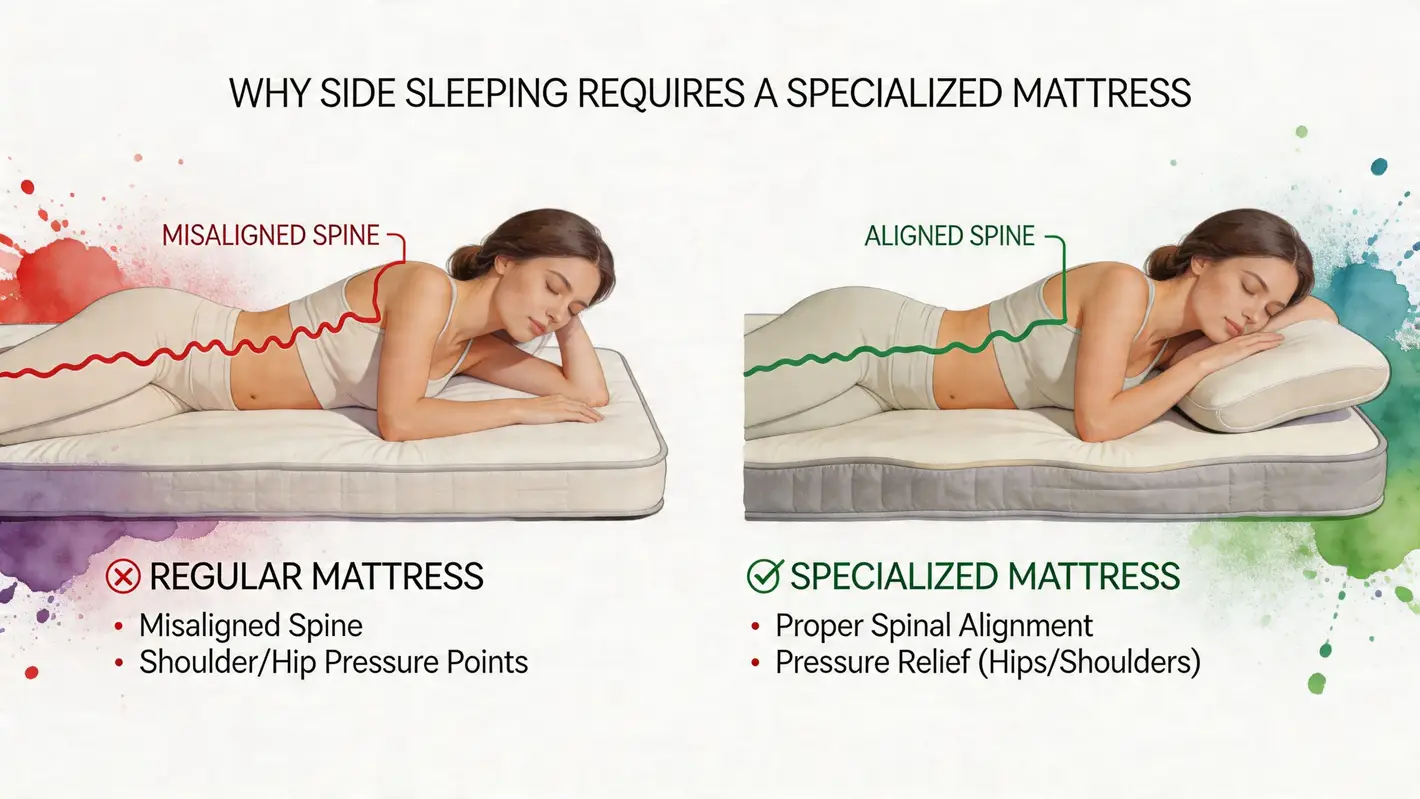
Lay a person flat on their back and weight spreads fairly evenly. Lay that same person on their side, and the body changes shape against the mattress. The shoulders and hips become the main contact points. The waist creates a gap. The neck needs support from a pillow, but the mattress still has a major job to do underneath.
What happens on a mattress that’s too firm
A very firm surface resists the natural depth of the shoulder and hip. Instead of allowing those wider joints to settle in, the mattress pushes back too hard. That creates pressure points.
You’ll usually feel this as a sore shoulder, a tender hip, tingling in an arm, or frequent tossing from one side to the other. The body keeps adjusting because it’s trying to escape concentrated pressure.
What happens on a mattress that’s too soft
Too much softness creates the opposite problem. The body sinks, but not evenly. The heaviest areas often dip the most.
For many side sleepers, that means the hips fall lower than the ribcage and legs. The spine no longer rests in a neutral line. Morning stiffness often follows, especially through the lower back and outer hip.
Practical rule: Side sleepers need a mattress that compresses at the shoulder and hip without letting the torso collapse.
The goal is straight, not flat
People often hear “alignment” and assume the mattress should keep the body flat like a board. That isn’t right. A side sleeper’s body has curves, width differences, and joints that need room.
A better way to think about it is this: your spine should look straight from neck to tailbone when you’re lying on your side. The mattress should adapt to your shape, not force your shape to adapt to it.
That’s why the best mattress for side sleepers usually includes comfort layers that cushion pressure points and a deeper support core that keeps the body from sagging. It’s a two-part job.
Why generic advice often misses the mark
“Get a firm mattress for support” is incomplete advice. So is “get something soft for pressure relief.” Side sleepers need both support and give, and the proportion depends on body type, materials, and mattress construction.
If you want a broader look at matching support to your build, this guide on which mattress is right for your body type is a useful next step.
The Three Pillars of a Side Sleeper Mattress
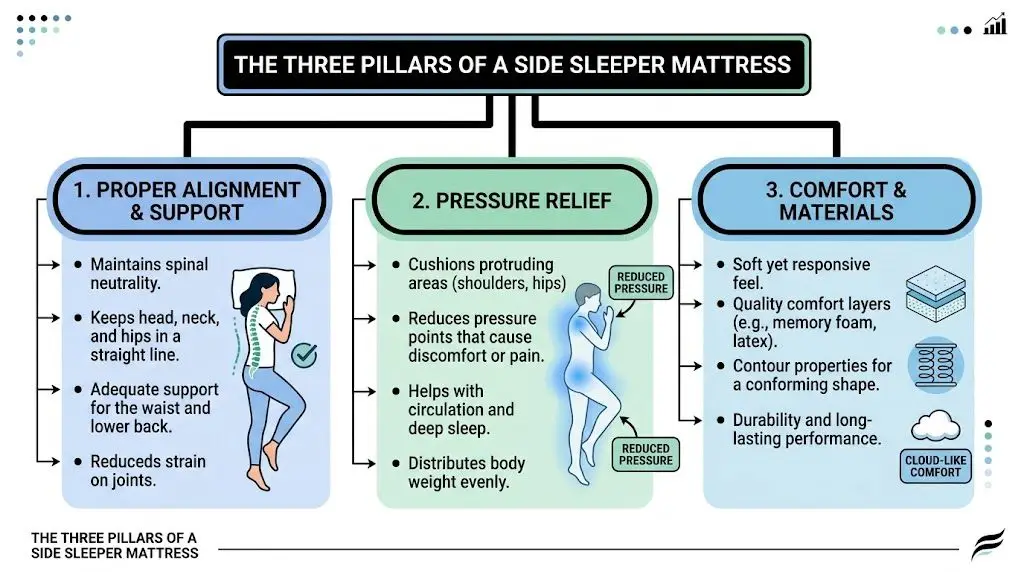
A good side-sleeper mattress does three jobs at once. It cushions the sharpest contact points, keeps the midsection from drifting out of line, and matches the sleeper’s body weight closely enough that those first two jobs still work after years of use.
Pressure relief at the shoulder and hip
Side sleeping concentrates force into a narrower area than back sleeping. The shoulder and hip carry much of the load, so the top of the mattress has to yield there without letting the rest of the body sink too far.
That balance is what many shoppers miss.
A plush surface can feel wonderful for five minutes in a showroom. If the comfort layers are too shallow, too dense, or unsupported underneath, the pressure returns by midnight. If the bed is soft all the way through, the hips can settle too low and pull the lower back with them. The best pressure relief has depth, not just softness on the surface.
For long-term comfort, look for comfort layers that allow noticeable contour at the shoulder and hip, paired with a support system underneath that resists sagging through the torso. In a family furniture business, we often describe this as good upholstery over good suspension. A fine sofa seat works the same way. The top welcomes you in, and the structure below keeps you from dropping through it.
Firmness that fits your build
Firmness labels are only rough guides. A mattress marked "medium" can feel gentle to one sleeper and uncomfortably hard to another because body weight changes how much the materials compress.
That matters even more for side sleepers, and generic buying guides often gloss over it.
| Body Weight | Recommended Firmness (1-10 Scale) | Why It Works |
|---|---|---|
| Under 130 lbs | 4-5 | Lighter bodies often need a softer surface to get enough contouring at the shoulder and hip. |
| 130-230 lbs | 5-6 | This range usually gives side sleepers a steadier mix of cushioning and support. |
| Over 230 lbs | 6 and up, depending on construction | Heavier bodies usually do better with stronger coils, denser foams, or latex that can hold alignment without flattening out quickly. |
Heavier side sleepers should pay close attention to construction, not just firmness. A softer premium mattress built with dense materials can outperform a firmer bed made with weaker foams. For a buy-it-for-life mindset, that distinction matters. You are not only buying tonight’s comfort. You are buying how the bed will carry your body two, five, and ten years from now.
Couples need another layer of personalization. If one partner is much lighter and the other is heavier, one firmness choice may leave one person floating on top while the other sinks too far. Split comfort designs, dual firmness models, and customizable hybrids deserve a close look in that situation because they solve a real support problem instead of asking both sleepers to compromise.
Zoned support that respects body shape
The third pillar is zoned support. This means the mattress is built with different levels of pushback across the surface, usually softer near the shoulders and firmer through the lumbar area and hips.
That layout suits side sleepers because the body is uneven. The shoulder needs more room to sink. The waist needs filling in. The hips need support from below so the spine can stay level from the neck down through the tailbone.
Manufacturers create zoning in a few ways. Some use coil systems with firmer springs through the center third. Others vary foam density across the bed. Either method can work if the transitions feel smooth and the support lines up with your frame.
Zoning becomes especially useful for broader shoulders, curvier hips, and heavier body types. It can also help couples who share a bed but carry weight differently, because stronger center support often keeps both sleepers on a more even plane.
If you want a practical framework for matching these features to your habits, body type, and preferences, read our guide on how to choose the right mattress for your sleeping style.
Comparing Mattress Materials for Side Sleepers
Materials shape the feel of a mattress more than most shoppers expect. Two beds can share the same firmness label and still feel completely different because the top layers, support core, and response speed aren’t the same.
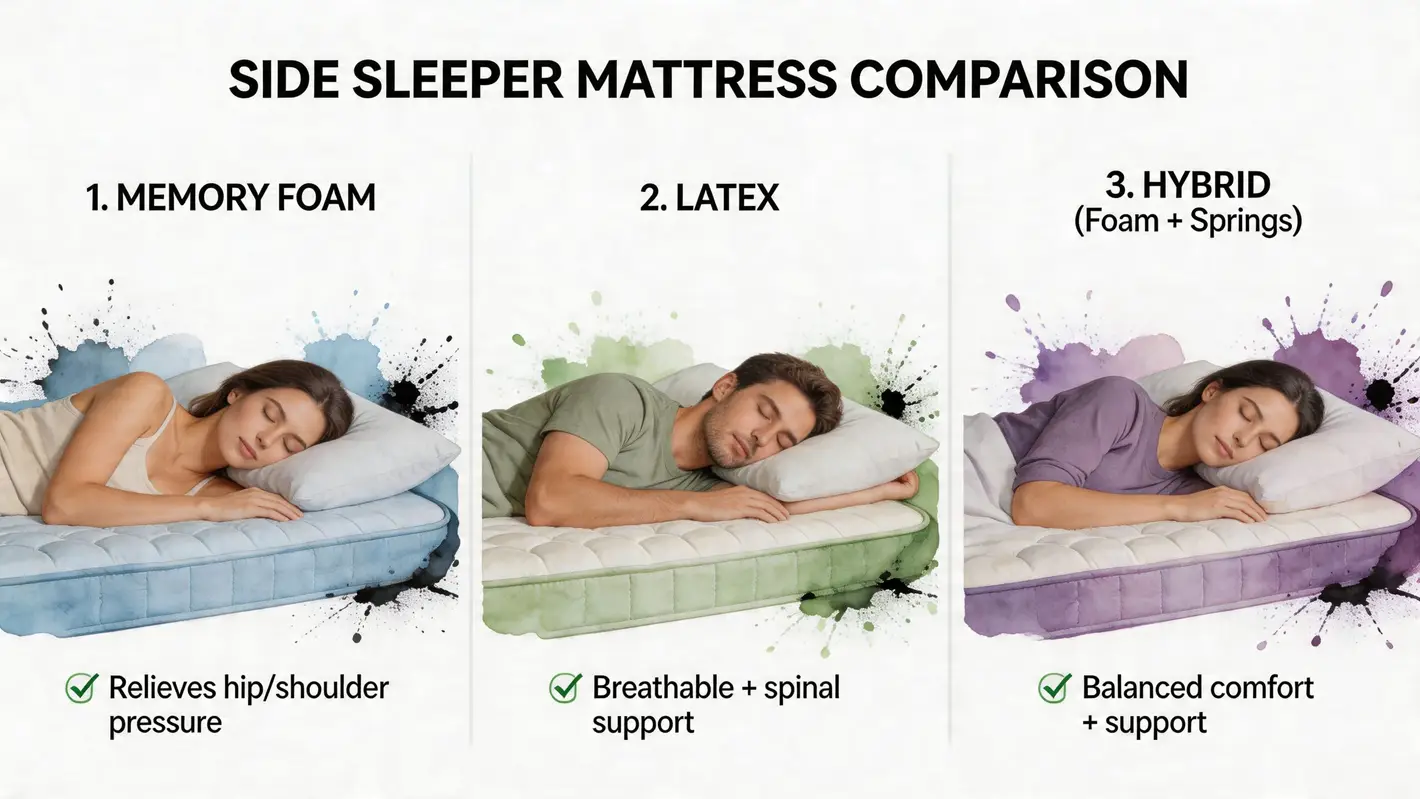
For side sleepers, the main material categories are memory foam, latex, and hybrid construction. Each solves the comfort problem differently.
Memory foam and deep contouring
Memory foam is popular with side sleepers for a simple reason. It conforms closely to the body. If your shoulder or hip feels sharp pressure on firmer surfaces, memory foam often softens that experience.
It can be a strong fit for people who want a cradled feel and less surface pushback. Some sleepers love that floating-in-place sensation. Others don’t.
The trade-off is responsiveness. Some memory foams recover more slowly when you move. If you change sides often, you may notice that “stuck” feeling more than a still sleeper would.
Latex and a more buoyant feel
Latex contours too, but it behaves differently. It has more natural spring and pushback than memory foam.
For side sleepers, that means cushioning without the same deep hug. Many people describe latex as easier to move on and more balanced under the hips. It can be a very good option for those who want pressure relief but dislike sinking into the bed.
The verified material also notes that latex is often praised in user discussions for durability and configurability, especially in customizable setups for couples. That makes it appealing to shoppers who think in terms of long-term use rather than short-term trends.
Hybrids and the middle ground
Hybrid mattresses combine a coil support unit with foam or latex comfort layers. For many side sleepers, the category holds particular appeal.
According to Saatva’s overview of side-sleeper mattress design, hybrid mattresses combining individually wrapped coils with foam or latex top layers address a critical need for side sleepers. The upper layer contours to reduce strain on shoulders and hips, while the coil base provides responsive support to maintain spinal alignment.
That combination often gives side sleepers three benefits at once:
- Pressure relief at the surface from foam or latex comfort layers
- Dynamic support underneath from coils that resist sagging
- Better airflow and edge stability than many all-foam designs
A simple side-by-side view
| Material | What side sleepers often like | What to watch for |
|---|---|---|
| Memory foam | Strong contouring, reduced pressure at shoulder and hip | May feel slow-moving or too enveloping for some |
| Latex | Responsive cushioning, buoyant support, durable feel | Less “hug” than memory foam, which some people prefer |
| Hybrid | Blend of pressure relief and support, steadier edges, easier movement | Performance depends heavily on quality of both the comfort layer and coil unit |
Which material is the best mattress for side sleepers
There isn’t one universal winner. The best match depends on what kind of discomfort you’re trying to solve.
Choose memory foam if pressure relief is your top concern and you like close contouring. Choose latex if you want comfort with a more lifted, resilient feel. Choose a hybrid if you want a balanced approach and don’t want to give up support, airflow, and easier movement across the bed.
One practical place to learn more about this middle-ground category is this page on hybrid mattress in a box, especially if you’re sorting through modern hybrid formats and trying to understand how construction affects feel.
How to Test a Mattress In-Store and Online
A mattress can sound perfect on paper and still be wrong for your body. That’s why testing matters. Side sleeping creates pressure in very specific places, and you won’t catch that by pressing a palm into the surface or sitting on the edge for ten seconds.
What to do in a showroom
When you test a mattress in person, lie down the way you sleep. Bring your usual habits into the test.
Use this checklist:
- Stay on your side long enough. Give the mattress time. Pressure problems often show up after several minutes, not instantly.
- Notice your shoulder first. If it feels crowded, jammed, or numb, the comfort layers may be too firm.
- Check your hip position. If your hips feel like they’re dropping lower than the rest of you, the support core may be too weak for your build.
- Pay attention to your waist. A good side-sleeper mattress fills the space enough to support the torso.
- Ask someone to look at your spine. From behind, it should appear fairly straight, not curved upward or sagging downward.
If you feel “fine” but not settled, keep testing. Side-sleeper comfort often reveals itself gradually.
In a no-pressure setting with non-commission consultants, this process gets much easier because no one is rushing you toward the quickest choice.
What online shoppers should inspect carefully
Buying online is convenient, but you lose the ability to feel how your shoulder and hip interact with the mattress before it arrives. That means the details matter more.
Read past the headline claims and look for:
- Comfort layer description so you know whether the top feels contouring or buoyant
- Support core type to understand whether the mattress relies on foam, coils, or both
- Edge support notes if you sit or sleep near the perimeter
- Trial and return policies because that’s your real-world safety net
A soft-looking cover and a long list of marketing terms won’t tell you much. Construction details will.
Common mistakes people make
Many shoppers test a mattress on their back even though they sleep on their side. Others bounce from one model to the next too quickly and end up comparing first impressions instead of real support.
Another common mistake is focusing only on plushness. Plush can feel appealing right away, but side sleepers still need structural support under the body’s heavier zones.
If you’re sorting through choices and want a useful starting point, this guide on how to choose a mattress can help you narrow the field before you step into a showroom or order online.
Advanced Solutions for Your Unique Sleep Needs
A side sleeper can follow every general rule and still wake up sore. That usually happens when the actual issue is more specific than a standard buying guide allows for. Two common examples are couples who need different feels on the same bed, and heavier side sleepers who need deeper support than many showroom favorites provide.
For couples with different needs
Sharing a mattress gets complicated fast. One partner’s shoulder may need more cushioning, while the other sleeps best with a firmer, steadier surface. Generic recommendation lists often flatten that problem into a single firmness score, but real bodies do not work that way.
A split comfort setup often solves the mismatch more cleanly than compromise. In plain terms, each sleeper gets a different feel on their side of the bed while still sharing one mattress. That can be especially useful for couples trying to balance pressure relief, motion control, and long-term comfort instead of chasing a quick showroom impression.
Discussions at Mattress Underground show how often couples get stuck here. The confusion makes sense. One mattress is being asked to do two separate jobs.
Latex systems with split firmness options deserve a close look if you plan to keep a mattress for years. They can offer a more personalized fit, and in some designs, one side can be adjusted or replaced without changing the whole bed. That is the sort of practical value many family furniture stores have respected for decades because it reduces waste and extends the life of the purchase.
One practical option to explore is Giorgi Bros. Furniture, which offers custom order services and personalized guidance for shoppers comparing more customized sleep setups alongside other premium mattress choices.
For heavier side sleepers
Body weight changes how a mattress performs. The same bed that feels cushioned and supportive to one sleeper can let another sleeper sink too far at the shoulder and hip. For side sleepers with heavier builds, the question is not about softness or firmness alone. It is whether the materials keep their shape and support under deeper compression night after night.
That usually points shoppers toward better-built hybrids, denser latex, and support systems designed to resist sagging without creating pressure points. A good model should still allow enough give for the shoulder to settle in. The difference is what happens underneath. Stronger coils, denser foams, and sturdier base materials keep the spine from bowing out of alignment.
In this context, a buy-it-for-life mindset matters most. Lower-grade comfort layers can feel pleasant for a short test and then lose performance early, especially under greater load. Better construction costs more up front, but it often saves money, frustration, and repeat shopping later.
Don’t ignore the pillow and topper
A mattress handles the larger frame of the body. A pillow finishes the alignment at the neck, jaw, and upper shoulder.
That last piece gets overlooked all the time.
If your mattress feels close, but you still wake with neck tightness or clenching through the jaw, the missing adjustment may be above the shoulders rather than below them. Readers dealing with facial tension or bite-related discomfort may find this guide on the best pillow for jaw pain relief helpful when refining the whole sleep system.
Toppers can help with fine-tuning too. They work best when the mattress underneath is still structurally sound and only needs a different surface feel. A topper can add a bit more cushioning or a touch more bounce. It cannot repair a worn-out support core.
The strongest setup is a matched system. Mattress, pillow, and comfort layers should work together for your body type, sleep position, and the many years you expect the bed to serve you well.
Find Your Lifetime Mattress at Giorgi Bros.
A mattress affects daily life in a quiet but powerful way. You don’t always notice great support in the moment, but you notice its absence in the morning. That’s why this choice deserves more care than a flash sale or a catchy brand promise.
A thoughtful mattress purchase should solve a real problem and keep solving it for years. That’s the heart of a buy-it-for-life mindset. You invest once in something built well, suited to your body, and less likely to send you back into the shopping cycle because comfort faded too soon.
Why long-term thinking matters
The best mattress for side sleepers isn’t always the one with the loudest promotion. It’s the one that matches your body, sleeping habits, and durability expectations.
That matters even more if you’re outside the “average” range used in many review roundups. As noted in verified guidance from Sleep Foundation, most mattress reviews cap recommendations at 230 lbs, while heavier side sleepers risk bottoming out, and premium hybrids with reinforced zoned coils or high-density latex can offer better durability and support for users over 250 lbs.
Why an in-person experience still helps
For many people, the clearest answer comes from lying on several well-made mattresses and feeling the difference in real time. That’s hard to replicate through product pages alone.
Our family has been serving South San Francisco and the Bay Area since 1933, and we still believe in no-pressure guidance. Non-commission consultants can help you compare materials, comfort layers, and support systems without rushing the process. If you’re also furnishing the rest of your home, it helps to work with a showroom that understands Custom Furniture, Bay Area Interior Design, and the value of durable investment pieces across the entire space.
Quality is also a sustainability decision. When you buy well, you replace less often. That usually means less waste, fewer compromises, and better value over time. And for many households, financing options are available, which can make a stronger long-term purchase easier to manage.
Visit Giorgi Bros. Furniture in South San Francisco to test premium mattresses in person, speak with our Non-Commission Sales Staff and design experts, and explore a sleep solution built around your body, your comfort, and your home. If you’d prefer a more guided approach, book a Design Consultation and let our team help you compare Premium Mattresses, custom options, and lasting investment pieces with no pressure.