Choosing hardwood flooring starts in a similar way. You stand over a few sample boards, hold them up to the light, and realize one choice affects almost everything else in the room. The sofa reads differently against warm oak than it does against a cooler white oak tone. A dining table that looked perfect in the showroom may suddenly feel too red, too dark, or too formal once the floor goes in.
That is why hardwood is more than a surface decision. It becomes the visual foundation for how the home feels every day.
For Bay Area homeowners, the stakes are even higher. You are often balancing design, resale value, climate, and longevity in one decision. A floor has to look right, wear well, and still make sense years from now when furniture changes, kids grow up, or the house goes on the market.
Since 1933, families in South San Francisco have approached home projects with that long view in mind. A good hardwood floor is not something you buy for this season. It is something you live on for decades. The right one can anchor a room, support a cohesive design story, and reward careful planning long after the installation crew leaves.
An Introduction to Your Forever Floor
The best approach to how to choose hardwood flooring is to stop thinking about flooring as a finish line. Think of it as the base layer for the life of the house.
A forever floor should do three jobs well. It should suit the way you live, support the style of your home, and age with grace. If one of those pieces is missing, the floor may still look good on day one, but it will not feel like the right choice over time.
Many homeowners start with color first. That is understandable, but it often leads to expensive second-guessing. A better sequence is to begin with where the floor is going, how the room gets used, and what other materials need to live with it.
If you are comparing options for a remodel, it helps to look at a broad mix of materials first, then narrow to hardwood once you know why wood is the right fit for your home. This overview of flooring and carpeting options is useful for that early sorting process.
Key takeaway: The right hardwood floor should still make sense when the room changes around it.
That long-term mindset is what separates a quick upgrade from a durable investment. Hardwood has staying power because it offers warmth, repairability, and a natural look that many homeowners still prefer when they want a room to feel grounded rather than temporary.
Assess Your Home and Lifestyle First
Some floors fail for simple reasons. They were wrong for the household before they were wrong for the room.
Before you compare species, widths, stains, or finishes, take inventory of daily life. A quiet guest room and a kitchen-family room corridor do not place the same demands on wood. Neither do a condo with stable indoor conditions and an older home that opens often to the outside air.
Start with wear patterns
Traffic matters, but not in the abstract. Ask where people walk, turn, pause, and drop things.
A few practical questions usually reveal the answer:
- Do pets run through the space? Claws, water bowls, and repeated pivot points change what finish and species make sense.
- Do children play on the floor? Toys, chairs dragged across the room, and frequent spills call for a more forgiving surface.
- Is this a dining area? Chair movement and dropped utensils create a very different wear pattern than a bedroom.
- Does the room connect to an exterior door? Grit and moisture tracked in from outside can wear a finish quickly.
Some families can live beautifully with a floor that shows character over time. Others want a floor that hides everyday evidence of life. Neither preference is wrong. It just changes what “best” means.
Look at light, moisture, and subfloor conditions
The room itself has a vote.
Sunlight can make undertones stronger than they appear on a sample board. A pale board may read crisp in one room and washed out in another. A medium brown may feel rich in the morning and overly dark at night. Always judge flooring in the actual space, not under showroom lighting alone.
Moisture matters just as much. Bay Area conditions can shift from dry interior heat to marine air, and older homes may respond differently than new construction. If the floor is going over concrete, near exterior openings, or in parts of the home where humidity fluctuates, that should shape the product category you consider.
Build a simple needs profile
A useful trick is to write down your top priorities in plain language before shopping. Not brand names. Not stain names. Just needs.
For example:
- Hide everyday wear in the dining room
- Work over a concrete slab
- Coordinate with warm wood furniture
- Stay timeless rather than trendy
- Allow for easy upkeep
That list keeps you from getting distracted by a beautiful sample that solves the wrong problem.
Practical tip: If you cannot describe what the floor needs to do in one sentence, you are not ready to choose color yet.
Think about maintenance
Every homeowner says they want low maintenance. Fewer stop to define what that means.
For one person, it means a floor that disguises dust and minor scuffs. For another, it means a floor that can be swept quickly and does not show every footprint. For someone else, it means choosing a product that better tolerates seasonal movement and household surprises.
The more honest you are at this stage, the easier the later decisions become. Hardwood rewards good planning. It is much less forgiving of wishful thinking.
The Great Debate Solid vs Engineered Hardwood
A floor can look perfect on a sample board and still be the wrong choice for the house. I have seen that happen more than once. The central question is not which construction sounds more premium. It is which one will live well in your rooms, with your climate, your subfloor, and the furniture you plan to keep for decades.
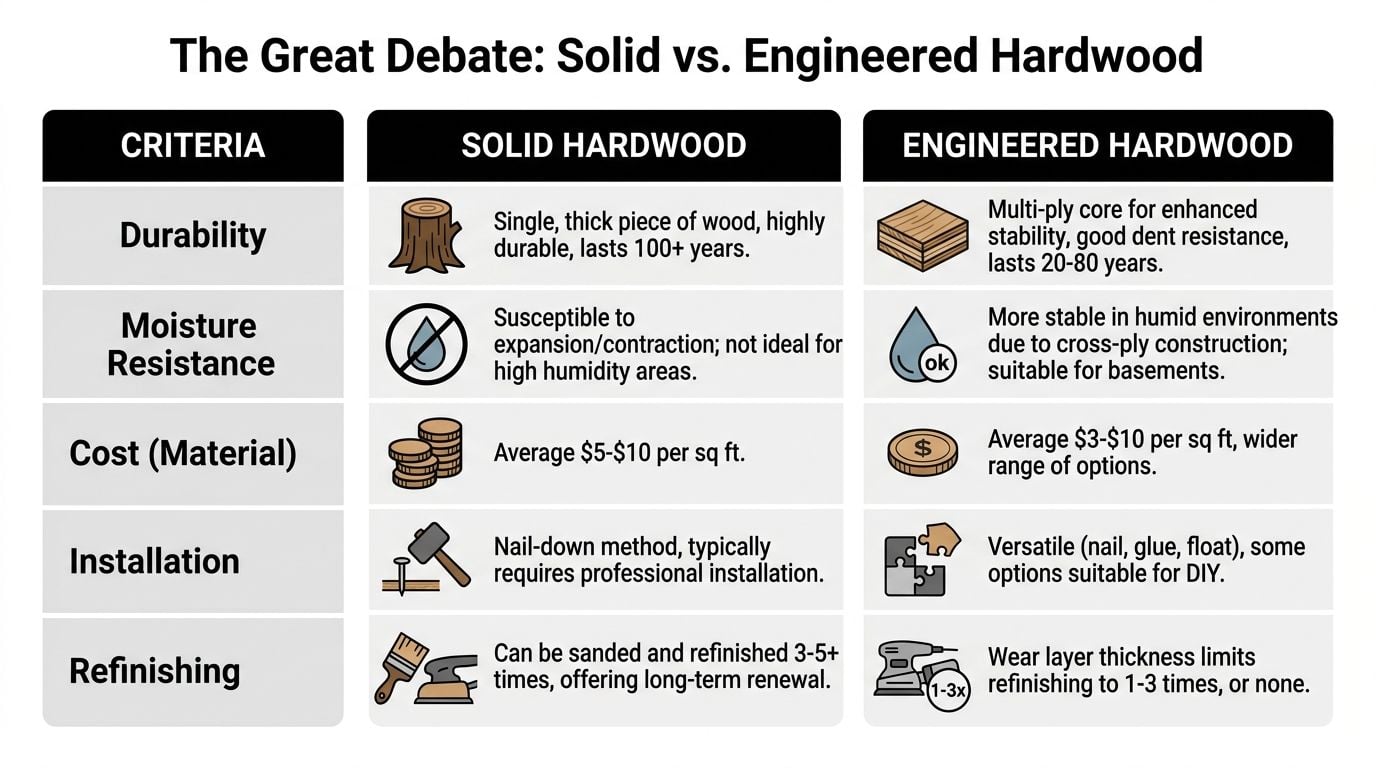
Solid hardwood is milled from a single piece of wood. Engineered hardwood has a real hardwood wear layer on top and a layered core underneath. Both are genuine wood floors. The difference is how they behave once they are installed and asked to handle real life.
Where solid hardwood still shines
Solid hardwood earns its reputation deservedly. It has the depth, feel, and long refinishing life that many homeowners want in a forever floor, especially in traditional homes with stable indoor conditions and wood subfloors.
It also makes sense for people who plan to stay put and maintain the house over time. A solid floor can be refinished more often, which gives you more room to correct wear, change stain color later, or restore the floor after years of use.
That long service life is appealing if you are designing the home as a whole. A floor that can be renewed over time pairs well with custom furniture, built-ins, and heirloom pieces that are meant to stay with the house instead of being replaced every few years.
The trade-off is movement. Solid wood reacts more to seasonal humidity swings, so the wrong room can turn a good product into a recurring problem.
Where engineered hardwood often makes more sense
Engineered hardwood solves a lot of the problems that show up in remodels. The layered construction helps the board stay more stable when moisture conditions change, which is why it is often the better fit over concrete slabs, in homes near the coast, and in spaces where indoor humidity is not perfectly consistent. The National Wood Flooring Association explains engineered wood construction and installation conditions clearly.
That does not make engineered a lesser floor. In many homes, it is the smarter one.
It also gives you more flexibility with installation methods, which can matter when you are trying to preserve floor height, transition cleanly into adjacent rooms, or work around an existing structure. If you want a second explainer that breaks down the difference between solid and engineered hardwood, this overview from J.R. Hardwood Floor Refinishing & Cleaning is a useful companion read.
Solid vs Engineered Hardwood at a Glance
| Feature | Solid Hardwood | Engineered Hardwood |
|---|---|---|
| Construction | One piece of wood | Real wood surface over layered core |
| Best setting | Stable, above-grade spaces | Variable conditions, concrete, remodels |
| Moisture behavior | More prone to expansion and contraction | More dimensionally stable |
| Refinishing potential | Strong long-term refinishing appeal | Depends on wear layer |
| Installation flexibility | More limited | More versatile |
The room usually decides faster than the showroom
A dining room over a wood subfloor may support either option. A slab foundation, a lower level, or a room that opens often to the outdoors usually pushes the answer toward engineered.
That choice affects more than performance. It shapes the rest of the design. If you are pairing the floor with custom walnut dining furniture, white oak case pieces, or built-in shelving, you want a floor that will stay predictable enough to age gracefully beside them. The best results come from choosing a wood floor that supports the whole room composition, not just the sample you liked under showroom lights.
Homeowners sometimes compare wood against look-alike materials at this stage. That is a fair comparison. This guide to luxury vinyl plank flooring pros and cons can help clarify what you gain and what you give up when you choose real wood over a printed surface.
Construction first, species second
Do not confuse board construction with wood hardness. They answer different questions. Construction tells you how the floor will handle the house. Species tells you how the surface will handle traffic, pets, chairs, and dropped objects.
The U.S. Forest Service’s Wood Handbook lists hickory as harder than red oak on the Janka scale, which helps explain why hickory is often chosen for active households that want better dent resistance over time. In practice, that can make engineered hickory a better long-term fit than solid walnut if the goal is durability, stability, and a floor that still works with substantial furniture years from now.
What works: Match the board construction to the house, then match the species to the way the room is used.
A good hardwood choice should still look right after the sofa is reupholstered, the dining table is refinished, and trends have changed twice. That is the standard for a buy-it-for-life floor.
Select Your Species and Finish for Lasting Beauty
A floor can look excellent on installation day and still be the wrong long-term choice. Species and finish decide how it will live with chair legs, sunlight, pets, rugs, and the furniture you bring into the room over the next twenty years.
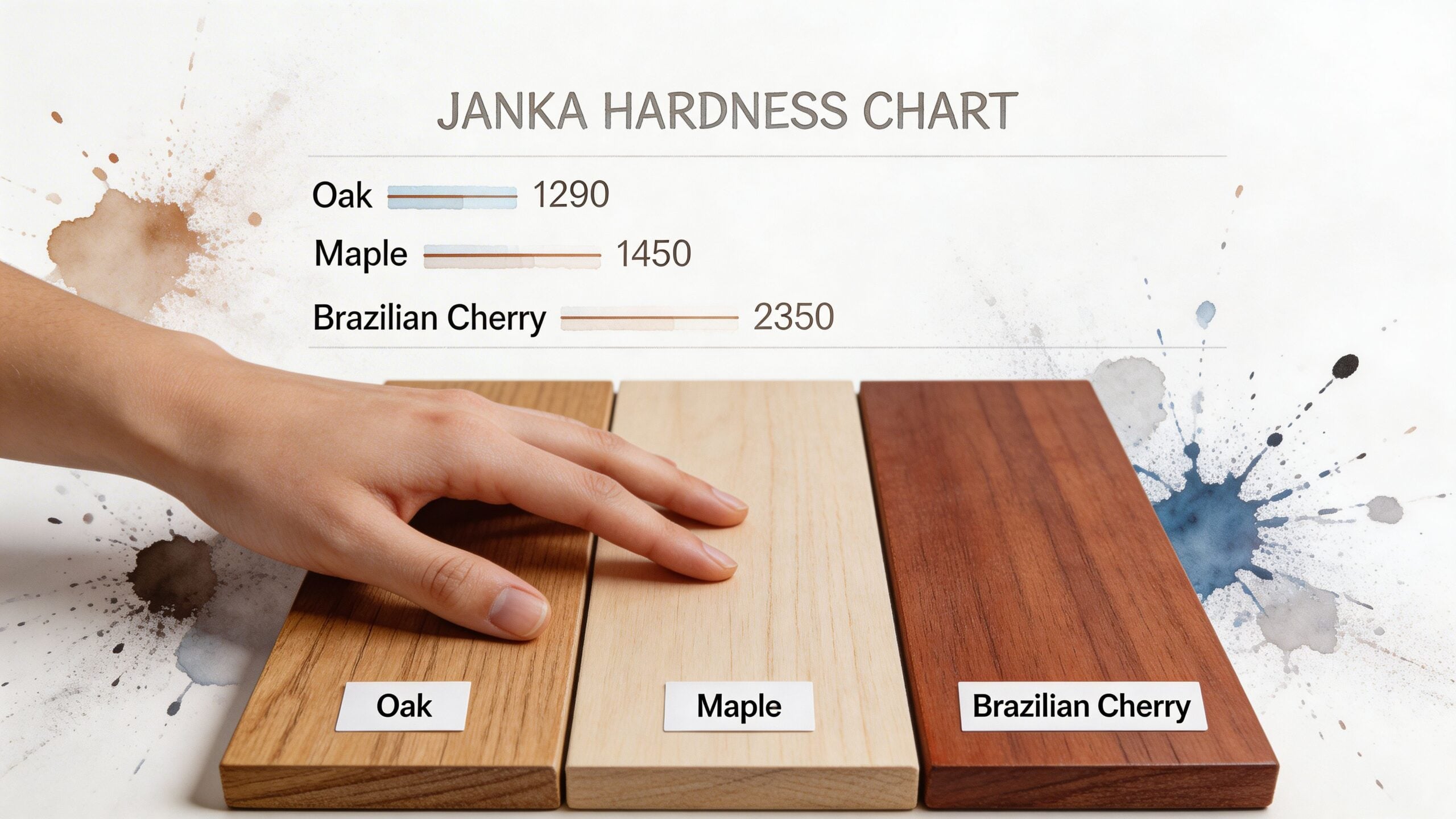
Species affects two things at once. It sets the visual character through grain and undertone, and it affects how the surface stands up to daily use. White oak tends to give homeowners a lot of flexibility because the grain is attractive without being loud, and the color works with both traditional and newer furniture. Maple is cleaner and more uniform, but it can be less forgiving if you want a darker stain. Walnut brings warmth and depth that many people love, though it is usually better suited to lower-impact rooms if dent resistance is a priority.
Read the Janka scale in plain household terms
The Janka scale is useful, but only if you translate it into real life. A harder species can make sense for kitchens, family rooms, hallways, and homes with large dogs or active children. A softer species may still be the better design choice for a formal living room, a primary bedroom, or a home where the goal is richness of color rather than maximum dent resistance.
Hardness alone does not decide how a floor ages.
Finish matters just as much, and sometimes more. I have seen moderately hard floors wear beautifully because the finish hid traffic well. I have also seen very hard floors look tired early because the homeowner chose a glossy surface that showed every scratch in afternoon light.
Finish changes the maintenance story
Low-sheen finishes usually make day-to-day life easier. Matte and satin finishes conceal dust, minor scuffs, and the small surface marks that come from ordinary use. Gloss reflects more light and can look striking in the right room, but it also calls attention to footprints, swirl marks, and pet nails.
Texture plays a role too. Light wire-brushing or subtle distressing can soften visual wear and help a floor stay calm-looking in busy spaces. That can be a smart trade-off for households that want real wood but do not want to fuss over every mark.
Pre-finished flooring also has practical advantages. The National Wood Flooring Association explains that factory-finished wood arrives with a cured finish already applied, which can shorten time in the home and reduce the mess and odor that come with site finishing. That makes it appealing for families who want durability and a faster return to normal routines.
Choose species with the whole room in mind
A hardwood floor is one of the largest wood surfaces in the house, so it should support the furniture rather than compete with it. If you expect to keep or commission substantial wood pieces, the floor needs an undertone and grain pattern that leave room for them. Busy hickory under a figured dining table can feel crowded. A quieter white oak floor may give that same room more balance.
That is why flooring should be chosen as part of a larger wood palette. If you are weighing floor tones against case goods, tables, or built-ins, this guide to choosing the right hardwood for longevity and style is a useful companion.
Durability and sustainability belong in the same conversation
Buy-it-for-life flooring is usually the more sustainable choice because it can be refinished, repaired, and kept in service for decades. The U.S. hardwood industry also has a strong practical advantage for homeowners who care where materials come from. The American Hardwood Export Council’s sustainability information on U.S. hardwoods explains that American hardwoods come from naturally regenerating forests where net growth has continued to exceed harvest.
That matters. A floor that lasts, can be renewed instead of replaced, and still works with future furniture changes is a better investment than a surface chosen only for this year’s color trend.
A practical way to narrow the field
Use these filters when you are comparing samples:
- For active households: Favor harder species and matte or satin finishes.
- For formal or lower-impact rooms: You can give more weight to color and grain character.
- For long-term design flexibility: Choose undertones that work with both upholstered furniture and natural wood furniture.
- For less disruption during the project: Ask about pre-finished options.
- For better long-term value: Ask whether the floor can be refinished and where the wood was sourced.
Practical tip: The best species is the one that still fits the room after the rug changes, the dining table changes, and ordinary life leaves its marks.
Design with Wood Plank Size Color and Custom Furniture
A floor can look perfect on a sample board and still miss the room once the dining table, rug, and sofa are in place.
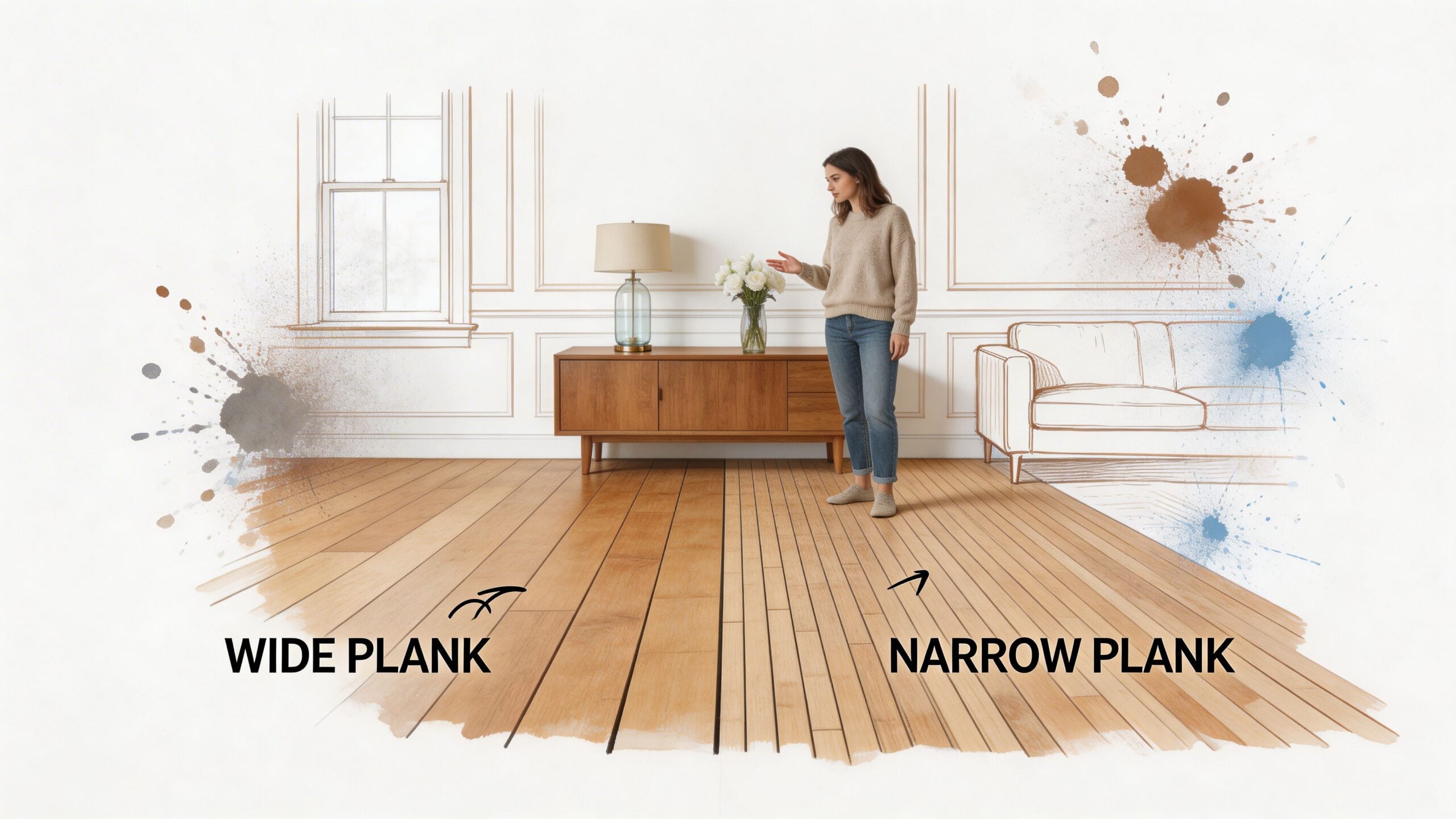
Hardwood covers more visual ground than almost any other finish in the house. It sets the tone for everything that sits on it, from a walnut trestle table to an upholstered bed to the brass and fabric choices that follow years later. If you want a floor that still feels right after a remodel, a new rug, or a custom furniture order, choose it as part of the whole design, not as an isolated product sample.
Plank size sets the visual pace
Wide planks usually read calmer and more contemporary because there are fewer seams. Narrow planks create more pattern and repetition, which often suits colonials, cottages, and other homes with traditional trim and smaller room proportions.
Room size matters, but so does furniture scale. A wide-plank floor under a long farmhouse table and large case pieces can feel settled and quiet. The same floor in a small room with busy grain, patterned upholstery, and strong cabinet details can start to feel heavy. Narrow planks can bring welcome structure to that kind of space.
Color has to work with the woods you live with
Paint can change in a weekend. A dining table, sideboard, or custom bed usually stays much longer. That is why I tell homeowners to bring cabinet doors, fabric swatches, and photos of their largest wood furniture pieces before they make a flooring decision.
The goal is not a matched set. The goal is cooperation.
Red-brown floors can fight with cooler walnut stains. Pale white oak can look clean and timeless with natural linen, matte black metal, and warm leather, but it may feel washed out beside pale oak cabinets if there is not enough contrast. Dark floors can frame a room beautifully, yet they ask more from maintenance and lighting. For ideas on balancing tone, finish, and room style, Sunset’s hardwood flooring design guidance offers useful visual examples.
Custom furniture changes the equation
Off-the-shelf furniture is one thing. Custom furniture lets you build a room around the floor, which is often the smarter order of operations for a buy-it-for-life home.
Start with the floor as the base layer. Then choose one dominant furniture wood tone and one supporting tone. If the floor has warm honey or amber undertones, furniture with some warmth usually settles in more naturally than cool gray-brown stains. If the floor is neutral white oak, you have more freedom to mix painted pieces, darker walnut, or blackened finishes without creating tension.
This matters for longevity. A floor with flexible undertones gives you room to reupholster chairs, replace a coffee table, or commission a custom dining set years from now without starting the whole room over.
Use rugs and finish level to tie the room together
Rugs do more than protect traffic lanes. They help connect woods that are close in value but different in undertone, and they soften the transition between a floor and large furniture pieces. This guide to the best area rugs for hardwood floors is helpful if you want to layer color and texture without covering up the reason you chose hardwood in the first place.
Finish sheen matters here too. A lower-sheen floor usually works better with mixed materials and custom furnishings because it reflects less light and lets the room feel more collected than polished. It also tends to be easier to live with day to day. Good habits help preserve that look over time, and this guide on how to maintain hardwood floors is a practical reference.
Key takeaway: The best hardwood floor is not the one that wins on a sample board. It is the one that still makes the room feel coherent after the furniture, rugs, and real life move in.
Plan for Installation Budget and Long-Term Value
You can choose the right wood, the right color, and the right plank width, then lose the whole effect with a rushed installation. I have seen beautiful floors undercut by hollow spots, poor transitions, uneven boards, and preventable movement that started before the first room was furnished.
That is why the budget has to cover the full job, not just the carton price.
Spend on the parts you will never see again
Subfloor prep, moisture testing, leveling, layout planning, and acclimation are the parts homeowners rarely get excited about. They are also the parts that determine whether the floor feels solid and stays that way.
Cutting these steps to save money usually shows up later as gaps, cupping, squeaks, edge wear, or awkward height changes between rooms. Those are expensive problems to correct after furniture is in place and the house is back in use.
Good installation also protects the design work you already did. If hardwood is the foundation for custom dining furniture, built-ins, or heirloom pieces, the floor needs to sit flat, wear evenly, and transition cleanly so the room feels intentional for decades, not just at move-in.
After the floor is down, everyday use becomes part of the ownership cost. Felt pads, proper glides, and smart placement matter more than many homeowners expect. This guide on how to protect your floors from your furniture is a practical follow-up once the installation is complete.
Measure value over decades
Hardwood costs more up front than many alternatives. It also gives you something cheaper floors usually do not. Repairability, refinishing potential, and the ability to stay relevant as the rest of the home evolves.
The National Association of Realtors has reported strong resale appeal for hardwood flooring, and Floor Covering News notes that buyers continue to place a premium on homes with hardwood and on projects that restore existing wood floors. That matters, but resale is only part of the equation.
The bigger value often shows up in how the house ages. A well-chosen hardwood floor can outlast several rounds of paint, rugs, upholstery, and furniture changes. That is what makes it a buy-it-for-life decision. You are not buying a surface to get through the next trend cycle. You are choosing a permanent material that can keep working with new custom furniture and new room layouts without asking you to start over.
Maintenance is part of the return
Long-term value depends on care. A floor that is cleaned properly, protected from grit, and maintained with the right products keeps its finish longer and looks settled instead of tired.
If you want a straightforward reference after installation, this article on how to maintain hardwood floors from Northpoint Construction covers the basics in a useful way.
Small habits make a difference. Entry mats, prompt wipe-ups, and periodic inspection around dining chairs and heavy case pieces do more for lifespan than any miracle cleaner.
Use a three-part budget
A practical hardwood budget usually works best in three buckets:
| Budget Area | What it covers | Why it matters |
|---|---|---|
| Material | The wood itself | Sets the visual foundation for the home and affects future refinishing options |
| Installation | Prep, labor, moisture evaluation, layout, transitions | Prevents avoidable failures and protects the investment |
| Ownership | Maintenance supplies, furniture protection, future care | Helps the floor age well and stay compatible with the rest of the home |
If the total feels high, compare it to how long you expect to live with the result. Cheap flooring is often affordable only at the register. A well-installed hardwood floor earns its keep in durability, repairability, and the way it supports a cohesive home long after the receipt is gone.
Your Showroom Visit A Checklist for Success
You are standing under bright showroom lights with three oak samples in your hand. One reads too pink beside your cabinet door, one looks flat next to your wool rug, and one starts to make the whole room make sense. That is a good showroom visit. You are not shopping for a board in isolation. You are choosing the surface that will carry your furniture, wall color, textiles, and daily wear for years.
Come prepared to compare, not just browse. Bring room photos, measurements, paint samples, hardware finishes, and fabric swatches. If a dining table, case piece, or upholstered bed is staying, bring clear photos of it. A drawer front or cabinet sample helps even more. Hardwood is easier to judge when you can see how it supports the rest of the home.
Questions worth asking in person
Good questions save expensive corrections later.
- Can I see this floor in a larger sample or full board? Small cut pieces hide grain movement, color variation, and how busy the floor will feel across a larger room.
- How does this product perform in Bay Area homes? Ask about concrete subfloors, coastal moisture, interior humidity swings, and sun exposure in specific rooms.
- Which finish will wear best with my household? A family with dogs, dining chairs, and active traffic needs a different answer than a low-use guest room.
- What other woods and finishes pair well with this floor? A good consultant should be able to help you coordinate the floor with walnut, cherry, oak, painted cabinetry, and custom furniture without forcing everything to match.
- What needs to happen before installation starts? Listen for subfloor prep, moisture testing, acclimation requirements, transitions, and layout planning.
Pattern is worth discussing in the showroom too, especially if you want the floor to shape the character of the room. Floorika’s guide to hardwood floor patterns is a useful reference if you are comparing straight lay, herringbone, chevron, or other layouts before you visit.
Store lighting can flatter almost anything. Ask to take samples to a window, then hold them next to your photos and finish samples. If the wood only works under showroom lights, keep looking.
What to look for beyond the sample board
Watch how the consultant handles trade-offs. The best help is specific and calm. If a floor scratches beautifully but shows every crumb, you should hear that. If a color works with your sofa but fights your built-ins, you should hear that too.
A strong showroom experience connects flooring to the rest of the house. You should be able to compare wood tones, furniture finishes, rugs, and upholstery in one conversation. That matters because a floor is the visual base layer of the room. Get that layer right, and custom furniture, antiques, and new pieces all sit more naturally on top of it.
Leave with clear reasons for your choice. You should know why one option fits your home better, what compromises come with it, and whether it still looks like a buy-it-for-life decision instead of a short-term trend.
If you are ready to see hardwood flooring alongside custom furniture, rugs, and design finishes in one place, visit Giorgi Bros. Furniture in South San Francisco. Since 1933, families have relied on our non-commission Consultants for thoughtful, no-pressure guidance, whether they are selecting investment pieces, exploring Custom Furniture, or planning a full Bay Area Interior Design update. You can walk our 50,000 square foot showroom, compare materials in person, and speak with Design Experts who help you choose for the long term. If you prefer a more guided start, book a Design Consultation and bring your room photos, samples, and questions. Financing options are available.