
A hot night usually doesn’t announce itself dramatically. It starts with one leg outside the covers, then a pillow flip, then the quiet irritation of waking up again because the room feels close and the bed feels warmer than it should. In the Bay Area, that kind of restless sleep can show up even when the day seemed mild.
It's often considered a minor nuisance. It isn’t. Your body needs a cooler environment to move into the deeper stages of sleep that perform restorative work. If the room, mattress, and bedding hold onto heat, your sleep gets fragmented long before you fully realize why.
Learning how to sleep cooler at night isn’t about chasing gimmicks. It’s about building a sleep setup that works with your body instead of against it. Since 1933, families have come to us in South San Francisco looking for long-term comfort, not quick fixes. Sleep is no different. The right room conditions, the right materials, and the right fit can turn a restless bedroom into a place that helps you recover.
The End of Tossing and Turning
A cooler bedroom changes the feel of the entire night. The air feels calmer. The bed feels more inviting. Your body doesn’t have to fight its way into sleep.
The science behind that is straightforward. The ideal bedroom temperature for sleep sits between 60-68°F (16-20°C), and your core temperature naturally drops by about 1-2°F as you fall asleep. That cooling process helps signal sleep onset and supports smoother sleep cycles. Heat gets in the way of that rhythm.
That matters because sleeping hot is common, not unusual. A Gallup report on sleep temperature and sleep quality found that 57% of U.S. adults report occasionally sleeping too hot, and 14% feel too hot always or most of the time. In the same report, 46% of adults who sleep hot rated their sleep as subpar, compared with 29% among those who rarely feel too hot.
Practical rule: If you regularly wake up irritated, sweaty, or tangled in bedding, treat temperature as a core sleep issue, not a side issue.
A cool bedroom isn’t created by one setting or one product. It comes from several choices working together. Block daytime heat before it settles in. Keep air moving gently across the room. Pay attention to the materials touching your skin.
That’s the difference between a temporary patch and a lasting solution. Good sleep usually comes from a system.
Creating Your Ideal Cool Sleep Sanctuary
At 10 p.m., many bedrooms still hold the heat they collected at 3 in the afternoon. The sheets may be clean and the mattress may be supportive, but if the room itself is radiating warmth, sleep starts as a struggle.
The room sets the conditions your bed has to work within. In our family business, we often see people blame the mattress first when the larger problem is a bedroom that runs warm, traps stale air, or never quite settles down by bedtime. Good cool sleep usually comes from a coordinated sleep system, not one isolated fix.

Set the room for sleep, not for daytime comfort
A bedroom can feel fine in the evening and still be too warm for the hours when your body is trying to cool itself for sleep. Set the thermostat in advance and give the room time to reach that temperature before you get in bed.
If your bedroom never seems to cool evenly, the problem may be mechanical rather than behavioral. Undersized equipment, poor return airflow, and hot upper floors can all leave one room warmer than the rest of the house. If you’re trying to determine your AC unit size, that guide can help you judge whether your cooling system matches the space it serves.
Three room adjustments tend to deliver the most noticeable improvement:
- Cool the room before bedtime. It is easier to maintain a comfortable temperature than to pull stored heat out of walls, flooring, and furniture late at night.
- Block solar heat during the day. Shades, lined drapery, and closed blinds on sun-facing windows reduce the heat load your bedroom releases after dark.
- Keep air circulating. Gentle movement helps the room feel fresher and less muggy, even when the thermostat setting stays the same.
Use airflow with intention
A fan helps most when it supports the whole room, not when it blasts one side of the bed. Aim for steady circulation across the sleep space and toward warmer parts of the room so heat does not sit around the body.
I usually recommend testing placement for a few nights before deciding a fan “doesn’t work.” In many bedrooms, a small shift in angle or height makes the difference between pleasant airflow and an irritating draft. Ceiling fans on a low setting often work well. In other rooms, a quiet floor fan aimed to move air past the bed does a better job.
A simple comparison makes the trade-offs clear:
| Bedroom condition | What usually happens |
|---|---|
| Cool room, no airflow | Heat lingers around the body and under bedding |
| Warm room, strong direct fan | Relief at first, then uneven comfort or dry eyes |
| Cool room, gentle air circulation | More stable comfort through the night |
Air movement is often the detail people overlook. A room can test cool on the thermostat and still feel stuffy once you are under covers.
Treat the room and bed as one system
Lowering the thermostat helps, but it cannot fully overcome a sleep surface that traps heat. The reverse is also true. Breathable bedding and a better mattress can only do so much in a room that stores heat and releases it all night.
That is why we encourage people to build the room and the bed together, the way a good designer approaches the whole space instead of one product at a time. Window coverings, airflow, mattress materials, sheets, pillows, and top layers all affect the same result. We’ve covered that relationship in more detail in this guide to creating a sleep sanctuary through lighting, temperature, mattress, and bedding.
A well-prepared cool bedroom should feel settled, quiet, and easy to forget. Once that foundation is right, the rest of your sleep system can do its job well.
The Foundation of Cool Sleep Your Mattress and Bedding
A hot room is one problem. A heat-holding bed is another. If your mattress and bedding keep warmth pressed against your body for hours, you feel it most at the back, shoulders, and head, right where sleep gets fragile.
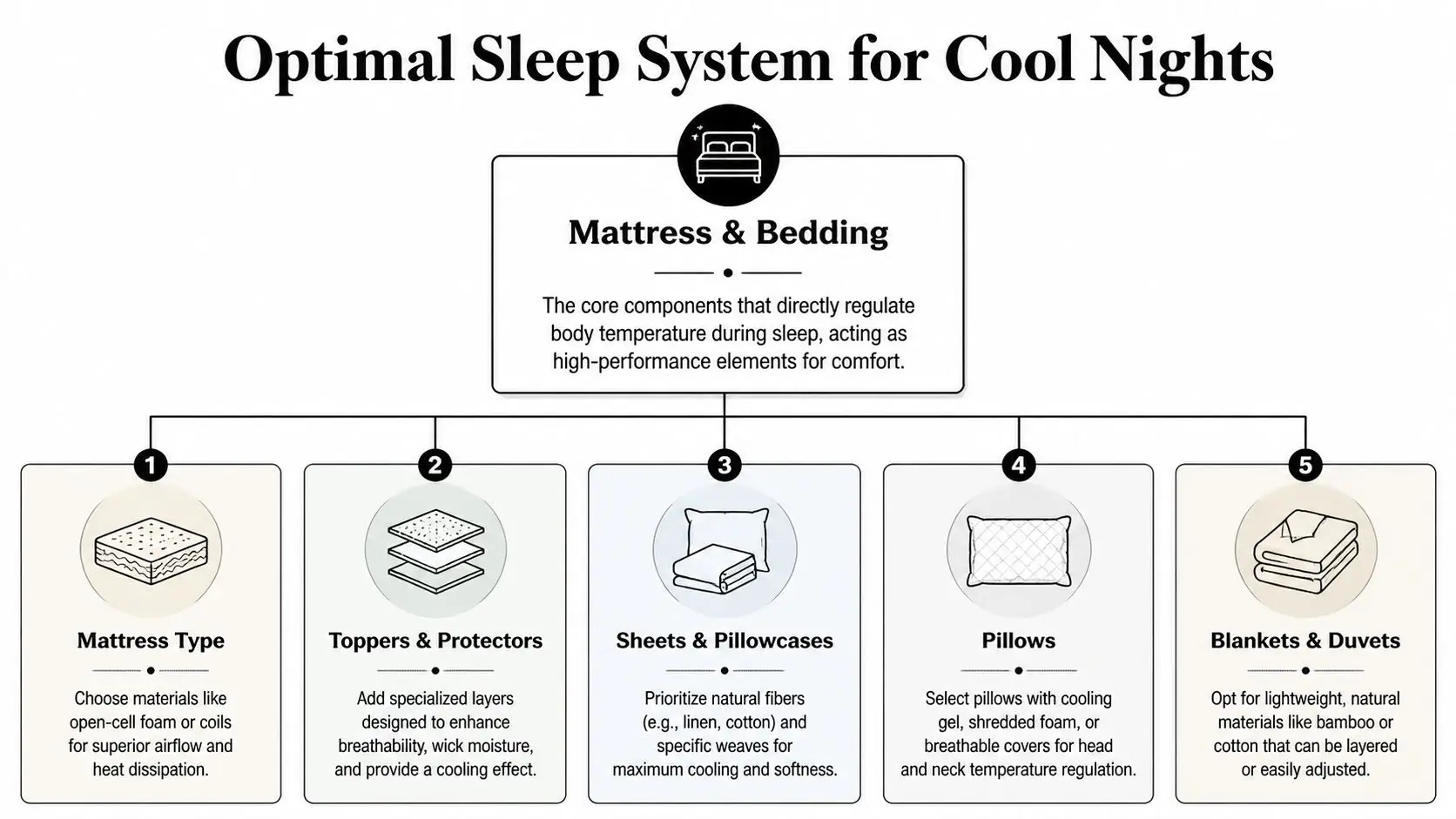
In our store, this is often the point where shoppers realize they do not need one “cooling product.” They need a better sleep system. The mattress, protector, sheets, pillows, and top layers all share the same job. Support the body well, let excess heat escape, and avoid that sealed-in feeling that wakes you at 2 a.m.
Not all cooling materials work the same way
Some materials breathe well over a full night. Some only feel cool for the first few minutes. Some soften and contour so much that airflow drops off once your body settles in.
Dense traditional foams are a common trouble spot for hot sleepers, especially under the torso. The complaint I hear most is not about firmness. It is about feeling held too closely by the bed. Latex usually feels more open, and hybrid mattresses with coil support often allow more airflow through the core, which can make a real difference in all-night comfort.
As noted earlier, research on sleep temperature has linked more conductive sleep surfaces with better restorative sleep. That does not mean every mattress with a cooling label performs well. It means the materials beneath you matter more than the label on the showroom tag.
Build the bed in layers
A breathable sheet cannot rescue a heat-trapping mattress. A cooler mattress can also be undermined by a heavy protector or an overly warm duvet insert. Good temperature control is cumulative.
Here is the practical order I recommend people evaluate:
- Mattress core. Start with the main support material. For many warm sleepers, latex and well-made hybrids are strong candidates because they tend to feel less closed-in.
- Protector or topper. This layer is often the hidden culprit. Waterproof options vary widely, and some block airflow enough to change the whole bed.
- Sheets and pillowcases. Cotton percale, linen, and other breathable natural fibers usually feel drier and less clingy through the night.
- Pillows. Heat gathers around the head and neck quickly. If the pillow sleeps warm, the rest of the bed can feel warmer too.
- Blankets and duvet inserts. Fill, shell fabric, and overall weight all affect how much heat gets released or trapped.
If you want help sorting through those upper layers, this guide to bedding, mattress protectors, and comforters lays out the differences clearly.
Cooling claims are everywhere now
Here, a little skepticism helps.
Usually worth serious consideration
- Latex instead of dense conventional foam. Often a better choice for airflow and easier movement.
- Hybrid construction. Coils can create a more ventilated interior than solid foam builds.
- Breathable natural-fiber sheets. Linen and cotton tend to feel more forgiving across changing temperatures.
- Pillows designed to release heat instead of smother it. This matters more than many people expect.
Often less impressive in practice
- Cool-touch covers over a heat-retaining support core. Pleasant at first contact, then less helpful after you settle in.
- Thick protectors with minimal breathability. Useful for protection, but sometimes too warm for sensitive sleepers.
- Layering the bed for looks instead of function. Decorative extras can work against comfort.
The best cooling bed rarely feels flashy. It feels settled, dry, and balanced.
Personal fit matters more than trend language
A mattress can test well in a lab and still sleep warm for the wrong person. Body weight, sleep position, and how much you sink into the surface all affect heat buildup. That is why I always caution against shopping by cooling buzzwords alone.
The better question is simple. Does this mattress keep your body supported in a posture that allows air, pressure relief, and less heat concentration where you sleep?
That same layered thinking applies at the pillow level. Giorgi Bros. Furniture carries the Zephyr 2.0 3-in-1 Pillow, which uses temperature-regulating materials and a gel-infused design. That can be useful for sleepers who overheat around the head and neck, but no pillow can compensate for a mattress and bedding stack that traps warmth underneath.
Well-made sleep products are long-term household pieces. In a heritage furniture store, that has always been the standard. Buy for fit, materials, and lasting comfort, and cooler sleep usually follows.
Choosing the Right Sleep System for Your Body
The most common cooling advice assumes everyone sleeps the same way. They don’t. A room that feels perfect to one person can leave another person overheated by midnight.

Why generic temperature advice falls short
A universal bedroom target sounds tidy, but real bodies are less tidy than that. The Sonu Sleep discussion of staying cool at night makes that point clearly. A universal room temperature of 65°F (18.3°C) can overlook major differences in body type, metabolic rate, and hormonal cycles. It also notes that athletes and people with higher metabolic rates may need more aggressive cooling than more sedentary sleepers.
That lines up with what many homeowners discover after trying every obvious trick. They lower the thermostat, buy lighter sheets, and still sleep hot because the issue isn’t just the room. It’s the interaction between the body and the bed.
Build your own cooling profile
A practical way to think about this is to identify what kind of hot sleeper you are. Not by diagnosis, just by observation.
Ask yourself:
- Do you feel warm all over, or mainly at your back and shoulders?
- Do you overheat at sleep onset, or wake up hot in the middle of the night?
- Do you run hot year-round, or mainly during certain seasons or hormonal changes?
- Do you sleep hot only on one mattress and not another?
Those answers point you toward different solutions. Someone who traps heat mainly where the body sinks deepest may need a different mattress construction. Someone dealing with periodic temperature shifts may need more adjustable bedding and better airflow rather than a complete mattress change.
A useful starting point is this mattress selection guide, especially if you’re trying to sort out support, pressure relief, and temperature concerns together rather than one at a time.
Match the solution to the sleeper
This isn’t a one-size-fits-all category, so the trade-offs matter.
| Sleeper pattern | What to prioritize |
|---|---|
| Warmer body temperature at baseline | More breathable mattress construction and lighter top layers |
| Heat concentrated where the body sinks in | Firmer support balance and materials with better airflow |
| Hormonal temperature changes | Flexible layers that can be adjusted easily |
| Athletic or high-metabolism sleeper | Stronger cooling support from both mattress and bedding |
Some people don’t need a colder room. They need a less heat-retentive sleep surface.
Adjustable bases can also help in the right situation. Slight elevation can change pressure distribution, improve comfort, and make the bed feel less confining. They’re not a cooling device by themselves, but they can support a setup that feels more open and breathable.
The larger point is simple. If you want to know how to sleep cooler at night, don’t shop by label alone. Shop by body response. The right sleep system should fit the person using it, not an average sleeper who doesn’t exist.
Solving the Partner Sleep Temperature Dilemma
Many couples think sleeping hot together is just part of sharing a bed. One person runs warm, the other gets cold, and both keep adjusting covers all night. That pattern is common, but it’s still a design problem with workable solutions.

Don’t reduce a couple problem to “sleep apart”
The phrase “thermal divorce” has become popular because it describes a very real frustration. The Sleep.me article on staying cool at night notes that many couples face this issue because they have different temperature preferences. It also points to two practical solutions: moving from a Queen to a California King for better thermal separation, and using split-temperature mattress systems so each person can customize their side.
That’s a much better lens than telling couples to avoid each other. Shared sleep should support closeness and recovery. If the bed is too small, too heat-retentive, or impossible to customize, the setup is failing the people in it.
The bed size question matters more than people expect
A larger bed doesn’t just add luxury. It changes heat transfer, movement, and airflow between bodies.
Here’s the practical effect:
- More distance reduces shared heat buildup. Bodies radiate warmth. Extra space limits that overlap.
- Each sleeper gets more independent bedding control. That alone can improve comfort.
- Movement feels less intrusive. Restless repositioning from one sleeper is less likely to disturb the other.
A resource on choosing a mattress for two sleepers is useful here because couples often need to solve several issues at once: support, firmness preference, motion transfer, and temperature.
Use layered compromises instead of nightly arguments
Couples rarely need identical sleep conditions. They need compatible ones. That usually means building flexibility into the bed.
Consider a combination like this:
- Choose a larger mattress if the current size feels crowded. Space is one of the simplest tools for managing shared heat.
- Separate the upper layers when needed. Different blanket weights can work better than one shared cover.
- Look for side-specific options. Split systems and dual-zone designs can help each person create a more comfortable microclimate.
- Place airflow for the room, not only one person. A fan aimed to support the whole bed often works better than one direct stream that bothers the cooler sleeper.
A good couples’ sleep setup doesn’t force one person to lose so the other can sleep.
Small habits still help
Product choices matter, but the nightly routine matters too. Couples usually get better results when they make a few simple adjustments together.
- Leave a little space between bodies at sleep onset. Once each person settles, shared heat is less likely to spike quickly.
- Use separate top layers if one of you kicks covers off. It keeps one partner from overheating and the other from waking up cold.
- Reset the room earlier in the evening. A bedroom that starts cool is easier for both people to tolerate.
- Be honest about what’s uncomfortable. Many couples talk about firmness and ignore temperature, even when temperature is the actual reason they’re waking up.
The best part is that this problem is solvable without turning the bedroom into a negotiation every night.
Simple Habits and Routines for Cooler Nights
Even the right mattress and room setup can be undermined by evening habits. If your body goes to bed overheated, your environment has to work harder to compensate.
Lower the body’s workload before bed
A calm pre-sleep routine should help the body release heat, not hold onto it. For many people, a lukewarm shower in the evening helps because it supports that gradual cooling feeling afterward. Heavy exercise right before bed can do the opposite, especially if you already run warm.
What you wear matters too. Lightweight sleepwear in breathable natural fibers usually feels better than clingy synthetic fabric that holds moisture close to the skin. If you’d rather sleep with fewer layers, make sure your bedding can still be adjusted easily so you’re not forced into one fixed temperature all night.
Keep the routine simple and repeatable
The best habits are the ones people can keep.
Try this evening checklist:
- Cool the room early. Don’t wait until you’re already uncomfortable.
- Choose lighter sleepwear. Less trapped heat around the body usually means fewer wakeups.
- Avoid heavy late meals. Digestive effort can make the body feel warmer and less settled.
- Watch alcohol in the evening. Many people feel drowsy at first, then warmer and more restless later.
- Hydrate through the day. Going to bed dehydrated can make the night feel more uncomfortable, but drinking too much right before bed can create its own interruption.
Cooler sleep often comes from ordinary discipline, not dramatic changes.
Think long term, not as-needed
Short-term fixes have their place. A fan on a warm night helps. Swapping to lighter bedding in summer helps. But the bigger payoff comes when your habits support the sleep system you’ve already built.
That’s why sleep hygiene still matters. The room, the bed, and the body all need to cooperate. These sleep hygiene tips for a better night’s sleep are a good reminder that comfort isn’t only about products. It’s also about routine, consistency, and giving your body the conditions it needs to settle down properly.
A lot of quick-fix advice treats sleep as something to hack. In practice, better sleep usually comes from steadier choices repeated over time.
Investing in a Lifetime of Restful Sleep
A cooler night’s sleep rarely comes from one trick. It comes from a room that doesn’t store heat, a mattress that doesn’t trap it against your body, bedding that breathes, and routines that help your body settle into rest.
That’s why the smartest approach is to think in terms of a sleep system. When each part works with the others, comfort becomes more reliable. You sleep with fewer interruptions. You wake up less irritated. The whole bedroom starts doing its job better.
There’s also a practical value in choosing quality the first time. Well-made sleep products last longer, perform more consistently, and usually create less waste than a cycle of replacements and impulse fixes. That buy-it-for-life mindset has always made sense in the home. It makes just as much sense in the bedroom.
For Bay Area homeowners, thoughtful selection matters. The right support, materials, and configuration can turn an ordinary bed into one of the most useful investment pieces in the house. Not because it feels indulgent, but because daily well-being depends on it.
If you’d like no-pressure guidance, visit Giorgi Bros. Furniture in South San Francisco to explore premium mattresses, custom options, and whole-home comfort ideas in person. Our non-commission Consultants can help you compare materials, test comfort levels, and build a sleep setup that fits your body, your home, and the way you live. You can also book a Design Consultation if you’d like more personalized help.