You’re probably seeing rattan everywhere again. A sculptural accent chair in a staged condo. A woven coffee table in a remodel photo. A vintage-look lounge chair that feels warmer than metal and lighter than a big wood frame.
That popularity creates a problem for careful buyers. A lot of people like the look of living room rattan furniture, but they’re not sure what they’re buying, how it holds up in a Bay Area home, or whether it belongs only in a boho room. Those are fair questions.
Rattan can be timeless, practical, and surprisingly elegant. It can also be disappointing if the material, weave, finish, or room conditions aren’t right. The difference usually comes down to understanding the material before you buy it.
The Enduring Appeal of Rattan in the Modern Living Room
On a cool San Francisco morning, a living room can feel dim, flat, and a little heavy before the light fully comes in. Rattan changes that quickly. It reflects light gently, breaks up hard lines, and adds the kind of texture that makes a room feel lived in rather than staged.
Its appeal has lasted for a simple reason. Good rattan is pleasant to look at, comfortable to live with, and light enough to move as a home changes over time. For Bay Area homeowners, that last point matters more than people expect. Furniture often has to adapt to smaller city rooms, hillside homes with shifting light, and the mix of dry summers, coastal fog, and everyday use that can test lesser materials.
Rattan has a long record in interior furnishings, and museums such as the Victoria and Albert Museum note its use in European and British interiors well before the current wave of interest. That history helps explain why it still feels at home in so many settings. A well-made rattan chair can sit comfortably beside refined upholstery, quiet modern casegoods, or older architectural details without looking like a passing fashion.
That versatility is one reason families keep coming back to it.
In the Bay Area, we often see rattan work best when homeowners treat it as a lasting part of the room rather than a theme. A lounge chair in Palo Alto might soften a clean-lined interior. In Marin, the same material can bring warmth to a mid-century space with glass, stone, and walnut. In a San Francisco Edwardian, it can lighten rooms that already have strong moldings, dark floors, and plenty of visual weight.
If you gravitate toward pieces with a long design life, it helps to look at the broader tradition of modern furniture classics. Rattan belongs in that group more often than shoppers assume, especially when the frame, weave, and finish are chosen for years of ownership instead of a single decorating moment.
Good rattan adds warmth, movement, and handcraft without asking the room to follow a theme.
Understanding the Language of Natural Woven Furniture
Good furniture shopping gets easier once the words are clear. Many Bay Area homeowners are not confused by style. They are confused by labels. A tag says wicker, another says cane, and a third says rattan, and all three may be used on pieces that look similar from across the showroom.
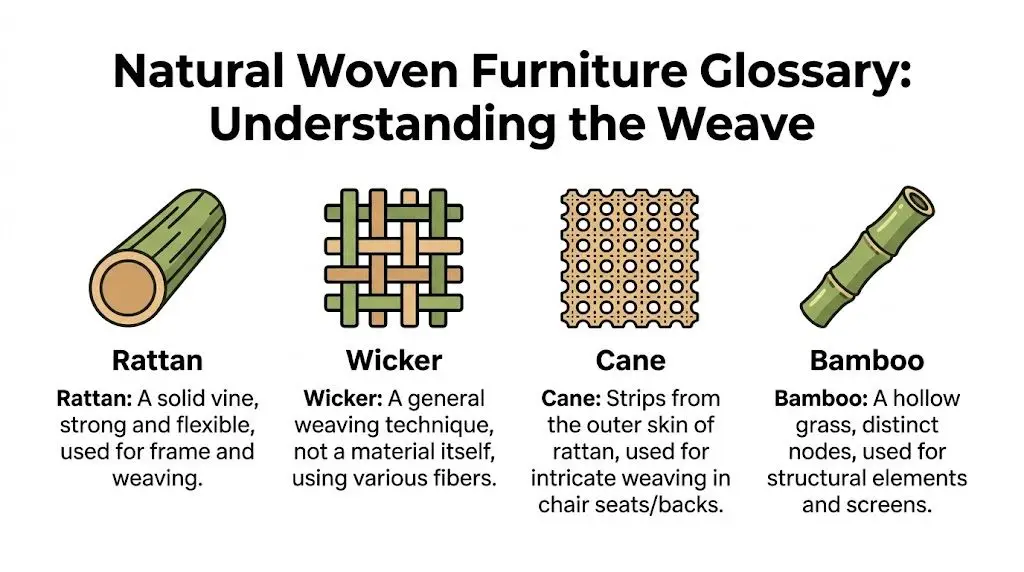
That distinction matters more than many shoppers expect, especially if you want a living room piece that will hold up through years of fog, sun, dry heat, and daily use.
Rattan and wicker are not the same thing
Rattan is the material. It comes from a climbing palm and can be used for structural frames, wrapped details, and woven surfaces.
Wicker is the weaving method. It describes how the furniture is made, not what it is made from. A wicker chair might be woven from natural rattan, cane, seagrass, or a synthetic fiber meant for different conditions.
That is why the word on the tag is only the start of the conversation.
In a well-made living room chair, the difference is practical. If the frame is rattan, you are looking at one kind of performance and repairability. If the piece is resin wicker over metal, you are looking at another. Both can have their place, but they are not interchangeable, and they should not be priced or judged as though they are.
Cane, bamboo, and seagrass each play a different role
Cane usually refers to the outer skin of the rattan plant, cut into narrow strips. Furniture makers often use it where they want a lighter, more refined pattern, especially on chair backs, cabinet panels, and decorative side details.
Bamboo is a separate plant altogether. It is hollow, jointed, and more rigid in appearance. It brings a crisp, architectural line, while rattan tends to offer more curve and visual softness.
Seagrass is another natural fiber, usually chosen for surface texture and a relaxed, casual character. It can be beautiful, though it usually creates a different feel than rattan in a formal living room or a sleek modern interior.
A clear way to sort the terms:
- Rattan is often the structural material.
- Cane is often the finer woven skin from rattan.
- Wicker is the weaving process.
- Bamboo is a different plant with a more linear look.
- Seagrass is a natural fiber used mainly for texture.
If you remember only one point, remember this one. Wicker tells you how it was woven. Rattan tells you what it is.
Why these distinctions matter for long-term ownership
For Bay Area homes, this vocabulary helps you buy with more confidence. A family in San Francisco may need a piece that handles coastal moisture without feeling heavy in a smaller room. A homeowner in Walnut Creek may care more about how a woven frame behaves through warmer, drier seasons. Someone furnishing a home in Marin may want the warmth of natural fiber but with cushion fabrics that stand up to bright afternoon light.
Those are ownership questions, not decorating questions.
Rattan often earns a closer look because it can serve as both structure and finish, which gives designers and makers more flexibility in scale, shape, and comfort. It also explains why better pieces can look light without feeling insubstantial. If you are considering a sofa, lounge chair, or sectional with loose cushions, the fabric choice matters just as much as the woven frame. This guide to upholstery materials for comfort, durability, and everyday use can help you compare options before you commit.
Rattan vs. Wicker vs. Seagrass at a Glance
| Characteristic | Rattan | Wicker | Seagrass |
|---|---|---|---|
| What it is | A natural material | A weaving technique | A natural fiber |
| Main role in furniture | Frame and weave | Construction style | Surface texture and weaving |
| Look | Warm, organic, structured | Depends on the material used | Relaxed, soft, coastal-leaning |
| What shoppers often confuse | Mistaken for wicker | Mistaken for a material | Mistaken for rattan |
| Best buying question | Is the frame natural rattan or another material? | What material is woven here? | Is this the right texture for daily living room use? |
The old rule from our family business is straightforward. Buy the piece after you understand the bones, the skin, and the finish. In woven furniture, the words tell you where to start.
The Unseen Strength of Rattan Craftsmanship
A rattan chair often gets judged the wrong way in the showroom. Someone lifts it with one hand, notices how easy it is to move, and wonders whether it will hold up in a busy living room. After decades in the furniture business, we can tell you that weight alone is a poor test of strength.

Good rattan works like a young tree branch. It has structure, but it also has give. That balance is part of why well-made pieces stay comfortable and useful through years of sitting, shifting, lifting, and daily family life. Indoors, with proper care, quality rattan can serve a home for many years without asking for the kind of heavy upkeep some buyers expect.
That flexibility matters in Bay Area homes. Here, furniture often gets moved to catch afternoon light, make room for guests, or open a path to the patio on warm evenings. A rigid material can resent that kind of life. Rattan is better suited to it, provided the frame is built well and the joinery is done with care.
Why flexibility helps a frame last
A strong rattan piece does not fight every bit of pressure. It handles use by yielding slightly, then returning to shape. That is a different kind of durability from dense hardwood, and it helps explain why a lighter frame can still feel dependable year after year.
You see the benefit most clearly in living room seating. Accent chairs get dragged a few inches. Ottomans get used as seats when company arrives. Lounge chairs handle the full weight of someone dropping into them after a long day. In those moments, a little controlled give is a friend.
For Bay Area homeowners, climate adds another layer to the story. Our region has coastal moisture in some neighborhoods, dry interior air in others, and temperature swings that can surprise you within the same week. Natural materials always respond to their surroundings. Well-crafted rattan tends to handle indoor climate changes gracefully when it is kept out of harsh sun, standing water, and prolonged damp conditions.
What quality craftsmanship looks like
You do not need a workshop background to spot the difference between rushed work and careful work. Start with the areas that carry stress and show the maker's discipline.
- Frame consistency should be easy to see. The poles should look balanced in thickness, with clean curves instead of abrupt bends.
- Joinery should feel secure and intentional. Pay close attention where arms meet the back, where legs meet the seat rail, and where a base carries most of the load.
- Weave tension should be even. A tight, orderly weave usually signals patience and skill. Loose strands and waviness usually signal shortcuts.
- Surface finish should protect the material without making it look coated in plastic. You want to see the character of the rattan, not a heavy film hiding flaws.
One of the oldest rules in our family business is simple. Calm furniture is usually well-made furniture. If a piece looks strained, crooked, or overworked in the showroom, time rarely improves it.
Why strong craftsmanship matters in modern rooms
Better construction gives designers and homeowners more freedom. A skilled maker can shape rattan into open, sculptural forms that keep a room from feeling crowded, which is especially helpful in San Francisco homes, East Bay bungalows, and peninsula floor plans where one living area may need to serve several purposes.
That is also why rattan fits current interiors better than many shoppers expect. It is not limited to boho rooms or vacation-house styling. In a well-designed space, a well-built rattan lounge chair or coffee table brings texture without adding visual heaviness. If you are comparing layouts and proportions before you buy, this guide on how to choose living room furniture that fits your space and habits is a useful next step.
A few combinations work especially well for long-term ownership:
- Pair one rattan lounge chair with a fully upholstered sofa for balance.
- Use a rattan coffee table with glass or stone to keep the center of the room visually light.
- Mix woven texture with walnut, leather, plaster, or matte metal for a cleaner architectural look.
- Keep the color palette grounded. Warm white, camel, olive, charcoal, and natural wood tones age well.
If you are still deciding how to design your living room, treat rattan as a structural material first and a style signal second. That mindset leads to better choices, especially when you want furniture that feels current now and still belongs in the room ten or fifteen years from now.
Styling Rattan Furniture in Contemporary Bay Area Homes
On a foggy Oakland morning, a living room can feel different than it did the afternoon before. Light turns cooler. Air feels heavier. Materials that looked perfect in the showroom suddenly have to prove themselves at home. That is part of styling rattan well in the Bay Area. The room has to look right, but it also has to live well through marine air, bright sun, pets, guests, and daily use.

The best results come from treating rattan as one material in a carefully built room, much the way a good wool rug or walnut table plays a role without dictating the whole house. In contemporary Bay Area homes, that usually means using rattan to add warmth, airflow, and texture where architecture can otherwise feel hard or flat.
Three room approaches that age well
In a minimalist room
Clean-lined spaces often need one note of softness. A rattan accent chair, a compact side table, or a bench with woven detail can do that job without adding bulk.
Keep the silhouette disciplined. Tight weaves, simple frames, and tailored cushions suit plaster walls, large windows, and modern millwork far better than ornate tropical motifs. The goal is quiet texture.
In a classic San Francisco interior
Period homes already have character. Picture rails, carved mantels, and tall windows do a lot of visual work on their own. Rattan helps balance that weight.
A woven-back chair beside a structured sofa, or a console with restrained cane panels, can break up a room full of dense upholstery and dark wood. It works like a linen shirt under a structured jacket. The room still feels polished, but it breathes more easily.
In a mid-century leaning space
Mid-century rooms and rattan often speak the same language. Both favor visible structure, honest materials, and comfort that does not need ornament to prove itself.
This pairing is especially useful for Bay Area homeowners who want a room to feel current without chasing trends. A well-proportioned rattan lounge chair can sit comfortably with teak, oak, leather, or matte black metal and still look appropriate years from now.
What families with pets should know
Pet owners often hesitate for a simple reason. They worry woven furniture will be delicate.
That concern is understandable, but the answer usually lies in construction and placement, not in avoiding rattan altogether. A chair with a tight, even weave and a strong frame will handle everyday family life much better than a loosely woven decorative piece. The cushion matters too. If the seat fabric takes wear well and the frame is positioned away from a favorite scratching corner or sunny nap spot, the piece has a far better chance of aging gracefully.
A recent article from Woodgrain, in this overview of rattan ideas and buyer concerns, notes that hesitation around durability is common among shoppers. In practice, I advise families to judge rattan the way they would judge a dining chair. Check the joinery, test the stability, inspect the weave, and ask where the wear will happen first.
A few practical choices help:
- Choose tighter weaves when pets share the room often.
- Look for protective finishes that reduce surface wear from everyday friction.
- Use performance fabrics on cushions so the upholstery, not the frame, absorbs the hardest use.
- Place statement pieces thoughtfully. A reading chair in a calm corner usually ages better than one in the household traffic lane.
Bay Area climate changes the styling conversation
In this region, styling is tied closely to ownership. A piece near a sunny window in Walnut Creek faces a different test than one in a fog-cooled Pacifica living room. The first may deal with stronger drying light. The second may deal with more moisture in the air. Good styling accounts for both.
That is why I usually suggest treating natural rattan as indoor furniture, even in homes with large doors opening to patios or decks. Near condensation-prone glass, exterior walls, or enclosed sunrooms, material choice and finish become part of the design decision. A beautiful room should still look beautiful after many seasons, not just the first one.
If you are comparing layouts and mixed materials before buying, this guide on how to choose living room furniture that fits your room and daily habits is a practical place to start. If you are still shaping the room itself, this resource on how to design your living room offers a helpful framework for layout, circulation, and balance.
For Bay Area homeowners, that is the heart of good rattan styling. Choose pieces that belong to the house, suit the climate, and can still earn their keep ten or fifteen years from now.
A Lifetime Care Guide for Your Rattan Investment
Natural rattan rewards routine care. It doesn’t need fussing over, but it does need attention, especially in the Bay Area.

In high-humidity climates like the Bay Area, where annual relative humidity averages 70 to 80%, untreated rattan can degrade 40% faster, according to this guide on rattan living room furniture and humidity. That’s the local issue many national buying guides skip. A beautiful piece that performs well inland may need more protection near coastal fog or in a poorly ventilated room.
A simple care routine that works
For most homes, a steady maintenance rhythm is more effective than occasional deep cleaning.
- Weekly dusting keeps debris from settling into the weave. Use a soft brush attachment or a dry cloth.
- Prompt spill cleanup matters because moisture can linger in woven areas longer than people expect.
- Quarterly maintenance is worth scheduling. The same humidity guide notes that proper sealing and quarterly care are important for preventing warping and mold in damp conditions.
- Good airflow helps more than people realize. Avoid pushing rattan tightly against exterior walls that stay cool and damp.
If you like seasonal checklists, treat rattan the way you’d treat any natural investment material. Inspect it, clean it gently, and correct small issues early.
Natural rattan and synthetic rattan are not interchangeable
One of the biggest ownership mistakes happens at the buying stage. People bring home natural rattan for a spot that really calls for synthetic material.
Natural rattan is best thought of as an indoor material. Synthetic PE rattan is engineered for tougher exposure. According to VonHaus’s rattan buyer’s guide, PE rattan retains 95% tensile strength after 2,000 hours of ASTM G154 exposure, while natural rattan can absorb up to 15% moisture by weight in 80% relative humidity environments. The same guide notes that PE rattan can endure 10 to 20 years with minimal maintenance, while natural rattan is more vulnerable in moist conditions without protection.
That doesn’t make synthetic better in every context. It means material choice should match placement.
Natural rattan belongs in the living room, not in a spot that behaves like a patio.
Indoor care choices that pay off over time
If you want the look and feel of natural rattan indoors, a few preventive habits make a real difference:
- Keep the room comfortably dry when marine air is heavy.
- Use breathable covers only when needed, not sealed plastic wraps.
- Rotate pieces occasionally so one side doesn’t take all the sun or dampness.
- Check feet and lower rails, especially if the piece sits on a cool floor near large windows.
For related habits that help preserve surrounding materials too, this guide on protecting furniture from scratches and stains pairs well with a whole-room maintenance plan.
What to watch for before damage spreads
Rattan usually gives warnings. Pay attention if you notice:
- A musty smell near the weave
- Surface dullness that looks patchy rather than naturally aged
- Loosening at stress points such as arms or seat edges
- Finish peeling in a room that tends to stay damp
Catching those signs early is what turns living room rattan furniture into a long-term piece rather than a short-term trend purchase.
How to Customize Rattan Furniture for Your Unique Vision
You bring home a rattan chair because the shape is right, the scale fits, and the weave has character. Six months later, it still looks good, but now you wish the cushion were firmer, the stain were warmer, or the seat height worked better with the rest of the room. That is the difference between buying a look and shaping a piece for long ownership.
Rattan has always rewarded thoughtful customization. As noted earlier, it has a long history in custom interiors. For Bay Area homeowners, that tradition matters because a custom choice is rarely just decorative. It often decides how well the piece lives with foggy mornings, bright afternoon light, active family use, and a room that blends older architecture with cleaner modern lines.
Start with function, then build the details
Color usually gets the attention first. In a well-planned room, function should come first.
Ask what the piece needs to do every day. A reading chair needs supportive pitch and an arm height that feels natural after an hour, not five minutes in a showroom. A sofa may need deeper cushions for lounging, or a tidier profile if the room already has generous upholstery. A coffee table might need a glass top for easier use, especially if you want woven texture without giving up a stable surface for books, trays, or a cup of tea.
That sequence works like tailoring a jacket. The fit comes first. The fabric and buttons come after.
The best custom choices often look quiet
Good customization usually shows up in proportion, finish, and upholstery, not in loud styling. Rattan has enough personality on its own. It does not need help.
A few examples tend to work well in Bay Area living rooms:
- A natural or lightly toned frame with performance fabric keeps the room bright without feeling beach-themed.
- A medium walnut stain helps rattan sit comfortably beside wood case goods and older architectural details.
- Leather or structured upholstered cushions give a woven frame a cleaner, more urban profile.
- Welting, boxed cushions, or a tighter seat can make a casual silhouette feel more disciplined.
Many homeowners find their perspective on rattan shifting. They stop seeing it as a boho accent and start seeing it as a frame material with real range.
Customize for your house, not for a showroom
Bay Area homes ask different things from furniture. Sun can be intense in one room and marine air can linger in another. That affects which custom options are worth paying for.
If your living room gets strong western light, choose a finish and fabric that will age gracefully rather than one that depends on a perfect, untouched surface. If your home is busy with children, guests, or pets, cushion construction matters as much as the weave. If you live in a smaller San Francisco room or a hillside home with tighter dimensions, custom scale can matter more than color. Two inches in arm width or seat depth can change how open a room feels.
Those are the decisions that turn a pretty purchase into a piece you keep.
Customization should solve a problem
The strongest custom plan answers practical questions.
Do you need a firmer seat for easier standing? A higher back for reading? Cushions that zip off for cleaning? A stain that connects the rattan to nearby walnut, oak, or painted millwork? A more formal fabric so the room feels collected rather than casual?
When those answers line up, the piece feels settled. It belongs in the house, and it usually keeps belonging there even as rugs, paint colors, and accent pieces change over time.
If you want to explore frame options, finishes, and upholstery in a more personalized way, a custom order consultation for rattan and woven furniture gives you room to make those decisions carefully.
The best custom rattan furniture rarely announces itself. It fits your room, your climate, and your daily habits so well that it feels as though it has always been there.
Partnering with Giorgi Bros for Your Furniture Journey
A Bay Area living room can teach you a lot about furniture before anyone says a word. The afternoon sun hits one side of the room hard. Fog rolls in for days at a time. Weekend guests gather in the same two seats. A piece that looks good for ten minutes in a showroom still has to earn its place over years of real use.
That is why buying rattan well calls for more than a quick first impression. You want to know what the frame is made of, how the weave is finished, whether the scale fits your room, and how the piece will handle your home's light, air, and daily traffic. Good guidance turns that process from guesswork into informed ownership.
Questions worth asking before you buy
Comfort matters, but it is only the starting point.
A careful buyer should also ask:
- Is this natural rattan or a synthetic woven material?
- Is it better suited to a sunroom, a living room, or a lower-light space?
- How is the finish likely to age in a room with strong western light or seasonal moisture?
- Can the cushions and fabrics be adapted for children, pets, or frequent guests?
- What should I look for at the joints, bindings, and weave to judge quality?
Those questions change the purchase in an important way. You stop shopping for a momentary style hit and start choosing a piece that can still serve you well after the room has been repainted, rearranged, and lived in.
Why heritage still matters
Rattan has lasted because it adapts. It has moved comfortably from classic sunrooms to mid-century interiors to quieter contemporary spaces without losing its character. That kind of staying power matters if you are furnishing a home you plan to keep, not a room you plan to redo next year.
The same is true of the buying process. A useful showroom conversation should help you judge whether a piece will still look right after the rug changes, after you recover the sofa, or after you move from one Bay Area home to another. Long-term furniture ownership is a little like buying a good coat. The best one is not always the loudest. It is the one that keeps fitting your life.
What a supportive buying process should include
A good furniture experience feels calm, informed, and specific to your home.
You should be able to sit in the chair long enough to judge real comfort, compare finishes beside your fabric samples, and talk through practical concerns such as sunlight, coastal moisture, and room size. You should also be able to ask whether a floor model is the right answer, or whether a custom version would solve a scale, fabric, or finish problem more effectively.
For homeowners who want that flexibility, custom order options for rattan and other furniture make room for better decisions on finishes, upholstery, wood tones, and overall fit. In many homes, the right piece is not the one you notice first. It is the one configured for how you live.
Why this matters in South San Francisco and the Bay Area
Bay Area homes ask more of furniture than a catalog page can show. A compact San Francisco flat, a breezy Peninsula house, and a hillside home with broad glass exposure each create different demands. Scale, light, moisture, traffic patterns, and sightlines all change what will feel comfortable and what will hold up gracefully.
That is where local experience earns its keep. A regional showroom sees the same questions come up again and again. Will this finish show wear in strong sun? Will this seat depth work in a narrower room? Will this woven frame feel too casual next to structured upholstery and older wood case goods? Those are ownership questions, not decorating slogans.
A family business with roots going back to 1933 brings useful perspective to those decisions. Years of helping customers furnish Bay Area homes teaches you which materials mature well, which construction details are worth paying for, and which custom choices people still appreciate many years later. Non-Commission Sales Staff also changes the tone of the experience. The conversation can stay focused on fit, quality, and value over time.
For some households, financing options are available, which can make a longer-lasting custom purchase easier to plan for. That matters because buy-for-life furniture often costs more up front and less over the years.
If you want to compare living room rattan furniture in person, a South San Francisco showroom still offers something a screen cannot. You can sit in the piece, study the weave, test the cushion, compare finishes in real light, and ask detailed questions before you bring it home.
If you would like help comparing rattan seating, custom upholstery, Amish Furniture, or other long-term investment pieces, visit Giorgi Bros. Furniture in South San Francisco or schedule a Design Consultation. You will find a family-owned showroom with quality craftsmanship since 1933, a broad custom order selection, premium mattresses, and consultants who offer clear, no-pressure guidance from first look to final delivery.