A lot of living rooms feel almost right. The sofa fits. The chairs are good-looking. The coffee table works. But the room still feels scattered, a little cold, or unfinished in a way that's hard to name.
In most homes, the missing piece is the rug.
A well-chosen area rug does more than add color. It defines the conversation area, softens hard flooring, and gives furniture a reason to belong together. If you're wondering how to choose an area rug for living room spaces that need warmth and structure, start by treating the rug as a foundation, not an accessory.
At our family business in South San Francisco, we've been helping Bay Area households furnish homes since 1933. Over those decades, one lesson has held up: when you buy with care, you live with comfort longer. A rug that's sized properly, made for your lifestyle, and chosen with patience becomes part of the room for years. That's the buy-it-for-life mindset. It's better for your home, often better for your budget over time, and usually a more sustainable way to furnish.
The Unsung Hero of Your Living Room
The rug is often the piece people shop for last, and that's usually backward. In a living room, the rug is what visually holds the seating area together. Without it, even quality furniture can look like it was placed one piece at a time instead of planned as a whole.
A good rug changes the feel of a room immediately. It adds softness underfoot, reduces the harshness of large expanses of wood or tile, and gives the eye a place to rest. It can also carry personality. Sometimes that means a quiet neutral that lets your upholstery shine. Sometimes it means a pattern that brings life to a room with simple forms.
Why the rug matters more than most people expect
The living room is where a lot of daily life happens. People read, host, nap, snack, and gather there. The rug has to do practical work while still making the room feel welcoming.
That means the right choice usually balances several jobs at once:
- Define the seating area: It tells the eye where the living zone begins and ends.
- Add comfort: A room with hard surfaces feels more livable when there's softness underfoot.
- Support your style: Rugs can either calm a busy room or give a simple room depth.
- Protect the investment around it: A thoughtful rug choice helps the whole furniture plan make sense.
A living room rarely feels finished because of one dramatic piece. It feels finished when the scale is right.
If you'd like another perspective on proportion and room planning, this guide on how to choose a living room rug is a useful companion read.
Buy it for life starts with buying the right rug
People often think longevity starts with price. It doesn't. It starts with fit. A rug that's too small, too delicate for the room, or disconnected from how your household lives won't feel right for long. That's when replacement cycles begin.
A timeless rug choice is usually the one that supports your room every day without asking for attention. That's the kind of no-pressure advice we've believed in for generations.
Start with Size Your Guide to Perfect Proportions
Before color, before pattern, before material, get the size right. The most common mistake is buying a rug that looks fine rolled up in a showroom or on a product page, then feels undersized once it's in the room.
Interior design guidance recommends using painter's tape to outline rug dimensions on the floor before buying, and for living room placement, the baseline is that the front legs of sofas and chairs should rest on the rug, with 6-18 inches of exposed floor between the rug edges and walls according to Slumberland's area rug guide.

Use painter's tape before you buy
This is one of the simplest tricks in furniture planning, and it works. Put painter's tape on the floor in the dimensions you're considering. Then stand back. Walk around it. Sit on the sofa and look at the perimeter.
What you're checking isn't only size. You're checking how the rug will affect movement through the room, how much floor will still show, and whether the furniture grouping looks anchored.
A taped outline helps answer questions that a product label can't:
- Does the room feel grounded: Or does the rug feel like a mat under a coffee table?
- Can people move comfortably around it: Especially near entry paths and adjoining spaces.
- Does the furniture relate to the rug naturally: Or does it look disconnected?
Practical rule: If the rug only catches the coffee table and leaves all seating fully outside the perimeter, it's usually too small for the living room.
A simple way to measure
If you're figuring out scale for the first time, keep the process straightforward.
- Measure the seating area first: Focus on the furniture grouping, not the full room.
- Mark more than one option with tape: It's easier to compare on the floor than in your head.
- Check leg placement: At minimum, the front legs of the main seating should land on the rug.
- Review the border of visible floor: You want breathing room around the rug, not wall-to-wall coverage.
If you need help measuring the room and the furniture already in it, this guide on how to measure furniture is worth keeping open while you work.
What works and what usually doesn't
A properly sized rug makes the room feel calmer because the eye reads one complete seating zone. An undersized rug does the opposite. It breaks the room into unrelated pieces.
In most cases, sizing up gives a better result than sizing down. People worry that a larger rug will overpower the room. In practice, the too-small rug is the one that usually feels awkward.
Mastering Rug Placement and Layout
Size answers one question. Placement answers another. Once you know the rug can physically fit, you need to decide how your furniture should sit with it. With this decision, the room starts to feel intentional.
The most common living room benchmark is the 8'x10' rug, described as the most popular choice for average-sized spaces because it supports the standard front-legs-on arrangement. Design guidance also recommends keeping a minimum of 18 inches between the rug edge and wall for balanced proportions, as noted in Tufenkian's living room rug guide.
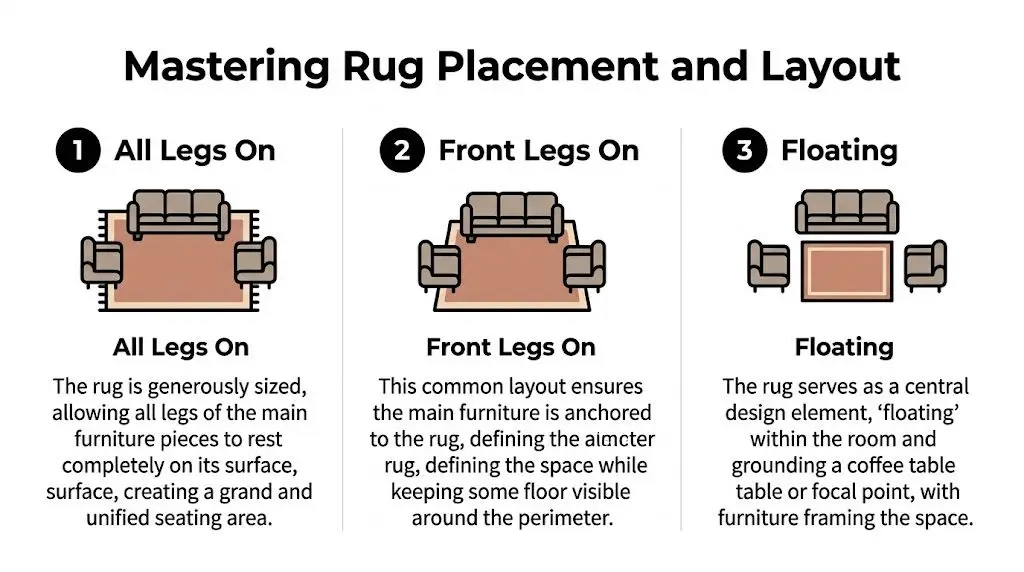
Three layouts that shape the room
Not every living room wants the same answer. Here are the three placement approaches people use most often.
| Layout | Best use | What it feels like | What to watch for |
|---|---|---|---|
| All legs on | Larger rooms and open-concept spaces | Unified and architectural | Needs a generously sized rug |
| Front legs on | Most standard living rooms | Balanced and versatile | Requires careful alignment |
| Floating | Smaller or decorative setups | Light and casual | Often looks too small in a main living room |
All legs on
This layout places the sofa and chairs fully on the rug. It works especially well when furniture floats away from the walls or when the living room sits inside a larger open-plan space.
The upside is cohesion. The whole seating area reads as one zone. The trade-off is that you need enough rug to support it without pinching the edges. In rooms with generous square footage, this is often the most composed look.
Front legs on
This is the workhorse layout. It suits many Bay Area homes because it gives the furniture connection without demanding the largest possible rug. The sofa and chairs touch the rug with their front legs, while the back legs remain off.
For many households, this is the sweet spot. It looks finished, preserves some visible flooring, and tends to work well with the proportions of common living room groupings. If you're also refining art and accessories after the rug is in place, this piece on how to choose wall art for your living room can help the rest of the room catch up to the foundation.
Floating
A floating rug sits in the center while all major furniture stays off the edges. This can work in a small sitting nook or in a room where the rug is mostly decorative.
In a primary living room, though, it's often the placement that causes disappointment. The coffee table may fit, but the seating area won't feel anchored. That's when people say the room looks unfinished, even if they can't explain why.
If your rug is floating in a full-size living room, the room usually asks for a larger rug, not more accessories.
If you're evaluating placement alongside a new seating plan, this guide on how to choose living room furniture can help you think through the whole arrangement.
Choosing Your Rugs Material and Pile
Once the size and layout are settled, the next question is how the rug needs to live. Good choices in this area begin to yield long-term benefits. A beautiful rug that can't handle the room it's in won't feel like a smart investment for long.
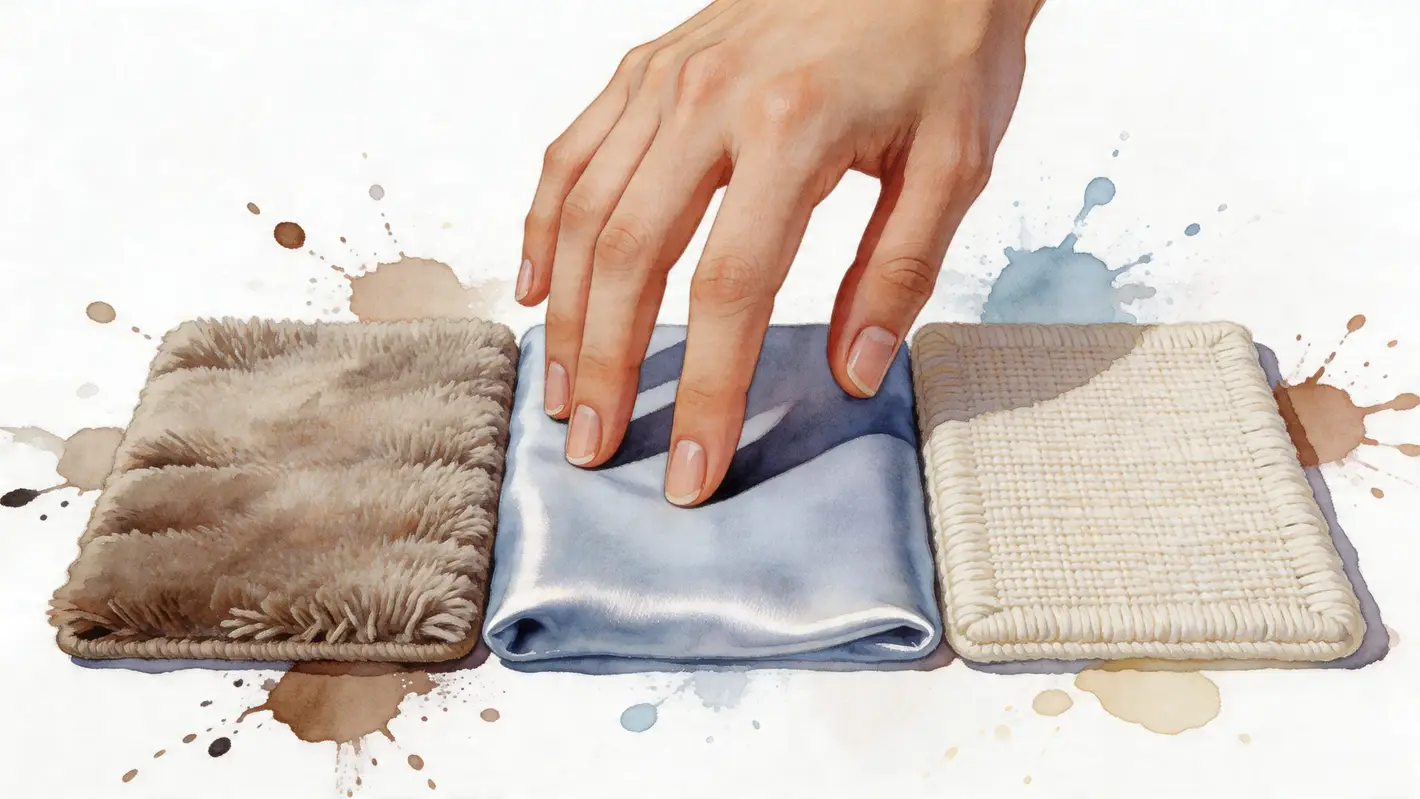
Guidance from Lowe's area rug buying guide notes that low-pile rugs perform best in high-traffic areas like living rooms because they conceal footprints and wear patterns, medium-pile rugs balance comfort and maintenance, and high-pile rugs are better suited to lower-traffic areas such as bedrooms.
Start with how the room is used
A formal living room used occasionally can handle a different rug than a family room where people gather every day. That's the first trade-off to respect.
- Low pile: Better for busy spaces. Easier to live with, easier to vacuum, and visually forgiving.
- Medium pile: A strong middle ground for households that want comfort without a fussy surface.
- High pile: Soft and inviting, but usually better where there is less daily traffic.
If your living room sees regular use, low or medium pile is usually the more dependable choice. It ages more gracefully in real life.
Material matters just as much as pile
Pile tells you how a rug will feel and wear. Material tells you how it will behave over time.
Wool has long been valued because it feels substantial, holds color well, and supports a buy-it-for-life mindset when chosen carefully. Natural fibers can bring beautiful texture and a relaxed look. Synthetics can make sense in some homes where easy care is the top priority. The right answer depends on who lives there, how often the room is used, and how much maintenance you're comfortable with.
To address this from a practical perspective, consider:
| Need | Often a good direction |
|---|---|
| Daily family use | Durable construction, low or medium pile |
| Comfort-first formal room | Softer hand, medium pile, refined texture |
| Visual texture | Natural fiber or subtle woven pattern |
| Long-term investment | Quality materials and construction over trend-driven finishes |
A rug earns its keep when its material matches the room, not when it wins the first impression test alone.
If your living room has wood flooring, this guide to the best area rugs for hardwood floors can help narrow the field by surface type as well as style.
Where buy it for life shows up
The buy-it-for-life approach isn't about buying the fanciest rug. It's about choosing one that still makes sense after daily use, seasonal changes, furniture updates, and years of foot traffic. Quality materials and practical pile height usually outlast impulse choices.
That also tends to be the more sustainable path. Fewer replacements mean less waste and a home that evolves thoughtfully instead of constantly restarting.
Finding Harmony with Color Pattern and Style
After the practical decisions, the visual side becomes easier. When scale and durability are already right, color and pattern can do what they're supposed to do: support the room instead of rescuing it.
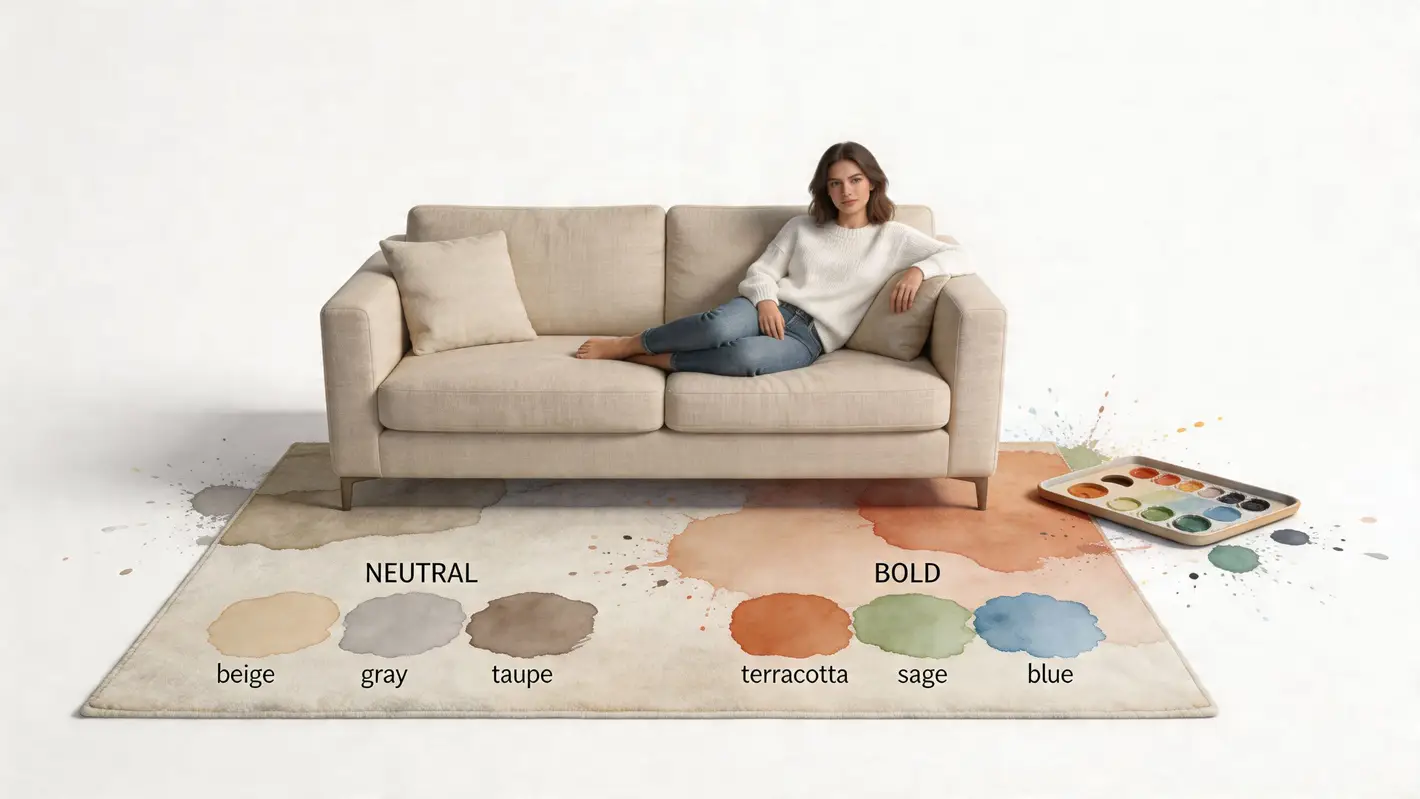
A rug can either lead the palette or echo what's already there. Both approaches work. The better choice depends on how much visual energy the room already has.
Choose whether the rug should whisper or speak
If your sofa, accent chairs, and art already carry strong color or movement, a quieter rug often gives the room balance. If the furnishings are mostly solid and restrained, the rug can bring in pattern, depth, or contrast.
This isn't about strict rules. It's about visual weight.
A few combinations tend to work reliably:
- Neutral furniture plus patterned rug: Good when the room needs life.
- Patterned upholstery plus calmer rug: Good when you want the room to settle.
- Tone-on-tone room plus textured rug: Good when you want subtle richness without obvious pattern.
Match pattern scale to the room
One of the easiest mistakes is choosing a pattern that's fighting the furniture. A very busy rug under heavily patterned upholstery can create noise. A tiny pattern in a large room can disappear.
Look for balance:
- Larger, simpler patterns often read better in open rooms.
- Smaller, more detailed motifs can add character when the rest of the room is quiet.
- Distressed or layered patterns can be forgiving in active households.
Sometimes the right answer isn't on the floor today. In Bay Area Interior Design work, custom solutions matter because homes aren't all built on standard proportions and tastes aren't all alike. If you need a different size, a more precise palette, or a rug that works with custom furniture in specific fabrics, leathers, wood species, or finishes, custom ordering can solve problems off-the-rack choices can't.
For help pulling the whole room together, this guide to the perfect color palette is a useful next step.
Timeless usually beats trendy
A rug doesn't need to be plain to feel lasting. It needs to have enough depth and restraint that you won't tire of it once the novelty wears off.
In practice, the rugs people keep longest are often the ones that feel personal without being loud. They support the room through furniture changes and repainting, and they still look right when the seasons shift.
Practical Rug Advice for Bay Area Homeowners
Bay Area homes ask for some special consideration. A rug that works beautifully inland may behave differently near the coast. A layout that feels generous in a newer suburban home may feel oversized in a narrow San Francisco living room.
After serving Furniture South San Francisco shoppers for generations, we've seen the same local patterns come up again and again.
Coastal homes need practical materials
In places like Pacifica, Daly City, and other fog-touched neighborhoods, air can feel damp even when the room looks bright. In those homes, rugs that are easier to maintain and better matched to daily use tend to be the wiser choice.
Low-profile constructions often make more sense than lush, lofty textures in those settings. They feel cleaner, simpler to care for, and more comfortable year-round.
Older city homes need proportion discipline
A classic Victorian or Edwardian living room can be beautiful, but it often has quirks. Narrow dimensions, fireplaces, built-ins, and angled entries all affect rug placement.
In those rooms, it's smart to measure from the actual seating zone, not from architectural edges alone. A rug should support the furniture arrangement first. The room's trim and charm can stay visible around it.
In older homes, the architecture already has a strong voice. The rug should support that voice, not compete with it.
Smaller spaces need confidence, not hesitation
Apartment living often pushes people toward smaller rugs because they worry about crowding the room. Usually the opposite happens. The smaller rug makes the room feel more fragmented.
A better move is to choose a rug that properly anchors the furniture and lets the room read as one space. If you're comparing constructions, styles, or sizes in person, Cyprus carpets and rugs are one example of the kinds of options people review alongside other living room furnishings.
Bay Area homes are diverse. That means the right rug choice is rarely one-size-fits-all. Local knowledge helps because the room isn't just a floor plan. It's a lived-in place with weather, architecture, habits, and history.
Do Not Forget the Rug Pad
A rug pad isn't an extra. It's part of the rug.
People sometimes spend time choosing the right size, material, and pattern, then place the rug directly on the floor. That shortchanges the investment. Without a pad, the rug can shift, bunch, wear unevenly, and feel thinner underfoot than it should.
Why a rug pad earns its place
A quality pad performs several functions:
- Improves safety: It helps reduce slipping and movement.
- Protects flooring: It creates a buffer between the rug and the surface below.
- Adds comfort: Even a refined low-pile rug feels better with the right support.
- Supports longevity: Less friction usually means better wear over time.
For hard surfaces, grip matters. For carpeting, the concern is usually controlling movement without creating bulk. The right pad depends on what the rug is sitting on, but skipping the pad is almost never the better choice.
Think of it as protection for the investment
A good rug pad helps the rug perform the way you expected when you bought it. It keeps edges calmer, footing more secure, and the overall feel more substantial.
That isn't upselling. It's basic stewardship of a piece you want to keep.
Find Your Forever Rug at Giorgi Bros
The right rug does a lot of work. It anchors the furniture, softens the room, supports how you live, and helps the whole space feel settled. If you approach the decision in the right order, size first, placement second, material third, style last, the process becomes much easier.
That's also how you buy better for the long term.
At Giorgi Bros., we've believed since 1933 that people deserve thoughtful guidance without pressure. Our Non-Commission Sales Staff model means our consultants can focus on fit, proportion, materials, and how a piece will live in your home. That's true whether you're selecting a rug, planning Custom Furniture, or coordinating a larger room with upholstery, wood finishes, and lighting in mind.
A good rug isn't just something to fill the floor. It's one of the investment pieces that makes home feel complete, and when you choose well, it can stay with you through many versions of the room.
Visit Giorgi Bros. Furniture in South San Francisco to explore our showroom, compare materials and styles in person, and get warm, no-pressure guidance from our design experts. If you'd like help with a full room plan, custom order options, or a rug that works with your furniture and flooring, book a Design Consultation and let us help you choose something you'll love living with for years.