
You're standing in the dining room with a tape measure in one hand and a phone full of saved furniture images in the other. The room is open to the living area, the table already anchors the space, and the question isn't whether a cabinet can hold dishes. It's whether an oak china cabinet can look intentional, function every day, and still feel right years from now.
That's the standard a buy-it-for-life piece should meet. A cabinet needs sound construction, thoughtful proportions, and a finish that works with the rest of the home. It also needs to suit the way a Bay Area household lives, with open-plan rooms, changing design preferences, and visible storage that can't hide behind a formal dining-room door.
Giorgi Bros. Furniture has helped South San Francisco homeowners make those decisions since 1933. The family-owned showroom uses a non-commission sales staff and offers no-pressure guidance, so the conversation can stay focused on wood, construction, placement, and long-term value. Custom order services also allow buyers to select wood species, finishes, fabrics, and leathers across a broader home-furnishing plan.
Why an Oak China Cabinet Still Earns Its Place
A dining room often serves several purposes. An oak china cabinet can hold heirloom plates, glassware, serving pieces, books, collected objects, and family photographs, while giving an open-plan room a clear visual anchor. It separates dining and living areas without adding a wall or starting a renovation.
That range of use gives the cabinet lasting value. A lighter oak display cabinet can sit comfortably beside a contemporary dining table. A substantial breakfront can give a larger room the architectural weight it needs. Choose the piece that stores what your household uses and displays what it values.
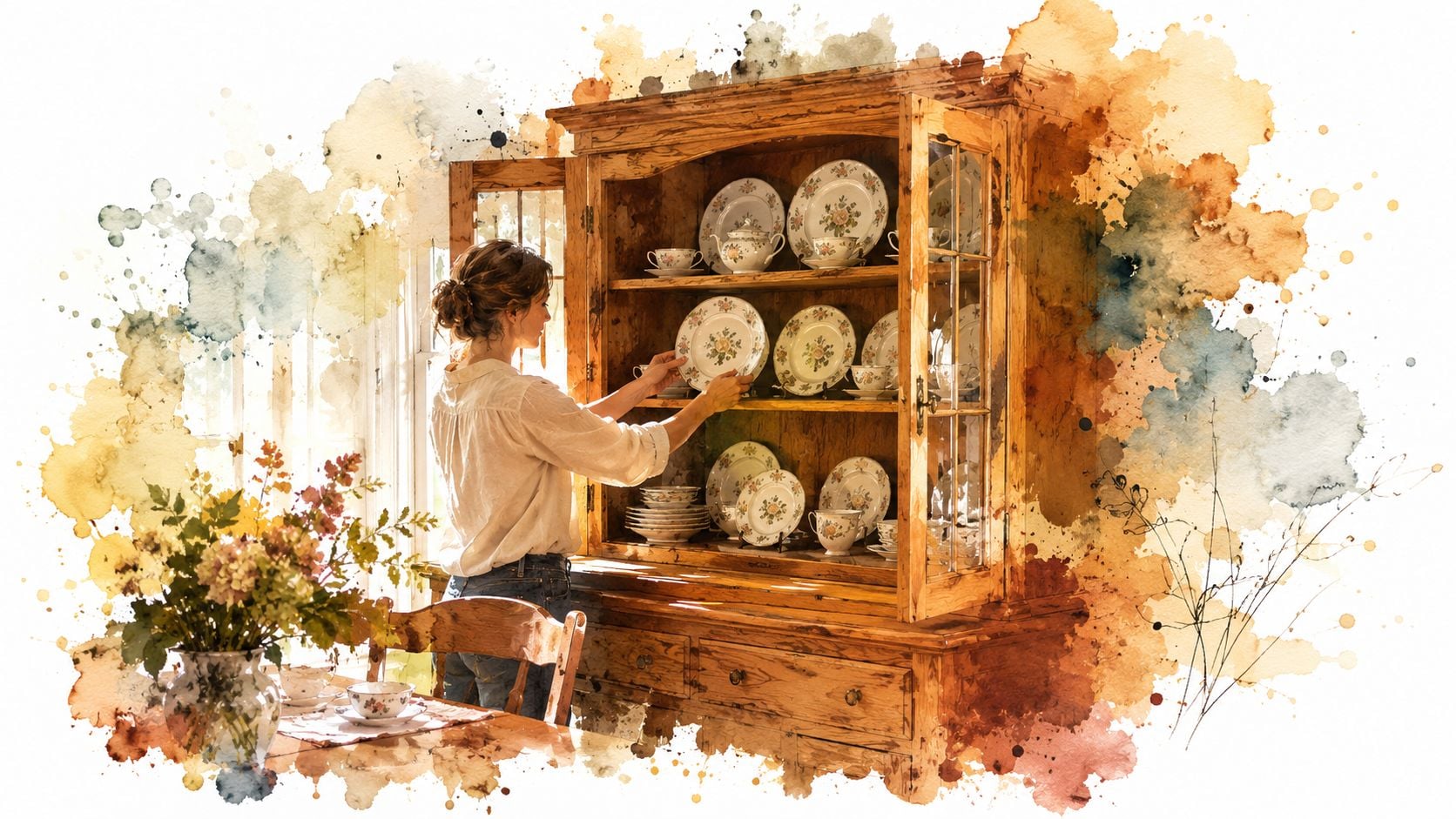
A cabinet should earn its floor space
The form has a long history. China cabinets date to the late 17th century, when European households used them to display imported Japanese porcelain and Chinese equivalents, particularly in England and the Netherlands. By the 18th and 19th centuries, the cabinet had become a standard showcase piece in wealthier homes. Later designs added glass doors, shelves, drawers, and decorative woodwork for both storage and display.
The practical lesson remains clear. Display and storage belong together in this furniture form. A well-designed cabinet performs that job with less ceremony and more flexibility. Its proportions, interior layout, and finish determine whether it feels useful or merely occupies space.
Design consultant's rule: If a visible piece can store useful items, display meaningful objects, and coordinate with nearby furniture, it's working harder than a purely decorative accent.
An oak china cabinet also supports long-term ownership. Buy one durable piece, maintain it, and restyle it as the room changes. That approach reduces the pressure to replace furniture whenever the color palette or decorating direction shifts. It turns a traditional purchase into an investment piece.
At Giorgi Bros. Furniture, the showroom conversation stays practical: choose the right oak, inspect construction, measure the room, set the interior layout, and specify a finish that can live with the home. The right cabinet is rarely the largest or most ornate. It is the one that fits the room, the collection, and the household's future.
Understanding Oak as a Furniture Wood
If your dining room needs one substantial piece that can serve for decades, oak deserves serious consideration. Its visible grain gives a china cabinet texture and presence, while its hardness suits regular use. Light moves across the doors, shelves, and top instead of disappearing into a flat finish, giving the cabinet a clear visual role without requiring ornate decoration.
Red oak and white oak are the two choices shoppers encounter most often. Red oak usually has a stronger grain pattern with warmer pink or reddish undertones. White oak tends to look calmer and more muted, with grain that can appear tighter and more restrained depending on the cut and finish.
Read the grain before choosing the stain
Species sets the starting point, but finish determines much of the final impression. A warm honey stain brings forward oak's traditional character. A lighter natural finish makes the same grain feel more current, while a matte treatment limits the glossy appearance associated with older oak furniture.
Inspect the cabinet in person whenever possible. Online photographs flatten texture and shift color with the lighting. In a showroom, look across the doors, frames, shelves, and top to judge whether the grain reads consistently and whether the finish leaves enough wood character visible.
Oak became common in early 20th-century china cabinets because it was a durable, widely used hardwood with prominent grain. Surviving examples often connect with the Edwardian and Art Nouveau era, roughly 1880 to 1920, as described in this historical reference on oak china cabinets. That history explains oak's association with display furniture. It does not require a traditional-looking cabinet today.
Oak compared with other furniture woods
Cherry usually appears warmer and smoother, developing a more refined tonal transition as it ages. Maple looks cleaner, with less visibly open grain. Walnut offers deeper contrast and a more dramatic presence. Oak occupies a useful middle position, providing strong grain definition without demanding a dark or formal room.
For a cabinet you may refinish or restyle later, prioritize sound wood, stable construction, and a finish that doesn't obscure the grain. Color preferences change. Good proportions and honest materials continue to work.
Oak also has lasting relevance in the furniture market. Its popularity in U.S. furniture and cabinet industries peaked in the early 1990s, when oak represented 30% of the groups displayed at High Point Furniture Market around 1990, according to this USDA analysis of oak's furniture-market role. That history shows how broadly oak served mainstream case goods, including display furniture. Today's case for oak comes from its visible grain, durability, and styling flexibility. Choose it for those qualities, then confirm that the cabinet's wood and finish suit the room you plan to keep for years.
Construction and Quality Features That Matter
A cabinet can look beautiful on the showroom floor and still disappoint if the maker ignored wood movement. Oak absorbs and releases moisture as indoor humidity changes. The movement occurs mainly across the grain, so a wide panel needs room to expand and contract without pushing joints apart.
The practical scale is easy to understand. A 12-inch-wide flat-sawn white oak board can move about 1/4 inch across the grain between dry and humid seasons, while a 36-inch glued-up top can move about 3/4 inch over a year, according to this wood-movement engineering guidance. A red oak 12-inch panel can change roughly 0.29 inches with a 9% moisture swing, as explained in this furniture moisture-content guide.
What careful construction looks like
The cabinet should accommodate movement instead of trying to eliminate it. Useful signs include:
- Floating panels: Door and side panels should sit within frames that allow seasonal movement rather than locking every piece rigidly together.
- Slotted fastener points: Screws and similar attachments may need elongated holes so a top can move without splitting or stressing the case.
- Proper door construction: Framed doors should feel square, close evenly, and maintain consistent reveals around the opening.
- Dovetailed drawers: Drawer boxes with strong corner joinery generally handle repeated use better than lightly stapled or poorly fitted boxes.
- Stable shelves: Shelves should sit level, carry their intended load, and remain removable or adjustable when the design calls for flexibility.
The distinction between solid oak, oak veneer, and mixed-material construction deserves a clear explanation. Solid oak offers substantial refinishing potential, but it also demands careful engineering because wide solid panels move. Veneer uses a thin oak surface over a stable substrate, which can reduce movement in large panels and create a more predictable case. Mixed construction can be entirely sensible when the maker uses each material where it performs best.
Practical rule: Don't ask only whether a cabinet is solid oak. Ask where solid oak is used, where veneer is appropriate, and how every panel is allowed to move.
Moisture content at assembly also affects longevity. Furniture-grade wood is typically assembled near 6% to 8% moisture content for conditioned interiors, and wood equilibrates near 8% moisture content at about 75°F and 55% relative humidity, according to the cited moisture guidance. Rapid swings outside the intended range can contribute to open joints, raised grain, veneered-part delamination, and doors that no longer fit cleanly.
A buyer should inspect the back, drawer interiors, shelf supports, door alignment, and hardware attachment points. Giorgi Bros. Furniture's 50,000-square-foot South San Francisco showroom gives homeowners a place to touch, operate, and inspect display furniture before committing. That hands-on evaluation is especially valuable for an investment piece, because construction details are easier to judge through movement and feel than through a product photograph.
Sizing, Placement, and Proportion in Real Rooms
A china cabinet should belong to the room without forcing the room to revolve around it. Start with the available wall, then check the ceiling height, nearby furniture, and circulation around dining chairs. Depth matters as much as width. A cabinet that technically fits can still make daily movement uncomfortable.
Traditional breakfronts and hutch-style cabinets bring formal presence. They suit dining rooms with architectural separation, generous wall height, and a clear need for display. Layered tops, a strong center, and deeper storage help a larger room feel finished.
Modern oak display cabinets take a lighter approach. Their cleaner profiles work well in open-plan homes where the cabinet can be seen from several directions. They define the dining area while keeping the visual connection between the table and living room open.
Choose the shape for the room's job
| Cabinet direction | Best fit | Main advantage | Watch carefully |
|---|---|---|---|
| Traditional breakfront | Formal dining room | Strong architectural presence and generous display | Visual weight and door clearance |
| Hutch-style cabinet | Dining room needing upper display and lower storage | Clear separation between showing and storing | Overall height and ceiling relationship |
| Modern oak display cabinet | Open-plan dining or living area | Lighter profile and flexible placement | Visibility of the back and side panels |
| Narrow vertical cabinet | Limited wall area | Uses height without spreading across the room | Stability and access to upper shelves |
Measure the delivery route, not only the final wall. Doorways, turns, stair access, and elevator dimensions can affect whether the cabinet reaches the room safely. Once inside, set it where the doors open without striking chairs, tables, or walkways.
Leave space behind the cabinet for airflow. Oak furniture care guidance recommends approximately 25 mm of space between the wall and the back of the piece to support airflow and stability, as noted earlier. Keep the cabinet away from direct sunlight, radiators, and heating vents. Uneven heat can stress the wood, while strong sunlight can fade the finish.
A quick showroom measurement reference
Bring these details to a Design Consultation:
- Wall width and ceiling height.
- Distance from the cabinet wall to the dining table.
- Chair clearance with chairs pulled out.
- Doorway and hallway measurements.
- Location of vents, radiators, and strong sunlight.
- Desired storage for tall pieces, plates, glassware, or books.
A useful showroom consultation should account for both the cabinet and the life around it. Measure with chairs pulled out, doors fully open, and the delivery path clear.
Proportion is what makes the piece look settled in the room, not decoration. When the scale, clearance, and placement work together, an oak china cabinet feels calm, useful, and built to stay.
Styling and Matching With Your Dining or Living Room
An oak china cabinet should serve the home, not become a museum case for objects nobody uses. Start with pieces that have meaning or regular use, then leave enough open space for the oak grain and glass to remain visible. A restrained display usually has more presence than shelves packed from edge to edge.
Warm honey oak pairs naturally with traditional dining tables, textured rugs, and rooms with golden or earthy undertones. A matte natural finish sits beside neutral upholstery and contemporary lighting. Choose a lighter wash when the cabinet is near pale walls or light flooring and the open-plan room needs to retain brightness.
Build a coordinated material story
Rather than matching every wood surface exactly, repeat a material or undertone with intention. An oak cabinet can relate to a table through similar grain direction, connect with flooring through shared warmth, or stand against darker accent furniture as the room's natural-texture element. The goal is a deliberate relationship, not a showroom set.
Customization makes that relationship easier to establish before the cabinet is built. Giorgi Bros. Furniture offers custom orders through Simply Amish, including choices of wood species and finishes. Specify the interior configuration, hardware character, and balance between glass and wood around the room's existing furniture and the way your household uses the cabinet.
Give the glass something to say
Build the display with varied heights, textures, and purpose:
- Heirloom pieces: Plates, serving bowls, and stemware carry family history without needing explanation.
- Everyday objects: Useful dishes keep the cabinet connected to daily life.
- Books and collected objects: These make the arrangement feel personal rather than staged.
- Open breathing room: Clear areas let the oak grain and glass doors remain part of the composition.
The interior should support the objects rather than compete with them. Adjustable shelving accommodates changing collections, and a darker or contrasting back can add depth behind light-colored ceramics. Keep the strongest pieces at eye level, group smaller objects instead of scattering them, and avoid filling every shelf just because space remains.
A cabinet in the living room can take on a different role. Use it for books, artwork, baskets, and small collections instead of treating it as dining-room storage. For a Bay Area Interior Design plan, coordinate the finish with a dining table, occasional tables, or other Custom Furniture. That repetition gives the home a considered identity while preserving enough variation to keep each room from feeling staged.
Customization, Ordering, and Buy-It-For-Life Value
Customization is a practical design tool. It allows a cabinet to answer the room's actual requirements instead of forcing the household to accept whatever combination of height, depth, stain, hardware, and shelving happens to be available on the floor.
A useful custom-order conversation starts with function. The household should identify what the cabinet must store, what should remain visible, and how often the doors and drawers will be used. From there, the design expert can help narrow the choices.
Make decisions in the right order
- Choose the wood species. Oak establishes the grain character and general visual direction. Red oak and white oak can produce different impressions under the same finish.
- Select the finish tone. A sample should be viewed beside the dining table, flooring, and wall color. Finish names alone rarely tell the full story.
- Set the interior layout. Adjustable shelves, plate display areas, drawers, and closed lower storage each solve different problems.
- Specify the hardware. Knobs and pulls should support the cabinet's scale and the room's overall language.
- Review the glass and doors. Clear display, divided panels, and different door proportions create distinct levels of formality.
- Confirm the final dimensions. A beautiful cabinet that blocks circulation remains the wrong cabinet.
A multi-step finishing process is standard for furniture-quality work, and finish options can include natural stains, hand-glazed treatments, hand-inked effects, and hand-distressed surfaces, as described in this cabinet-maker finish guide. The point isn't to select the most elaborate finish. It's to select one that suits the room and can be lived with.
Why longevity changes the value calculation
Buying once and buying well can reduce replacement, disposal, and redesign decisions over the life of a home. A durable cabinet can also shift roles. It might begin in the dining room, move to an open-plan living area, and later become storage in another home.
Family ownership provides a useful parallel. Research cited in 2026 reports that 83% of family-owned businesses have operated for 20 years or more, 32% have lasted 50 to 100 years, and 14% have surpassed 100 years, according to this family-business longevity summary. Separate research notes that only about 30% of family companies reach a second generation, around 13% reach a third, and roughly 3% reach a fourth generation or beyond, as discussed by INSEAD's research on family-firm longevity.
Giorgi Bros. Furniture's South San Francisco operation has served families since 1933. Its non-commission consultants can help buyers compare an in-stock option with a custom order without turning the conversation into a pressure tactic. Financing options are available for households that want to plan a quality purchase responsibly, but the recommendation should remain tied to fit, construction, and intended use.
Care, Maintenance, and Common Questions
An oak china cabinet lasts longer when its care stays simple and consistent. Dust it with a soft cloth, wipe spills promptly, and avoid harsh chemical cleaners that can dull or strip the finish. Keep the cabinet away from direct sunlight, radiators, vents, and other heat sources. Uneven exposure can fade the surface and place stress on the wood.
Use this routine to protect both appearance and construction:
- Seasonal inspection: Check door alignment, shelf seating, and hardware as indoor conditions change.
- Gentle cleaning: Match the cleaning product to the cabinet's specific finish. If the finish is unknown, ask before applying polish.
- Periodic polishing: Guidance for new furniture recommends waxing or oil polishing at roughly three-month intervals, as noted earlier in the care recommendation. Follow the finish manufacturer's instructions rather than applying product by habit.
- Airflow protection: Leave the recommended space behind the cabinet. Pushing it tightly against the wall can restrict airflow and complicate cleaning.
- Light control: Use room planning, curtains, or blinds to limit direct sun on the doors, sides, and top.
Common buyer questions
Can an oak cabinet coordinate with existing furniture? Yes. Match the wood's undertone and repeat one material instead of forcing every piece to use identical oak. A Design Consultant can compare samples with the dining table, flooring, and nearby upholstery.
What happens during delivery and setup? The plan should confirm access points, final placement, door movement, shelf position, and wall clearance before delivery. Those details prevent a cabinet from arriving at a location where it cannot operate properly.
Can an oak china cabinet hold more than china? Certainly. Books, glassware, serving pieces, artwork, and collected objects can all work. Vary the height of displayed items, leave breathing room, and avoid packing every shelf.
Should a buyer choose solid oak or veneer? Judge the panel size, construction method, refinishing goals, and budget together. Solid oak can offer strong refinishing potential. Well-designed veneer can provide stability across broad panels. Construction matters more than the label alone.
Giorgi Bros. Furniture's South San Francisco showroom supports whole-home planning with dining furniture, Custom Furniture, Amish Furniture, Premium Mattresses, and other furnishings. Its non-commission Design Consultants can review maintenance needs without turning one purchase into a rushed package.
Visit the Giorgi Bros. Furniture showroom in South San Francisco to inspect oak grain, door movement, shelving, and finishes in person. You can also book a Design Consultation to compare an in-stock cabinet with custom wood species, interior layouts, and finish options suited to the room for years to come.