
A family sectional has to do more than look good in a staged room. It has to absorb movie-night sprawl, homework, pet traffic, dropped snacks, visiting relatives, and the daily scramble from one room to the next. The right piece becomes the place where a household gathers. The wrong one develops sagging seats, drifting connectors, or upholstery that looks tired long before the family is ready to replace it.
The best sectionals for families are therefore chosen from the inside out. Frame construction, cushion density, upholstery durability, configuration, and repairability matter more than a fashionable silhouette. Quality furniture costs less over its useful life when it stays comfortable, useful, and attractive through changing family needs. That buy-it-for-life approach also reduces the waste created by replacing disposable furniture too soon.
Why the Sectional Is the Heart of the Family Home
By dinner, the family room is already working overtime. One child finishes homework on the arm, another stretches across the chaise, a parent answers messages from the corner, and the dog claims the warmest cushion. When guests arrive, the same sectional supports conversation without forcing the household to redesign the room.
That flexibility makes the sectional a practical family-room format. For households sharing space for television, gaming, homework, pets, and visitors, one coordinated seating system keeps people together while giving each person room to settle in. The sectional buying guide offers a useful overview of the decisions that shape fit and function.
A family sectional should be judged by what happens after the showroom shine wears off. Foam density determines whether cushions keep their support under daily use. Joinery affects how well the frame handles repeated sitting, shifting, and reclining. Rub counts indicate how much friction upholstery can withstand before the surface shows wear. These construction details deserve more attention than a fashionable silhouette.
A family hub deserves investment-piece thinking
Buy for the years ahead. Children grow, rooms change, entertaining habits shift, and upholstery records every snack, nap, and muddy-pawed arrival. A well-built frame, resilient cushions, durable fabric, and a recoverable design give the sectional a better chance of staying useful through those changes.
The form itself has staying power. Furniture historians trace sectional-sofa origins to the early 1800s, with surviving examples in Virginia dated from 1800 to 1860. Its longevity comes from a straightforward solution: several people can share comfortable seating within one coordinated system.
Quality also supports sustainability. A sectional that remains supportive and repairable avoids the waste of replacing a disposable piece after a short service life. Choose construction you can live with, maintain, and recover instead of shopping for the lowest immediate price.
Giorgi Bros. Furniture has served South San Francisco for more than 90 years, with roots dating to 1933. That family-owned history supports a buying process centered on no-pressure guidance. A sectional should earn its place through sound construction, useful design, and comfort that holds up to family life.
Planning Your Layout and Sizing for Real Life
The family is carrying laundry through the room, someone is opening a cabinet, and another person is stretching out for a movie. If the sectional blocks those routines, its attractive shape will not matter. Plan the room first, then choose the configuration and dimensions that support daily movement.
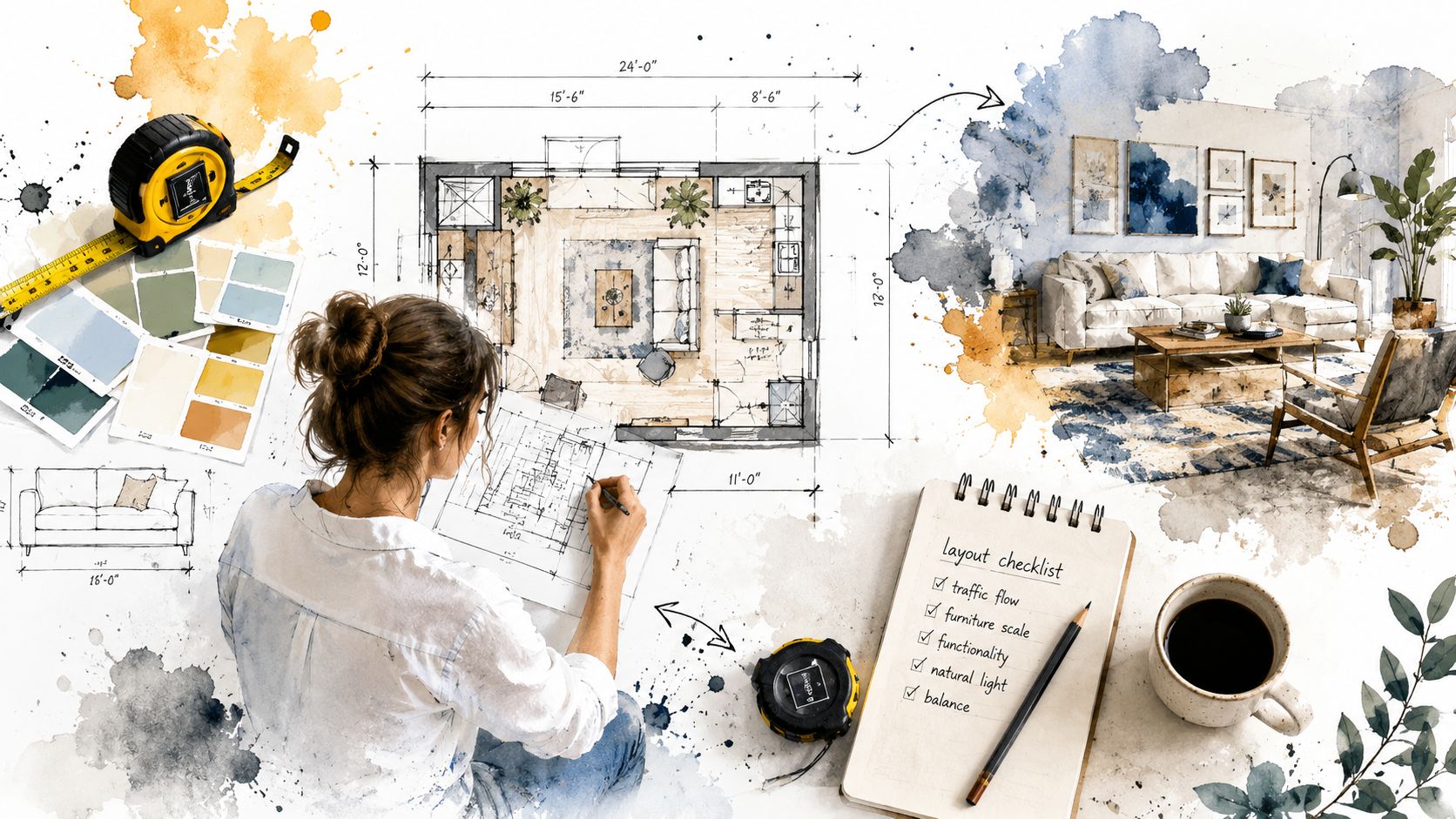
Measure the room and the route
Record the room's usable dimensions and every path the household uses. Mark door swings, cabinet openings, vents, stairs, and the route between the seating area and adjacent rooms. A sectional can fit the floor yet fail at delivery if a component cannot pass through the entryway or turn through a hallway.
Use painter's tape to outline the complete footprint on the floor. Include the back, arms, chaise, and any extension beyond the main sofa. Walk around the taped shape at different times of day. Carry a laundry basket through the traffic lane, and open doors and drawers to confirm they clear the furniture.
Practical rule: A sectional should support family movement, not force everyone to walk around it.
The living room furniture layout guide provides further direction on arranging seating, tables, and circulation.
Choose the shape that matches the household
An L-shaped sectional suits a room where one wall and an adjoining wall can define the seating area. It creates a clear zone for conversation or television viewing while preserving a primary walkway. For many family rooms, it offers the best balance between seating and usable floor space.
A U-shaped sectional forms a more enclosed lounging area, with seats facing inward from several sides. Choose it only when there is enough open floor around the perimeter for people to pass comfortably. It works well for households that want group seating rather than a single side oriented toward the television.
A chaise configuration sits between those options. It gives one person room to stretch out without using the full footprint of a U shape. Check the chaise side against the room's traffic pattern. If the chaise occupies the passage everyone uses, daily convenience will suffer.
Treat seat depth as a comfort decision
Seat depth affects posture as much as relaxation. Deeper cushions can suit taller family members and movie-night lounging, while shorter users may struggle to sit upright if their feet do not reach the floor. A family sectional should accommodate the smallest regular user as well as the tallest.
Test several depths together. Sit upright, recline, and stand without pushing against the arms. Ask whether children can sit securely and whether adults can change position without sliding forward. Dimensions are buying decisions, not minor style details.
Plan for the long term, too. A generous layout can still feel cramped once side tables, toys, baskets, and walking space enter the room. Leave enough clearance for real family routines rather than sizing the sectional to an empty floor plan.
The Hidden Engineering of Long-Lasting Comfort
A family sectional earns long-term value through parts you cannot see. Before judging its silhouette, inspect the cushion core, frame joints, suspension, and repair options. These details determine whether the favorite seat stays supportive or develops a dip that reshapes daily routines. For a broader look at long-lasting furniture construction, use the same standard: materials and joinery must match the demands of constant household use.
Foam density determines recovery
Foam density measures how much material fills a given volume. Denser foam generally provides firmer support and resists permanent impressions because more material supports the cushion structure.
Technical guidance identifies 1.8 to 2.0 pounds per cubic foot as suitable for everyday use and recommends 2.3 to 2.5 or more pounds per cubic foot for high-traffic, all-day seating. Choose the higher range for the family's most-used seats, as explained in this foam-density guidance.
Lower-density foam can feel comfortable at first, then develop uneven impressions and soft spots after repeated sitting. Higher-density foam helps maintain a flatter seat plane and a more consistent feel across the sectional. Ask whether the stated density applies to the seat foam itself, not only to a surrounding fiber wrap. That distinction matters.
Frame and suspension carry the load
The frame gives every cushion a stable platform. Kiln-dried hardwood helps reduce warping, twisting, and cracking because controlled drying removes excess moisture before assembly. Reinforced joints, including mortise-and-tenon construction where appropriate, keep frame components aligned through repeated sitting, standing, and shifting.
Quality construction may pair kiln-dried hardwood with 8-way hand-tied spring suspension. Each spring is tied in eight directions, distributing support across the seat instead of concentrating pressure at isolated points. The construction details described in this upholstery construction document illustrate why suspension is more than a luxury specification. It helps the seat remain composed under daily use.
Ask these questions before ordering:
- Seat core: What foam density is used in the main cushions?
- Frame material: Is the frame kiln-dried hardwood, and which joints reinforce it?
- Suspension: Does the base use a durable spring system or another documented support method?
- Serviceability: Can cushion interiors, connectors, or covers be repaired or replaced?
A sectional built for years earns its value through the materials and construction hidden beneath the upholstery.
Choosing Kid-Proof and Pet-Friendly Fabrics
Upholstery should be selected as a performance specification, not as a last-minute color decision. A family sectional faces repeated abrasion at the chaise end, corner seat, and primary entry points. It also faces spills, pet claws, toys, and the friction created when people shift positions throughout the day.
Use double rubs as a durability filter
A double rub measures resistance to surface wear. Independent fabric guidance places everyday residential seating at about 15,000 double rubs as a starting point and recommends 30,000 or more double rubs for a main family seat. Those figures and the explanation of abrasion resistance are covered in this upholstery fabric guidance.
The target doesn't make a fabric indestructible. It gives shoppers a useful way to compare options before falling in love with a texture. Higher abrasion performance generally supports slower fuzzing, fewer visible wear paths, and better appearance retention in high-contact areas.
Compare practical upholstery categories
Tight-weave performance fabrics are the strongest general recommendation for households with children and pets. Their compact construction offers fewer loose loops for claws and toys to catch, while performance treatments can make spot cleanup more manageable. Families should still request the fabric's cleaning code and care instructions before ordering.
Microfiber favors practicality over trend appeal. Its dense surface can resist snagging and often handles routine spot cleaning well, which makes it useful for homes where the sectional functions as the daily headquarters.
Premium leather offers a different kind of durability. It can be wiped more easily than many textiles and may develop a patina as it ages. Families should inspect the leather grade and understand that sharp objects can still mark the surface. A natural change in tone can look intentional, while a deep scratch remains a real defect.
Loose decorative weaves demand more caution. Open textures can catch claws, collect debris, and show damage quickly. If a family loves that look, it belongs in a lower-contact room rather than on the primary family sectional.
Color and texture also matter. Heathered, patterned, or subtly varied surfaces can disguise minor marks better than a completely uniform light tone. That isn't a substitute for cleanability, but it makes everyday wear less visually dominant. For households that need extra protection during especially messy periods, a practical resource on pet-proof sofa covers can complement the underlying upholstery choice. More fabric selection guidance is available through pet-friendly furniture fabrics.
The Case for Custom Orders Over Floor Stock
Floor stock earns its place in the showroom because families can test it immediately. It also creates pressure to accept the closest available match. The color may work while the chaise faces the wrong direction, the length may fit while the seat depth does not, or the upholstery may look appealing around a frame and cushion package unsuited to heavy daily use.
A custom order begins with the room, the household, and the construction required for years of use. Families can choose fabrics, leathers, wood species, and finishes, then set dimensions around a difficult wall, preserve a busy walkway, or balance the sectional with existing architectural features. Those choices matter more than matching a display model on the same day.

Match the specifications to the household
Customization earns its cost when it improves daily performance. Specify upholstery suited to the household, choose cushion construction that supports repeated use, and set a configuration that keeps a high-traffic lane open. Ask for the frame joinery, foam density, suspension, and expected rub count before approving the order. These details determine whether the sectional remains supportive and presentable after years of family use.
A custom order also lets the room's wood details and finish work together. Coordinating exposed wood or an accompanying occasional piece can remain useful through decorating changes. The goal is a sectional built around the home's architecture and routine, not a predetermined package that forces the room to adjust.
Giorgi Bros. Furniture presents custom upholstered sofa options that can help families review upholstery and configuration choices in one place.
Remove pressure from the decision
A non-commission environment gives families room to ask direct questions about fit, construction, upholstery, and comfort without being rushed. Take the time to compare specifications, confirm care requirements, and decide whether the proposed materials suit children, pets, and daily lounging.
The right question is not whether a floor model looks appealing today. It is whether the finished sectional will still feel intentional after children grow, rooms change, and routines evolve. A custom order takes longer to specify, but it can prevent years of compromise and keep durable materials in use longer.
How to Test for Quality in the Showroom
A 50,000-square-foot showroom gives shoppers room to compare construction and comfort in person. A sectional should be tested like a long-term tool, not admired like a sculpture.
Follow a physical inspection
- Sit in every main position. Test the corner, center, chaise, and outer edge. Each place should provide stable support without an abrupt change in height or firmness.
- Check cushion recovery. Stand up after sitting for several minutes and look for how the cushion regains its shape. Ask what foam density supports the seat.
- Lift a corner carefully. A substantial, well-supported frame often feels more stable than a light structure that flexes excessively. The test isn't about choosing the heaviest sofa. It is about noticing whether the frame feels composed.
- Listen at the edge. Sit on the front edge and shift naturally. Unwanted spring noise or excessive movement deserves a direct question.
- Run a hand along seams and joins. Consistent stitching, even welting, aligned panels, and secure connections indicate careful upholstery work.
Children and shorter adults should test the sectional too. A deep seat can delight a tall lounger while leaving another family member unsupported. South San Francisco shoppers can touch, sit on, and compare different cushion constructions before committing.
Investing in Quality for the Long Haul
A buy-it-for-life sectional rests on three decisions: a stable frame, resilient foam, and upholstery suited to actual family use. Those choices support comfort, reduce premature replacement, and keep a large piece of furniture useful through changing household stages.
Families can also protect that investment with sensible care. A practical guide to how to clean a sectional couch can help owners establish an appropriate maintenance routine without treating the sectional as delicate museum furniture.
Giorgi Bros. Furniture's 90-plus-year history, family-owned structure, custom order services, non-commission Consultants, and financing options are available for shoppers evaluating quality furniture in South San Francisco. The same showroom also offers Amish Furniture, Custom Furniture, Premium Mattresses, and whole-room guidance for households planning beyond one purchase.
Visit Giorgi Bros. Furniture in South San Francisco to test sectional comfort, compare upholstery, and discuss frame and cushion construction with non-commission Design Experts. Families can also book a Design Consultation to specify fabrics, leathers, wood species, finishes, and a layout built for long-term use.