
A room can be well furnished and still feel unfinished. The sofa is right. The rug works. The lighting is pleasant. Yet the space doesn't quite catch the eye or hold the light the way it should. In many homes, the missing piece is a mirror with enough presence to do more than reflect. It needs to shape the room.
That's where Uttermost mirrors gold often enter the conversation. A gold mirror can warm a room, bounce light into darker corners, and add the kind of polish that makes everything around it look more intentional. Done well, it feels settled rather than flashy.
For Bay Area homeowners making long-term choices, that distinction matters. Families who've furnished homes in South San Francisco since 1933 have seen the same pattern again and again. Quick décor purchases come and go. Well-made mirrors stay, adapt, and often work through more than one redesign. The smartest choice is rarely the loudest one. It's the piece that still looks right years later.
Table of Contents
- The Finishing Touch Your Home is Missing
- Why a Quality Gold Mirror Is a Lifetime Investment
- Decoding Gold Finishes From Antique to Champagne
- The Art of Scale and Placement for Maximum Impact
- Styling Your Gold Mirror in Any Room
- Find Your Perfect Fit at Giorgi Bros Furniture
The Finishing Touch Your Home is Missing
Many rooms don't need more furniture. They need a better focal point. A gold mirror solves a practical problem and a visual one at the same time. It reflects light, adds depth, and gives the wall a finished look without making the room feel crowded.
That's especially helpful in spaces that feel flat. A dining room with one long blank wall. An entry that needs brightness. A bedroom corner that looks empty no matter what chair or plant gets placed there. A mirror gives those spots structure.
Why gold works when other finishes fall short
Gold has warmth. That's the simplest way to say it. Black frames sharpen a room. Silver cools it down. Gold softens hard edges and brings a little glow to wood, upholstery, and painted walls.
It also bridges styles well. A gold mirror can sit comfortably with traditional furniture, transitional upholstery, or cleaner contemporary lines. The finish changes the mood, but the basic idea stays the same.
A good mirror doesn't just fill wall space. It helps the room feel brighter, taller, and more complete.
Readers often get stuck on whether a mirror counts as decoration or function. The answer is both. That's why it's worth choosing carefully. The same logic appears in other home decisions too. Homeowners weighing custom details elsewhere may find it useful to compare custom vs store-bought blinds, because the broader lesson is the same. A finishing element changes how the whole room performs.
For homes with bronze, iron, or brass details already in place, it also helps to understand how metal tones interact. This guide to metal accents in the home gives a useful foundation for choosing a gold mirror that feels integrated instead of random.
Why a Quality Gold Mirror Is a Lifetime Investment
A quality mirror earns its place differently than fast décor. It doesn't depend on novelty. It brings craftsmanship, utility, and enough visual weight to keep working as the room changes around it.
That matters with Uttermost mirrors gold, because the category isn't treated as a one-off accent. Product details across the line show a mature, long-standing approach to decorative mirrors, including metal frame construction and bevels described as 1 inch or 1 1/4 inch, which points to long-term residential use rather than disposable styling, as described in the Uttermost Sutton Aged Gold Vanity Mirror listing.
What separates quality from decoration
A well-made gold mirror usually shows its value in quiet ways.
- Frame substance: Metal frames tend to feel more settled and architectural than lightweight alternatives.
- Glass detail: A beveled edge adds depth and refinement. It catches light differently than a flat plain edge.
- Finish character: An aged or antiqued surface generally hides minor wear better than a finish that looks too sharp or overly bright.
Those details don't just affect appearance on day one. They influence how the mirror ages in a family home.
Why longevity matters
People often think of sustainability as a matter of materials alone. Durability matters just as much. A mirror chosen once, hung well, and kept for years creates less waste than a cycle of replacements that never quite feel right. Homeowners interested in that long-view approach may appreciate these tips for homeowners on eco-friendly design, especially when the goal is buying fewer, better things.
Practical rule: If a mirror has enough quality to move from one home, one room, or one redesign to the next, it's usually a better investment than a cheaper piece that only works in one moment.
There's also a financial side to this. Investment pieces often cost more up front, but they don't ask to be replaced as often. That buy-it-for-life mindset has guided furniture choices for generations because it respects both the home and the budget over time. For readers who want a deeper look at that philosophy, the case for quality craftsmanship is worth reading.
Decoding Gold Finishes From Antique to Champagne

Gold isn't one color. That's where many shoppers get tripped up. They picture a bright yellow metallic finish, decide it's too much, and move on. In reality, gold mirrors come in a broad range of expressions.
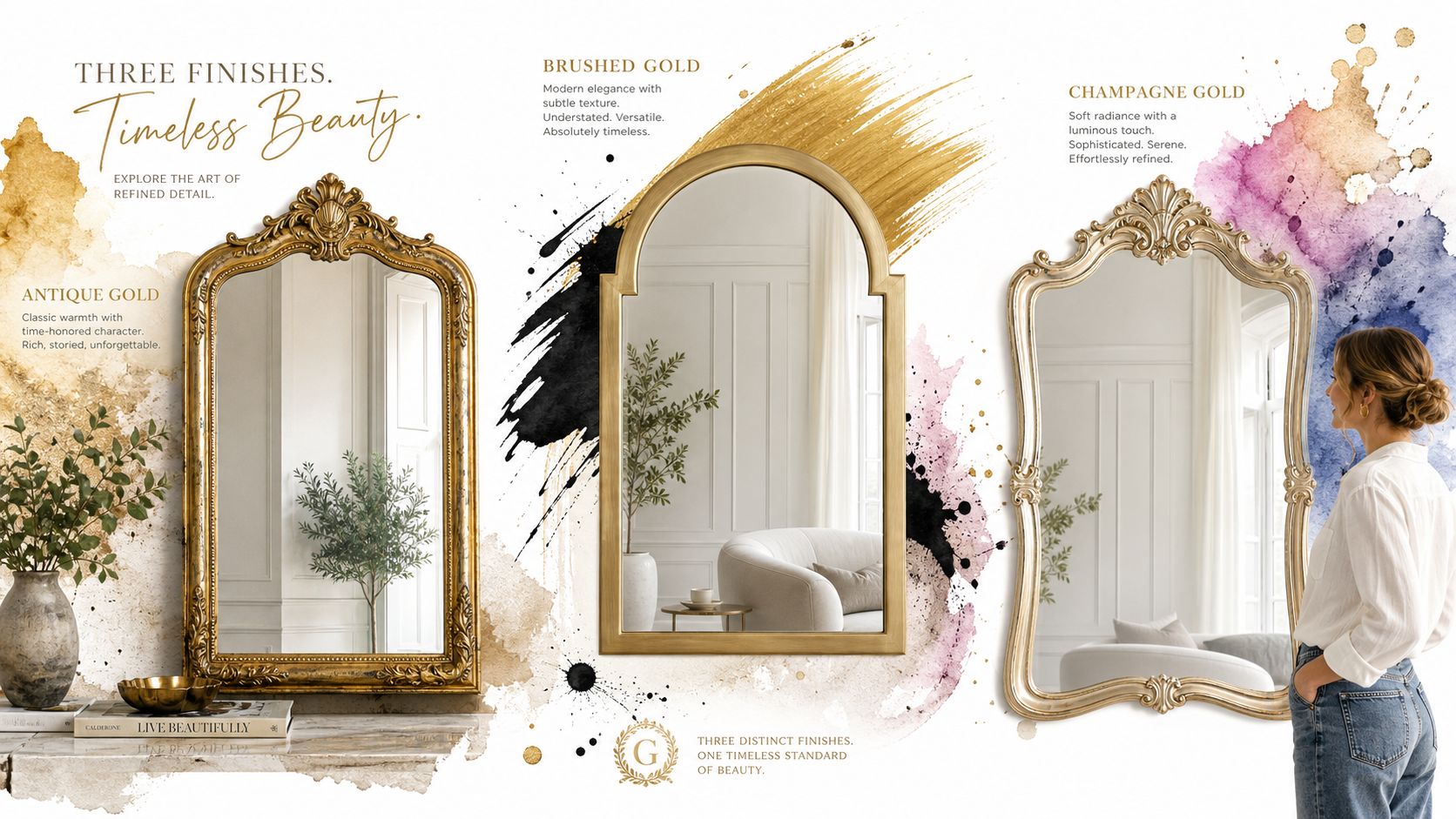
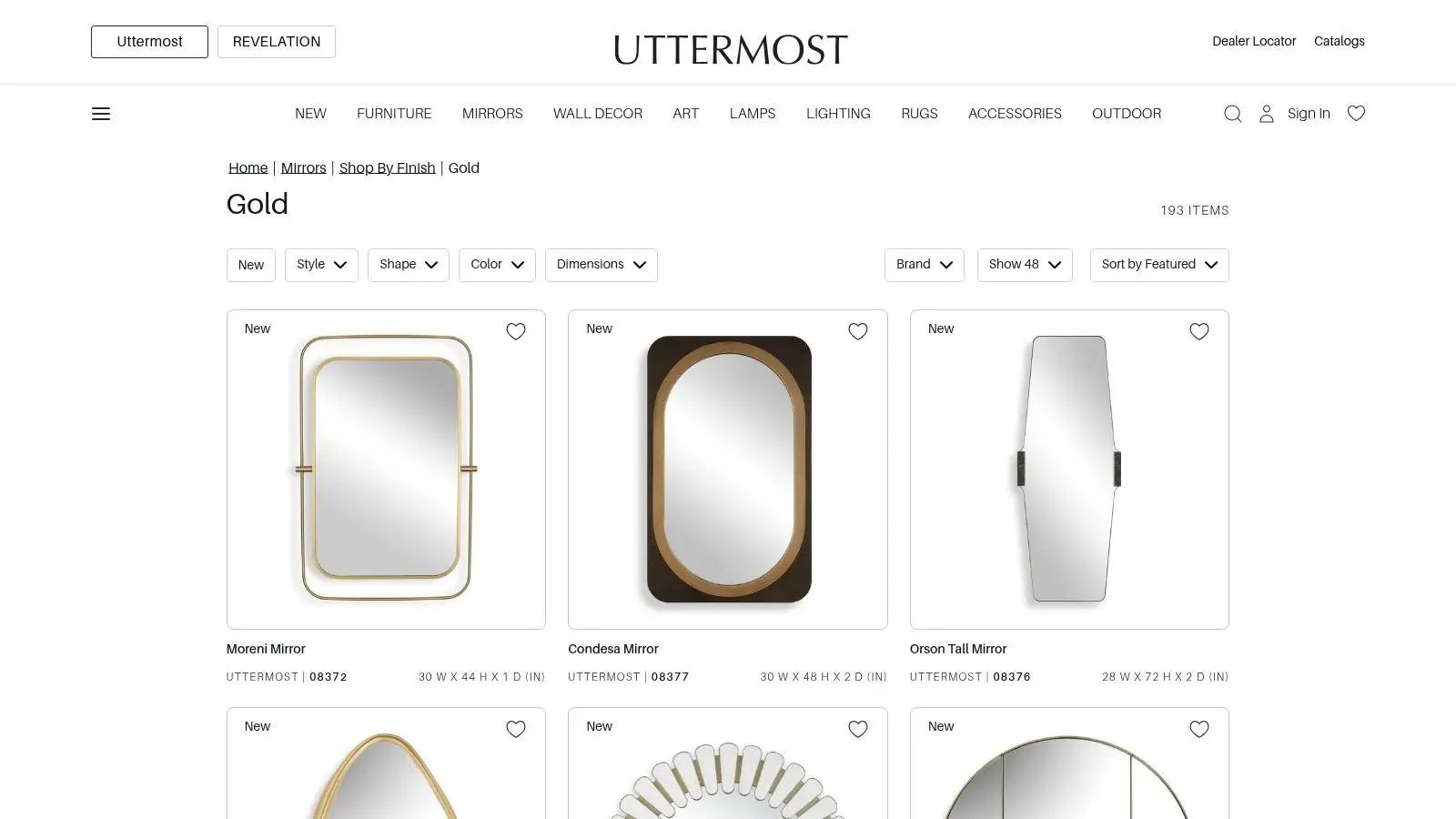
Uttermost's own collection shows that range clearly, with a dedicated gold-finish grouping that includes aged gold, antique gold, lightly antiqued gold leaf, and plated gold-copper blends, which suggests a sustained design language rather than a passing finish idea, as seen in the brand's Gold Finish mirror collection.
How to read the language of gold
A finish name usually tells the shopper two things. First, how bright the surface will look. Second, how formal or relaxed the mirror will feel.
Antique gold tends to look softened. It has a sense of age and pairs well with wood tones, layered textiles, and rooms that lean traditional or collected.
Aged gold usually feels slightly deeper and quieter. It often works beautifully in transitional rooms where the furniture isn't ornate, but the space still needs warmth.
Lightly antiqued gold leaf has more texture. It can feel elegant without being stiff, especially in dining rooms, powder rooms, and entryways.
Plated gold-copper blends often read cleaner and more contemporary. They bring shimmer, but with a smoother, more deliberate edge.
Antique gold has a quiet whisper of history. A smoother plated finish brings a cleaner gleam.
A simple finish guide
| Finish feel | Best for | Overall mood |
|---|---|---|
| Soft and aged | Traditional rooms, layered spaces | Relaxed, established |
| Warm and muted | Transitional interiors | Balanced, welcoming |
| Textural and leafed | Formal accents, refined spaces | Elegant, decorative |
| Cleaner and brighter | Contemporary or tailored rooms | Crisp, polished |
One helpful shortcut is to match the mirror's finish to the room's personality, not necessarily to every metal in it. A room with black iron lighting can still handle a gold mirror if the frame has enough patina. A bedroom with upholstered pieces and warm wood often benefits from a quieter gold rather than a highly reflective one.
For readers drawn to a softer end of the spectrum, this champagne-finished round mirror example shows how gold can lean subtle rather than bold.
The Art of Scale and Placement for Maximum Impact
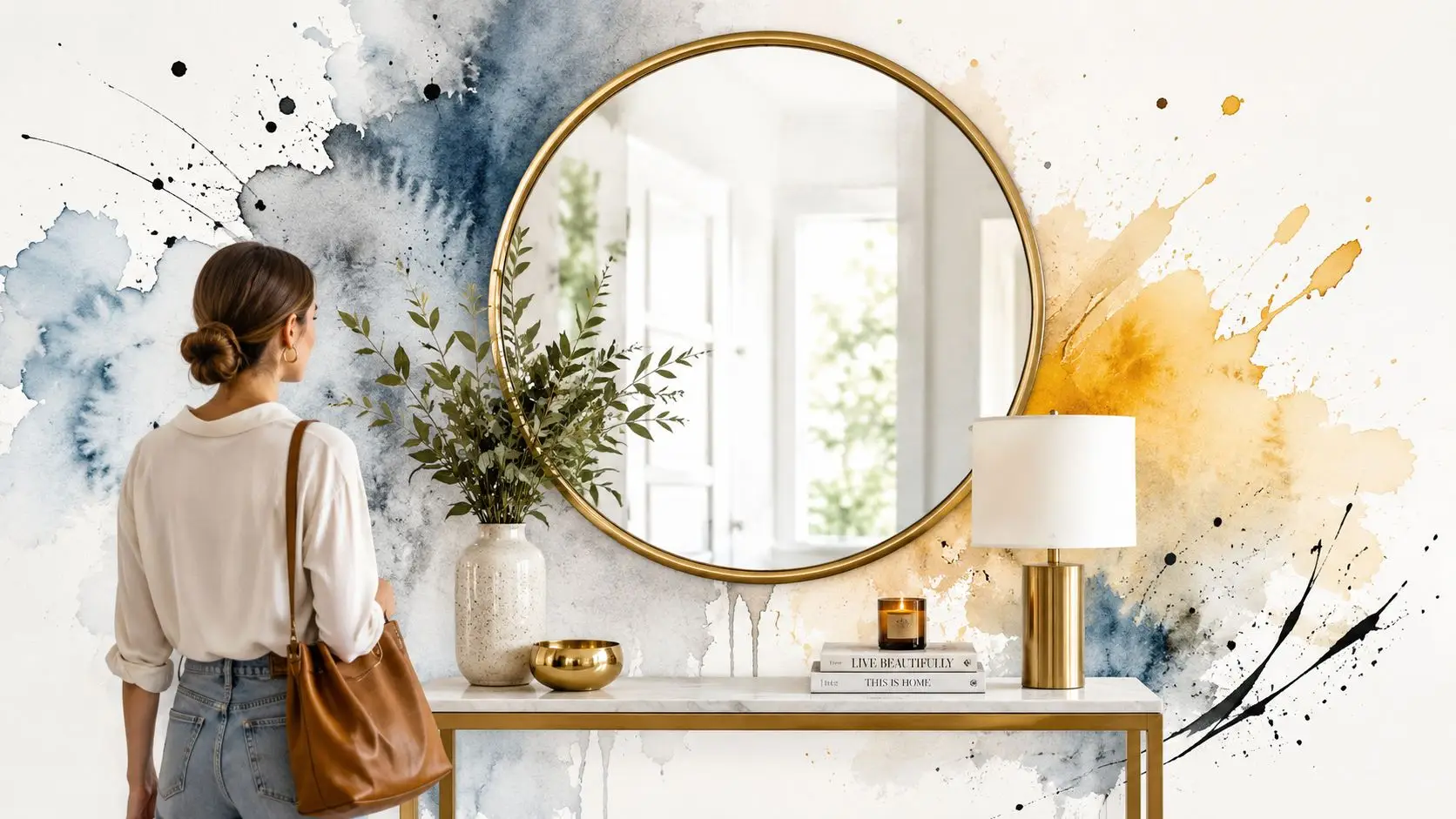
A beautiful mirror in the wrong size won't help the room. Scale decides whether the piece feels confident or awkward. That's why placement should be considered before finish, not after.
Large-format mirrors can do heavy lifting in a room. The Edmonton Gold Floor Mirror is listed at 76 inches high, 28 inches wide, and 5 inches deep, and that kind of vertical scale places it in the statement-mirror category, where height can increase the sense of ceiling height. Its 5-inch depth also means more projection from the wall, which affects circulation and anchor-point decisions, as noted in the product dimension reference for large-format Uttermost mirrors.
When a mirror should whisper and when it should lead
Over a console, sideboard, or sofa, the mirror should usually relate to the furniture beneath it. If the frame is too small, it looks like an afterthought. If it's too large, it dominates without purpose.
A floor mirror plays by different rules. It can anchor an empty corner, fill a vertical gap, and give the eye somewhere to rest in a room with many horizontal lines.
A few practical guidelines help:
- Above a console: Keep the mirror visually centered so the arrangement feels stable.
- In an entryway: Let it reflect light or a pleasing view, not clutter or a crowded passage.
- As a floor mirror: Check door swing, traffic flow, and how far the frame projects into the room.
The best placement often comes down to what the mirror reflects. A strong reflection doubles the beauty. A poor one doubles the problem.
Placement mistakes worth avoiding
One common mistake is hanging a mirror too high. Another is ignoring what people will see in it while seated. A living room mirror should still make sense from the sofa, not only when standing.
Some homeowners also benefit from broader room-harmony guidance before choosing the wall. For that, Colorado Art Services' mirror placement advice offers a thoughtful perspective on how reflection influences the feel of a space.
If the mirror is being added as part of a larger seating refresh, this guide on how to layout living room furniture can help determine where the mirror will have the most effect instead of competing with artwork, lamps, or tall case pieces.
Styling Your Gold Mirror in Any Room
A gold mirror becomes easier to choose once it's placed into a real room story. The frame, shape, and finish all make more sense when tied to furniture, lighting, and daily use. Three common settings show how versatile the piece can be.
An entry that feels welcoming
An entryway asks for clarity. People pass through it quickly, so every piece should earn its place. A round or softly shaped gold mirror above a console table can warm the wall and soften the hard lines of doors, trim, and tabletops.
A simple arrangement often works best. A lamp for glow. A bowl or tray for keys. Perhaps a small branch or greenery for height. The mirror does the rest by opening up the space and making it feel less narrow.
The most successful entry mirrors don't fight for attention. They gather the vignette together.
A bedroom corner with purpose
Bedrooms often have one neglected corner. It may be near a dresser, beside a window, or at the end of the bed. A tall gold mirror can solve that problem elegantly, especially when the rest of the room needs a little vertical lift.
In a softer bedroom, an aged or champagne-toned frame usually feels more restful than a high-shine finish. Add an upholstered bench, a quiet rug, and warm bedside lighting, and the mirror starts to act like part of the architecture instead of an accessory.
- For calm rooms: Choose a quieter finish and a simple silhouette.
- For styled bedrooms: A stronger geometric frame can add structure.
- For dressing areas: Place the mirror where natural light is useful, but glare isn't harsh.
A living room wall with balance
Gold mirrors work well in living rooms because they break up heavy furniture. A room with a substantial sofa, wood cocktail table, and upholstered chairs often needs something reflective to keep the composition from feeling too dense.
A single statement mirror can lead the wall. A smaller gold mirror can also join a gallery arrangement if the surrounding art varies in texture and scale. The trick is balance. If every frame shines, the wall gets noisy. If the mirror is the only warm metallic note in the room, it can become a beautiful accent.
Mixing metals works best when the finishes look intentional, not identical. Gold can sit comfortably with black, bronze, or silvery tones when each one appears somewhere else in the room.
This is why gold mirrors remain useful through changing tastes. A room may gain a new chair, lose a cabinet, or switch from cooler tones to warmer ones. A well-chosen mirror usually adapts.
Find Your Perfect Fit at Giorgi Bros Furniture
Good mirrors don't live in isolation. They have to work with wall scale, upholstery, wood finishes, lighting, and how a family uses the room. That's why the best choice on paper isn't always the best choice in person.
Some homeowners will find exactly what they need in a ready-made design. Others need a piece that coordinates with custom furniture, specific finishes, or a room that doesn't follow standard proportions. That's where a broader design conversation becomes valuable. The ideal mirror may need to relate to custom fabrics, leathers, wood species, or finishes elsewhere in the home so the result feels cohesive rather than pieced together.
For shoppers exploring Furniture South San Francisco, Bay Area Interior Design, and Custom Furniture, there's real value in seeing materials firsthand. A gold finish can read completely differently under showroom lighting than it does on a screen. The same goes for texture, bevel detail, and scale.
A round option like the Junius gold mirror is a good reminder that shape matters just as much as finish. Sometimes the right answer isn't more ornament. It's a cleaner line, a better proportion, or a softer metallic note.
Homes that are furnished for the long run benefit from guidance without pressure. That's especially true when the project includes investment pieces, custom orders, or a whole-home update that also touches bedroom furniture, dining furniture, Amish Furniture selections, or even Premium Mattresses. Thoughtful support makes those decisions easier, and Financing options are available for homeowners planning carefully.
For homeowners ready to find a gold mirror that feels right for today and still right years from now, Giorgi Bros. Furniture offers a warm, no-pressure place to start. Their family-owned South San Francisco showroom has served the Bay Area since 1933, with Non-Commission Sales Staff, custom order options in fabrics, leathers, wood species, and finishes, and Design Experts who help clients choose investment pieces for life, not just for the season. Visit the showroom or book a Design Consultation to see scale, finish, and craftsmanship in person.