
You stand in front of a long blank wall and start doing the math in your head. A sofa could go there. Art could go there. But what you really want is something that changes the whole room. More warmth. More storage. More character. Something that looks like it belongs to the house, not like it was dropped in on moving day.
That’s where a wall to wall bookcase earns its keep.
Done well, it isn’t just shelving. It becomes part of the architecture. It frames a fireplace, turns a den into a library, gives a living room a focal point, and solves the everyday problem of where books, objects, baskets, and family pieces should live. Done poorly, it can feel bulky, improvised, or out of scale.
After decades of helping Bay Area homeowners choose lasting furniture, one thing stays true. The best pieces are the ones you don’t have to rethink every few years. A wall to wall bookcase falls squarely into that category when it’s planned with care. It’s a buy-it-for-life idea, and that mindset is good for your home, your budget over time, and the simple comfort of living with quality every day.
If your goal is a room that feels finished and personal, this project deserves a thoughtful start. Before you choose dimensions or wood species, it helps to think about how the bookcase will support the life of the room. If you’re also shaping a reading corner around it, this reading nook guide is a helpful companion.
The Enduring Appeal of the Wall to Wall Bookcase
A family buys a house they plan to stay in for years. One wall in the living room keeps bothering them. It is too large for a single cabinet, too important to leave empty, and too visible for a patchwork of mismatched shelves. A wall to wall bookcase solves that kind of problem better than almost any other piece of furniture because it gives the room order, storage, and a settled look all at once.
That lasting appeal is not really about fashion. It is about fit. In our family business, we have seen the same pattern for decades. Homeowners come in asking for more storage, but what they really want is a room that feels finished and useful every day. A well-planned bookcase does both.
It also works like good trim or well-made cabinetry. Once it is right, the whole room makes more sense.
Why it keeps earning its place
A wall to wall bookcase asks one wall to do more work. That matters in real homes, especially the ones generic advice tends to ignore. Older Bay Area houses have alcoves that are not quite square, plaster that waves a little, baseboards that project farther than expected, and ceilings that drift out of level from one end of the room to the other. Newer homes bring their own puzzles, from oversized media walls to open-plan rooms that need structure.
That is one reason these bookcases endure. They are one of the few furnishings that can be shaped around the room instead of forcing the room to adapt to the furniture.
When the design is handled well, a wall to wall bookcase can:
- Give a large wall purpose so the room feels grounded rather than unfinished
- Use height wisely by turning empty upper wall space into practical storage or display
- Hide daily clutter with lower cabinets, baskets, or doors where needed
- Show personality through books, framed art, collected objects, and family pieces
A good bookcase brings quiet to a room. The effect is similar to a well-fitted suit. You may not study every detail, but you can tell when the proportions are right.
More than storage
Homeowners rarely choose a library wall only because they need more shelves. They choose it because they want a room with presence. That might mean framing a reading chair, turning a den into a true working library, or giving a family room a backbone so the space does not drift.
It also gives you options over time. Shelves can start with books, then hold pottery, framed photographs, or closed storage where life gets busy. If you are planning a quiet corner nearby, this guide to creating the perfect reading nook pairs naturally with a full library wall.
The same logic that helps a kitchen work well applies here too. Proportion, access, finish, and daily use all matter. Our customers often find that the planning principles in this guide to selecting kitchen cabinets translate surprisingly well to built storage in living spaces.
Why the idea lasts
Trends come and go, but useful architecture stays welcome. That is the fundamental strength of a wall to wall bookcase. It can feel traditional in a classic home, crisp in a newer interior, and perfectly at ease in rooms that mix old and new.
A quality piece does not look temporary. It looks considered.
That difference matters when you are buying for the long haul. A wall to wall bookcase is one of those rare furnishings that can store the practical parts of life and still make a room feel richer year after year.
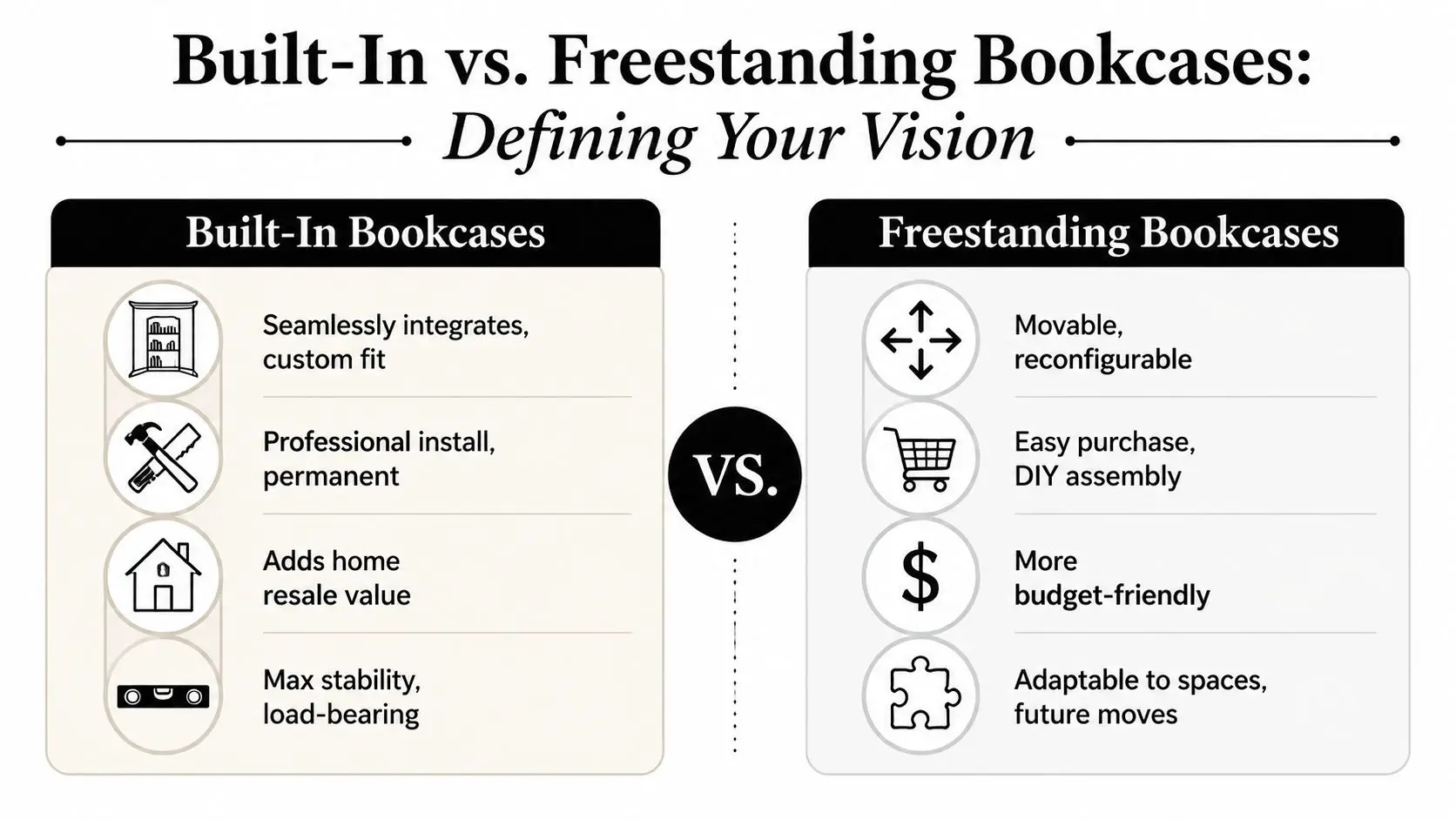
Defining Your Vision Built-In vs Freestanding Bookcases
A family comes into our showroom with the same wall measurements and two completely different goals. One wants a library that looks like it was part of the house from day one. The other wants full-wall storage they can take with them if they move in five years. Both are asking for a wall to wall bookcase. They are not asking for the same solution.
What built-in really means
A built-in bookcase is made for one room and one set of conditions. It is fitted to the wall, adjusted to the ceiling, and planned around trim, outlets, vents, and the small irregularities that real houses always have. In older homes especially, that matters. A wall may look straight from across the room and still be out enough to affect the fit from one end to the other.
That is why built-ins feel architectural. They do not just sit against the wall like a dresser or a cabinet. They become part of how the room is read.
Built-in shelving has a long history in domestic interiors and libraries because permanent storage solves a practical problem beautifully. The idea has lasted for centuries for a simple reason. Books are heavy, walls are often imperfect, and fitted joinery handles both better than generic furniture.
What freestanding does better
A freestanding wall of bookcases is still furniture, even when it spans an entire room. That can be a real advantage. You can reconfigure it, move it, add to it later, or take it to a new house. For a growing family, a renter, or anyone who expects a remodel down the road, that flexibility can be the wiser investment.
Freestanding units also give you more room to test proportions before you commit. If you are still deciding on depth, finish, or how much open shelving you really want, looking through unfinished wood shelving ideas can help you compare modular and furniture-based options in a practical way.
The difference is similar to custom-made clothing versus a well-made coat off the rack. One is cut for a particular body. The other gives you freedom to change course.
| Type | Best fit | Main advantage | Main tradeoff |
|---|---|---|---|
| Built-in | Long-term home plans | Fully-fitted, custom appearance | Permanent and more involved to install |
| Freestanding | Flexible layouts or future moves | Easier to rework later | Less architectural presence |
Questions that usually settle the decision
Clients usually arrive thinking the decision is about style. In practice, it is usually about commitment, wall conditions, and how the room needs to work ten years from now.
Ask yourself:
Is this house your long-term home?
Built-ins make the most sense when you are designing for the life of the house, not just the next few years.Is the wall straightforward?
Alcoves, radiators, off-square corners, low soffits, and uneven ceilings often push the project toward custom work. This is one of those real-world complications generic advice tends to skip.Do you want the bookcase to behave like furniture or like architecture?
Freestanding pieces remain distinct objects. Built-ins shape the room itself.Will your storage needs change?
If today's book wall may need cabinets, display space, or media storage later, that should influence the choice now.
A simple rule helps. Choose built-in if you want the room to feel settled and permanent. Choose freestanding if adaptability matters more.
Many homeowners find it useful to compare this decision with another fitted storage project. This guide to selecting kitchen cabinets is helpful because the same questions come up there too. Fit, finish, function, and how long you expect the solution to serve the house.
The Blueprint for Success Planning and Measuring Your Space
A good wall to wall bookcase starts long before anyone cuts wood. It starts with honest measuring. That’s the part people rush, and it’s usually where trouble begins.
Most walls aren’t as straightforward as they look. Floors slope a little. Baseboards project farther than expected. Outlets land in inconvenient spots. In older Bay Area homes, corners and wall angles often refuse to behave like a standard plan assumes they should.

Start with the room, not the bookcase
Before you measure shelf widths, measure the room like a trim carpenter would. Take width at the floor, mid-wall, and near the ceiling. Then measure height at several points across the span. If those numbers vary, the bookcase has to respond to the room, not the other way around.
Write down every interruption on the wall:
- Baseboards and crown that affect fit at the top and bottom
- Outlets and switches that cannot disappear
- Air vents that need airflow
- Windows and casings that may limit depth or height
- Door swings that can collide with projecting shelves
A quick sketch with dimensions is enough. It doesn’t need to be fancy. It just needs to be accurate.
The issue generic guides often skip
Non-standard walls are common, and they’re where custom planning earns its keep. A common challenge in older Bay Area homes is fitting shelving to walls with 45-degree or 135-degree angles and jogs. Professional custom solutions often use tapered back panels and scribe molding to create an integrated built-in appearance against irregular architecture, as shown in this custom bookcase video example.
That matters because the eye notices bad gaps immediately. Even a beautifully made bookcase can look wrong if it meets a crooked wall carelessly.
If the wall isn’t square, the bookcase shouldn’t pretend it is.
What to bring to a design consultation
You’ll save time and avoid guesswork if you gather a few basics before meeting with a design expert or craftsperson.
Bring these:
- A simple wall sketch with overall width and height
- Photos of the full room plus close-ups of trim, outlets, and corners
- Notes on what the shelves must hold, such as art books, baskets, framed photos, or media
- A list of required elements, like lower cabinets, adjustable shelves, or a desk section
If you’re also planning a move and need help picturing how much built-in style storage compares to freestanding volume, this article on understanding moving volume is a practical way to think about how much furniture a room really holds.
A plain-language measuring checklist
Use this order and you’ll avoid most common mistakes:
Measure wall width in multiple places
Walls can bow. One number isn’t enough.Measure ceiling height at several points
A tight floor-to-ceiling design needs the smallest useful height, not the most generous one.Record trim depth
Baseboards and casings often decide whether a unit sits flush.Locate studs if built-in installation is likely
Anchoring matters later, and it’s smart to know your options early.Mark obstacles on your sketch
Outlets, vents, returns, and switches should be shown exactly where they are.
The planning stage isn’t glamorous, but it’s where a smooth project is won. Good fit looks effortless only because someone paid close attention before the first shelf went in.
Choosing Materials and Finishes for a Lifetime Investment
Once the dimensions are settled, the distinct personality of the bookcase begins to show. Material choice changes how a wall to wall bookcase looks, how it feels to the touch, and how well it ages over the years.
Many homeowners often get pulled toward the cheapest shortcut. That’s understandable. But shelving that spans a full wall does heavy visual work every single day. If the material looks flat, chips easily, or ages poorly, the room feels it.
Why solid wood still matters
There’s a reason custom wood bookcases have lasted across generations. Good wood develops character instead of just wearing out. It also gives you better repairability, richer grain, and a more convincing sense of substance.
Historically, quality storage often blended materials with intent. Early modular concepts tied to Charles Andre Boulle, who lived from 1642 to 1732, included low bookcases about 4 feet high with marble tops and lattice doors, showing that custom storage has long balanced function with material richness, as described in this history of modular bookcases.
That old lesson still applies. Material choice isn’t decoration after the fact. It’s part of the design itself.
Common wood personalities
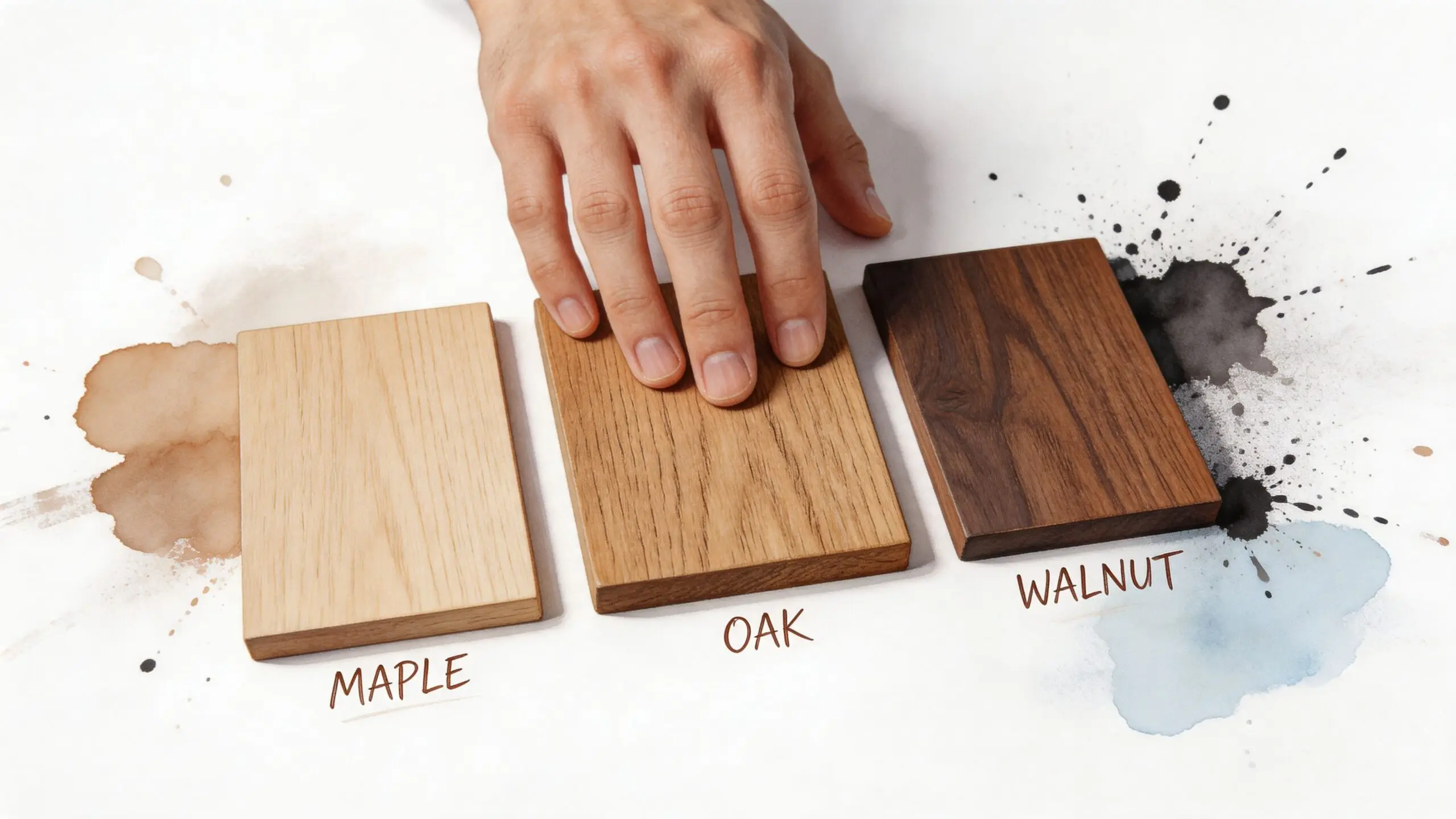
Different hardwoods bring different moods to a room. Some read casual and sturdy. Others feel refined or darker and more formal.
Here’s a quick comparison:
| Wood Species | Hardness (Janka Rating) | Grain Pattern | Best For |
|---|---|---|---|
| Oak | Qualitatively known for strength and visible character | Pronounced grain | Family rooms, libraries, traditional or transitional spaces |
| Maple | Qualitatively known for a smoother, cleaner look | Fine, subtle grain | Painted finishes, cleaner contemporary rooms |
| Cherry | Qualitatively valued for warmth and depth over time | Fine grain with rich tone | Formal studies, classic interiors |
| Walnut | Qualitatively prized for darker natural beauty | Rich, flowing grain | Statement walls, sophisticated living spaces |
Because verified hardness numbers weren’t provided here, it’s best to treat the table as a style-and-use guide rather than a technical engineering chart.
Finish choices that affect daily life
Homeowners often use these terms interchangeably, but they’re different:
- Stain changes the color while letting grain remain visible.
- Finish is the protective layer and sheen. It affects how the wood feels and how light reflects off it.
- Distressing gives the surface an intentionally aged or hand-worked character.
A dark stain on oak can feel grounded and traditional. A natural finish on maple can feel light and sleek. A low-sheen finish often reads calmer on a large bookcase wall than something glossy.
Material insight: The bigger the bookcase, the more important grain and sheen become. On a full wall, you’re not choosing a sample. You’re choosing an atmosphere.
How to choose without overthinking it
If you’re stuck between several species or finishes, use the room itself as the guide.
Ask:
- What other woods are already in view? Floors, beams, tables, and trim all matter.
- Should the bookcase blend or stand out? Matching trim creates integration. Contrast creates drama.
- Who uses the room every day? A busy family room may need a forgiving finish. A quiet study can take a more considered approach.
- How long do you want to live with it? Strong materials age better than trend-driven surface treatments.
A solid-wood piece is often the wiser long-term choice because it can be refinished, maintained, and appreciated rather than replaced. That’s what makes it a sustainable decision too. Buying one excellent piece for decades is different from cycling through several lesser ones.
If you want to compare craftsmanship details and proportions in a purpose-built piece, this solid wood bookshelf example is a useful reference point.
Beyond Books Smart Styling and Storage Strategies
A wall to wall bookcase shouldn’t look like a storage problem in plain sight. It should look composed. Lived-in, yes. Crowded, no.
That’s where styling matters. People often spend weeks choosing the bookcase and then fill it shelf by shelf with no plan. The result is usually too even, too dense, or too busy.

Use the triangle method
One reliable styling principle is the triangle method. Stylists use it to avoid a cluttered look on large shelves by grouping three objects of different heights in a triangular formation, then repeating that rhythm across the bookcase. That explanation comes from this triangle method shelf styling short.
In practice, that might mean:
- a tall vase
- a medium stack of books
- a small box or object
The triangle doesn’t need to be literal. It just guides the eye. You’re creating rise and fall, not perfect symmetry.
Mix categories, not just objects
The strongest shelves usually combine several types of items:
- Books for weight, color, and personality
- Objects such as pottery, bowls, or sculpture for shape
- Natural elements like a plant or branch for softness
- Closed storage in baskets or cabinets for the things you don’t want on display
Restraint helps. Leave some breathing room. An empty stretch of shelf isn’t wasted. It gives the eye a place to rest.
A full shelf and a finished shelf are not the same thing.
Create zones so the wall works harder
A large bookcase performs better when it has informal zones. One area can hold reference books. Another can carry family photographs. Lower shelves can take baskets or cabinets for less attractive necessities.
Try this approach:
Keep heavier books lower
It feels grounded and makes daily use easier.Place favorite items near eye level
That’s where they’ll have the most visual impact.Reserve top shelves for lighter or less-used pieces
Decorative boxes, seasonal items, and occasional books belong there.Repeat colors lightly across the wall
A little rhythm keeps one side from feeling unrelated to the other.
If you like the logic of mixed open and closed shelving, some of the same planning ideas show up in adjacent spaces too. This article on designing your butler's pantry is useful because pantry shelving and bookcase styling both depend on balance, access, and visual order.
For more room-by-room display ideas, this guide on how to decorate shelves in any room offers practical inspiration without making everything look over-staged.
Understanding the Investment Cost and Installation
A wall to wall bookcase is one of those projects where cost depends less on a single feature and more on the combination of choices. Material quality matters. Finish choices matter. Design complexity matters. And installation matters more than many people realize.
That last point deserves attention. A beautiful bookcase that isn’t installed correctly is not a bargain.
What shapes the investment
Most of the cost comes from a few variables working together:
- Size of the span and whether it runs floor to ceiling
- Material selection, especially when solid wood enters the picture
- Custom details such as lower cabinets, ladder rails, lighting, or unusual angles
- Finish work, including stain matching and sheen selection
- Installation conditions, particularly if walls are uneven or access is tight
A simple freestanding arrangement is one kind of purchase. A fitted library wall with custom finish work is another. They shouldn’t be judged by the same yardstick.
Why installation is not optional
In the Bay Area, structural anchoring is part of the conversation, not an afterthought. For stability in seismic zones, wall to wall bookcases use horizontal wood nailers screwed into wall studs to anchor the unit and distribute the load of books, which can run 20-40 lbs per linear foot, directly into the building frame, helping prevent tipping and racking, according to this bookcase anchoring reference.
That sentence may sound technical, but the takeaway is simple. Shelves full of books get heavy fast. Tall units need to be treated like serious built work.
What professionals are looking at during install
A proper installation team doesn’t just ask whether the bookcase fits through the door. They think about:
- Stud locations for secure anchoring
- Floor level so the unit sits correctly
- Wall irregularities that create visible gaps
- Trim transitions where the bookcase meets the room
- Weight distribution once books and objects are loaded in
When people say a custom bookcase “looks built with the house,” installation is usually the reason.
Why quality often costs less over the long run
Flat-pack furniture has its place. But if you know you want a library wall and plan to keep the home for years, replacing sagging or poorly fitted pieces can cost more in frustration and repeat spending than choosing well from the start.
That’s also where the buy-for-life mindset pays off. Better materials, better joinery, and professional anchoring don’t just improve appearance. They protect the function of the piece and the safety of the room.
If you’re weighing options and want a clearer picture of how custom work usually begins, this overview on getting started with custom order helps explain the process in practical terms.
Frequently Asked Questions About Wall-to-Wall Bookcases
A few questions come up in almost every conversation about a wall to wall bookcase. Here are the answers that tend to help most.
| Question | Answer |
|---|---|
| Do wall to wall bookcases only work in traditional homes? | Not at all. They can look classic, modern, rustic, or tailored depending on the wood, finish, trim profile, and overall proportions. |
| Is built-in always better than freestanding? | No. Built-in is better when you want permanence and a custom architectural look. Freestanding is better when you want flexibility or may move later. |
| Can a wall to wall bookcase work in a small room? | Yes. In smaller rooms, vertical storage often helps more than scattered furniture does. The key is getting scale and depth right so the room doesn’t feel crowded. |
| Should every shelf be adjustable? | Not necessarily. Adjustable shelves add flexibility, but fixed shelves can improve visual consistency and may better support specific design goals. A mix often works well. |
| What if my wall is uneven? | That’s common, especially in older homes. Custom fitting, scribing, and trim details can help the bookcase meet the wall cleanly instead of leaving awkward gaps. |
| How do I keep it from looking cluttered? | Use fewer accessories than you think you need, vary heights, leave open space, and group items with intention rather than filling every inch. |
| Are lower cabinets worth adding? | For many homes, yes. Cabinets hide the practical items that don’t belong on display and make the overall wall look calmer. |
| What maintenance does a quality wood bookcase need? | Dust regularly with a soft cloth, avoid harsh cleaners, and wipe spills promptly. A stable indoor environment also helps wood age gracefully. |
| Can I style it with more than books? | You should. The best shelves usually mix books with art, framed photos, boxes, pottery, and a few natural elements. |
| Is financing an option for a custom furniture project? | In many showrooms, yes. Financing options are available, which can make a long-term investment piece easier to plan for. |
A few maintenance habits that matter
Most bookcases don’t need complicated care. They need consistency.
Keep these habits in mind:
- Dust gently and often so grit doesn’t dull the finish
- Don’t soak the surface with wet cloths or harsh sprays
- Rotate styled objects occasionally so sunlight exposure stays more even
- Check anchors and hardware from time to time if the unit is heavily used
The question behind most other questions
Usually, what people are really asking is this: will I still like this years from now?
If the scale is right, the material is honest, and the design suits the house, the answer is usually yes. The safest path isn’t the flashiest one. It’s the one built on proportion, function, and craftsmanship.
Bring Your Vision to Life at Our South San Francisco Showroom
A wall to wall bookcase does more than fill a wall. It gives shape to a room and order to daily life. It can hold books, yes, but it can also hold the things that make a house feel personal. That’s why it’s worth slowing down and getting it right.
For Bay Area homeowners, this kind of project benefits from in-person guidance. Seeing wood species in natural light, comparing finishes side by side, and talking through room constraints with experienced Design Experts makes the decision clearer. It also removes a lot of the guesswork that online shopping can’t solve.
At a family business that’s been part of South San Francisco since 1933, the value of a piece like this is easy to understand. Good furniture should serve you well, age gracefully, and spare you from buying the same solution twice. That’s the heart of the buy-it-for-life approach.
If you’re weighing built-in versus freestanding, comparing Amish Furniture options, or trying to coordinate a library wall with the rest of your Bay Area Interior Design plans, a calm conversation goes a long way. No pressure. No commission-driven push. Just experienced help.
Visit Giorgi Bros. Furniture in South San Francisco to explore 50,000 square feet of inspiration, including Custom Furniture, Amish Furniture, and whole-home pieces you can see and feel in person. Our non-commission Design Experts can help you compare wood species, finishes, layouts, and installation needs for a wall to wall bookcase that fits your home for the long haul. If you’re ready to start, stop by the showroom or book a Design Consultation. Financing options are available.