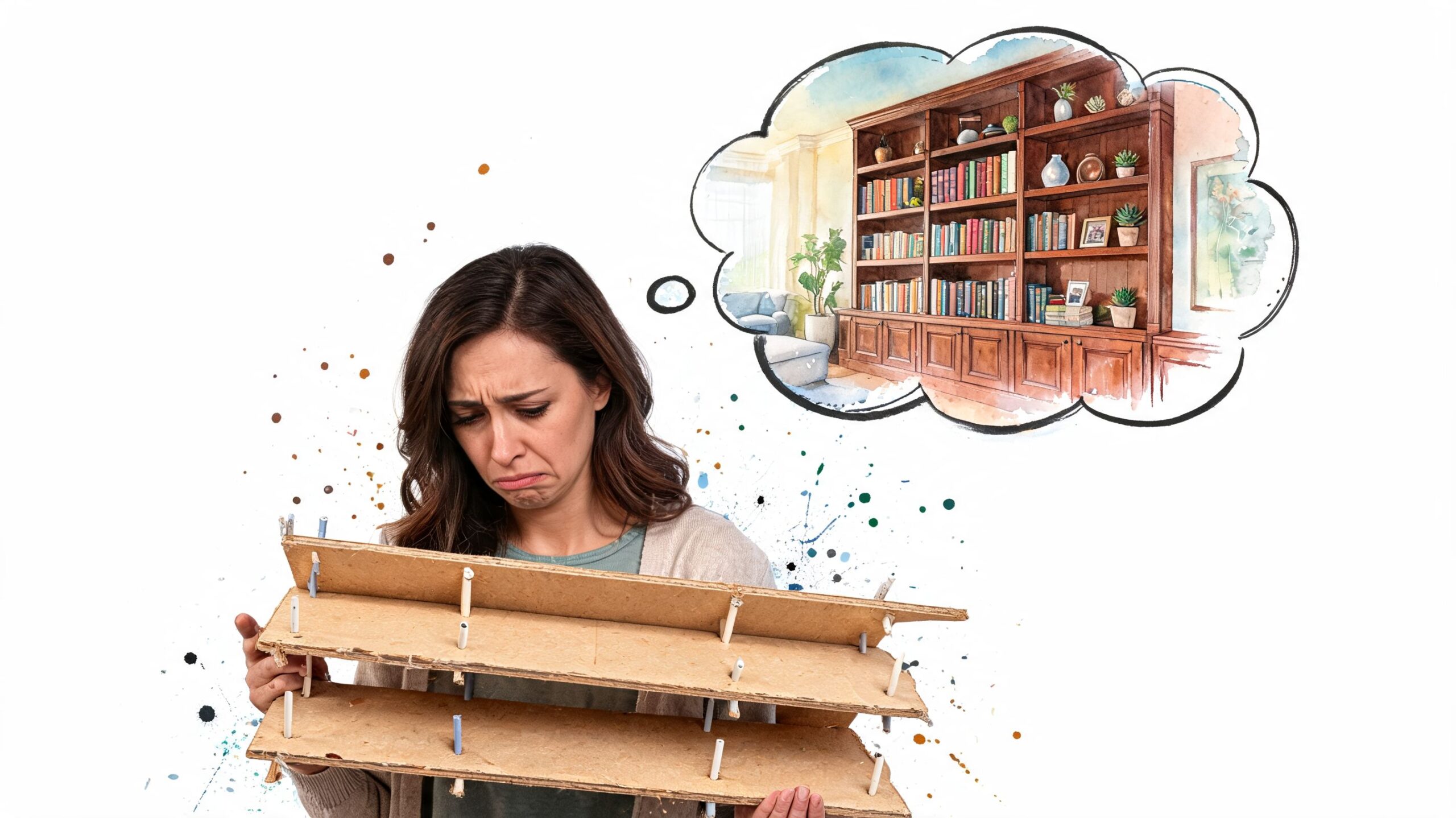
You buy a set of shelves because the room needs order now. A year later, the shelves bow in the middle, the finish chips at the edges, and the size still isn’t quite right for that wall alcove or sloped ceiling. Most homeowners don’t set out to buy temporary storage. They just end up there.
That’s why custom shelving wood deserves a closer look. The wood species, the thickness, the span, and the way the shelf is mounted all shape whether a shelf becomes a lasting part of the home or a piece you replace after the next remodel. In Bay Area homes especially, where rooms often carry odd dimensions and older architectural details, a shelf has to do more than look good. It has to fit, hold, and age well.
Beyond the Big Box Custom Wood Shelving as an Investment
A shelf can be cheap in the short term and costly over time. If it sags, flakes, or never fits the room properly, you’re paying again in repairs, replacement, or frustration. Custom shelving wood changes that equation because it starts with permanence.
The broader demand tells an interesting story. The global market for wood retail shelving systems, which includes custom home solutions, was valued at USD 12.5 billion in 2023 and is projected to reach USD 18.7 billion by 2032, driven by interest in aesthetic, functional, and customizable storage, according to Dataintelo’s wood retail shelving market report. People aren’t just buying shelves. They’re looking for storage that belongs to the room.
That shift makes sense when you compare a temporary piece with something built around your life. A built-in bookcase in a family room doesn’t only store books. It frames the wall, handles daily use, and often becomes one of the room’s defining features. That’s why many homeowners exploring solid wood bookshelf options end up asking different questions than they expected. Not “What’s cheapest?” but “What will still look right ten years from now?”
Why buy-for-life thinking matters
Quality custom furniture asks you to think beyond the move-in phase. It helps to look at shelving the same way you’d look at flooring or millwork. You live with it every day. You touch it, load it, clean it, and see it from every angle.
Practical rule: If a shelf needs to look finished, stay straight, and support meaningful weight for years, treat it as an investment piece, not an accessory.
There’s a sustainability lesson here too. A well-made shelf that lasts reduces the cycle of replacing flimsy furniture. Buying once, and buying well, often wastes less material and causes fewer headaches than buying twice.
What custom adds that stock shelves can’t
Custom shelving wood solves problems stock pieces usually ignore:
- Exact fit for real walls so gaps and fillers don’t distract from the room.
- Material choices that match use whether the shelf holds books, ceramics, or everyday items.
- Finish coordination so shelving works with nearby furniture instead of competing with it.
- Long-term serviceability because solid wood can often be refinished rather than discarded.
That’s the heart of the investment argument. Better shelving isn’t about chasing a trend. It’s about choosing something sturdy enough, handsome enough, and useful enough to earn its place for the long haul.
Selecting the Right Wood for Your Custom Shelves
The most common mistake people make with custom shelving wood is choosing by color alone. Color matters, but wood also has a job to do. Some species resist dents better. Some hold screws more confidently. Some stay more stable when the room’s humidity shifts. The best choice depends on what the shelf will carry and how visible it will be.
If you’re new to wood selection, start with a simple question. Is this shelf mainly structural, mainly decorative, or both? A display shelf for framed photos and pottery gives you more flexibility than a long span holding books.
Hardness tells part of the story
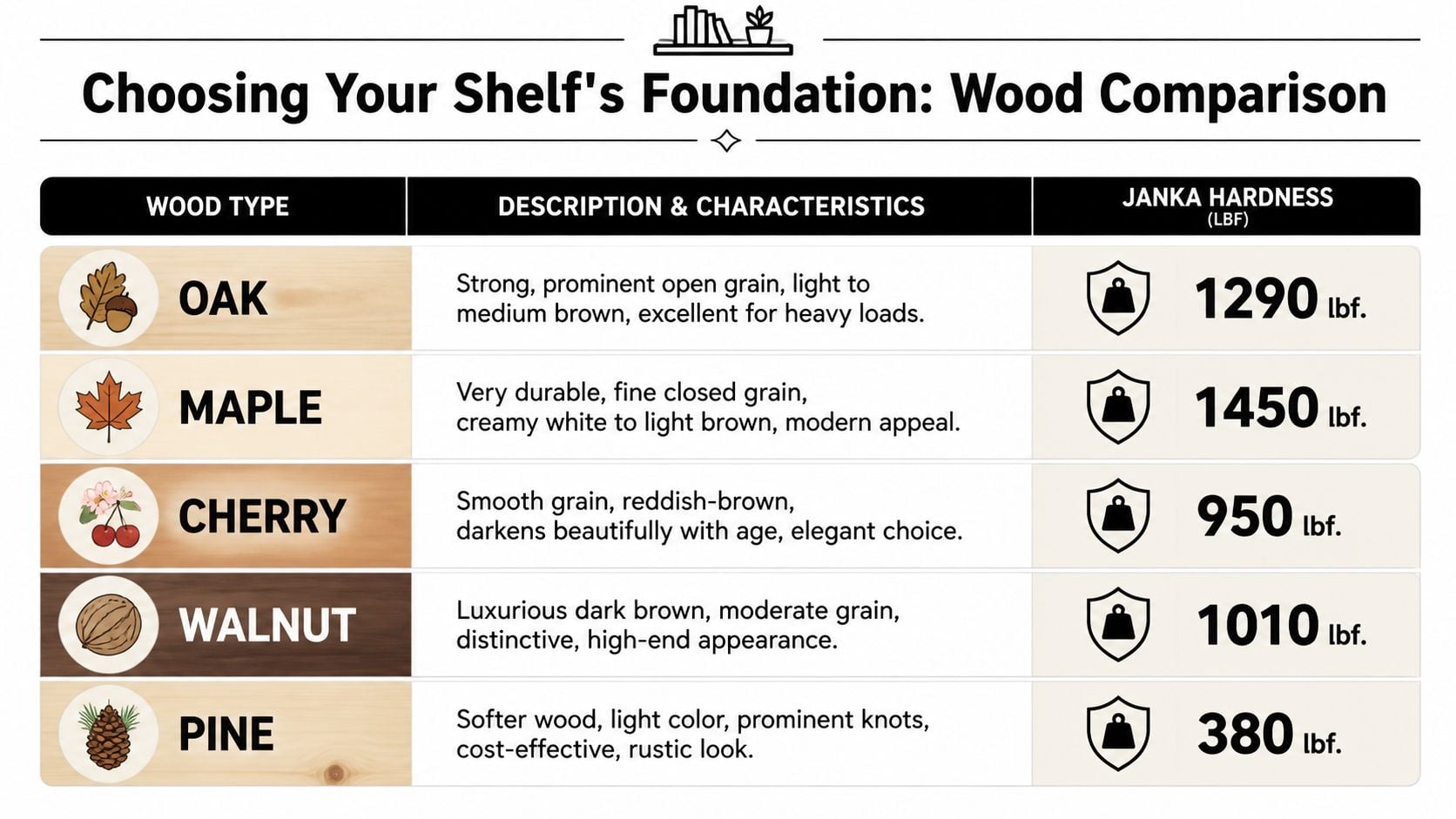
A useful way to compare wood is the Janka hardness rating. It isn’t the only factor, but it helps explain why one shelf stands up to daily wear better than another. Harder woods generally resist dents and surface damage more effectively.
Here’s a quick comparison of commonly discussed wood species for shelving.
| Wood Species | Hardness (Janka) | Appearance | Best For |
|---|---|---|---|
| Oak | 1290 lbf | Strong open grain, light to medium brown | Heavy-use shelving and traditional rooms |
| Maple | 1450 lbf | Fine closed grain, creamy to light brown | Clean-lined interiors and durable everyday use |
| Cherry | 950 lbf | Smooth grain, warm reddish-brown | Elegant display shelving |
| Walnut | 1010 lbf | Rich dark brown, moderate grain | Statement shelves and formal spaces |
| Pine | 380 lbf | Light color, knots, rustic character | Lighter decorative storage |
Those species are often part of the conversation when homeowners compare appearance and durability. For a broader primer on cabinet-friendly species and how they’re commonly used, Resurrect Wood Refinishing’s wood choices offers a practical overview that can help you recognize trade-offs before you make a finish decision.
Why birch deserves special attention
Some woods don’t get as much attention in casual showroom conversations, even though they perform beautifully. Solid birch is one of them. At 3/4-inch thickness, solid birch provides a Janka hardness of 1,260 lbf and supports up to 100kg/m² with minimal sag, making it a benchmark material for durable cabinet shelving, according to Soil and Oak’s shelf dimension guide.
That matters because cabinet-style shelving often carries a mix of weight and repetition. Dishes, books, media, baskets, and folded linens all create steady, everyday demand. Birch’s strength and resistance to deflection make it a smart choice when you want a shelf that feels refined but also earns its keep.
Birch is often the quiet overachiever. It may not call attention to itself the way walnut does, but it performs exceptionally well in hardworking interiors.
Appearance still matters
A shelf is part structure, part furniture. You should still choose a species that complements the room.
Consider these visual tendencies:
- Oak brings grain and texture. It suits homes where you want the shelving to read as classic and grounded.
- Maple feels cleaner and more understated. It works well in transitional and contemporary rooms.
- Cherry develops a richer tone over time, which many homeowners love in libraries, dining areas, and formal spaces.
- Walnut adds depth and contrast. It can make shelving feel more architectural.
- Pine leans casual and relaxed. It can be charming, but it’s softer and better for lighter-duty use.
If you want a deeper grounding in hardwood behavior, this guide to choosing the right hardwood for longevity and style is helpful because it connects appearance to long-term performance rather than treating wood choice as a purely decorative decision.
A simple way to narrow the field
If you’re stuck between species, use this order of priority:
- Start with load. Books and dense objects need a stronger shelf than decorative accessories.
- Look at wear. A hallway, family room, or child’s room benefits from harder species.
- Match the room’s tone. Grain pattern and color should support the surrounding furniture.
- Think about finish. Some woods absorb stain differently, while others look best with a clear or lightly tinted finish.
That’s the right mindset for custom shelving wood. You’re not picking a sample chip. You’re choosing the foundation for a piece that should stay attractive and dependable for years.
How to Ensure Your Shelves are Strong and Safe
A beautiful shelf that isn’t engineered well becomes a problem. Many DIY plans often fall short in this regard. They talk about stain color and bracket style but skip the basic physics that decide whether a shelf stays straight.
Think of a shelf like a small bridge. The longer the distance between supports, the harder the material has to work. Add more weight, and the middle wants to bend. That bending is what people call sag.
Span thickness and load
Three factors matter most:
- Span is the distance from one support point to another.
- Thickness affects stiffness. A thicker shelf usually resists sag better.
- Load is what sits on the shelf, both the total weight and how evenly it’s distributed.
A short shelf made from a moderate species can perform very well. A long floating shelf carrying heavy books asks much more from the wood and the wall anchors. That’s why one shelf can be rock solid while another, made from a “nicer” wood, still fails.
Why floating shelves need special planning
Floating shelves are popular because they look clean and sleek. But the hidden hardware has to do serious work. The wood species matters more here than many people realize.
For floating shelves, Paulownia at 4cm thickness offers a chunky look without exceeding typical wall fixing limits of 50 to 75 kg per meter, because its lighter density reduces cantilever stress and lowers the risk of shear failure compared with heavier woods at the same thickness, according to My Desk’s custom solid wood shelving guide. In plain terms, you get visual heft without asking the wall to carry unnecessary dead weight.
A floating shelf isn’t only a wood decision. It’s a wall, anchor, bracket, and load decision all at once.
That’s one reason homeowners often move from a sketch idea to a more integrated built-in plan. A full wall-to-wall bookcase design can spread weight more effectively and create a stronger visual anchor in the room.
Questions worth asking before you build
When you’re evaluating shelf safety, ask practical questions:
- What exactly will live on this shelf most of the time? Books are very different from framed art.
- How long is the unsupported run? Even good wood can sag if the span is too ambitious.
- Is the wall suitable for the mounting system? Hidden bracket systems depend heavily on proper support.
- Do you want adjustability? Built-ins and cabinet-style systems offer different structural advantages than simple floating planks.
A strong shelf doesn’t happen by accident. It comes from matching wood, dimensions, and mounting to the specific application of the piece. That’s what turns custom shelving wood from a design idea into something dependable.
Tailoring Shelves Perfectly for Your Bay Area Home
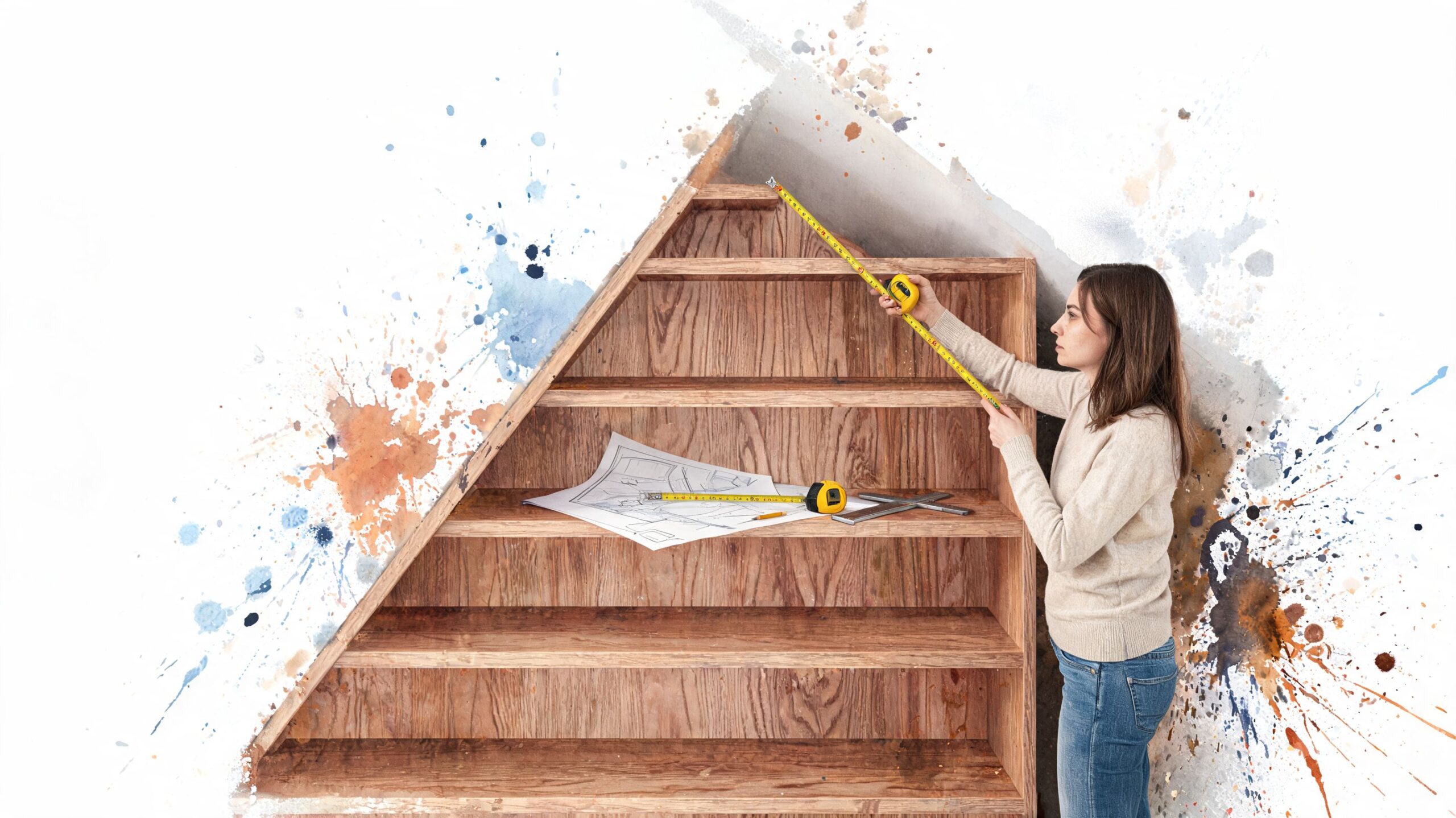
Bay Area homes rarely behave like showroom boxes. Walls drift slightly out of square. Ceilings slope. Alcoves narrow at the back. Older homes add charm, but they also punish standard-size furniture.
That’s where custom shelving earns its keep. A shelf that’s made for the actual opening looks calmer, works harder, and feels intentional in a way off-the-shelf units usually don’t.
Where standard shelving falls short
The trouble spots are familiar:
- Under sloped ceilings where rectangular units leave awkward dead space
- Narrow alcoves that need near-exact sizing
- Historic homes where walls and floors may not be perfectly level
- Open-plan remodels that need storage to double as architecture
DIY guides can help with templates and basic cuts, but they often gloss over what precision costs in time and waste. For irregular angles, professional services can reduce installation time by 60% and avoid up to 25% material waste, helping create a precise fit in non-standard spaces, according to House Digest’s article on cutting shelves for irregular closet angles.
That’s an important distinction. In a square room, a small miscalculation may be forgivable. In a sloped or tapered space, it can affect every joint.
Precision changes the result
Good custom work usually starts with careful measuring, then moves into proportion. The goal isn’t only to make the shelf fit. It’s to make the shelf look like it belongs there.
A useful way to think about it is this:
- Measure the architecture, not the idealized room in your head.
- Decide what the shelving should solve. Storage, display, room definition, or all three.
- Choose a wood and finish that support the home’s character rather than fighting it.
For homeowners collecting ideas before a remodel, Kitchen Renovations Perfected custom cabinetry examples can be a helpful visual resource because they show how custom storage can work in spaces where standard dimensions just don’t cooperate.
In an irregular room, close enough usually looks wrong. Precision is what makes custom work feel effortless.
Why this matters beyond storage
Custom shelving can soften difficult architecture or celebrate it. A shelf tucked under a stair run can turn leftover space into useful storage. A built-in that follows an angled ceiling can make an awkward wall feel resolved. In living spaces, that kind of fit often matters as much as the shelf’s capacity.
If you’re coordinating shelving with seating, tables, and room layout, it helps to think about the whole space at once. A guide on how to choose living room furniture can be a useful companion because shelving shouldn’t feel isolated from the rest of the room’s scale and materials.
What to Expect When Ordering Custom Wood Shelving
Ordering custom shelving wood feels easier once you know what drives the final price and the final result. Most of the variation comes from material, scale, finish, and installation complexity. The more customized the project becomes, the more craftsmanship enters the picture.
The market preference is clear. In the broader cabinetry market, wood holds 60.15% of revenue share and semi-custom options hold 37.85% market share, showing strong consumer preference for custom-made, high-quality wood solutions, according to Mordor Intelligence’s kitchen cabinets market analysis. That same logic carries into shelving. People value fit, material quality, and finish control.
The cost drivers to know
Custom shelving pricing can surprise people because they compare it to flat-pack furniture. That’s not the right comparison. You’re paying for choices and precision.
Here are the major variables:
Wood species
A premium hardwood usually costs more than a simpler or softer option. The species also affects finishing labor and visual character.Project size
A single recessed nook is different from a full wall unit. More linear footage and more vertical elements usually mean more labor and material.Construction details
Floating shelves, integrated lighting channels, unusual depths, and furniture-grade ends all increase complexity.Finish work
Painted, stained, or clear finishes each create different preparation demands. Grain visibility and color matching can also affect the process.
Real-world cost ranges
For custom built-in wood bookshelves, installed costs range from $500 to $1,200 per linear foot, while prefabricated options run $150 to $300 per linear foot, according to Dataintelo’s wood shelving market research. That same source notes an average project cost of $3,077, with high-end custom units reaching $9,600.
Those figures are useful because they reset expectations. Custom shelving isn’t priced like temporary furniture. It’s priced more like architectural furniture, where fit and craftsmanship matter.
If you’re budgeting for multiple storage projects at once, a related guide for organizing closet budgets can help you think through priorities and sequencing.
What the ordering process usually looks like
Most custom shelving projects follow a practical path:
Clarify the need
Start with the room, the objects being stored, and the feeling you want the shelving to create.Review material and finish options
The focus shifts to wood species, stain tones, paint, and edge details.Confirm dimensions and installation conditions
Irregular walls, floor variation, and mounting requirements need to be understood early.Place the order with a realistic timeline
Custom work rewards patience. Precision and finishing take time.
For shoppers who haven’t ordered a made-to-order piece before, getting started with custom order furniture is a useful reference because it shows how consultation, selection, and lead times typically come together.
The best custom experience feels clear, not rushed. You should understand what you’re choosing, why it costs what it costs, and how those decisions affect the finished piece.
Begin Your Custom Furniture Journey at Giorgi Bros
The best custom shelving wood choice usually comes down to three things. The right material, the right structure, and the right fit for the room. When those three line up, a shelf stops feeling like storage and starts feeling like part of the home itself.
That’s the long view Bay Area families have appreciated for generations. Since 1933, Giorgi Bros. Furniture has helped homeowners in South San Francisco and across the region choose lasting pieces with care, patience, and no-pressure guidance. In a world full of disposable furniture, that kind of steady expertise still matters.
Why the experience feels different
A custom order is easier when you can see and touch the options in person. Giorgi Bros. offers 50,000 square feet of showroom inspiration, along with access to custom choices in wood species, finishes, fabrics, and leathers. If you’re exploring Amish Furniture, comparing investment pieces for a remodel, or furnishing a whole home, the goal is the same. Help you choose well the first time.
A big part of that confidence comes from the people guiding you. The team includes Non-Commission Sales Staff, which means the conversation stays focused on what fits your home, your needs, and your long-term budget. If you need flexibility while planning a larger project, financing options are available as well.
Good furniture decisions rarely come from pressure. They come from clear information, honest guidance, and enough time to compare what will serve you best.
A lasting fit for Bay Area homes
Whether you’re refining a reading nook, planning wall-to-wall shelving, or coordinating storage with a larger Bay Area Interior Design vision, custom work rewards thoughtful choices. It also pairs naturally with the rest of a well-furnished home, from dining and bedroom pieces to Premium Mattresses that support daily comfort the same way quality shelving supports daily living.
For homeowners searching for Furniture South San Francisco shoppers can trust, or for anyone ready to invest in Custom Furniture that’s made to last, a well-guided custom order is often the smartest path forward.
Visit Giorgi Bros. Furniture in South San Francisco to explore custom wood species, finishes, Amish Furniture, and whole-home inspiration in person, or book a Design Consultation with one of our non-commission Consultants for friendly, no-pressure guidance on shelving and other investment pieces for your home.