
A worn armchair can create an awkward pause in a room. The fabric is tired, one cushion has collapsed, and the chair no longer looks presentable, but the frame still feels sturdy when someone sits down. The core question isn't whether new fabric would look better. It's whether the piece deserves another life or needs to be replaced.
Learning how to do custom upholstery starts with that decision. A successful project moves from structural diagnosis to padding, fabric selection, measuring, patterning, sewing, and careful attachment. Giorgi Bros. Furniture, a family-owned showroom in South San Francisco since 1933, has seen Bay Area homeowners face this choice for more than 90 years. Its approach centers on no-pressure guidance, quality materials, and furniture treated as an investment piece rather than a disposable purchase.
Why Custom Upholstery Is Worth the Learning Curve
Custom upholstery makes sense when a piece has good bones, useful proportions, or sentimental value that a replacement can't reproduce. A well-built chair may have a solid hardwood frame, comfortable dimensions, and joinery that still holds firm after years of use. Recovering it can preserve those strengths while allowing a homeowner to change the fabric, cushion feel, welt cord, and overall character.
The craft is learnable, but it isn't just a matter of pulling cloth tight and firing staples. A chair can look promising from across the room while hiding broken rails, tired webbing, or padding that has turned to dust. The best results come from slowing down before the first cut.
Practical rule: Fabric is the visible part of an upholstered piece, not the foundation of it.
A careful project usually includes:
- Structural inspection: Check the frame, joints, rails, springs, and webbing before ordering materials.
- Material selection: Match upholstery fabric, foam, batting, thread, and closures to the way the piece will be used.
- Pattern preservation: Remove the old cover in an orderly way so it can guide the replacement.
- Controlled installation: Attach fabric from the center outward to manage tension and alignment.
- Final detailing: Finish corners, welting, cushion closures, and the underside so the piece looks intentional from every angle.
This buy-it-for-life mindset also has an environmental benefit. Reupholstering a sound piece keeps usable furniture in service and reduces the need to discard it for a cosmetic problem. Industry guidance describes reupholstery as a more resource-conscious alternative to replacement and notes that it can cost less than buying new, even before disposal costs are considered. The case for reupholstering instead of replacing furniture explains that trade-off in practical terms.
Custom upholstery also supports the broader custom furniture experience. Giorgi Bros. Furniture offers custom order services involving fabrics, leathers, wood species, and finishes, so homeowners can approach a room as a coordinated design project rather than a series of disconnected purchases.
Assessing Your Piece Before You Commit
The most common mistake is judging furniture by its fabric. A beautiful cover can't compensate for a failing frame, and a plain cover may conceal a piece that deserves serious restoration.
Start with a flashlight, a firm hand, and enough space to walk around the furniture. Spend a focused quarter hour examining the piece before choosing a textile or estimating yardage.
A practical inspection checklist
Begin with the frame. Press along the front rail, side rails, and rear rail. A hardwood frame should feel stable rather than hollow or crumbly. Particleboard deserves extra caution because staples may pull out and screws may lose their grip when the material has deteriorated.
Test every joint. Hold one side of the chair while gently rocking the opposite side. Listen for clicks and watch for movement where the legs, arms, rails, or back meet. Loose joinery can often be repaired, but it changes the project from recovering to rebuilding.
Look beneath the cover. Check for cracked rails, broken corner blocks, damaged spring supports, and sagging or collapsed springs. A seat that feels low may need more than new foam. It may have a failed support system beneath the cushion.
Inspect the padding. Push firmly across the seat and back. Uneven valleys, hard lumps, and a cushion that stays compressed point to worn foam, batting, or both. Take note of whether the problem affects one cushion or the entire frame.
Check the legs and feet. Confirm that each leg sits firmly and that fasteners aren't missing. A stable frame with loose feet is a manageable repair. A frame that twists under light pressure is a different decision.

A solid hardwood frame with sound joinery is usually a strong candidate for reupholstery. Particleboard frames, cracked rails, loose joints, and collapsed springs may turn a fabric project into a structural repair. A hands-on guide to deciding whether furniture is worth reupholstering makes the same practical distinction. Older, well-built furniture can outlast newer mid-range pieces, but only when its hidden structure is still serviceable.
Separate appearance from condition
Before stripping the cover, decide whether cleaning could solve part of the problem. A professional resource on signs your furniture needs cleaning can help distinguish surface soil from fabric failure. Cleaning won't repair broken webbing or collapsed foam, but it may prevent an unnecessary recover.
For a deeper decision framework, compare the inspection findings with this sofa reupholstery assessment. If the frame is sound and the shape works in the room, reupholstery often protects the value already built into the piece. If several structural components have failed, replacement may offer a cleaner and more predictable result.
Choosing Upholstery Fabric by Durability
Fabric selection should begin with use, not color. A delicate textile may be suitable for a formal chair that receives occasional use, while a family-room sofa needs a covering chosen for repeated friction, stretching, and daily contact.
Two abrasion tests appear frequently on upholstery specifications. The Martindale test, widely used in the UK and Europe, rubs fabric in a figure-eight motion until visible damage appears. Many manufacturers present results in 1,000-rub increments, with roughly 10,000 to 15,000 rubs often treated as light domestic use, 15,000 to 30,000 rubs as medium-duty residential upholstery, and 30,000 to 50,000 or more as heavy-duty or commercial-grade performance. American Leather's explanation of fabric rub tests provides the relevant context.
The Wyzenbeek test, common in the United States, uses double rubs to assess wear. Below 10,000 double rubs generally suits light-use applications, around 15,000 to 25,000 fits ordinary residential furniture, and 25,000 to 30,000 or more is better suited to homes with children, pets, or heavier daily use. These thresholds come from upholstery guidance on custom upholstery fabric performance.
Fabric durability ratings by household use
| Household Scenario | Wyzenbeek Double Rubs | Martindale Rubs | Best Fabric Types |
|---|---|---|---|
| Occasional accent chair | Below 10,000 | Roughly 10,000 to 15,000 | Decorative woven fabric, textured linen, or other light-use covering |
| Everyday living room seating | Around 15,000 to 25,000 | 15,000 to 30,000 | Durable woven fabric, performance textile, or resilient leather |
| Busy family room | 25,000 to 30,000 or more | 30,000 to 50,000 or more | Heavy-duty performance fabric, tightly woven textile, or suitable leather |
| Commercial-style banquette | 30,000 or more | 30,000 to 50,000 or more | Commercial-grade upholstery selected for repeated abrasion |
Ratings aren't the whole decision. A high-rub fabric can still disappoint if its nap shows marks, its pattern is difficult to align, or its surface feels wrong against bare arms. Pattern repeats also affect cutting efficiency, while a directional design may require more careful layout than a small-scale texture.
Sustainability adds another layer. The eco-friendly upholstery fabrics segment was valued at $255 million in 2025 and is projected to grow at a 9% CAGR through 2033, according to market coverage of eco-friendly upholstery fabrics. The same source reports that more than 57% of furniture buyers in Western Europe and North America considered environmental credentials in 2025, and that sustainably sourced upholstery can command a 15% to 20% premium. Those figures don't make one fabric automatically better. They show why durability, recycled content, bio-based fibers, dyeing methods, and price should be considered together.
Read the performance label on every sample. Order swatches before committing, place them in the room, and observe them in real sunlight. A household with pets should also test how the texture catches hair and how easily the surface recovers from brushing or contact. More guidance on balancing appearance and performance appears in this resource on choosing upholstery fabric.
Padding Foam and Webbing Explained
A recovered chair can look flawless and still feel disappointing if the material beneath the fabric is wrong. Foam density, batting thickness, cushion dimensions, and webbing condition determine whether the seat supports the body or bottoms out after regular use.
Foam density measures durability, not firmness. Industry guidance commonly treats about 1.8 lb/ft³ as a minimum for indoor seating, while foams around 2.5 to 3.0 lb/ft³ are recommended for stronger shape retention and may last roughly 5 to 10 or more years under regular use. Custom upholstery foam guidance explains why a firm cushion isn't necessarily a durable one. Firmness depends on the foam's formulation, while density indicates how much material supports that performance.
Measure the cushion before ordering
Foam sizing causes two predictable failures. Bare foam ordered too small leaves a loose cover and soft edges. Foam ordered too large creates an overstuffed cushion that strains seams and distorts the cover.
For a standard cushion using bare foam, one supplier advises adding 1/2 inch to the measurements. When the foam will be wrapped in Dacron, the foam should be ordered at the exact seam-to-seam cover size. Dacron is typically about 3/4 inch to 1 inch thick, and that wrap thickness shouldn't be added to the foam measurement. The foam measurement guide sets out the distinction clearly.
Measurement rule: Decide whether the foam will be bare or Dacron-wrapped before calculating the cut size.
Webbing deserves the same attention. Stretchy or torn webbing allows the seat to sag even when the foam is new. Replace webbing that has lost tension, pulled away from the frame, or developed visible breaks. A webbing stretcher helps create consistent tension, while a professional can assess whether the frame can accept new webbing without additional reinforcement.
Foam also changes during break-in. One density guide says upholstery foam can soften by about 20% to 30% after 6 months to a year of heavy use, so a cushion that feels slightly firm at first may settle into a more comfortable profile. Foam density and break-in guidance helps set that expectation. Material choices and sizing details are also covered in everything to know about upholstery materials.
Tools Measuring and Patterning the Old Cover
A clean upholstery project needs fewer tools than many beginners expect, but each tool must suit the material. A staple lifter removes fasteners without tearing the frame, while an air or heavy-duty staple gun drives staples consistently. Add a tack hammer, webbing stretcher, sharp scissors, chalk, masking tape, a measuring tape, and a sewing machine capable of handling heavy thread.
Set up a large, well-lit work surface. Keep a container for removed staples and a separate area for fabric panels. Mixing old pieces together is one of the fastest ways to turn a recover into a guessing game.
Photograph before disassembly
Take photographs from the front, back, sides, top, and underside. Open drawers or remove cushions where possible and photograph how fabric folds around corners, arms, and the rear edge. These images become a visual record when the old cover no longer shows how the piece was assembled.
Remove staples and tacks in a controlled sequence. Start with one section and finish it before moving to the next. Avoid ripping the cover away because the old panels may contain the most accurate information about seam placement and tension.
Turn the old cover into a pattern
Label every panel immediately after removal. Use masking tape and chalk to mark the location, direction, and neighboring pieces. A useful label might identify the left outside arm, front rail, inside back, or seat deck, along with an arrow showing the top or grain direction.
Record details that aren't obvious from the shape alone:
- Grain line: Mark the direction that should follow the furniture.
- Nap direction: Note which way velvet-like or brushed fabric must face.
- Seam placement: Identify adjoining panels and seam allowances.
- Welting position: Mark where cord was sewn into the original cover.
- Pleats and folds: Photograph and label their spacing before taking them apart.
- Fastener locations: Record whether a section used staples, tacks, a zipper, or hook-and-loop closure.
The old cover isn't always a perfect pattern. It may have stretched, shrunk, or been distorted by years of use. Treat it as evidence, then verify each piece against the frame and your new measurements. The furniture measuring guide can help establish a reliable measurement process before fabric is cut.
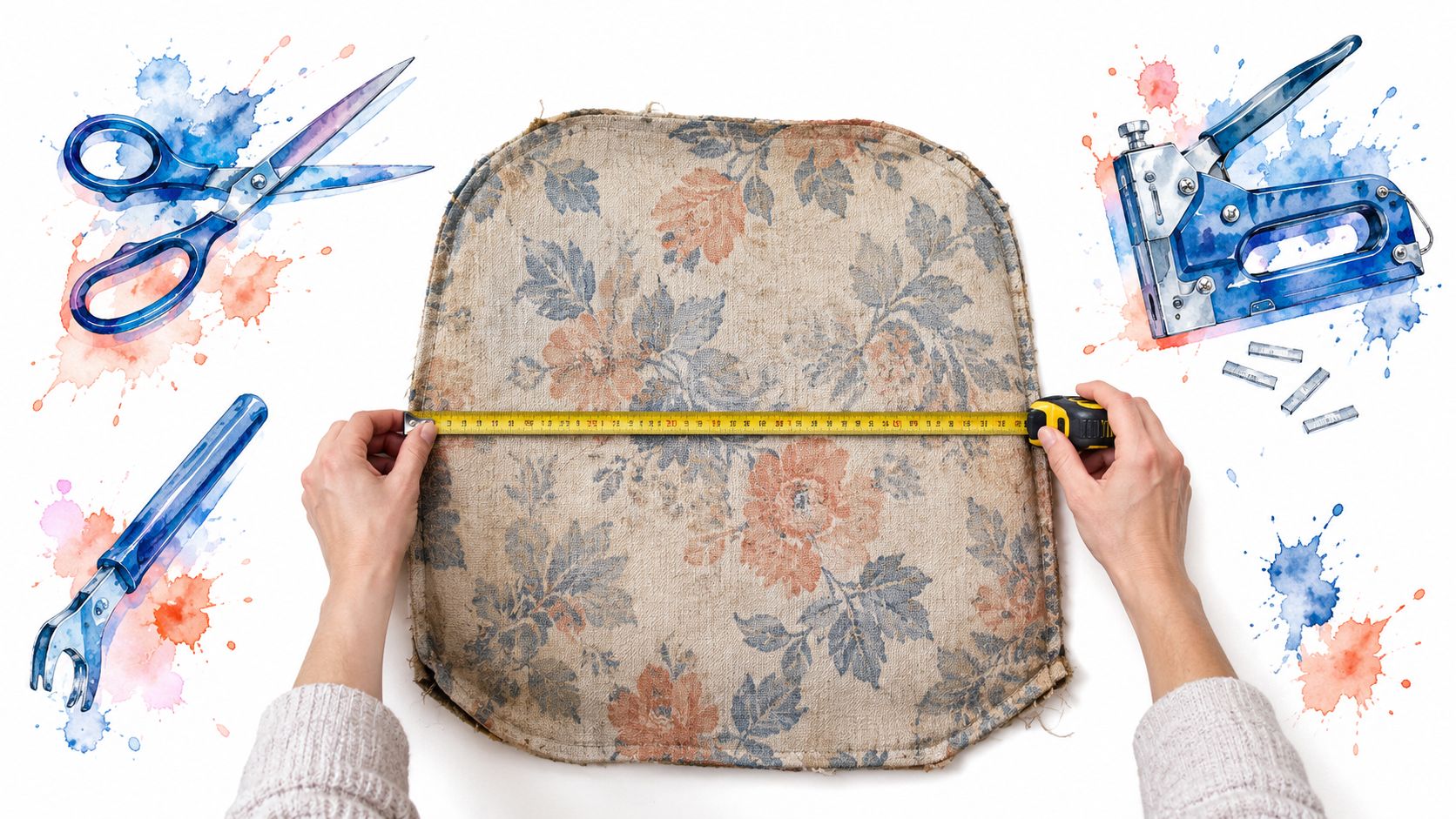
Inspect the exposed frame and padding while the cover is off. This is the point where hidden damage becomes visible, and it's much easier to correct a broken rail or replace webbing before new fabric conceals the work.
Cutting Sewing and Attaching the New Fabric
A dining chair seat is a manageable first project because the cover usually has a small number of panels. A sofa arm is more demanding because it combines curves, directional tension, visible seams, and corners that must finish cleanly.
For the dining chair, place the old seat panel on the new fabric with the grain aligned. Mark the seam allowance rather than cutting directly around the old cover. If the fabric has a pattern, center the important part of the design before cutting. Cut the top panel, boxing strip, and any underside panel separately, then sew the boxing to the top with the correct orientation.
If the seat needs new support, install the replacement foam first, then add cotton batting. The batting softens edges and helps the fabric move smoothly over the cushion. Sew welting into the seams when the design calls for a defined edge, and use a zipper or other closure that allows the cushion cover to be removed where appropriate. A practical upholstery how-to for sewists can help with thread, needle, and machine considerations.
The sofa arm demonstrates why order matters. Remove the old cover, repair the frame, replace worn padding, and install the new high-density foam and cotton batting before laying out the fabric. Position the arm panel so the grain and pattern repeat match neighboring sections. Sew any welt cord or joined panels before attaching the cover to the frame.
Attach from the center outward
Professionals generally anchor the fabric at the center of a section, then work toward the corners. Place a few staples at the top center, bottom center, and corresponding side points. Check the grain and pattern alignment before filling in the spaces between those anchors.
Pull the fabric firmly enough to remove slack, but don't stretch it so aggressively that the pattern distorts. Slightly over-tensioning a stable woven fabric can allow for normal relaxation, but excessive force will create puckering and stressed seams. Work symmetrically so one side doesn't consume more fabric than the other.
Finish corners with deliberate folds rather than bunching excess material underneath. Trim surplus fabric after the tension and alignment look right. Add a clean dust cover to the underside, then inspect the cushion closure, welt lines, and exposed staples. A careful underside often distinguishes a durable upholstery job from a rushed cover-up.
Troubleshooting Costs and When to Hire a Professional
Most failed upholstery projects don't fail because the fabric was unattractive. They fail because the fabric was cut before the structure was understood, the old cover was discarded too quickly, or the installer tried to correct a measurement problem with extra tension.
Common fit problems and their causes
Puckering usually comes from uneven tension, a stretched seam, or fabric cut off grain. Release the affected area, smooth the fabric from the center, and reattach with smaller adjustments. If the seam itself is distorted, remove the stitches and correct the panel rather than pulling harder.
Pattern mismatch starts at layout. A centered motif on one cushion may sit too high or too low on the next if the repeat wasn't marked before cutting. Save extra fabric for matching visible panels, especially on sofa fronts, inside backs, and arms.
Insufficient fabric is often a planning error rather than bad luck. Directional designs, large repeats, nap, and matching can consume more yardage than a plain fabric. Keep the old panels intact until the new layout is confirmed.
Uneven padding creates ridges and hollow spots that fabric can't hide. Check the foam, batting, webbing, and underlying support separately. Adding batting to a collapsed support system only masks the issue for a short time.
Compare the project with the risk
A dining chair seat may suit a careful weekend project when the frame is sound and the cover is simple. A full sofa demands more workspace, more pattern management, and a longer commitment. Curved arms, attached backs, tufting, leather, complex repeats, and extensive sewing raise the difficulty considerably.
Structural repairs change the calculation. Particleboard deterioration, cracked rails, loose joinery, and collapsed springs can require carpentry or spring work before upholstery begins. If the furniture has several of these problems, replacement may be more sensible than investing in a cover that rests on an unstable foundation.
A professional is the safer choice when the furniture has significant sentimental value, a difficult shape, expensive leather, intricate tufting, or a pattern that must align across multiple planes. The same applies when the frame needs repair, the cushion design is complex, or the household can't tolerate a long unfinished project.
Reupholstery remains compelling for quality pieces because it preserves materials and construction already in use. The broader upholstered furniture market is projected to grow from USD 65.72 billion in 2025 to USD 69.18 billion in 2026 and USD 89.36 billion by 2031, with a projected 5.25% CAGR, according to upholstered furniture market estimates. A separate estimate projects growth from USD 73.71 billion in 2026 to USD 122.45 billion by 2034, at a projected 6.55% CAGR. Those are market projections, not a promise about one individual project, but they reflect continued interest in upholstered furniture and made-to-order choices. At the same time, IBISWorld reports that the U.S. repair and reupholstery industry declined at a 1.4% CAGR between 2021 and 2026, which points to a competitive, specialized service environment rather than an easy shortcut.
Giorgi Bros. Furniture offers custom reupholstery services for homeowners who want guidance with new fabrics, leathers, finishes, and tailoring decisions. The South San Francisco team includes non-commission Design Consultants and ASID interior designers, with access to thousands of designer fabric and leather options. The showroom also provides custom furniture services, including Amish Furniture, custom wood species and finishes, and Premium Mattresses for broader room planning.
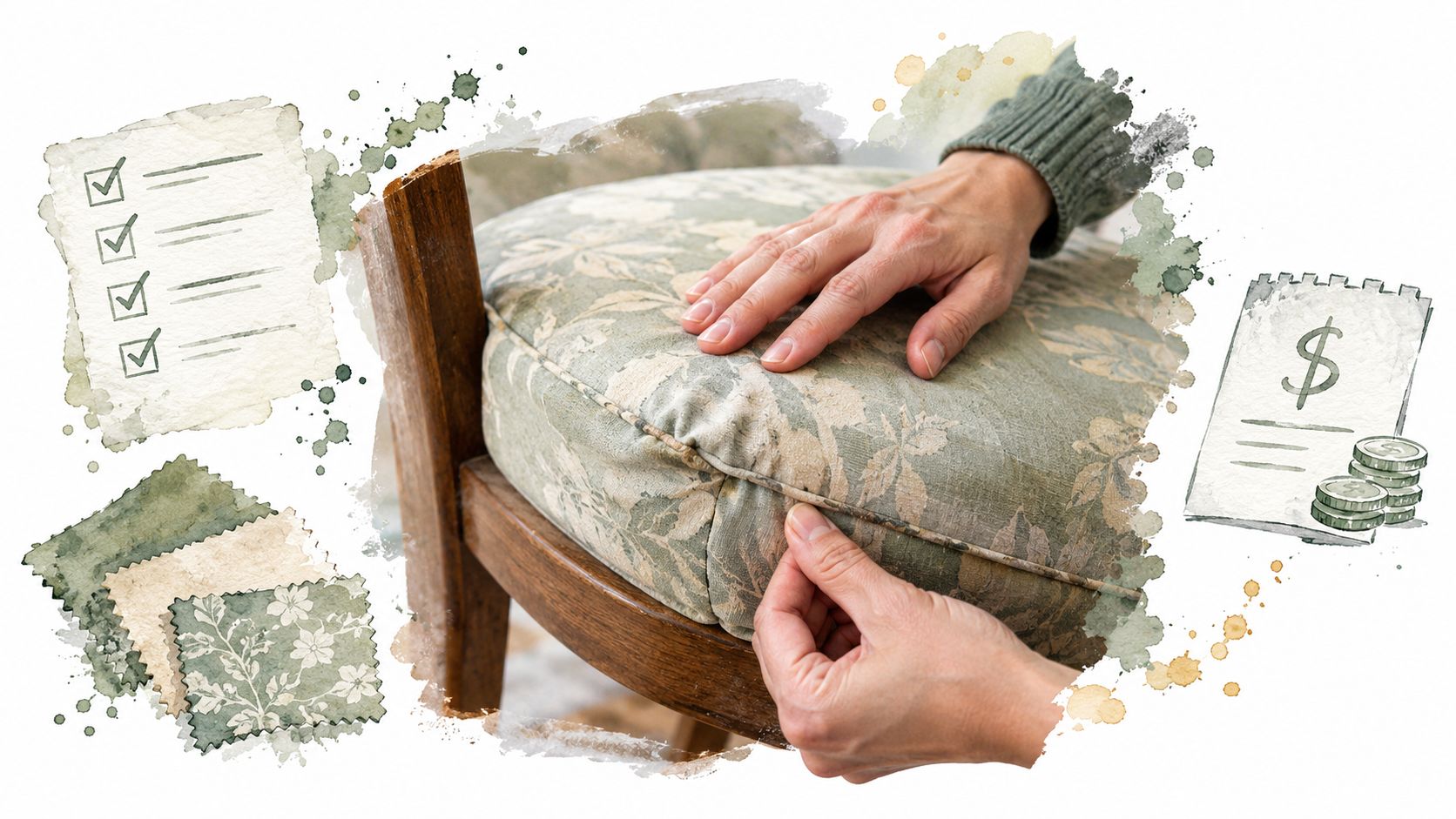
A professional engagement should begin with an honest inspection, not a rushed fabric selection. The team can assess the furniture's condition, discuss comfort and appearance, explain which materials need replacement, and outline the trade-offs before work starts. For a larger furnishing plan, the 50,000-square-foot showroom gives homeowners a place to compare textures, leathers, finishes, and related Custom Furniture in person. Flexible financing options are available for qualifying investment pieces, and white-glove delivery is priced by location rather than per piece across the Western United States.
Giorgi Bros. Furniture offers custom reupholstery guidance, designer fabrics and leathers, custom order services, and no-pressure consultations for furniture intended to last. Visit Giorgi Bros. Furniture in South San Francisco to evaluate a treasured piece, explore the showroom, or book a Design Consultation for the next upholstery project.