A dining table can look perfect in a showroom and still become a source of frustration at home. A wobbly leg after two holiday meals, a finish that marks easily, or chairs that loosen with ordinary use can turn a major purchase into an early replacement. Another table, built with properly dried hardwood and sound joinery, may host daily dinners, celebrations, and future generations without losing its stability.
That difference isn't explained by the words “American made” alone. Buyers need to understand what the label means, how moisture content affects wood movement, which joinery deserves attention, and whether a custom order will arrive on a workable schedule. A family-owned South San Francisco showroom with more than 90 years of history, serving the Bay Area since 1933, knows that no-pressure guidance matters just as much as the furniture itself.
Why American Made Dining Room Furniture Is Worth a Closer Look
A shopper furnishing a Bay Area home often faces two very different choices. One table may use lower-cost composite panels and arrive quickly in a fixed size. Another may be built from solid hardwood, ordered in a selected species and finish, and designed to remain useful through changing homes and family routines.
The first option can make sense when the immediate priority is a low starting price. The second asks the buyer to look further ahead. Quality dining furniture is an investment piece, not just a surface for serving dinner. Its value comes from stability, repairability, comfort, and the ability to keep working when a household's needs change.
A tradition shaped by craft and production
American dining furniture has deep roots. Cabinetmakers in New York, Boston, Baltimore, and Philadelphia produced the first American sideboards in the late eighteenth century. By the 1860s, dining rooms had become dedicated spaces in many middle-class and upper-class homes, which encouraged more specialized furniture. Industrialization then moved production from small workshops toward factories using powered machinery, making dining pieces available to more households. This history of the American sideboard shows why domestic dining furniture is associated with both handcraft and regional manufacturing.
That background still helps explain the range of choices available today. A handmade Amish dining table and a carefully produced domestic collection may use different methods, yet both can reflect an established preference for durable materials and furniture intended for regular use. Buyers can explore additional guidance on American-made furniture brands and construction before visiting a showroom.
The questions that matter most
The best purchase process doesn't begin with a patriotic slogan or a stain color. It begins with practical questions:
- What is the wood? Ask whether the table, apron, legs, and chairs use solid hardwood or a mixture of engineered panels and veneer.
- How was the wood prepared? Kiln-drying and controlled moisture content affect how the piece behaves after delivery.
- How are the joints made? Look for construction that supports repeated loading, movement, and everyday use.
- Can the piece be repaired or refinished? A dining table that can be renewed has more useful life than one that must be discarded after surface damage.
- What does the domestic claim cover? The maker should be able to explain where materials were sourced and where assembly occurred.
A family-owned, non-commission environment makes these questions easier to ask. Buyers don't need to rush toward the first attractive set. They can compare construction, sit in the chairs, inspect the finish, and decide whether the piece suits the home for today and for life.
What American Made Actually Means
“American made” isn't a synonym for “high quality,” and it shouldn't be treated as one. A domestic product can be built well or poorly, just as imported furniture can vary by maker and construction. The label tells buyers about origin. The materials and workmanship tell them about value.
The Federal Trade Commission states that furniture can be advertised as “Made in USA” only when “all or virtually all” of the product, including materials and labor, is sourced and made domestically. This explanation of the FTC standard gives shoppers a useful compliance reference. In plain language, a maker shouldn't imply that a dining table is fully American made if only the final assembly happened in the United States while most materials and labor came from elsewhere.
Four questions that clarify the label
A buyer doesn't need manufacturing expertise to investigate a claim. A short conversation with a design consultant can reveal whether the retailer has specific answers.
- Where was the lumber milled? The answer may distinguish domestic hardwood from a piece assembled domestically with imported material.
- Where did the main construction happen? Ask where the table was cut, joined, sanded, and finished, not only where it was packed.
- Who made the piece? A retailer should be able to identify the maker or collection rather than relying on broad language such as “American style.”
- Which components are domestic? Hardware, drawer parts, finishes, and upholstery materials may come from different places, so buyers should ask what “all or virtually all” means for the specific item.
These questions aren't accusations. They're part of responsible buying, especially when a customer is paying for domestic origin as well as construction quality.
Why the history still matters
The American dining room developed alongside American cabinetmaking. Early sideboards served both practical and social purposes, while dedicated dining rooms later created demand for tables, chairs, storage pieces, and coordinated sets. Industrialization expanded access, but it also made production consistency and material selection important parts of the furniture business.
That history helps shoppers avoid a false choice between “handmade” and “factory made.” A well-run domestic factory can use repeatable processes and skilled workers. An independent craft shop can produce highly individualized work. The useful distinction is whether the maker explains the materials, construction, and origin clearly.
Practical rule: Treat “American made” as a claim to verify, then judge the furniture by its wood, joinery, finish, comfort, and repair options.
A genuine origin claim may matter to a buyer who wants to support domestic labor or reduce transport distance. It shouldn't replace an inspection of the actual dining set. The strongest purchase combines verified origin with construction that can withstand years of meals, movement, and maintenance.
The Craftsmanship Behind a Lasting Dining Set
Wood responds to its surroundings. It takes in and releases moisture as indoor humidity changes, so a dining table isn't completely static after it leaves the workshop. Skilled furniture makers account for that movement before assembly. Poor preparation can leave joints under stress before the first family gathering takes place.
Interior furniture lumber is typically dried to about 6% to 8% moisture content, a benchmark explained in the Forest Products Laboratory guide to wood moisture. Drying the lumber near the moisture level expected in an indoor environment helps reduce post-purchase shrinkage, joint loosening, and seasonal warping. It doesn't stop wood from moving. It helps keep that movement predictable.

Why moisture affects the joints
Consider a chair assembled with a mortise-and-tenon joint. The tenon fits into a matching opening, creating a strong connection when the parts remain properly fitted. If the surrounding wood shrinks or swells significantly after delivery, the joint can loosen. A glued connection may also experience stress as adjoining pieces move at different rates.
Dovetail joints face a similar challenge in drawers and casegoods. Screws and other fasteners also perform better when the wood has appropriate moisture content. A dining chair encounters repeated shifting, leaning, and loading, while a table experiences pressure from serving dishes, writing, children, and everyday cleaning. Small changes at several joints can eventually become wobble.
Buyers don't need to measure every component themselves, but they should ask whether the lumber is kiln-dried for interior use. A clear answer signals that the maker understands how the furniture will behave after installation.
Solid hardwood compared with composite construction
Oak, maple, walnut, and cherry are common solid hardwood choices for dining furniture. Dense hardwood fibers generally resist dents and hold fasteners more effectively than softwoods. Solid wood can also be sanded and refinished when the surface eventually shows wear.
Fiberboard-based panels and other engineered materials have legitimate uses, but they require careful protection at edges and connection points. They can be more vulnerable to swelling, edge damage, and long-term loosening under daily use. A table made largely from such panels may be suitable for a temporary setting, yet it offers fewer repair options when damage reaches the edge or fastener points.
A buyer comparing two tables should inspect more than the top. The underside, table apron, leg connections, chair stretchers, drawer construction, and finished end grain all reveal how the maker approached durability.
A practical inspection checklist
Look for these features before placing a custom order or selecting a floor model:
- Kiln-dried solid hardwood: Ask about the species and whether the lumber was prepared for interior conditions.
- Reinforced joinery: Examine mortise-and-tenon, dovetail, or other substantial connections where the design calls for them.
- Protected end grain: End grain absorbs finish differently and needs adequate protection, especially around tabletops and exposed edges.
- Stable table support: Check how legs attach to the apron and whether leaves use dependable support hardware.
- Firm chairs: Sit down, shift weight, and listen for movement or creaking at the joints.
- Repairable surfaces: Confirm whether the finish can be renewed and what care the maker recommends.
For readers who want a closer explanation of one traditional method, this guide to mortise-and-tenon joints offers useful construction context. The goal isn't to turn a dinner-table purchase into an engineering exam. It's to recognize the features that reduce wobble, surface wear, and premature replacement.
Choosing the Right Wood Species for Your Dining Room
Wood species changes more than color. It affects grain visibility, the way a finish appears, resistance to everyday marks, and the atmosphere a dining room creates. A household with children and daily meals may want a different balance from a room used mainly for formal entertaining.
Warm natural wood tones are especially prominent in projected 2026 dining-room collections, according to industry trend coverage, so species and finish choices are likely to play an even more visible role in current design decisions. This overview of cabinet wood species can help shoppers become familiar with grain and color differences before comparing dining tables in person.
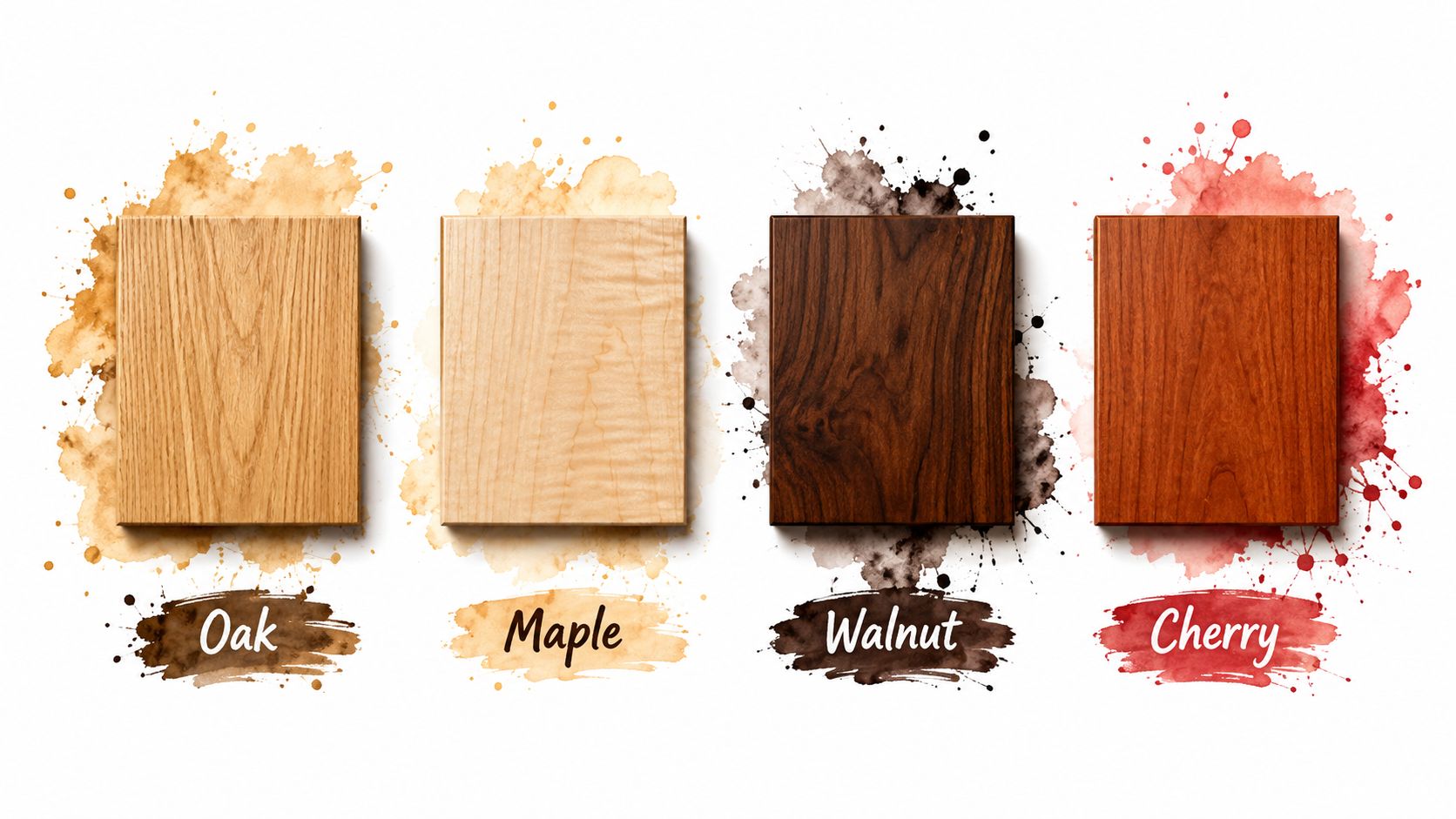
Comparing common American hardwood species for dining furniture
| Wood Species | Durability Character | Look and Grain | Best For |
|---|---|---|---|
| Oak | Strong, dense, and well suited to active daily use | Pronounced grain with a traditional, rugged character | Family dining, farmhouse rooms, and classic interiors |
| Maple | Dense and resistant to everyday dents | Fine, relatively subtle grain that accepts light finishes well | Busy households and bright, contemporary spaces |
| Walnut | Durable hardwood with a naturally rich presence | Darker color and expressive grain with contemporary warmth | Statement tables, refined dining rooms, and modern interiors |
| Cherry | Durable hardwood that responds beautifully to finishing | Smooth grain and color that deepens over time | Formal dining, heirloom designs, and traditional rooms |
Oak often feels familiar and substantial. Its visible grain can hide small variations from daily use, which makes it a comfortable choice for a table that serves breakfast, homework, and holiday meals. Maple has a cleaner appearance and can support a lighter room without sacrificing the density expected from a hardwood.
Walnut brings visual weight. Its darker color can anchor a dining room with lighter walls and upholstery, while its grain keeps the surface from looking flat. Cherry starts with a warm, graceful tone and deepens as it ages, a quality many owners appreciate because the table develops character rather than looking unchanged.
The construction still matters more than the species name. A poorly joined walnut table isn't a better investment than a well-built oak table. Species selection should follow the household's use, lighting, desired finish, and tolerance for visible marks.
For an Amish dining setting, oak and cherry remain especially versatile choices. This Amish oak and cherry dining furniture guide provides another way to compare the character of these woods before a shopper selects a finish.
Customization Options That Make a Set Yours
A dining room rarely has a perfectly standard footprint. Bay Area homes may include compact dining areas, open-plan rooms, narrow passageways, or spaces that need to serve both everyday meals and larger gatherings. A fixed table can force the room to work around the furniture. Custom furniture lets the furniture respond to the room.
Many American-made makers offer made-to-order choices in dimensions, wood species, finishes, fabrics, and leathers. The availability of these options means customization isn't merely a decorative luxury. It can solve a practical problem, such as fitting a table through a doorway, matching existing woodwork, or creating enough seating without overwhelming the room. This custom furniture design service explains how a design consultation can turn those decisions into a coordinated plan.
Start with the room, not the catalog
Measure the dining area, walking paths, doorways, and nearby furnishings before choosing a table shape. A compact rectangular table may suit a narrow room, while an extending table can support ordinary meals and larger gatherings without occupying its full footprint every day.
Bring the measurements to a showroom. A design consultant can help test whether a chosen table leaves comfortable circulation, whether the chairs fit beneath the apron, and whether a bench creates useful flexibility along one side. Chair count should reflect actual use, not only the number of seats shown in a photograph.
Choose the details in a useful order
A practical sequence keeps the process manageable:
- Set the dimensions: Decide whether the table should remain compact, extend for gatherings, or use a shape that improves movement through the room.
- Select the wood: Match oak, maple, walnut, or cherry to the home's light, existing finishes, and expected wear.
- Test the finish: View samples under the home's likely lighting, because showroom illumination can change how color and sheen appear.
- Plan the seating: Compare chairs, benches, upholstered seats, and mixed arrangements for comfort and visual balance.
- Confirm the order: Ask about production stages, estimated lead time, delivery access, and what happens if room dimensions change before completion.
Finish samples deserve more attention than many buyers give them. A stain can look different beside a floor, rug, wall color, or nearby casegood. Touching the samples also reveals texture and sheen in a way a screen can't reproduce.
A full-service showroom can make the process more reassuring. In a 50,000-square-foot space, shoppers can touch, feel, sit in, and test furniture before ordering. Non-Commission Sales Staff, design consultants, and ASID interior designers can provide no-pressure guidance without turning a personal design decision into a rushed transaction.
Customization also has boundaries. A made-to-order piece may require more planning than an item ready for immediate delivery. Buyers should ask for a written specification that records dimensions, species, finish, upholstery, hardware, and expected timing. That document protects the design intent and gives the household a clear reference before production begins.
Price Versus Value in Investment Pieces
The sticker price tells only part of a dining set's cost. A lower-priced table may seem sensible until the surface declines, the joints loosen, or the household replaces it after a shorter service period. A better comparison asks how long the furniture can remain useful, whether it can be repaired, and how well it can adapt to a new room or a new stage of family life.
Independent furniture guidance commonly places solid wood furniture in a 30 to 50 year lifespan range, with some high-quality pieces lasting 50 years or more when properly maintained. This solid wood furniture guidance supports the buy-it-for-life case, while the actual result still depends on construction, care, environment, and use.
The replacement-cycle calculation
Suppose a household buys a low-cost table that cannot be meaningfully repaired when the top swells or the fasteners lose their grip. The initial purchase may be modest, but the household pays again when the table no longer serves its purpose. A solid hardwood table asks for more commitment at the outset, yet it can spread that investment across decades of meals.
The comparison isn't about assuming every domestic table will last forever. It's about examining what the buyer receives for the price:
| Value question | Lower-cost temporary approach | Buy-it-for-life approach |
|---|---|---|
| Material | May rely heavily on composite panels | Prioritizes solid hardwood where structure requires it |
| Surface damage | Replacement may be the practical answer | Sanding, staining, or refinishing may restore the surface |
| Style changes | The entire piece may be discarded | A new finish or surrounding design can refresh the room |
| Long-term use | Best suited to a short-term need | Designed for regular use across changing life stages |
Solid wood can be sanded, re-stained, and refinished multiple times without compromising its strength, according to this guide to custom furniture durability and refinishing. That repairability changes the meaning of a scratch. Instead of treating a marked tabletop as a failed purchase, an owner may treat it as a surface ready for renewal.
Sustainability through longer use
Buying furniture for life can reduce the waste associated with repeated replacement. A durable table avoids the materials, manufacturing, packaging, and shipping involved in replacing a disposable piece. Domestic production may also shorten transport distances, although buyers should ask makers about material sourcing and production practices rather than assume every domestic product has the same environmental profile.
Sustainability also includes emotional durability. A table that remains useful through a remodel, a move, or a growing family is less likely to be discarded because it no longer fits a temporary trend. A well-chosen species and finish can age gracefully, while a repairable surface allows the owner to update the room without abandoning the structure.
Transparent everyday pricing, manufacturer-authorized savings, and flexible financing options can make investment pieces easier to plan for without relying on high-pressure tactics. Financing options are available in some showroom settings, so buyers should request the terms in writing and compare the complete obligation with the expected service life. The right question isn't “What is the cheapest table today?” It's “Which table delivers dependable use, repair options, and satisfaction for the life of the home?”
Caring for Your Dining Furniture and Finding the Right Showroom Partner
A durable dining set still needs sensible care. Dust with a soft cloth, use tablecloths or placemats when appropriate, and place trivets beneath hot serving pieces. Keep solid wood away from direct heat and radiators, and periodically check and tighten chair joints before a small movement becomes a larger repair.
Spills should be addressed with the care instructions supplied by the maker. Avoid harsh products unless the finish manufacturer specifically approves them. This furniture protection guidance can help owners build a simple routine that protects tabletops, chair frames, and finished surfaces.

What a full-service partner adds
A family-owned South San Francisco showroom serving the region since 1933 can support more than the initial selection. The team offers custom American-made and Amish options, design consultation, custom reupholstery, and white-glove delivery through its own service. Delivery uses location-based flat rates across most of the Western United States rather than per-piece charges, and the team unpacks, sets up the furniture, and removes the packaging.
For locations outside the direct delivery area, a trusted deluxe nationwide carrier network can support the order. Buyers can also ask about in-store pickup, custom order timing, and how the finished piece will enter the home.
The same no-pressure approach applies whether a shopper is comparing a dining table, planning broader Bay Area Interior Design, or exploring a showroom's wider offerings, including Premium Mattresses. A thoughtful consultation should leave the buyer with clear specifications, realistic timing, and confidence in the decision.
Visit the South San Francisco showroom to compare American-made dining tables, Amish Furniture, hardwood species, finishes, and seating in person. Book a Design Consultation with the non-commission design team at Giorgi Bros. Furniture to plan a Custom Furniture set built for the room, the household, and the years ahead.