You walk into a room with a tape measure, a few screenshots on your phone, and a clear problem. The chair you like is too deep. The sideboard that fits the wall blocks the walkway. The dining table looks fine online, then feels oversized the minute it lands in the house. A furniture project often starts right there, with something that is almost right.
That's why learning how to furniture design matters. It's not about becoming a draftsman or memorizing design history. It's about solving a real household problem with better questions, better measurements, and better choices. When you approach furniture that way, the process becomes practical.
For Bay Area homeowners, that practical mindset matters even more. Older homes, hillside layouts, remodels with odd corners, and rooms that have to do double duty all punish guesswork. A good piece doesn't just match the paint color. It supports how you live, fits the architecture, and holds up long enough to earn its place.
From Frustration to Creation An Introduction to Custom Design
The most common mistake I see is buying for the showroom photo instead of the room you have. A sofa can be handsome and still be wrong. A bed can have a beautiful silhouette and still crowd the doorway. A cabinet can offer storage and still make the room feel tighter, not better.
That gap between “nice piece” and “right piece” is where custom design starts. Not with luxury. With fit.

A first custom project is often simple. A narrower dining table for a breakfast area. A media console that has to clear a vent. A bedroom chest that needs better drawer storage without overwhelming the wall. The homeowner usually doesn't need a lesson in design theory. They need a process that turns “almost” into “exactly.”
Why forever pieces change the decision
Fast furniture looks cheaper at the start. It often costs more over time because you replace it, work around it, or regret it. A well-designed piece does the opposite. It serves the room for years, adapts to your routines, and avoids the churn of buying something temporary just to keep moving.
Practical rule: If a piece solves a daily frustration and is built to stay in your home for the long haul, it deserves more thought on the front end.
That's also why custom doesn't have to mean ornate. Some of the best work is quiet. Clean lines. Good proportions. Strong joinery. Materials that age well instead of falling apart. If you want a grounded starting point for that process, this guide on making custom furniture simple is a useful next read.
The real goal
You're not trying to design a museum piece. You're trying to create something that feels natural in your home and still looks right years from now. When people get that part right, the room calms down. The furniture stops fighting the architecture and starts supporting it.
First Steps From Need to Concept
Good furniture design starts with purpose. Before you think about wood species, tufting, or leg shape, define the job the piece must do. If the job isn't clear, every later decision gets muddy.
A useful way to start is with blunt questions. What problem is this piece solving? Who uses it most? What frustrates you about the current setup? What must this piece do on its best day and on its busiest day?
Start with function before style
The Bauhaus school made “form follows function” a defining design principle, and it operated until 1933, the same year Giorgi Bros. Furniture was established, according to this history of furniture design. That phrase still holds up because it prevents a costly mistake. People often choose the look first, then force the room and their routines to adjust.
Try this filter instead:
- Daily use: Is this for reading, dining, working, storing, lounging, or several of those at once?
- Primary user: A tall person and a shorter person won't experience seat depth the same way. A family with children uses surfaces differently than a retired couple.
- Hidden needs: Do you need drawers that fully extend, arms that support getting up easily, or a table base that won't interfere with knees?
- Room role: Is the piece meant to anchor the room or disappear into it?
Build a concept you can describe in one sentence
If you can't describe the piece clearly, the concept probably isn't ready. Strong concepts sound like this:
- A dining table that seats family comfortably without tightening the walkway.
- A lounge chair with a supportive sit, slimmer arms, and a wood finish that warms up a cool room.
- A bedroom dresser with serious storage but a lighter visual footprint.
That sentence becomes your design brief in plain English.
A good custom concept is specific enough to guide decisions and simple enough that everyone understands it the same way.
Use style as a refinement tool
Style matters. It just works best after function is set. Look at what's already in the room. Are your lines mostly straight or soft? Do you have painted trim, warm woods, black metal, brass, linen, leather, or stone nearby? A new piece should relate to those signals, not compete with all of them at once.
If you need a visual vocabulary for clean-lined rooms, contemporary furniture styles can help you sort through what belongs and what only looks good in isolation.
A useful concept usually includes these three elements:
Purpose The essential job.
Character
Quiet and architectural, relaxed and casual, structured and formal, or rustic and grounded.Limits
Width, depth, delivery constraints, storage needs, and budget comfort.
Once those are set, the project gets easier. You're no longer shopping blindly. You're editing toward a clear answer.
Measuring for Fit Flow and Comfort
Most furniture failures are measurement failures. Not because people forget the room width, but because they miss the details around it. Delivery path. Door swing. Window casing. Walking clearance. The way a drawer opens into a passage. The way a chair back lands under a sill.
In Bay Area homes, that problem gets sharper. A 2025 Houzz report found that 42% of San Francisco remodels contend with awkwardly shaped spaces, which is noted in this article on designing awkward rooms. If your home has a sloped ceiling, an angled wall, or a room carved up by a remodel, standard sizes often miss the mark.
Measure the room, then measure movement
People often measure where the furniture will sit and stop there. Don't. A room has to work in motion, not just on paper.
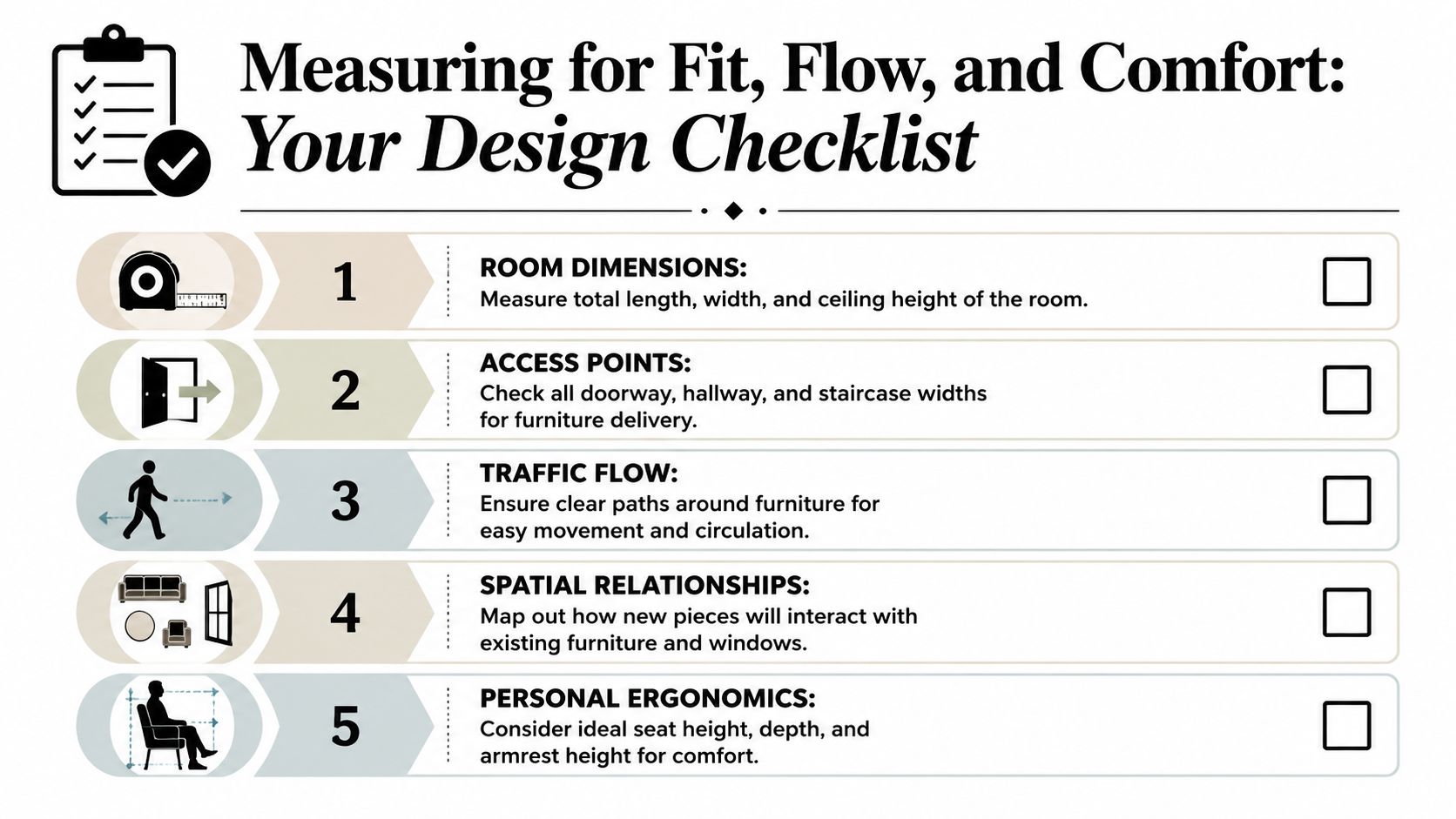
Use this checklist before you approve any design:
- Overall envelope: Measure length, width, and ceiling height. If there's a slope, capture where the ceiling changes, not just its highest point.
- Entry path: Check the front door, interior doors, hall turns, stair landings, and elevator access if relevant.
- Obstructions: Note baseboards, radiators, vents, outlets, switches, and window trim.
- Operating space: Leave room for drawers, recline functions, extension leaves, and people pulling chairs back.
- Sight lines: Stand in the doorway and in your main seat. Large furniture should support the room's balance, not block its best view.
If you need a practical worksheet for that process, how to measure furniture is worth bookmarking before you order anything.
Comfort is a fit issue too
Furniture can fit the room and still fit the body poorly. Here, appearance can easily sway people. A low, deep lounge seat may look inviting, but if you prefer an upright sit for reading or easier standing, it will become a daily irritation. The same goes for dining chairs with arms that catch on the table apron or a bed height that feels awkward morning and night.
Pay attention to these relationships:
- Seat depth and posture: Deep seats encourage lounging. Moderate depths support conversation and reading better.
- Seat height and ease of use: A chair should let your feet rest comfortably without making it hard to stand.
- Arm height: Arms should support the shoulder without forcing it upward.
- Table clearance: Knees need space. So do chair backs when pulled out.
Field note: If you can't sit in a similar scale piece before ordering, mock it up with boxes, painter's tape, or dining chairs already in the house. Crude tests catch expensive mistakes.
Handling awkward Bay Area layouts
An awkward room doesn't need a novelty solution. It needs disciplined proportion.
For sloped ceilings, keep tall case goods on the full-height wall and consider lower, longer profiles where the ceiling drops. For angled corners, don't force a square piece unless you're happy to waste the space behind it. A custom footprint, a softened corner, or a shallower depth often solves more than decorative tricks ever will.
In rooms with narrow circulation, slimmer arms and raised legs can reduce visual heaviness. In hillside homes where one wall dominates and another breaks unexpectedly, symmetry often loses. Better to balance the room with scale and visual weight than insist on matching pieces where the architecture won't support them.
Selecting Lifetime Materials and Finishes
Materials decide whether a piece merely arrives well or lives well. The quality of materials separates investment pieces from placeholders. Good materials don't just last longer. They age with more dignity, tolerate repairs better, and usually look more settled in a room instead of more tired.
The old Arts and Crafts idea of “honest materials” still makes sense because it asks the right question. What is this piece made of, and will that substance improve with time? According to this overview of furniture design history, that tradition of visible craftsmanship and durable construction supports buy-for-life options that can last 30 years or more, compared with 10 to 15 years for typical mass-produced furniture.
Wood choice shapes the whole piece
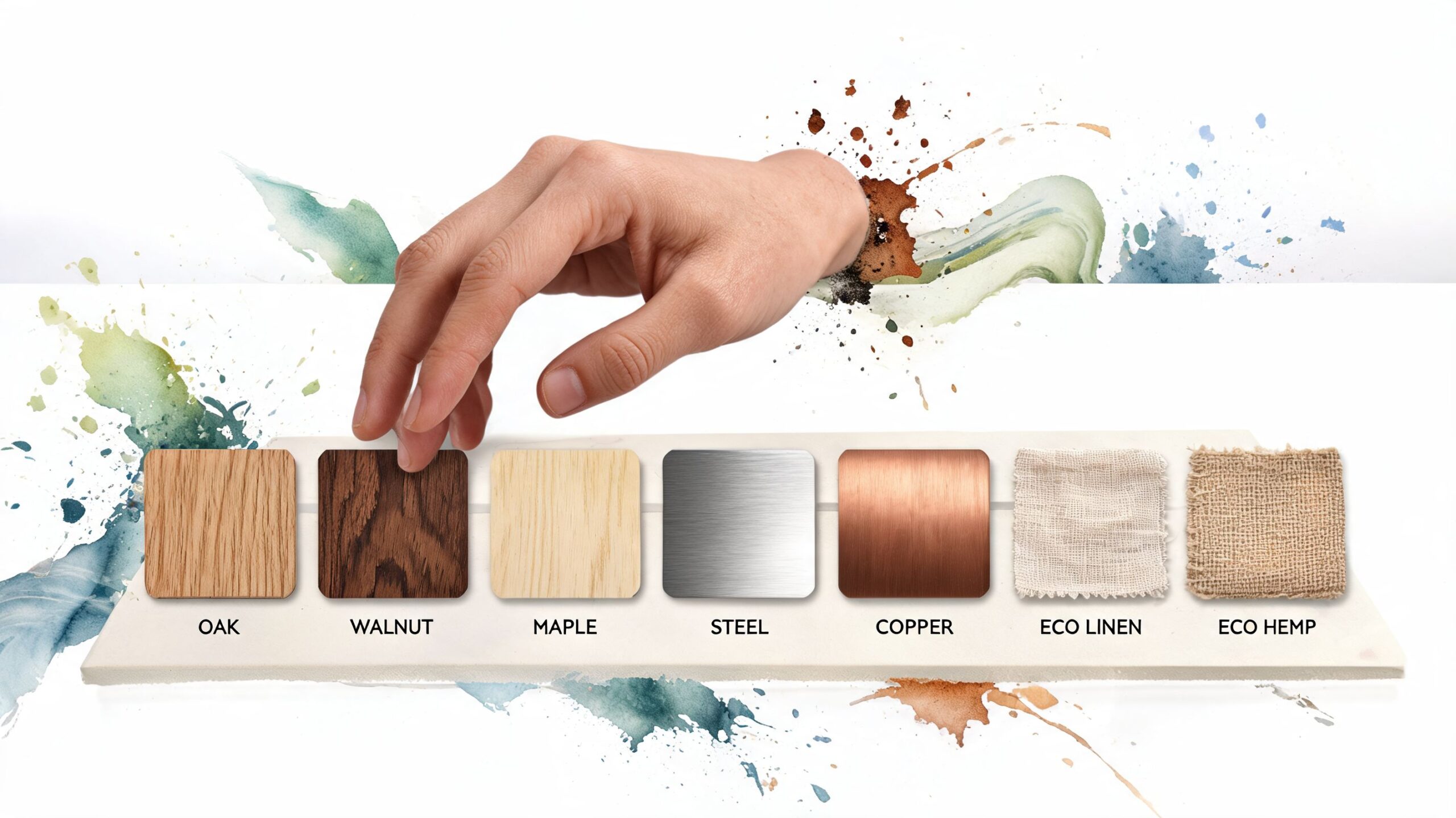
Wood isn't just color. It affects grain movement, visual character, and the way a piece feels in the room. Oak brings texture and clarity. Walnut reads deeper and more refined. Cherry often warms and develops a richer look as it ages.
Here's a straightforward comparison:
| Wood Type | Key Characteristics | Best For |
|---|---|---|
| Oak | Pronounced grain, sturdy feel, classic character | Dining tables, case goods, Arts and Crafts or Amish Furniture looks |
| Walnut | Rich tone, refined grain, sophisticated presence | Desks, bedroom furniture, statement pieces |
| Cherry | Warm color, elegant appearance, graceful aging | Traditional or transitional pieces, bedroom suites |
| Maple | Smoother grain, cleaner appearance | Contemporary furniture, painted finishes, lighter visual profiles |
For a deeper look at grain, color, and long-term wear, choosing the right hardwood for longevity and style is a practical reference.
Upholstery requires honest trade-offs
Leather and fabric are not interchangeable decisions. They answer different lifestyle needs.
Consider leather if you want a precise surface that develops character, is easy to wipe down, and suits rooms that benefit from structure. Consider performance fabric if softness, texture, and color flexibility matter most. If you have pets, children, or bright sunlight, ask tougher questions about abrasion, cleanability, and colorfastness instead of defaulting to what feels nicest in the moment.
A few rules hold up well:
- High-contact seats: Choose materials that forgive repeated use.
- Formal rooms: You can lean more decorative if the piece won't take daily abuse.
- Sun-exposed areas: Avoid delicate finishes and ask how the material changes with light.
- Mixed-material rooms: Sample leather, fabric, and wood together. Don't judge any one of them alone.
The best finish combination is rarely the most dramatic one. It's the one that still feels right after the novelty wears off.
Sustainability starts with lifespan
People often treat sustainability as a label issue only. It's also a lifespan issue. A piece you keep and repair is usually a better environmental decision than one you replace because the surface failed or the frame loosened.
That means asking practical questions when you order:
- Wood sourcing: Is the wood responsibly sourced, and can the maker speak clearly about it?
- Finish chemistry: Ask about low-VOC options if indoor air quality matters to you.
- Repairability: Can cushions, covers, hardware, or finish surfaces be serviced later?
- Adaptability: Will the piece still work if the room changes use?
Sometimes this thinking extends beyond furniture. If you're planning a compact bath, for example, this guide on finding sinks for compact spaces shows the same principle at work. Good design gets tighter, not sloppier, when space is limited.
Bringing Your Design to Life With Confidence
A lot of homeowners freeze at the word design because they think they need to draw like a professional. They don't. A simple sketch with dimensions, arrows, and notes is enough to start a serious conversation. In fact, rough sketches often help more than polished inspiration photos because they reveal what you care about.
Start with the shape, the size, and the function. Mark the overall width, depth, and height. Add the features that matter most, like drawers, shelf spacing, arm style, leg shape, or whether the back should look finished from all sides.

What to hand a design expert
A good brief saves time and avoids confusion. It doesn't need fancy formatting. It needs clarity.
Bring these pieces together:
- A rough sketch with key dimensions
- Room photos from several angles
- Material preferences such as oak versus walnut, leather versus fabric, matte versus higher sheen
- Use notes like “needs to hide cords,” “must clear a vent,” or “comfortable for long reading sessions”
- Reference images that show details you like, not just entire rooms
If you're designing around a larger renovation, supporting finishes matter too. Something as simple as a wall treatment can affect whether your furniture should stand out or settle back. This tiled feature wall guide is a helpful example of how surrounding surfaces change the furniture conversation.
Why 3D modeling prevents expensive surprises
Before prototyping, professional furniture designers use 3D CAD modeling as a mandatory quality control step, which allows them to create precise drawings, test mechanisms, and visualize custom materials before production, according to this furniture design process explanation.
That matters because a rendering is not just a pretty picture. It's a checkpoint.
What CAD catches that mood boards miss
A mood board can suggest color and feeling. A CAD model tests reality.
It helps confirm:
Proportion
Does the arm look too heavy? Is the cabinet too tall for the wall?Function
Will the extension work cleanly? Does the recline mechanism clear the space behind it?Material relationships
Does that wood stain still work beside the floor tone and rug pattern?Construction feasibility
Can the joinery, hardware, and silhouette be built the way you're imagining?
A custom piece gets safer to order when every important decision is visible before the first cut is made.
If you want help translating your notes into that kind of plan, interior design consultation services can bridge the gap between your idea and a buildable solution.
Your Custom Furniture Journey and Next Steps
By the time a project is ready to order, the process usually feels less mysterious than people expected. It starts with annoyance. A room that doesn't work. A piece that almost fits. A finish that looks right in isolation and wrong in the house. Then it becomes manageable once the questions get better.
The strongest projects usually share the same pattern. The homeowner defines the core problem. Measurements get handled carefully. Materials are chosen for service life, not just first impression. The final design is checked closely enough that surprises are minimized before production begins.
What works and what doesn't
What works is restraint. Clear dimensions. Real samples. Honest priorities. A willingness to spend more on the structure and less on decoration that won't matter in a year.
What doesn't work is rushing to the finish line because you're tired of shopping. That's how people accept a wrong scale, a weak material, or a layout compromise they'll notice every day.
A first custom piece also teaches something useful. Once you've gone through the process once, your eye gets sharper. You begin to notice seat pitch, drawer quality, wood character, finish depth, and why some rooms feel settled while others feel pieced together.
The long view matters
Buy-for-life thinking isn't old-fashioned. It's disciplined. It respects your budget, your home, and the resources that go into making furniture in the first place. When a piece is designed well, it doesn't need to chase trends to stay relevant. It keeps working.
That approach is especially valuable in Bay Area Interior Design, where homes often ask more from furniture than a standard catalog can answer. Tight footprints, unusual architecture, coastal conditions, and multi-use rooms all reward better planning. Custom Furniture gives you a way to respond to those realities without settling for compromise as the final answer.
Choose the piece that will still make sense when the room evolves, not just the one that solves this month's frustration.
If you're shopping in Furniture South San Francisco or anywhere in the Bay Area, it helps to work with people who can guide the process without pressure. A good consultant won't push you into a floor sample because it's available. They'll help you decide whether the right answer is on the floor, made to order, or worth revising before you commit.
That's especially important with Amish Furniture, custom leathers, and wood finishes, where one smart decision early can improve the piece for decades. The same steady approach applies when you're comparing Premium Mattresses or wondering whether financing options are available. The goal is the same. Buy thoughtfully, buy comfortably, and buy for the long haul.
If you're ready to move from ideas to a real plan, visit Giorgi Bros. Furniture in South San Francisco. Since 1933, our family-owned showroom has offered no-pressure guidance from Non-Commission Sales Staff, custom order options in wood species, finishes, leathers, and fabrics, and a chance to test quality in person across 50,000 square feet of inspiration. Bring your measurements, photos, and questions, or book a Design Consultation. We'll help you create an investment piece that fits your home and your life.