
A familiar bedroom scene often points to a problem bigger than the mattress alone: pillows sliding while someone tries to read, a partner snoring nearby, or a stiff lower back after a night spent in one position. An adjustable base can change how the body rests, but only if the mattress bends with it and still supports the sleeper. Treating the two as separate purchases is how people end up with a bed that moves but doesn't feel right.
Giorgi Bros. Furniture has served South San Francisco and the Bay Area for more than 90 years, with a 50,000-square-foot sleep gallery where shoppers can test mattresses and adjustable bases together. The useful question isn't which feature sounds impressive. It's how to choose a mattress on adjustable base that works as one system and earns its place in the bedroom for the long term.

For an overview of electric-base features and use, DME Superstore's electric adjustable bed guide is a useful companion. The decision, though, comes down to compatibility, posture, room fit, and whether the mattress returns to a stable, supportive shape after moving.
What an Adjustable Base Actually Changes in Your Bedroom
A fixed bed gives the sleeper one main position. An adjustable base lets the head and foot of the mattress move, changing how the body rests for reading, relaxing, or sleeping. That can make a bedroom more useful, but the base doesn't fix every discomfort on its own.
Someone who props up with stiff pillows to read may find that the pillows shift or push the neck forward. Someone who wakes with lower-back tightness may need to assess mattress support and sleeping posture, not raise the head. And if a partner snores, a change in position may help, but it shouldn't be mistaken for a diagnosis or a guaranteed solution.
The right way to think about the purchase is as an engineered sleep system. The base articulates. The mattress flexes and recovers. The sleeper needs a position that feels comfortable without creating pressure, a gap at the waist, or a loss of support. The bedroom itself matters too, since furniture clearance and headboard fit can affect what works in practice.
Showroom perspective: A feature is only useful if the whole bed works comfortably in the position where it'll be used.
Giorgi Bros. Furniture's sleep gallery gives Bay Area shoppers a chance to test the mattress and base as a pair rather than guess from a product description. That's a better starting point than choosing a base first and hoping a preferred mattress will follow.
The question worth answering before buying is straightforward: how do you pick a mattress on an adjustable base that earns its place for the next decade or more?
How Adjustable Bases Move and Why That Matters
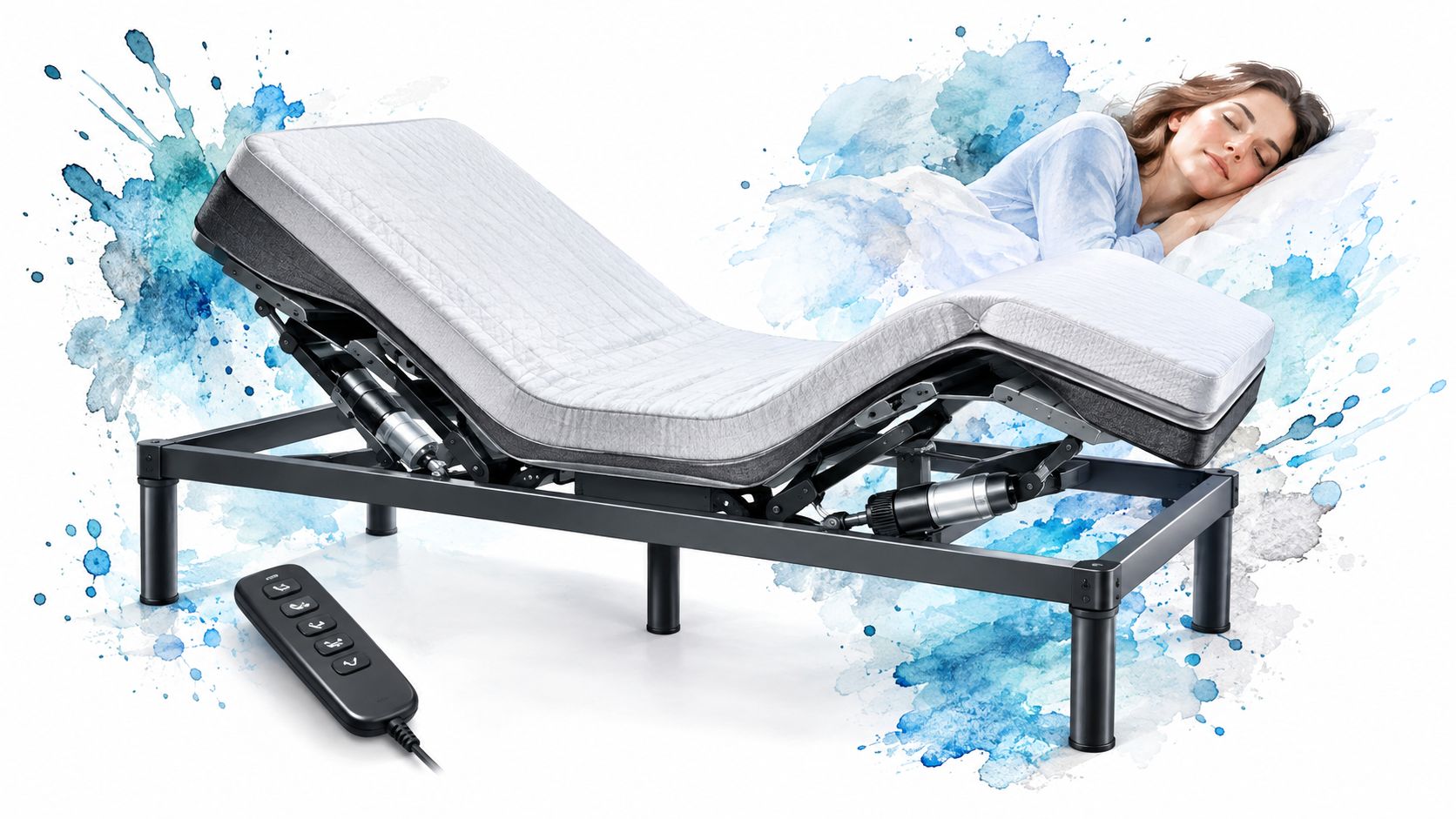
An adjustable base is a hinged frame with head and foot sections that move independently. Electric motors drive the movement, typically through a remote. Raise the head, and the upper part of the mattress follows; lift the legs, and the lower section changes angle. Some bases also offer preset positions, such as a lounge or zero-gravity setting.
Think of a recliner mechanism beneath a mattress. The frame bends at set points, so the mattress has to follow those curves without pulling apart, buckling, or losing its shape. A mattress that resists the movement can tent at the foot or leave a gap. One that bends but doesn't recover can develop creases or a permanently uneven surface.
The base also lifts a combined load, not just the people sleeping on it. Mattress, bedding, and occupants all count toward the model's capacity, and the load needs to remain within the manufacturer's instructions. Some manuals distinguish between the total load supported by the foundation and the load a motor is designed to move, so those details deserve a close read. A base rated for a particular total weight shouldn't be assumed to lift that full amount when only the head or foot section is raised.
A split base adds another practical concern: each side should carry its share of the load. Uneven loading can make the two sides rise differently. A resource on using a two-pillow breathing aid can offer general positioning context, but pillows and an adjustable base serve different purposes and aren't interchangeable.
The mechanical demands are simple to describe: the mattress needs to bend repeatedly, recover when the base returns flat, and keep supporting the sleeper throughout the movement. Those demands make mattress construction more important than a label alone.
Which Mattress Types Actually Flex Well
Foam-dominant mattresses and flexible hybrids usually adapt more readily to an adjustable base than stiff traditional innersprings. But “flexible” isn't the whole test. A mattress also needs structural recovery, which means it returns to a flat profile and retains support after repeated movement.
| Construction | Articulation | Recovery | Best Fit |
|---|---|---|---|
| Memory foam | Usually follows the base smoothly | Look for a model that regains its shape without lasting creases | Sleepers who want close contouring |
| Latex | Can flex well, depending on the design | Check that it settles evenly when flat | Shoppers who prefer a responsive feel |
| Foam-forward hybrid | Often balances contouring with support | Varies with the coil unit and foam layers | People seeking a middle ground |
| Pocketed-coil hybrid | Depends on the coil design and surrounding layers | Test for stable alignment and no coil protrusion | Shoppers who want both foam comfort and a spring core |
| Traditional continuous-coil innerspring | More likely to resist sharper bends | May slope or leave gaps near the foot | Generally a cautious choice unless explicitly approved and tested |
Thick, stiff designs deserve particular attention. When the base bends, a rigid mattress may slope awkwardly or pull away from the foot section. That's not just a cosmetic flaw: gaps and instability can make the surface feel uneven and affect support. Material quality alone doesn't predict whether a mattress will articulate well.
Very hard surfaces can also feel unforgiving when the base changes the body's posture. Independent mattress guidance notes that medium-firm surfaces tend to support comfort, sleep quality, and spinal alignment better than very hard surfaces. The adjustable base should fine-tune posture, not compensate for a surface that feels excessively rigid.
For a more detailed construction comparison, see Giorgi Bros. Furniture's guide to memory foam vs. hybrid vs. innerspring mattresses. In person, test each option flat and raised. Look for tenting, a persistent fold, exposed or protruding coils, and a mattress that fails to lie evenly when the base comes down.
Showroom Evaluation You Can Run in Five Minutes
Don't test a mattress only in the flat position. A mattress can feel comfortable when still and perform poorly as soon as the base moves. Ask to operate the exact mattress-and-base pairing you're considering.
Start with the base flat and notice whether the mattress lies evenly. Then raise the head section to a comfortable reading angle. Pay attention to your neck, shoulders, and lower back, and check whether the mattress slides or pulls away from the frame.
Next, raise the foot section. Look closely for tenting near the foot, a gap between the mattress and platform, or a fold at a hinge point. Try a combined lounge or zero-gravity position, too. A mattress should follow the frame without losing a stable feel under the body.

Before settling on a model, ask the consultant two direct questions:
- Has this exact pairing been tested together? Ask about the positions you expect to use, not just whether the products can be sold as a set.
- Does the mattress manufacturer explicitly approve this model for adjustable-base use? A general claim about a whole product category isn't the same as approval for the model in front of you.
Brand matching doesn't guarantee a good mechanical fit. The important factors are flex, surface stability, and recovery. Giorgi Bros. Furniture's premium mattress brands page can help shoppers review available options, but the showroom test tells more than a logo or description.
Finish by returning the base to flat and checking whether the mattress settles back into a smooth, even profile. A few minutes spent testing can help prevent a long-term mismatch.
What the Sleep Research Actually Shows
Adjustable bases can change how people feel, but research doesn't establish a universal improvement in sleep or health. A 2022 controlled study tracked more than 1,100 nights among 26 participants while evaluating an adjustable bed base (study summary in Sleep). A separate study reported an increase of 6 minutes in total sleep time and 5 minutes in light sleep compared with baseline, with statistical tests reported as significant. Those are measurable differences, not a promise that every sleeper will notice the same effect.
A 2025 field study reported modest objective changes alongside larger self-reported benefits: participants reported 26% better perceived sleep, 45% less back pain, and 29% greater morning refreshment (study report in Sleep). Another 2025 study found no objective sleep change after the switch to an adjustable base, while participants reported better perceived sleep, morning refreshment, and back comfort. That contrast matters. A person may value easier positioning or less discomfort even when a sleep tracker shows little change.
In a small home study, self-reported snorers used a 12-degree upper-body incline during the study's inclined phase. Objective monitoring found a 7% relative reduction in snoring duration (home study in JMIR Formative Research). The result supports treating elevation as a positioning strategy, not a cure. Persistent loud snoring, pauses in breathing, or daytime sleepiness deserves clinical evaluation. A guide to sleep breathing disorders can help explain why symptoms shouldn't be dismissed.
For shoppers, the practical expectation is better positioning and comfort where the setup suits the sleeper. Universal medical improvement isn't a reasonable promise. Giorgi Bros. Furniture's overview of adjustable bed health benefits can provide additional context, but persistent pain, reflux, or sleep concerns call for professional advice.
Setup, Weight Limits, and Split-Base Balance
Treat setup as part of choosing the bed, not a detail to handle after delivery. Add up the expected weight of the mattress, bedding, and occupants, then compare that total with the base's manual. One manufacturer's manual sets a maximum of 750 pounds for a Queen and 500 pounds for a Twin XL, including mattress and bedding, and rates its motors at 320 pounds (manual and specifications). Those figures apply to that manufacturer's product, not to every adjustable base.
The manual also explains that the base isn't intended to lift the full rated load using only the head or foot section. Keep the load distributed evenly and follow the model-specific operating instructions. With a split setup, uneven weight can cause the sides to rise differently, so a compatible mattress and balanced loading matter (split-base safety manual).
Before delivery, check the room and bed frame:
- Measure mattress height and headboard clearance. A taller mattress can change the way the bed sits and moves.
- Confirm sheet fit and retainer-bar placement. The mattress needs to stay in position as the platform articulates.
- Check access and clearance around the bed. Make sure the frame can be positioned and operated as intended.
- Register the warranty after delivery. Keep the manual and product details accessible.
Giorgi Bros. Furniture's mattress thickness guide can help with planning the finished bed height. The team's white-glove delivery handles in-home setup across most of the Western United States with location-based flat-rate pricing, and a trusted deluxe carrier network supports orders outside its direct delivery area. Those logistics matter, but the base's own manual remains the authority on its limits.
Buy It Once, Use It for Decades
A mattress-and-base system is an investment piece, not a disposable bundle. A mattress that bends easily but loses its shape isn't a long-term choice, and a capable base can't make an unsuitable mattress feel supportive. Fit, recovery, and comfort deserve more attention than a list of features.
There's an environmental reason to choose carefully, too. Massachusetts environmental documents estimate that roughly 75% to 90% of mattress components are recyclable, while the state reports that more than 600,000 mattresses and box springs are discarded there each year (state background document). The same document reports that recycling one mattress can save about 500 gallons of water, enough energy to power a home for three days, and emissions comparable to driving a car 60 fewer miles. Responsible recycling keeps recoverable steel, wood, cotton, and foam in circulation instead of sending those materials to landfill.
For Bay Area households, the buy-it-for-life approach means testing carefully, confirming compatibility, and choosing a mattress that fits the sleeper's needs and the base's motion. It also means looking beyond the mattress when furnishing a bedroom. Giorgi Bros. Furniture is family-owned, and its non-commission Consultants can help shoppers consider the complete room and explore custom order services for fabrics, leathers, wood species, and finishes. In-store financing options are available, so shoppers can discuss a purchase at a pace that suits their budget.
The point isn't to buy the most features or commit before feeling sure. It's to make an informed choice, use the system well, and plan for responsible recycling when replacement eventually becomes necessary. For adjustable-base options and practical consumer feedback, browse adjustable bed base reviews.
Experience It in the Showroom Before You Commit
Bring your real bedroom needs into the showroom: the positions you use, the room's clearance, the sleeper's weight, and the finished bed height. Then test a mattress and base together. A useful showroom visit shows how the whole system behaves under the body, which no remote demo or feature list can convey.
Start with the mattress flat, then raise the head and feet and try the lounge position. Notice whether the mattress bends without feeling strained, stays supportive, and returns to shape when lowered. Ask to compare a foam mattress with an individually pocketed coil model on the same base, then check how each feels in the positions you expect to use. If you're shopping for a split base, test both sides and confirm the setup suits the room.
Set realistic expectations, too. Positioning may improve comfort or how a sleeper feels, but an adjustable base does not guarantee a medical or sleep-tracking improvement. Ask direct questions about mattress compatibility, weight limits, clearance, and delivery access before choosing a pairing.
Giorgi Bros. Furniture's South San Francisco showroom lets shoppers try mattresses and adjustable bases in person, with guidance from non-commission staff and design experts, including ASID interior designers. Shoppers furnishing a broader Bay Area project can also explore custom furniture, Amish furniture, and custom-order options for fabrics, leathers, wood species, and finishes. The focus is on choosing pieces that fit the home and work well together over years of use.
Bring your room measurements and ask to test the mattress-and-base pairings that match your needs. Visit the showroom or book a Design Consultation for guidance on a system built for long-term comfort.
Giorgi Bros. Furniture offers premium mattresses, adjustable bases, and non-commission design guidance. Visit Giorgi Bros. Furniture in South San Francisco or book a Design Consultation to test a mattress-and-base combination before committing.