
A shopper comparing recliners usually reaches the same moment: one chair has a side lever, the other has a quiet button panel. Both feel comfortable in the showroom. Both look capable of becoming the household's favorite seat. The better choice depends less on which chair feels impressive for five minutes and more on how the mechanism, placement, maintenance, and daily use will hold up over the long term.
For households planning a buy-it-for-life furniture investment, the power recliner vs manual decision deserves careful attention. A manual chair offers mechanical simplicity and freedom from outlets. A power model offers precise positioning and easier movement. Neither is automatically better, and a no-pressure comparison can save years of frustration.
The Recliner Decision Most Shoppers Actually Face
The decision often starts with a simple test. A shopper sits in a manual recliner, reaches for the lever, and feels the footrest rise. The movement is familiar and direct. Then the shopper tries the power model beside it, presses a button, and watches the back and leg rest move gradually into position.
Both chairs can feel right for different reasons.
A recliner may become the most-used seat in a home. It might serve for reading, television, afternoon rest, conversation, or recovery after a long day. That makes the purchase more important than a quick showroom reaction. Upholstery matters, but so do the internal mechanism, frame construction, body fit, service access, and the habits of the person who'll use it.
The global category is also substantial and expanding. One 2025 global market estimate values the recliner market at $27.4 billion, with a projected rise to $39.8 billion by 2034 at a 5.2% CAGR. The same estimate reports that power recliners represent about 58.3% of unit sales and 63.2% of revenue, while manual models represent 41.7% of units. That revenue difference reflects the added motors, controls, and premium features found in power seating, as outlined in this global recliner-market estimate.
The trade-offs worth weighing
A serious comparison should answer practical questions:
- Comfort: Does the chair support the body in the positions used most often?
- Effort: Can every household member recline and return upright comfortably?
- Durability: How many components could require service later?
- Placement: Can the chair work without creating a cord or clearance problem?
- Value: Does the mechanism solve a real daily need, or add features that may go unused?
Practical rule: Choose the mechanism that makes everyday use easier, not the one with the longest feature list.
Giorgi Bros. Furniture has served South San Francisco and the Greater Bay Area for over 90 years, with a family-owned, non-commission environment built around no-pressure guidance. That kind of setting matters when a recliner will remain in the home for years. Quality furniture costs less over its useful life when the frame, upholstery, and mechanism fit the household from the beginning.
How Power and Manual Recliners Actually Work
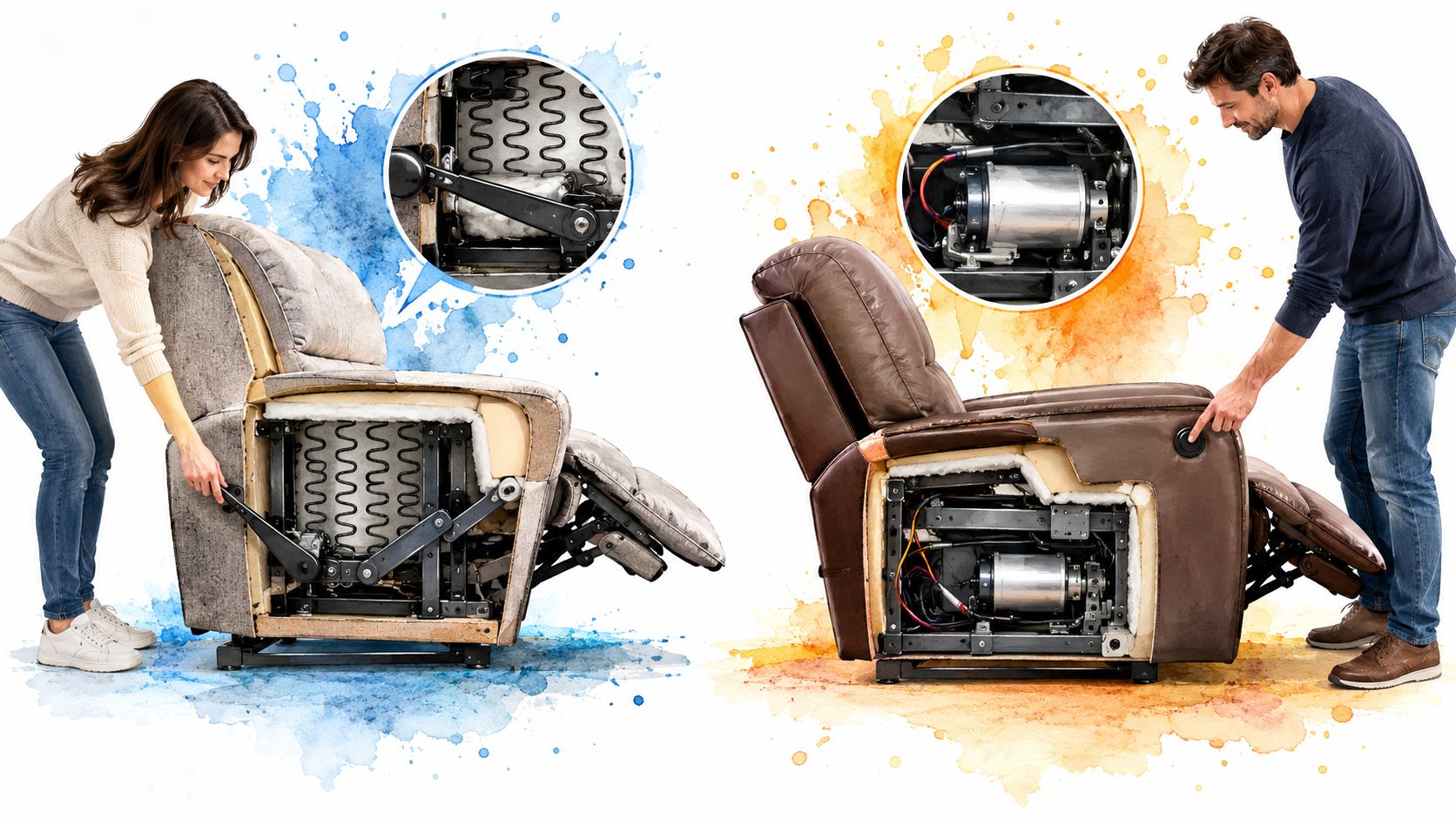
The simplest way to understand the choice is to look inside the chair.
A manual recliner uses a mechanical mechanism connected to a lever, handle, or push-back action. The user supplies the force. Pulling a lever or handle releases the mechanism, while leaning back activates a push-back design. Springs, cables, latches, and metal components guide the chair into its available positions.
Manual recliners generally fall into three practical styles:
- Lever-pull models place a release lever on the outside of the arm. The lever activates the footrest and recline.
- Handle-pull models use a smaller handle, often tucked into the side of the chair.
- Push-back models have no obvious exterior control. The user shifts body weight backward to recline, which can work well in rooms where a cleaner silhouette matters.
The mechanism usually offers selected positions rather than unlimited stopping points. That simplicity is useful because the chair doesn't need electricity, a control box, or a charging plan.
What the motor changes
A power recliner adds an electric motor or linear actuator to move the reclining frame. Buttons on the arm or a remote control send the command, allowing the user to stop the backrest or leg rest at a chosen point. As this explanation of power reclining seating notes, powered movement can support more precise positioning than a basic manual mechanism.
Depending on the chair, the motor may control the back and footrest together or operate separate sections independently. More advanced models can include powered headrests, lumbar adjustment, USB charging, massage, heat, or zero-gravity positioning. Those features can be valuable, but only when the household will use them regularly.
Power seating can connect to a wall outlet through a cord or use a battery pack. A battery solves some placement problems, but it has to be recharged and may not operate every function indefinitely.
In practical terms, manual seating favors mechanical simplicity and repairability. Power seating favors effortless movement and adjustment, while adding electrical components that deserve attention during selection.
Comparing the Differences That Matter Most
The right power recliner versus manual recliner comparison starts with daily use, household needs, and the years ahead. A manual chair suits buyers who want a straightforward mechanism and freedom to place the chair anywhere. A power chair earns its higher cost when precise adjustment or reduced physical effort will improve comfort every day.
| Factor | Power Recliner | Manual Recliner |
|---|---|---|
| Everyday comfort | Smooth movement and more precise stop-points | Direct operation with selected positions |
| Upfront cost | Usually higher because of motors, controls, and added components | Usually lower because the mechanism is simpler |
| Durability | Quality frames can be durable, but motors and wiring add service points | Fewer components can make long-term ownership simpler |
| Maintenance | Electrical parts may need diagnosis or replacement | Mechanical service is often more straightforward |
| Ease of use | Helpful for arthritis, limited strength, or post-surgery recovery | Requires physical effort to activate and close |
| Placement | Needs an outlet or charged battery plan | Works anywhere without electrical dependence |
| Features | May support headrest, lumbar, charging, heat, massage, or zero gravity | Focuses on core reclining function |
Comfort and positioning
Power models provide continuous adjustment across the motor's range. Users can make small posture changes instead of moving to the next fixed position. That control can help someone managing arthritis, chronic pain, or limited strength, especially when the chair is used for reading, resting, or sleeping.
Manual chairs respond more directly. Some buyers prefer leaning back or pulling a lever, while others do not need fine adjustments. Test the available positions with the person who will use the chair. The best mechanism is the one that supports comfortable sitting without making daily use feel like work.
For shoppers focused on posture and lumbar support, this guide to recliners for back support helps organize the showroom test around body fit rather than appearance.
Durability and service
A quality manual mechanism can provide decades of service with basic care. Its simpler construction can be an advantage in a busy household, particularly when several people use the chair. A power mechanism adds a motor, wiring, switches, and control components. A well-built power recliner remains a sound investment, but warranty coverage and access to local service matter more.
A durable frame matters more than a crowded control panel. Upholstery, mechanism quality, and service access should come before features that may rarely be used.
Choose a manual recliner for simplicity, easy placement, and fewer service points. Choose a power recliner for independent positioning and reduced physical effort. Over decades rather than seasons, the better investment is the chair your household will use comfortably and maintain appropriately.
The True Cost of Owning Each Type Over Time
The purchase price tells only part of the story. A manual recliner generally has fewer components that can wear out, which can make ownership easier to manage. The lever, handle, cable, springs, upholstery, cushions, and frame still deserve quality inspection, but the chair doesn't depend on an electrical system.
That simplicity can make a manual model a sound long-term value when the fit and comfort are already right. A chair that costs less but feels wrong will still be a poor investment if it gets avoided. Comfort determines whether the household uses the piece, and frequent use is what gives a recliner its real value.
Power recliners carry more components from the start. Motors, wiring, switches, control boxes, and battery packs can all affect future service. Buyers should ask how the manufacturer handles replacement parts, whether technicians can service the mechanism locally, and what the warranty covers. The warranty information from Giorgi Bros. Furniture provides a useful example of why after-sale terms belong in the buying conversation.
| Cost Factor | Power Recliner | Manual Recliner |
|---|---|---|
| Purchase | Higher because the chair includes powered hardware and controls | Generally lower because the mechanism is mechanical |
| Routine use | May involve cord management or battery charging | Needs no electricity or charging |
| Repairs | Electrical diagnosis can require a technician | Mechanical repairs are often more direct |
| Replacement concerns | Motors, controls, wiring, and batteries may need attention | Levers, cables, springs, upholstery, or cushions may need service |
| Long-term value | Strong when powered movement supports daily comfort or independence | Strong when simplicity, fit, and low maintenance are the priority |
Look beyond the first receipt
The useful calculation is cost per year of comfortable service. A well-built manual recliner may continue working for decades with limited intervention. A quality power model may also be a responsible long-term investment when its motorized movement supports independence, reduces effort, and keeps the chair in daily use.
The frame should receive more scrutiny than the motor count. Buyers should inspect the joinery, cushioning, upholstery, reclining mechanism, and service plan. Custom upholstery can also extend the practical life of a piece when the structure remains sound.
The sustainability of quality furniture becomes practical. Keeping one well-made investment piece in service avoids the cycle of replacing a disposable chair whenever a weak mechanism, thin cushion, or unsuitable fabric gives out. Flexible financing options are available at Giorgi Bros. Furniture, but financing should support a thoughtful purchase, not encourage a rushed one.
Matching the Right Recliner to Your Household
The household, not the showroom trend, should decide the mechanism.
For empty nesters, a power recliner often makes sense in the main living room. Repeatedly reaching for a lever or pushing a footrest closed may become inconvenient, especially when one person has less strength or flexibility than before. Button-controlled movement lets the user adjust position independently without asking for help.
A manual recliner suits a quieter reading room, guest space, or second home where simple operation matters more than powered precision. It works without an outlet, avoids another remote, and can feel more visually restrained.
Match the chair to the user
Family rooms demand a slightly different judgment. Frequent use favors sturdy construction and upholstery suited to the household's routines. Manual models offer fewer electrical concerns, while power models can help children, older guests, and adults with limited strength change position more easily.
Post-surgery recovery deserves a careful fitting process. A power or lift recliner may be the more practical investment when rising, sitting, or returning upright requires reduced effort. The chair still needs appropriate seat height, depth, arm support, and physician-approved positioning. A broader complete guide for back pain can provide general context, but individual medical guidance should come from the relevant healthcare professional.
For a second home or occasional-use space, a manual chair often offers the cleaner ownership experience. A mixed household can place a power recliner in the primary living area and use manual seating elsewhere.
Upholstery belongs in the decision
Mechanism choice shouldn't overshadow the cover. Fabric, leather, wood accents, and finish all affect whether the piece remains attractive and useful as the room changes. Performance materials can be worth considering in a busy living space, and this overview of performance fabric furniture offers a practical starting point.
Custom Furniture allows the buyer to select fabrics, leathers, wood species, and finishes rather than settling for whatever sits on the floor. Giorgi Bros. Furniture also offers Amish Furniture and premium mattresses, making it possible to coordinate a broader room plan with the same no-pressure guidance.
Sizing, Placement, and Power Considerations at Home
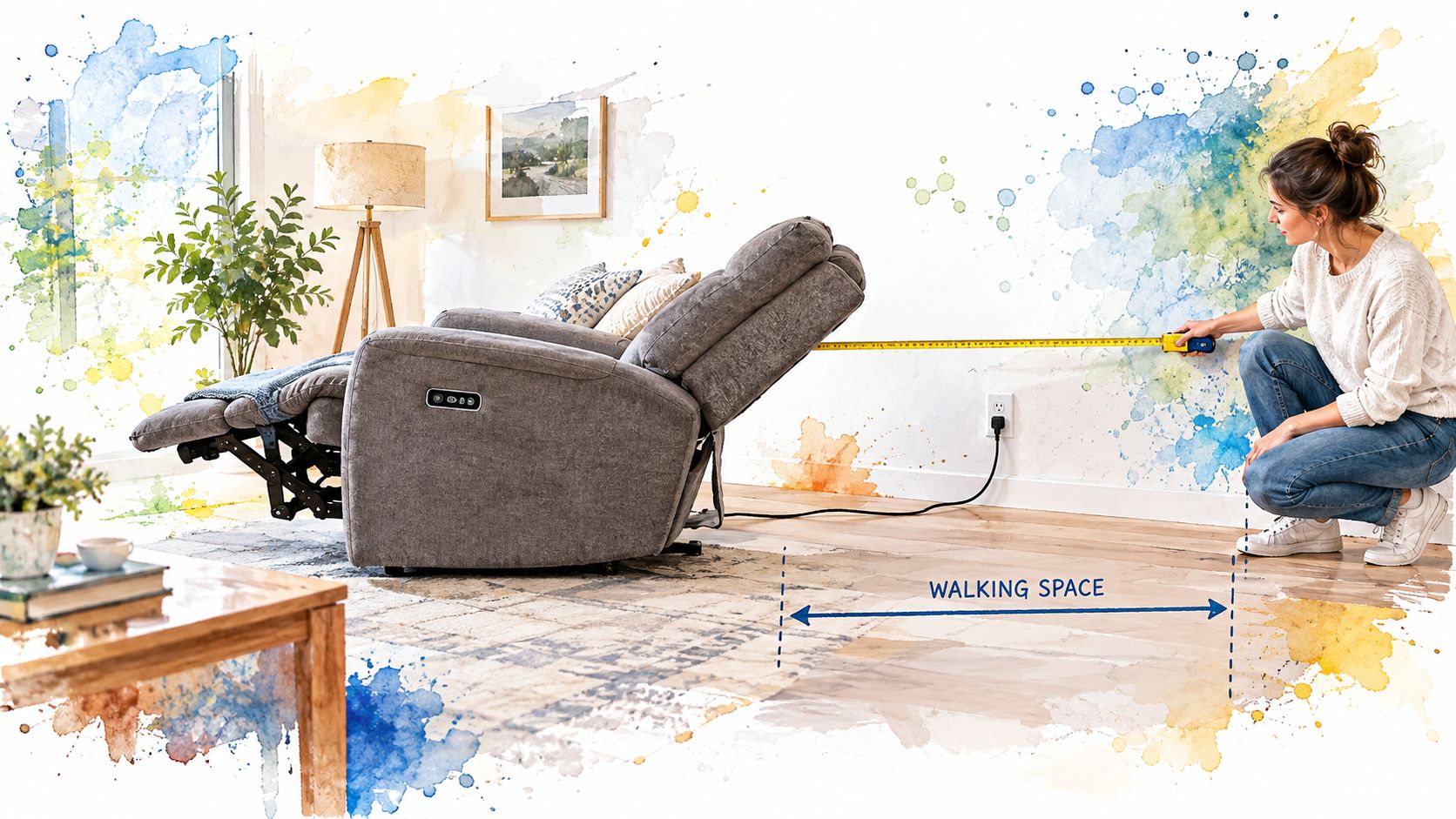
A recliner can fit the floor plan upright and still create trouble when fully open. Measure the chair in both positions, then account for walking space around the arms and footrest. A wall-hugger or space-saving design may preserve clearance in a compact room, but its required distances should still be confirmed before purchase.
Delivery access deserves the same attention. Measure doorways, stairways, hallways, and elevator openings before the order is finalized. A chair that cannot turn through a narrow entry can create avoidable costs and delays.
Fit the body, not just the room
Seat dimensions determine whether the recliner feels supportive after extended use. Compare:
- Seat height: The feet should meet the floor naturally when sitting upright.
- Seat depth: Excess depth can leave shorter users without reliable leg support.
- Seat width: A narrow seat can restrict movement, while too much room can reduce side support.
- Back height: The back should support the shoulders, neck, and head as intended.
- Arm position: Arms should support relaxed shoulders rather than forcing them upward.
- Weight capacity: The selected model must suit the intended user and household needs.
Testing matters. Sit upright, recline, return to standing, and remain seated long enough to notice pressure points. A chair can look supportive yet feel unbalanced after extended use.
Plan the electrical connection early
A wired power recliner needs a grounded outlet and a safe cord route. The cord shouldn't cross a walkway, sit beneath a moving mechanism, or become trapped against the wall. A battery pack can reduce outlet dependence, but it requires routine charging and may not support every feature.
Ask whether the chair can return upright during a power outage and whether the battery is removable. Leave enough access around the motor and power connection for future service. Giorgi Bros. Furniture offers furniture installation support, which can help ensure that placement and setup are handled properly.
Which Recliner Is the Right Investment for You
The manual choice is clear for buyers who prioritize a lower entry cost, simple mechanics, unlimited placement freedom, and straightforward service. It works particularly well when the user has no trouble operating a lever or push-back mechanism and doesn't need continuous position adjustment.
The power choice is clearer for buyers who need assisted movement, precise posture changes, or easier transitions after surgery. It also suits a shared household where different users need different recline angles. Features such as powered headrests, lumbar support, USB charging, massage, heat, and zero gravity should be treated as tools, not decorations. If the household won't use them, they shouldn't drive the purchase.
Market direction supports the growing appeal of powered seating, but adoption still depends on price, electricity access, and personal preference. In the United States living-room recliner category, one estimate places power models at roughly 55% to 60% of unit sales in 2026, with a projection of 70% to 75% by 2035. In India, the same source describes a different balance, with powered recliners representing 40% to 45% of new product launches while manual models account for about 55% to 60% of unit demand, as shown in this market analysis of living-room recliners. The figures point to a transition, not a universal answer.
Make the showroom test count
A proper test includes both types side by side. Sit in each chair for at least five minutes. Try the upright, partially reclined, and fully reclined positions. Pay attention to foot support, lumbar contact, head position, arm height, and the effort required to return upright.
Ask design consultants about frame construction, upholstery durability, replacement parts, warranty service, and cord or battery options. A 2026 market report describes power seating as the projected growth leader, while trend coverage highlights smart integration and ergonomic design as purchase drivers. Those developments are worth considering, but buyers should still ask whether the additional functions will be used enough to justify their maintenance and placement requirements, as discussed in this coverage of current recliner trends.

The final recommendation: Buy manual for simplicity. Buy power for accessibility and precise comfort. In either case, choose the strongest frame, best body fit, and most serviceable construction available for the household's needs.
Giorgi Bros. Furniture offers manual and power seating in a 50,000-square-foot South San Francisco Showroom, with non-commission Consultants, Custom Furniture services, flexible financing options, and white-glove delivery across much of the Western United States. Visit Giorgi Bros. Furniture to test both mechanisms in person or book a Design Consultation for no-pressure guidance.