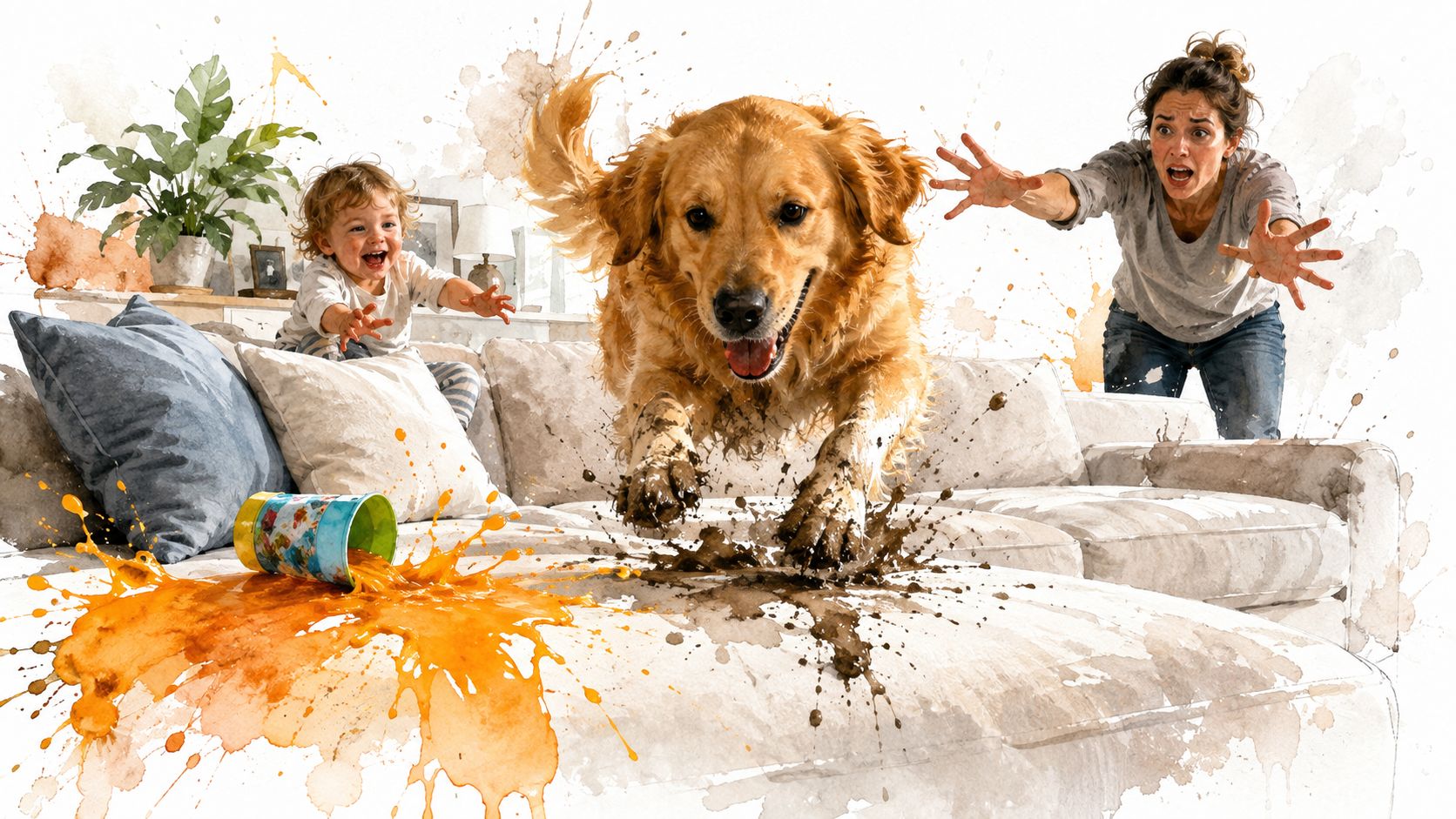
Saturday morning starts with the kind of scene every Bay Area household knows. A toddler tips a juice cup onto a cream sectional, a golden retriever jumps up with muddy paws, and the homeowner braces for a ruined cushion. Instead, the drink beads on the surface and wipes away with a clean cloth.
That moment captures the appeal of performance fabric furniture, but the label alone isn't enough to guide a smart purchase. “Performance” describes a category of engineered upholstery designed to resist stains, moisture, abrasion, and fading. It doesn't guarantee that every fabric handles every spill, feels comfortable, or keeps its protection forever.
Families furnishing a living room, remodeling a whole home, or choosing Custom Furniture need to understand what creates that protection. Fiber chemistry, weave structure, and topical finishes behave differently in daily use. Durability ratings also measure narrower qualities than many buyers realize. The right questions reveal whether a fabric offers lasting protection or impressive showroom beading.
Why Performance Fabric Furniture Deserves a Place in Your Home
A cream sofa can serve a busy family room. A textured chair can hold its own in a formal sitting area. The value of performance fabric furniture is practical: it gives you more time to respond when daily life brings spills, muddy paws, and heavy use.
An early indoor performance fabric line launched in March 2014, using polypropylene, a fiber produced as a byproduct of oil refining and natural gas processing. That milestone reflects the broader move toward engineered, stain-resistant synthetics for indoor upholstery. The category has continued to expand. One market report valued the furniture performance fabric market at USD 140.98 million in 2025, projecting USD 152.28 million in 2026 and USD 256.31 million by 2032, an implied 8.91% CAGR, as covered by Furniture Today's coverage of Revolution Performance Fabrics.
Performance means more than stain resistance
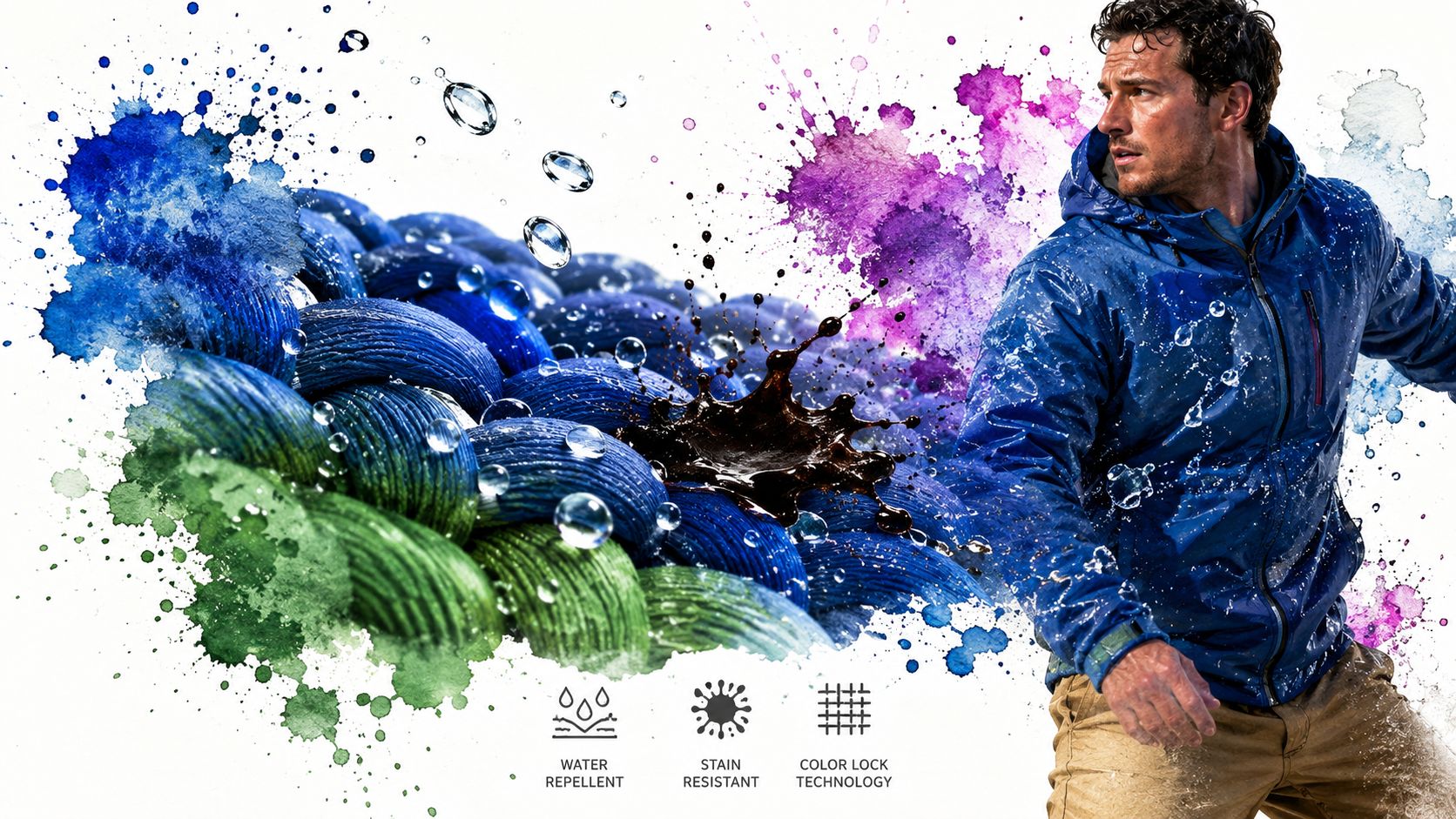
A well-chosen upholstery fabric should balance several demands:
- Stain release: Spills remain closer to the surface or clean away more readily.
- Moisture management: Some constructions slow liquid penetration.
- Abrasion resistance: The upholstery withstands repeated sitting and friction.
- Color retention: Certain fibers and finishes help limit visible fading.
- Comfort: Newer textures can feel soft, substantial, and suitable for designer rooms.
Those results do not always come from the same source. A fabric can resist abrasion while still absorbing liquid. Another can repel water because of a topical finish that becomes less effective after repeated cleaning. Ask whether the protection comes from the fiber itself, the weave, or a surface treatment. Fiber-based protection generally has a stronger claim to lasting through use, while a finish can provide useful short-term repellency but requires more attention to cleaning instructions.
Consumer demand also reflects how long families expect furniture to serve them. Industry guidance cites a survey in which just over one-third of consumers expect to replace a sofa within 5 to 9 years, while about half plan to keep one for 10 years or more, including 25% expecting 10 to 14 years and 25% expecting 15 years or more (FiberGuard's performance fabric guidance). If your household expects that lifespan, inspect the upholstery alongside the frame, cushion construction, and finish.
Practical rule: A performance label starts the conversation. It should not end the inspection.
Performance fabric furniture belongs in high-design interiors because manufacturers can combine cleanability with color, texture, and a comfortable hand feel. Choose the fabric whose protection matches your household's actual risks, not the one with the most impressive showroom beading.
How Performance Fabrics Actually Resist Stains and Wear
Performance upholstery generally relies on three protective strategies. The first works inside the fiber, the second uses the structure of the textile, and the third adds a surface treatment. Understanding that difference helps a buyer predict what may remain effective after years of sitting, vacuuming, sunlight, and cleaning.
Fiber-level protection
Solution-dyed fibers receive color during production, so the pigment becomes part of the fiber rather than sitting only near the surface. Acrylic and olefin are common examples of fibers chosen for moisture and light exposure. Polypropylene, the fiber used in the indoor Revolution launch discussed earlier, also illustrates how engineered synthetics became central to the category.
Fiber chemistry can provide durable color performance and resistance that doesn't depend entirely on a coating. It isn't a universal shield against oil-based spills, though. Fiber-level protection may perform particularly well against moisture and fading while still requiring prompt, approved cleaning for grease or colored substances.
Structural barriers and woven density
A tightly woven textile leaves less open space for crumbs, dust, and liquid to move through. The weave can support easier surface cleanup and help upholstery feel substantial. A woven barrier or backing can add another layer against liquid penetration, but it doesn't make the fabric puncture-proof or immune to seam failure.
The most useful question is whether the construction has a barrier, how the manufacturer defines its cleaning limits, and whether the protection exists throughout the textile or only on one face.
Topical finishes
A topical hydrophobic finish encourages water-based liquids to bead on the surface, giving residents time to blot. Some upholstery uses a protective surface finish so everyday stains can be removed with water and mild soap, according to Crevin's performance fabric information. Another fabric system describes a PFAS- and fluorocarbon-free hydrophobic finish that wraps the yarn and temporarily keeps spills on the surface (Vescom's information about Clint).
Topical treatments offer an excellent first response, but they aren't permanent by definition. Repeated cleaning, friction, and exposure can reduce surface effectiveness. Buyers should ask whether the protection is embedded, woven into the construction, backed by a barrier, or applied as a finish.
For households comparing options, pet-friendly furniture fabrics can help frame the broader lifestyle questions, but the fabric specification still deserves close review. The most dependable upholstery often combines more than one method. The buyer's job is to identify which method does the primary work.
Comparing Leading Performance Fabric Technologies
Different performance technologies solve different problems. A moisture barrier is useful in a household with frequent spills. Solution-dyed acrylic makes sense in a bright room. A nano-coated natural-looking textile may appeal to someone who cares most about softness and visual character. No option eliminates the need to follow the care code.
A practical comparison
| Technology | Protection Method | Best Against | Cleaning Compatibility | Protection Lifespan | Ideal Use-Case |
|---|---|---|---|---|---|
| Immersion-treated fabric with moisture-barrier backing | Fiber treatment combined with a backing | Liquid penetration and everyday stains | Follow the manufacturer's approved water or solvent instructions | Fiber and barrier protection can outlast a surface-only finish, but the fabric remains vulnerable to cuts and punctures | Young children, pets, and heavily used family rooms |
| Solution-dyed acrylic | Color and performance properties built into the fiber | UV exposure, fading, and moisture | Often supports robust cleaning, but product instructions control what is safe | Fiber-level color protection is designed to remain through normal use | Bright rooms, sun-exposed seating, and indoor-outdoor applications |
| Nano-coated textile | Hydrophobic surface treatment | Initial water beading and stain release | Gentle cleaning is usually preferred to preserve the surface | The finish can diminish with cleaning, friction, and exposure | Buyers prioritizing natural texture with added spill response |
| Recycled polyester with a water-repellent finish | Recycled fiber content plus surface repellency | Water-based spills and easier routine cleaning | Use the stated care method and respond promptly | Surface repellency requires realistic maintenance expectations | Sustainability-minded homes seeking cleanable upholstery |
The comparison becomes more useful when buyers separate stain resistance from wear resistance. Healthcare guidance treats stain resistance as the ability of a fiber or finish to inhibit specific stains from adhering or discoloring the textile. It also evaluates 24-hour stain resistance with defined reagents, showing that liquid protection and abrasion are separate performance questions (healthcare upholstery performance standards).
Match the technology to the room
A formal room with limited traffic doesn't need the same spill strategy as a sectional used for meals, naps, and pet lounging. A sunny room needs colorfastness information. A home with children needs a clear cleaning protocol and, ideally, a construction that slows liquid movement into the cushion.
Buyers exploring upholstery fabric types should ask about the fabric's protection source, not just its brand name. The most honest recommendation may involve accepting a little less beading in exchange for a softer hand, or accepting a slightly more technical feel for stronger moisture control.
Understanding Durability Testing and What the Numbers Mean
A high abrasion rating can support a durable upholstery choice, but it cannot predict every form of wear. The Wyzenbeek double-rub test moves a standardized piece of material back and forth across the upholstery, then records the resulting cycles. Martindale testing uses a different method and reports cycles rather than double rubs. Treat both results as comparisons within their testing systems, not as a complete durability promise.
Industry guidance commonly treats about 15,000 Wyzenbeek double rubs or 20,000 Martindale cycles as a minimum for general contract use. Heavy-duty upholstery is often specified at roughly 30,000 double rubs or 40,000 Martindale cycles (abrasion-testing guide). The rating still does not reveal whether protection comes from the fiber itself or from a topical finish. Fiber-level performance generally remains part of the material, while a surface treatment can diminish through cleaning and repeated use.
Read the rating in context
| Test Name | What It Measures | Residential Minimum | Heavy-Duty / Pet Household |
|---|---|---|---|
| Wyzenbeek double rubs | Resistance to surface abrasion | About 15,000 | Roughly 30,000 |
| Martindale cycles | Resistance to abrasion using a different test method | About 20,000 | Roughly 40,000 |
| Pilling resistance | Tendency for small fiber balls to form | Ask for the tested grade | Ask for a stronger result where daily friction is high |
| Colorfastness to light | Resistance to fading from light exposure | Match the room's exposure | Prioritize stronger light performance in sunny rooms |
| Seam slippage | Movement of yarns at a seam under stress | Review for loose or open weaves | Pay close attention on deep seating and active furniture |
These numbers do not measure stain resistance, tear strength, softness, pilling, fading, or overall quality. A fabric can score well for abrasion and still fade in a sunny room, pill under friction, or perform poorly against oil-based food spills. Read the full specification sheet, including the cleaning code and information about any applied finish, instead of chasing the largest number.
A toddler-and-dog household should assess abrasion, seam stability, cleanability, colorfastness, and the protection method together. A formal sitting room may place greater value on hand feel, pattern, and light performance. Match the test profile to actual behavior in the room.
For additional perspective on light exposure, see Joey'z Shopping on fade resistant fabric. Before ordering, confirm the exact fabric, care code, test results, and whether stain protection is built into the fiber or added at the surface.
The Rise of Textured Performance Fabrics That Feel Luxurious
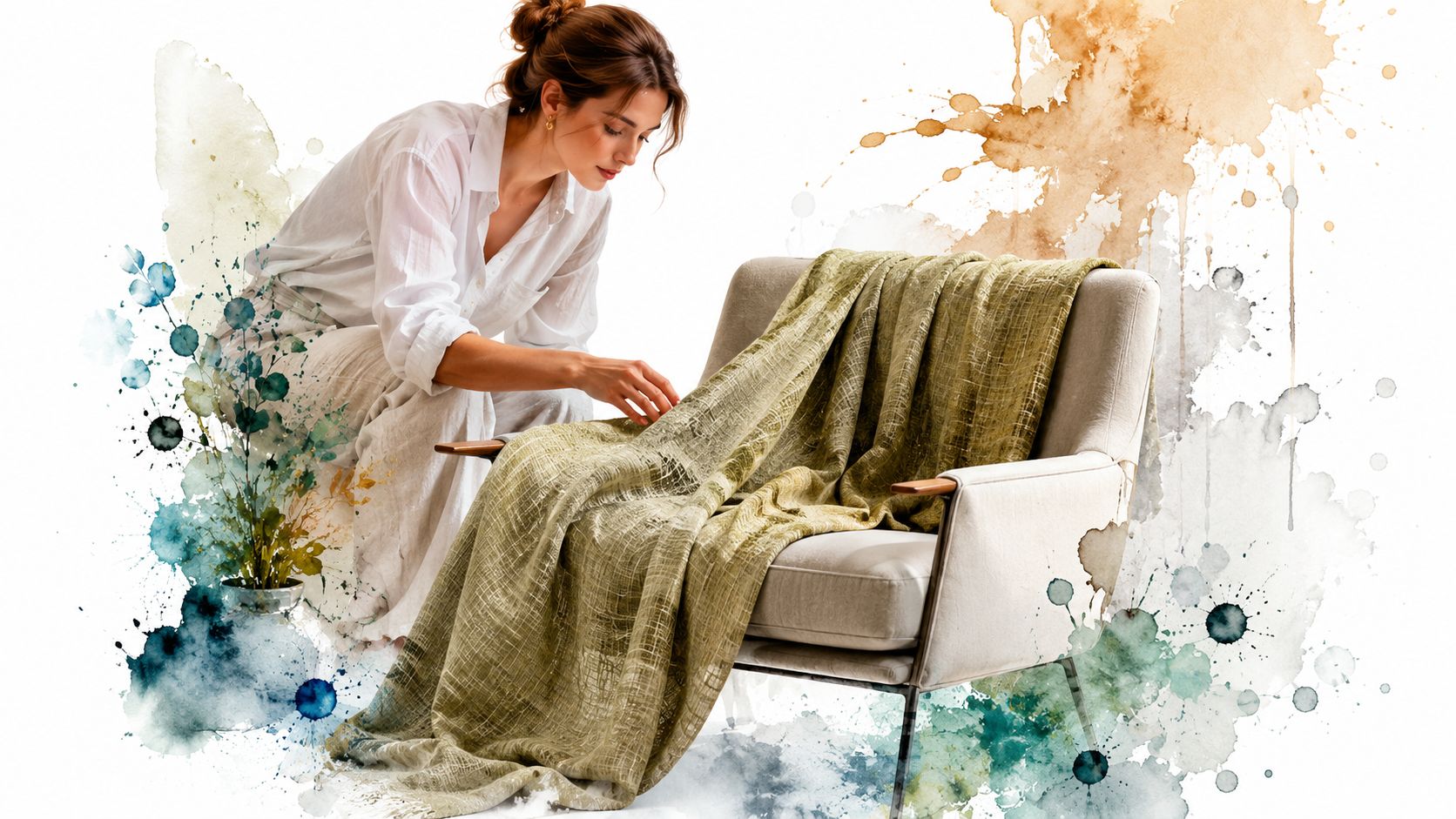
Performance fabric furniture no longer has to look or feel utilitarian. Better yarn engineering and weaving techniques now support performance-rated bouclé, velvet, linen-look, and chenille textures with visual depth. That matters because a family room still needs to feel inviting, not like a commercial waiting area.
Texture also performs a visual job. Nubby surfaces and dimensional weaves can disguise small marks, minor compression, and everyday variation better than an extremely flat fabric. A mid-tone textured upholstery may make a room look composed even between cleanings.
Texture requires a more careful evaluation
Bouclé and looped yarns create warmth, but pets with sharp claws may catch the loops. Velvet-like surfaces feel soft and luxurious, yet they can show changes in nap direction where people sit. Chenille can offer a comfortable hand and rich color, while its surface still demands attention to cleaning instructions.
Blends can balance softness and maintenance. A fabric may combine solution-dyed acrylic with recycled polyester, or use recycled polyester with a water-repellent construction. One sustainability-focused product line demonstrates that upholstery can use 100% recycled polyester fibers while remaining water-repellent and easy to clean (Luonto's performance fabric information).
A beautiful texture is a good choice only when its maintenance matches the household.
Heavily textured fabric can make spot cleaning more difficult because a spill may settle into crevices. That makes fiber-level protection more valuable than relying only on a topical finish. Before placing a custom order, buyers should request swatches, rub each sample between their fingers, inspect the reverse side, and test a small drop of water only when the manufacturer permits such testing.
A fabric that feels wonderful in a showroom but frustrates the household every week isn't a successful design decision. Comfort includes the emotional relief of knowing the upholstery suits real life.
Cleaning and Maintenance Best Practices for Lasting Results
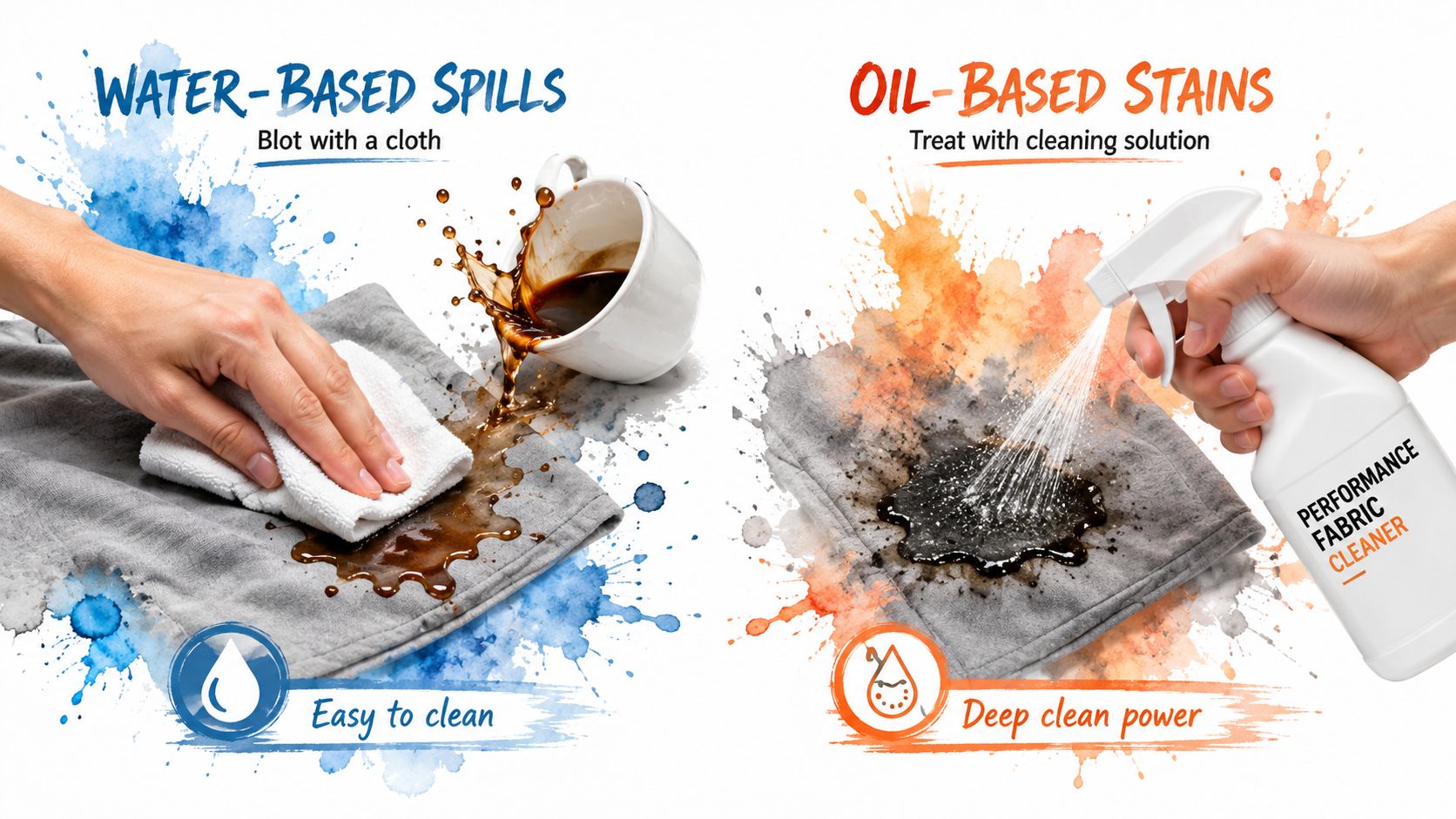
Performance fabric reduces maintenance, but it doesn't replace it. The first response matters more than a dramatic cleaning product. A fresh spill should be addressed quickly, with the fabric's care code and manufacturer instructions treated as the final authority.
The first response to a spill
- Lift solids carefully: Use a spoon or dull edge to remove food without grinding it into the weave.
- Blot, don't rub: Press with a clean, absorbent cloth. Rubbing spreads the stain and drives it deeper.
- Treat water-based spills: Coffee, tea, wine, soft drinks, and juice generally call for the approved water-based method. Mild dish soap and distilled water may suit fabrics labeled for water cleaning.
- Treat oil-based stains differently: Grease, sunscreen, mayonnaise, and ketchup need the approved solvent-based approach when the care code permits it.
- Dry gradually: Avoid aggressive heat and don't overwet the cushion. Excess moisture can move into the foam and create a larger problem.
Water repellency doesn't cover every spill. One manufacturer specifically states that its finish repels water-based liquids such as coffee, tea, wine, and soft drinks, but not oil or oil-based stains such as mayonnaise and ketchup. The same source identifies a 100% recycled polyester FR upholstery fabric with 34 color combinations (Vescom's water-stain repellence guidance).
Build a routine
- Vacuum weekly: Use an upholstery attachment to remove abrasive dust, crumbs, and pet dander before they work into seams.
- Rotate cushions: Exchange or rotate compatible cushions so one sitting area doesn't absorb all the wear.
- Inspect the finish: If water stops beading where it once did, a topical treatment may have diminished.
- Clean professionally when needed: High-use pieces benefit from professional assessment when a stain has set or routine cleaning no longer restores the surface.
The same principle applies to other textile care in a home. Guidance on affordable carpet shampoo in Toronto offers useful context on why material type and cleaning method must be matched rather than treated with one universal product. For upholstered furniture, upholstery cleaning services can help when the fabric's care requirements exceed a household spot treatment.
Bleach is not automatically safe just because a fabric is marketed for performance. Use it only when the manufacturer explicitly approves it for that exact textile.
Sustainability and the Buy-It-for-Life Investment Mindset
A sofa that survives children, pets, guests, and changing tastes creates less waste than one replaced after each stage of family life. Start with the frame, then choose upholstery that suits the room's actual demands. The initial price matters, but long-term value comes from years of useful, attractive service.
Market forecasts point to sustained interest in lower-maintenance upholstery. One forecast places stain-resistant fabric at USD 14.2 billion in 2024 and projects USD 24.3 billion by 2033, with a projected 5.5% CAGR from 2025 to 2033. A separate forecast places the market at USD 14.3 billion in 2025 and projects USD 29.8 billion by 2036, a 7.0% CAGR. Projections are not guarantees, but they reflect continued commercial attention to fabrics designed for daily use.
Evaluate the material, not just the promise
Performance marketing can hide an important distinction. Protection may come from the fiber itself, the weave, a backing layer, or a topical finish. Fiber-level protection generally remains part of the textile through ordinary use, while a surface treatment can diminish with abrasion and cleaning. Ask which one you are buying.
Some finishes use fluorocarbon chemistry, while newer systems are explicitly PFAS- and fluorocarbon-free. Recycled polyester offers another route, but recycled content alone does not answer questions about recyclability, repair, or end-of-life handling.
Before ordering, ask:
- What is the fiber content? Request the exact composition, not only the word “performance.”
- Where does the protection live? Fiber, weave, backing, and surface finish carry different durability implications.
- Can the frame be reupholstered? Replaceable upholstery can extend the useful life of a sound frame.
- What certifications apply? Ask for relevant indoor-air or textile certifications.
- What happens at the end? Ask directly about take-back and recycling policies.
Long-lasting furniture supports a practical buy-it-for-life philosophy. Fewer, better Investment Pieces can reduce repeated replacement while preserving the labor and materials already invested in a durable frame.
Buy-it-for-life does not require keeping a piece unchanged. Reupholstering, refinishing, or updating the design can preserve a frame that still works. Performance fabric belongs in that strategy when its protection type, maintenance needs, and expected service life match the household.
Choosing the Right Performance Fabric with Expert Guidance
The right fabric choice starts with household behavior, not a fabric wall's most popular sample. A design consultant should ask where the furniture will sit, who will use it, and which problems create the most anxiety. That information leads to a better recommendation than selecting the highest abrasion rating.
Questions that improve the decision
A buyer should arrive prepared to discuss:
- Pets: Do animals shed, climb, dig, or scratch?
- Children: Are spills likely during meals, crafts, or play?
- Sunlight: Does direct light reach the sofa or chair for much of the day?
- Entertaining: Will guests eat and drink near the upholstery?
- Texture: Is softness more important than maximum spill resistance?
- Care tolerance: Will the household follow a specific cleaning protocol?
A consultant may recommend olefin for a room with demanding light exposure, a moisture-barrier construction for a household with young children, or a nano-coated linen-look textile for someone who values natural texture. Those recommendations should always be checked against the specific product's care code and testing.
Test the actual swatches
Swatches deserve more than a quick glance. Buyers should feel the face and reverse of the fabric, inspect the weave, compare it under the room's lighting, and ask whether common household stains can be tested at home. A textile that looks soft may feel different across a full cushion, while a textured weave may hide daily marks but collect pet hair in its recesses.
Readers researching cotton linen in home décor can use that material perspective to clarify whether a linen-look performance fabric meets the desired aesthetic without requiring untreated natural fiber. The important distinction is between the visual language of a material and its actual fiber composition.
At Giorgi Bros. Furniture, custom ordering allows buyers to specify upholstery alongside fabrics, leathers, wood species, and finishes rather than choosing only from floor models. The showroom's non-commission Consultants can discuss custom upholstered sofa options through the custom upholstered sofa service, helping connect the fabric decision to the frame, silhouette, and room.
The South San Francisco showroom has served the community since 1933, giving Bay Area homeowners a place to touch, feel, and compare materials in person. Giorgi Bros. Furniture offers a 50,000-square-foot showroom, custom order services, Amish Furniture, Premium Mattresses, and financing options are available, with guidance from a Non-Commission Sales Staff rather than commission-driven salesmen.
Giorgi Bros. Furniture offers custom performance fabric furniture, upholstery choices, wood species, leathers, and finishes for households that want quality without daily worry. Visit Giorgi Bros. Furniture in South San Francisco for no-pressure guidance, or book a Design Consultation to match the right fabric to the way the home is lived in.