
A couple stands in the dining room with a tape measure, trying to picture a table that can handle homework, weekday dinners, holiday meals, and the occasional craft project. The right table may eventually become the place where their grown children gather with families of their own. That's why solid wood dining tables deserve more careful thought than a quick style decision.
A buy-it-for-life table is a fixture, closer to a kitchen range or front door than a temporary furnishing. The strongest choice depends on more than wood species. Home humidity, joinery, dimensions, and the table's ability to adapt to changing family life determine whether it becomes an heirloom or looks substantial on delivery day.
Choosing a Table You'll Hand Down
The first useful question isn't whether oak or walnut looks better. It's whether the household wants a table that still works after the room, routines, and number of diners have changed.
Start with the life the table must support
A long-term buyer should answer three questions:
- How long should the table last? A table intended for a move or short-term furnishing has different requirements from one expected to serve several generations.
- How much might the household change? Children grow, relatives visit, work patterns shift, and a dining room may become a homework or work-from-home space.
- Which daily rituals matter most? A family that eats together every evening needs a different surface and seating plan from a household that mainly entertains on weekends.
A family kitchen may need a finish that tolerates constant use and an extension system for holidays. A formal dining room may prioritize a refined edge, generous proportions, and a base that keeps the center open for conversation. A smaller home may benefit more from an adaptable table than from a permanently oversized statement piece.
Practical rule: A table should fit the household's ordinary Tuesday, not only its most impressive holiday.
Treat longevity as part of the budget
A long-life table costs more at the beginning, but the value calculation changes when replacement is taken seriously. Solid wood furniture is commonly described as lasting 20 to 50 or more years, with some pieces continuing for over 100 years, and refinishing may be needed around every 15 to 20 years when the surface requires renewal, according to solid wood furniture longevity guidance.
That makes a thirty-year table a budgeting tool as much as a furniture choice. Replacing disposable tables repeatedly creates more cost, more delivery work, and more discarded material. Buying once, maintaining the piece, and refinishing it when appropriate supports both household finances and a more sustainable buy-it-for-life mentality.
The final test is not weight alone. A table earns heirloom status through movement-aware construction, sound joinery, a suitable finish, and a size that can keep serving the room. The following checks reveal those qualities before a purchase is made.
What Solid Wood Actually Means
Solid wood means the primary table components come from real lumber, either as a single board or as properly joined boards cut from a tree. A tabletop may use several edge-glued boards and still qualify as solid wood, provided the visible and structural material is wood throughout rather than a thin decorative layer over a manufactured core.
Separate the materials clearly
A veneer table uses a thin layer of real wood over MDF, plywood, or another core. Engineered wood may use a hardwood face over a manufactured or layered substrate. Printed laminate uses an image that imitates grain over a constructed panel. None of those descriptions automatically means poor furniture, but they describe different repair and aging characteristics.
A simple analogy helps. Solid wood is to veneer what a leather wallet is to bonded leather. Both may serve a purpose, but the material behaves differently when it wears and when it needs repair. Solid wood can generally be sanded, repaired, and refinished repeatedly, while veneer has a limited wear layer and laminate usually can't be resurfaced like lumber.
For an additional plain-language explanation of material differences, Flacks Flooring's hardwood advice offers useful context about how solid wood differs from layered construction. Buyers comparing a table's core and surface can also review this solid wood versus particle board guide.
| Material Type | Core Construction | Can Be Refinished | Typical Lifespan | Price Range |
|---|---|---|---|---|
| Solid wood | Real wood boards throughout the main structure | Yes, often multiple times | Long-life, repairable construction | Varies by wood, size, and craftsmanship |
| Veneer | Thin real-wood surface over a core | Limited by the veneer layer | Depends heavily on core and construction | Often lower than comparable solid wood |
| Engineered wood | Layered or compressed wood-based core with a finished face | Limited to the surface system | Depends on moisture protection and joinery | Often positioned below solid wood |
| Printed laminate | Decorative printed layer over a manufactured panel | No conventional wood refinishing | More replacement-oriented | Often the lowest initial category |
Accept the tradeoff
Solid wood isn't maintenance-free. Wood is hygroscopic, so it expands as indoor humidity rises and shrinks as humidity falls. Most dimensional movement occurs across the grain rather than along it, which means a wide tabletop needs a construction system that allows seasonal change.
That movement is the honest cost of owning real lumber. A well-built table accommodates it with appropriate fasteners, floating attachments, and correctly prepared boards. A buyer shouldn't reject solid wood because it moves. The buyer should reject a table that pretends movement doesn't exist.
Popular Wood Species and How They Age
Wood species affects appearance, touch, dent resistance, and how a table changes over time. It doesn't replace construction quality. A beautifully colored slab with poor moisture preparation can perform worse than a straightforward domestic hardwood built correctly.
Match the wood to the room
Oak remains the practical workhorse. Its visible grain gives a dining room texture, and its forgiving character can make everyday scratches less conspicuous. Oak suits family kitchens, farmhouse interiors, and rooms where the table needs to look better with honest use rather than remain visually perfect.
Maple brings a pale, clean surface with a restrained grain. It fits modern and Scandinavian-inspired rooms, though its light appearance can make marks easier to notice. Walnut offers a darker, richer starting point and works well as a statement table in a refined dining room. Its color generally softens toward a lighter honey character as it ages.
Cherry has the classic heirloom look and develops a deeper tone with light exposure. That transformation appeals to buyers who want a table with a visible life story, but direct sun deserves attention. Ash provides pronounced grain and a lighter, flexible appearance when a buyer wants character without the visual weight of darker woods.
Reclaimed pine and other softwoods bring warmth and rustic charm. They're also more likely to show dents, which can be a feature in a casual room and a frustration in a formal one. Teak and other imported hardwoods offer premium appeal and strong outdoor associations, but the table's intended indoor setting, sourcing, and finish still matter.
| Wood Species | Hardness Feel | Grain Character | How It Ages | Best Room Fit |
|---|---|---|---|---|
| Oak | Durable, forgiving | Bold and visible | Develops an honest, lived-in surface | Family kitchen or farmhouse room |
| Maple | Hard, smooth | Fine and restrained | Keeps a clean, pale appearance | Modern or Scandinavian room |
| Walnut | Substantial and refined | Expressive but controlled | Softens toward a lighter honey patina | Statement dining room |
| Cherry | Smooth, classic | Moderate and elegant | Darkens noticeably with light exposure | Formal or heirloom setting |
| Ash | Resilient and lively | Open, pronounced grain | Gains character without heavy visual weight | Flexible contemporary room |
| Pine and softwoods | Softer, dent-prone | Rustic and prominent | Shows marks quickly and honestly | Casual kitchen or rustic room |
| Teak and imported hardwoods | Dense, premium feel | Varies by species | Develops depth with proper care | Premium indoor or outdoor-capable setting |
The best choice is the wood whose aging behavior fits the household. Species drama attracts attention, but daily compatibility keeps a table in the home for decades.
Construction and Joinery That Last
A heavy table can still be poorly built. The difference between a table that lasts a decade and one that serves several generations usually appears underneath, inside the apron, and at the points where the top meets the base.
Inspect the joints, not just the finish
Mortise-and-tenon joinery creates a substantial wood-to-wood connection. Dowels can also provide dependable alignment when precisely made. Screws and staples have their place, but a design that relies on small fasteners alone may loosen under repeated movement and loading.
Breadboard ends deserve particular attention. They can help control the appearance of a wide top, but the attachment must include elongated holes or another movement-aware system. Rigidly locking cross-grain parts together invites stress as the tabletop expands and contracts.
Edge-glued planks are practical and stable when the boards are properly prepared. A single slab offers dramatic grain, but it still moves and requires careful drying, acclimation, and attachment. Corner blocking and corner brackets inside the aprons add useful support, especially where the base receives repeated side loads.
Furniture guidance emphasizes that solid wood designs must allow movement in service. Buyers can review mortise-and-tenon joint construction before examining a table in person.

Use the showroom test
A buyer doesn't need to be a cabinetmaker to spot warning signs. The table should feel stable, the legs should meet the floor evenly, and the underside should look intentionally finished rather than ignored.
- Rock the table: Apply light pressure from several directions. Movement at the floor may be adjustable, but movement at the joints deserves scrutiny.
- Lift one end: A controlled lift can reveal whether the base stays coherent or flexes excessively.
- Look underneath: Check aprons, blocks, brackets, fasteners, and tabletop attachments.
- Inspect the finish: An underside finish suggests the builder considered moisture exchange across the entire component.
Kiln-dried, properly acclimated lumber reduces the risk of cupping and checking. The top should also attach with floating hardware, such as metal clips or elongated fasteners, rather than rigid glue that prevents natural cross-grain movement.
Giorgi Bros. Furniture showcases construction details openly, including dovetailed drawer construction on accompanying furniture. That transparency matters because buyers deserve to see what they're paying for, not just judge a polished surface.
Sizing, Height, and Style for Real Life
A table can be beautiful and still make a room miserable. Correct sizing protects circulation, keeps chairs usable, and gives the household flexibility when an ordinary dinner becomes a larger gathering.
Start with the measurements people feel
Standard dining tables generally sit at 28 to 30 inches high, with 29 to 30 inches often treated as the common range, according to table design dimensions. Chair seats typically sit about 10 to 13 inches below the tabletop, giving the legs room to move.
A practical planning rule allows about 24 inches of table edge per chair. Comfortable movement also requires meaningful space behind seated guests. The room should be measured with chairs pulled out, not tucked in, because that is how the dining area functions during a meal.
Rectangular tables suit long rooms and larger gatherings. Round tables improve conversation and circulation in square spaces, particularly when the room is compact. Extension leaves provide a better answer than permanently choosing a table that overwhelms the room, but the leaves should have careful grain matching and a secure support system.
Let the base and edge serve the room
A pedestal or trestle base keeps more legroom open and helps diners move around the ends. Four legs provide a familiar outline and can work well in rooms where the table needs to appear visually lighter. Turned legs add traditional character, while straight legs suit modern interiors.
Edge profiles change the physical experience. An eased square edge feels crisp without being harsh. A rounded edge feels more forgiving in a family setting. Live edges create drama, but their irregular outline needs more careful placement and may reduce predictable seating.
For a closer look at the relationship between table and chair dimensions, use this dining chair height guide.
| Seats | Table Length | Table Width | Minimum Room Size |
|---|---|---|---|
| Four | Compact length suited to the room | Narrow to moderate width | Allow chair pull-out and walking clearance |
| Six | Medium rectangular or round format | Moderate width for shared meals | Measure the room with chairs extended |
| Eight | Longer rectangular or extendable format | Generous serving space | Plan circulation at both ends |
| Ten or more | Large rectangular, trestle, or expandable format | Wide enough for entertaining | Consider extension storage and traffic paths |
The right dimension is the one that supports real routines without forcing the room to serve the table.
Pricing, Longevity, and the Investment Case
Price differences usually come from material, labor, and construction details rather than brand markup alone. Board width, wood availability, finish complexity, joinery, extension hardware, and custom sizing all affect the final figure.
A domestic hardwood table may sit in the low-thousands to mid-four-figure range, while premium hardwoods, live-edge slabs, and heirloom-grade Amish construction can reach five figures. Those ranges are qualitative buying guidance, not a promise of a particular quote. The useful comparison is between initial price and usable service over time, not between showroom tags alone.
Compare the whole ownership cycle
Engineered and veneered tables often cost less at purchase. They can be sensible for a temporary room or a carefully protected setting, but their resurfacing options are limited by the face layer. Solid wood offers repair and refinishing potential, which can preserve the table when the household changes or the surface collects years of use.
Longevity follows construction quality more reliably than species prestige. A properly dried oak table with strong joinery can outlast a poorly dried walnut slab. The attractive species name doesn't compensate for trapped movement, weak connections, or a finish that fails under ordinary use.
Include sustainability in the calculation
A buy-it-for-life decision can reduce replacement demand and keep useful material in service longer. Sustainably sourced hardwoods and local custom production can also reduce unnecessary shipping distance and damage risk, though responsible sourcing should be confirmed with the maker or retailer.
The broader market supports treating wood dining furniture as a core category rather than a niche. The global wood dining table market was estimated at USD 4.75 billion in 2024 and is projected to reach USD 10.13 billion by 2035, with a reported 7.13% CAGR from 2025 to 2035, according to wood dining table market data. A separate market report places the North American wooden furniture market at USD 188.37 billion in 2025, projected to reach USD 210.38 billion by 2034, with tables holding 28.3% of the segment in 2024 and solid wood representing 42.3% of material share, as reported in North American wooden furniture market data.
That scale doesn't decide which table belongs in a home. It does reinforce the practical point: quality wood dining furniture has lasting relevance across custom, premium, and everyday settings.
Care, Humidity, and Seasonal Maintenance
Solid wood isn't maintenance-free, and vague advice such as “keep it away from moisture” doesn't help much. The main issue is relative humidity stability, because normal indoor changes drive the expansion and contraction that create gaps, stress, and seasonal warping.
Control the room before blaming the table
Independent care guidance commonly places a useful indoor target around 45% to 55% relative humidity, with some recommendations extending from 40% to 60% RH. Museum guidance also recommends 45% to 55% RH and warns against exceeding 65% RH, as summarized in this solid wood table care guide.
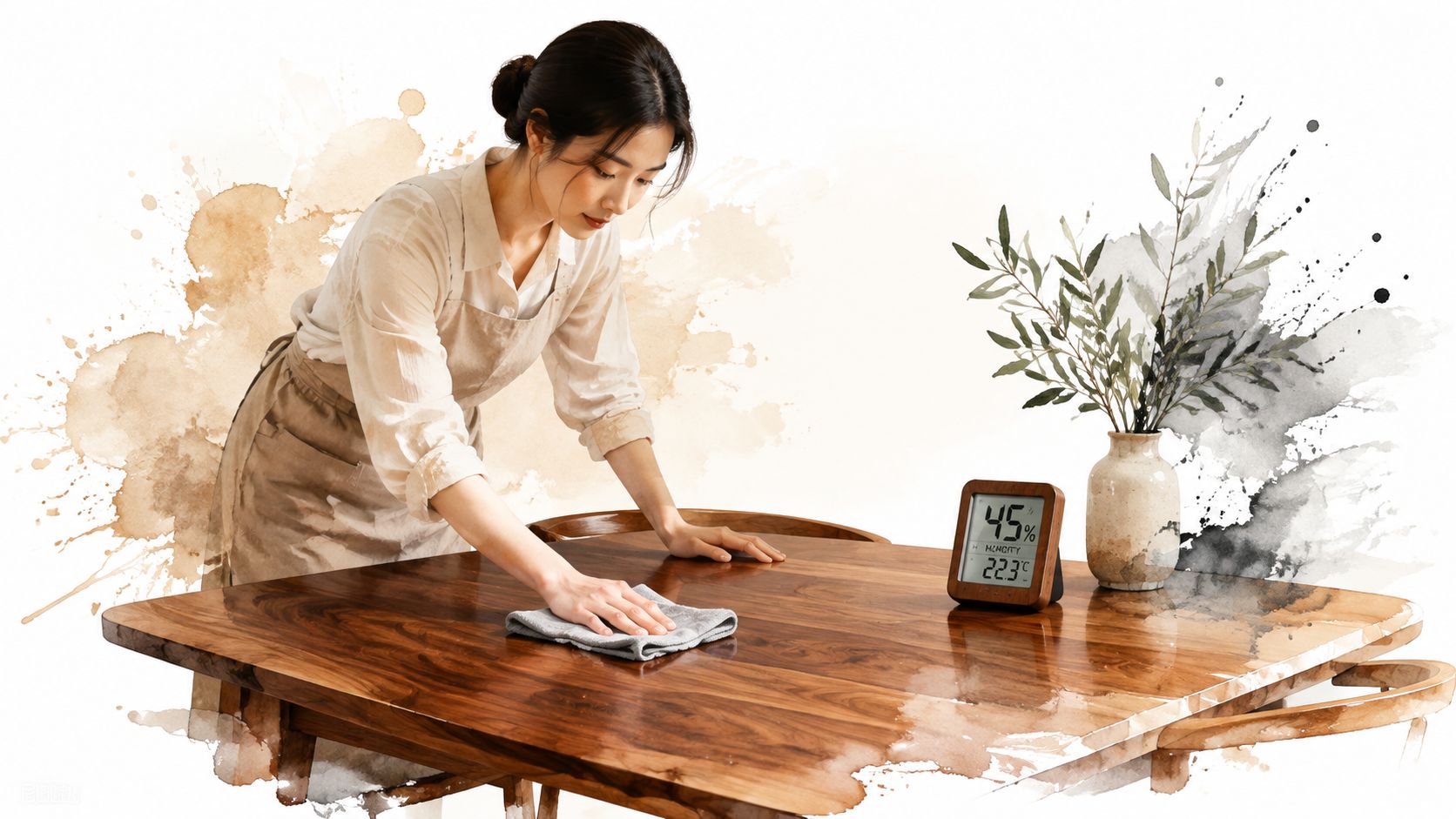
A small hygrometer makes the condition visible. Heating, air conditioning, coastal air, and closed rooms can all create swings that owners don't notice until a joint opens or a panel cups. Woodworking guidance recommends sourcing or building interior furniture near 6% to 9% moisture content, a range associated with conditioned homes, as explained in guidance on wood movement.
Humidity rule: Stable conditions protect solid wood better than occasional emergency treatments.
Swedish Wood describes moisture-related movement in pine and spruce at about 0.26% for each percentage-point change in moisture content, and identifies target moisture content levels of 8%, 12%, and 16% for different wood products, according to its wood moisture guidance.
Keep maintenance simple
A weekly wipe with a damp, not wet, microfiber cloth removes ordinary residue without saturating the surface. Harsh cleaners and unapproved oil soaps can leave buildup or interfere with the finish. Polishes should be used only when the finish manufacturer permits them, and paste wax belongs on finishes designed to accept it, not as a default treatment.
Use coasters and placemats where they help prevent heat, liquid rings, and abrasion, but daily life shouldn't require anxiety. Once each year, inspect tabletop clips or breadboard fasteners, check leg bolts, and look for changes in joints or finish. Refinishing makes sense when wear warrants it or before a major life event, not because an arbitrary calendar says the table must be stripped.
For finish selection and maintenance questions, this guide to wood furniture finishes offers a useful starting point.

Working With a Local Custom Showroom
Ordering a table online can make dimensions and color feel abstract. A local showroom lets buyers test the things photographs can't communicate, including chair clearance, surface texture, edge comfort, finish reflectivity, and the visual scale of the base.
Make the appointment productive
A useful custom order session starts with room information. Buyers should bring measurements, photographs, existing finish samples when available, and a clear description of how the table will be used. Design Consultants can then help compare:
- Wood samples: View species and stains under lighting that resembles the home.
- Table height: Sit at the intended height with the actual chair style.
- Edge profiles: Compare eased, rounded, beveled, and live-edge treatments by touch.
- Base styles: Test leg, pedestal, and trestle layouts for knee room.
- Extension options: Confirm leaf storage, grain matching, and support when extended.
- Finish matching: Coordinate the new table with nearby furniture without forcing an exact match that looks artificial.
Custom ordering matters because a stock table may be close to the right size but wrong for the room. Giorgi Bros. Furniture offers options involving wood species, dimensions, styles, and finishes through its custom wood dining table service. The showroom also provides custom order services across fabrics, leathers, wood species, and finishes, with financing options available.
The family-owned business has served South San Francisco and the Greater Bay Area for over 90 years, tracing its heritage to 1933. Its non-commission sales staff and Design Experts support a no-pressure process, which is especially valuable for an investment piece that should be evaluated slowly.
A showroom visit is the cheapest part of the buying process and often prevents the most expensive regret. Measurements, samples, and a short consultation can expose a sizing or finish problem before the table is ordered.
Giorgi Bros. Furniture offers custom solid wood dining tables, Amish Furniture, design consultations, financing options, and no-pressure guidance from a family-owned South San Francisco showroom. Visit Giorgi Bros. Furniture to see the wood in person, request a quote, or book a Design Consultation for a table built around the room and the life it needs to serve.