
A Bay Area homeowner can stand in a showroom comparing two dining tables that look nearly identical. One is solid wood. The other uses a particle board core beneath a wood veneer. A $1,200 price difference can turn a simple furniture decision into a debate about budget, appearance, and how long the table should serve the household.
The surface doesn't tell the whole story. The material beneath it affects structural strength, screw and hinge performance, moisture response, indoor air quality, repairability, and the number of times the piece may need replacement. That makes material selection one of the most consequential decisions in furniture buying, even though shoppers often treat it as a style detail.
For Bay Area homeowners, the practical choice isn't just solid wood versus particle board. It's a choice between engineered affordability and a buy-it-for-life investment. Giorgi Bros. Furniture has helped South San Francisco households make that decision since 1933, with non-commission Consultants who provide no-pressure guidance rather than pushing a predetermined sale. The recommendations below are direct because furniture should work for the way a household lives.
Why the Material Behind Your Furniture Matters More Than You Think
A Bay Area dining table can look perfect on delivery day and still become the wrong purchase after years of use. The finish, proportions, and wood pattern may match another table across the showroom, while the material underneath determines how each piece handles daily meals, moves, moisture, and repairs.
Solid wood furniture has a continuous natural structure beneath its finish. A veneered particle board table uses a manufactured core made from wood particles and resin, covered by a decorative surface. Both materials have practical uses, but they do not respond alike to repeated stress or changing room conditions.
The difference becomes clear as furniture ages. Solid wood can often be maintained, sanded, or refinished when its surface looks worn. A particle board edge exposed to moisture may swell, chip, or separate, leaving replacement of the affected component as the practical fix. A lower purchase price does not tell you what the piece will cost in service, upkeep, and eventual replacement.
Practical rule: Choose the stronger core for furniture that will be used daily, moved during remodels, repaired over time, or kept as a permanent part of the home.
The hidden costs of a surface-level decision
Material also affects indoor air quality. Composite wood products are regulated for formaldehyde emissions in the United States, and regulated particleboard must meet a formaldehyde limit of 0.09 ppm, as explained by the U.S. Environmental Protection Agency's formaldehyde standards.
Heat and humidity add another long-term concern. In West Coast homes, coastal moisture, warm rooms, and limited ventilation can place greater stress on particle board and its bonded materials. That makes certification, construction quality, room placement, and expected service life important buying questions. A particle board piece is not automatically an indoor air problem, but climate exposure deserves more attention than a showroom inspection can provide.
Durability and air quality belong in the same decision. Furniture that lasts longer can reduce repeated manufacturing and disposal, while responsibly produced engineered panels can use wood residues productively. Review sustainable furniture materials by considering the entire life cycle, including service, repair, and replacement.
For a buy-it-for-life purchase, solid wood usually earns the stronger recommendation. Particle board makes sense when the piece has a shorter planned service life, limited exposure to humidity, and a role where replacement is acceptable. Evaluate that trade-off before comparing prices.
Understanding Solid Wood and Particle Board Construction
Solid wood furniture uses lumber milled directly from trees. Common furniture species include oak, maple, cherry, and walnut, each with distinct grain, color, hardness, and finishing behavior. Traditional construction may use dovetails, mortise-and-tenon joints, corner blocks, floating panels, and other methods that distribute stress through the wood rather than relying only on adhesive or small fasteners.
That craft tradition has deep roots. Solid wood has dominated furniture making for centuries, and modern Amish Furniture continues to associate the material with careful joinery, repairability, and long service. The important distinction is structural, not romantic. Solid lumber contains continuous fibers that run through the component, while particle board relies on a compressed matrix of fragmented wood material and synthetic resin.
Particle board developed as an engineered panel rather than a traditional lumber product. Its documented history reaches back to 1887, when Ernst Hubbard proposed artificial wood made from sawdust and animal blood albumin. A layered-board patent application followed in 1889, Watson submitted a patent for heat-pressed thin particles in 1905, and German inventor Max Himmelheber patented the first commercial particleboard machine in 1932. One historical source records the first particleboard factory beginning production in Bremen, Germany, in 1941, at about 10 tons per day. These milestones are documented in this history of particleboard development.
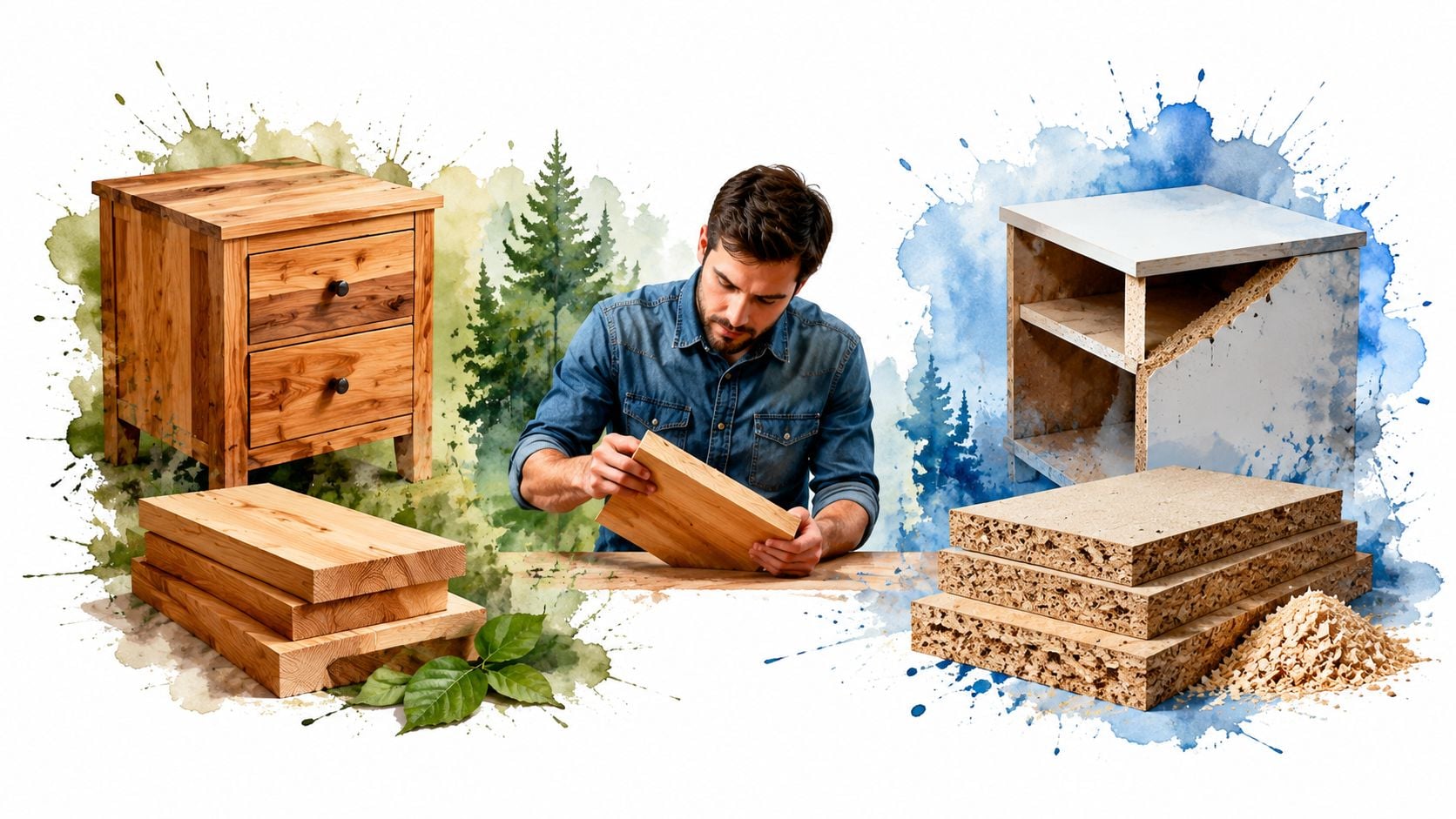
Density reveals the construction difference
Particle board typically falls within a standardized density range. Industry data places standard particleboard around 650 to 750 kg/m³, with low-density versions as low as 250 kg/m³ and high-density versions reaching 1,300 kg/m³. Architectural woodwork standards commonly specify particle board at 40 to 50 lb/ft³, or approximately 640 to 800 kg/m³, as described in the Architectural Woodwork Standards material guidance.
A peer-reviewed study of three-layer particleboards measured average densities from 566.2 to 641.6 kg/m³, with emissions measured at 0.284 to 0.382 mg/m²·h. The samples were classified as E1, below the European EN 13986:2004 limit of 3.5 mg/m²·h, according to the published particleboard emissions and density study. Because the research link provided for that study is not available here, the study's findings should be verified directly before being used for a product specification.
Particle board usually receives a laminate, melamine surface, or thin wood veneer. That finish can provide a convincing appearance, but it doesn't transform the core into solid lumber. The distinction becomes visible at damaged edges, fastener points, cutouts, and areas exposed to moisture.
Durability and Structural Performance Under Real Conditions
Solid wood earns its reputation through how it handles repeated use. Its continuous grain gives screws, dowels, and joinery more material to engage, while the component can absorb and distribute everyday impact. Properly designed hardwood furniture can be repaired, sanded, and refinished rather than discarded when the surface shows normal wear.
Particle board performs well in the right role. It offers predictable sheet dimensions, consistent mass, and an efficient way to manufacture furniture at accessible prices. The limitations appear when the piece carries sustained loads, receives repeated knock-down assembly, or experiences moisture at unprotected edges.
What fasteners reveal after repeated use
Fastener performance is one of the clearest practical differences. Technical sources place particle board screw-holding values in the several-hundred-newton range for face and edge withdrawal. Newer test data for moisture-resistant particleboard reports approximately 700 to 1,000 N of edge screw-holding and 700 to 800 N of face screw-holding, as documented in this particleboard fastener performance data.
Those values can be adequate for light-to-moderate furniture loads. They become less reassuring around hinges, drawer slides, bed hardware, and joints that someone repeatedly assembles and disassembles. Once the compressed material around a screw breaks down, a replacement screw may not restore the original holding power.
Moisture creates a second major vulnerability. Standard particle board can show 15% to 25% thickness swell after 24-hour water exposure, while water-resistant grades are expected to remain below 10%, according to technical guidance on particleboard water response. Architectural standards identify moisture-resistant grades with a maximum thickness swelling of 5.5%, showing that product grade matters substantially.
| Performance Metric | Solid Wood (Hardwood) | Particle Board |
|---|---|---|
| Core structure | Continuous natural grain | Compressed wood particles and resin |
| Repair potential | Can often be sanded, refinished, or repaired | Damaged swollen areas are difficult to restore |
| Fastener behavior | Stronger long-term engagement when properly joined | Acceptable for moderate loads, more vulnerable at edges and after repeated assembly |
| Moisture response | Expands and contracts, but can be protected by finish and design | Can swell and lose cohesion after water exposure |
| Best application | Permanent, high-use investment pieces | Cost-sensitive, lower-stress applications |
For practical background on how durability claims should be documented, the durability evidence resources for fashion brands offer a useful framework for separating testable performance from vague marketing language. The same discipline helps furniture shoppers ask what was tested, under which conditions, and for which product grade.
In a Bay Area home, finish quality and edge protection matter. The guide to best wood finishes for furniture can help homeowners understand how surface protection supports the service life of solid wood, although no finish makes any material immune to standing water or poor placement.
Sustainability and Indoor Air Quality Over Time
A dining room may feel dry in winter, then turn hot and humid in summer. That shift matters when furniture contains particle board. The material choice affects not only environmental impact, but also how long the piece stays stable and what it releases indoors.
Solid wood is not automatically the greener option. Its environmental profile depends on forestry practices, processing, transportation, finishing, service life, and end-of-use handling. Particle board can use smaller wood particles that might otherwise have limited value, while engineered panels can reduce demand for larger clear lumber in some applications.
Life-cycle research on wood-based panels reports cradle-to-gate emissions ranging from 124.5 to 655 kg CO2e per cubic meter, depending on the product and manufacturing route, as detailed in this life-cycle research on wood-based panels. Some assessments find that particle board stores more carbon than it emits at the product level. That result still depends on resin selection, feedstock, energy use, transportation, and production methods.
Climate stress changes the evaluation
Indoor air quality deserves equal attention. Particle board relies on resin binders, and formaldehyde emissions can rise with heat and humidity. Long-term testing found that UF-bonded particleboard emissions increased substantially under hotter, more humid conditions even after 3.5 years. No-added-formaldehyde boards were less affected, as reported in the study of long-term emissions under climate stress.
Bay Area homes can create these conditions through strong daytime heating, coastal dampness, or weak ventilation. Climate stress can also accelerate swelling, edge breakdown, and loss of structural reliability. For furniture intended as a buy-it-for-life purchase, ask for current compliance documentation and construction details instead of treating a wood-look surface as proof of low emissions or long service life.
U.S. composite-wood regulations, including CARB Phase 2 and EPA TSCA Title VI, set particleboard formaldehyde emissions at 0.09 ppm, MDF at 0.11 ppm, and thin MDF at 0.13 ppm, according to this formaldehyde grade guide. The 2026 indoor pollution checklist by Purified Air places furniture within the broader indoor environment review.
Solid wood is not automatically emission-free. Finishes, adhesives, and composite components can still be present in a finished piece. For lower-emission choices, review low-VOC furniture guidance and request documentation for the complete product, not only its primary material.
When to Choose Solid Wood and When Particle Board Makes Sense
The right material depends on the job. Solid wood should carry the pieces that anchor a room, receive daily contact, or need to remain useful through multiple stages of a household's life. Particle board can make sense when the expected service is shorter, the load is moderate, and replacement or relocation is already part of the plan.
Match the material to the furniture type
| Furniture Type | Recommended Material | Key Reasoning |
|---|---|---|
| Dining table | Solid wood | Handles daily contact and can be refinished |
| Bed frame | Solid wood | Supports repeated movement and hardware stress |
| Heirloom dresser | Solid wood | Offers stronger repair and finish-renewal potential |
| Media console | Either, with careful design | Particle board can work under limited structural load |
| Temporary apartment furniture | Particle board can make sense | Lower commitment suits short-term housing |
| Children's furniture likely to be outgrown | Particle board may be adequate | Expected use may not justify a lifetime construction |
| Shelving for heavy books | Solid wood | Better choice for sustained load and long-term stability |
A dining table, bed frame, or dresser usually deserves solid wood. These pieces face repeated loading, frequent contact, and visual scrutiny. A particle board edge near a damp wall or coastal window can become a weak point, especially if the finish or edge banding gets damaged.
Temporary housing changes the calculation. A lightweight media console, staging piece, or children's item with a limited use horizon may not need heirloom construction. The key is to keep the load modest, protect exposed edges, and avoid treating a short-term panel as if it were a permanent structural investment.
Use a mixed-material strategy
A mixed approach often delivers better value than choosing one material for every room. A solid wood tabletop paired with engineered storage can preserve quality where hands and weight meet the furniture while directing the budget toward less demanding components. Solid wood shelving remains the stronger choice for heavy collections, and homeowners comparing options can review solid wood shelving units for guidance on construction and intended use.
For open-plan Bay Area interiors, the visual role matters too. A dining table or bookcase often anchors the entire room, so a piece with durable joinery and a finish that can age gracefully may justify the investment even when a less visible component does not.
The True Cost of Furniture Over a Lifetime
The lowest price isn't the same as the lowest cost. A particle board piece may solve an immediate furnishing need, but repeated replacement can consume more money, time, and attention than a single well-built solid wood piece. The calculation becomes especially important for furniture that a household expects to keep through moves, remodels, and changing decor.
A fair comparison should include more than the checkout total:
- Replacement cycles: Count how many times a lower-cost piece may need to be purchased when sagging, swelling, delamination, or failed fasteners make repair impractical.
- Maintenance options: Solid wood may support sanding, refinishing, hardware replacement, or localized repair.
- Usable life: A durable piece can remain functional while its style evolves through finish changes, new upholstery, or different room placement.
- Disposal burden: Replacing furniture creates another manufacturing, transportation, and disposal cycle.
The prompt to buy a dresser, dining table, or bookcase at the lowest available price often ignores the emotional cost of living with a piece that chips, wobbles, or no longer opens smoothly. A household also loses the time spent shopping again, arranging delivery, disposing of the old item, and adapting the room to a replacement.
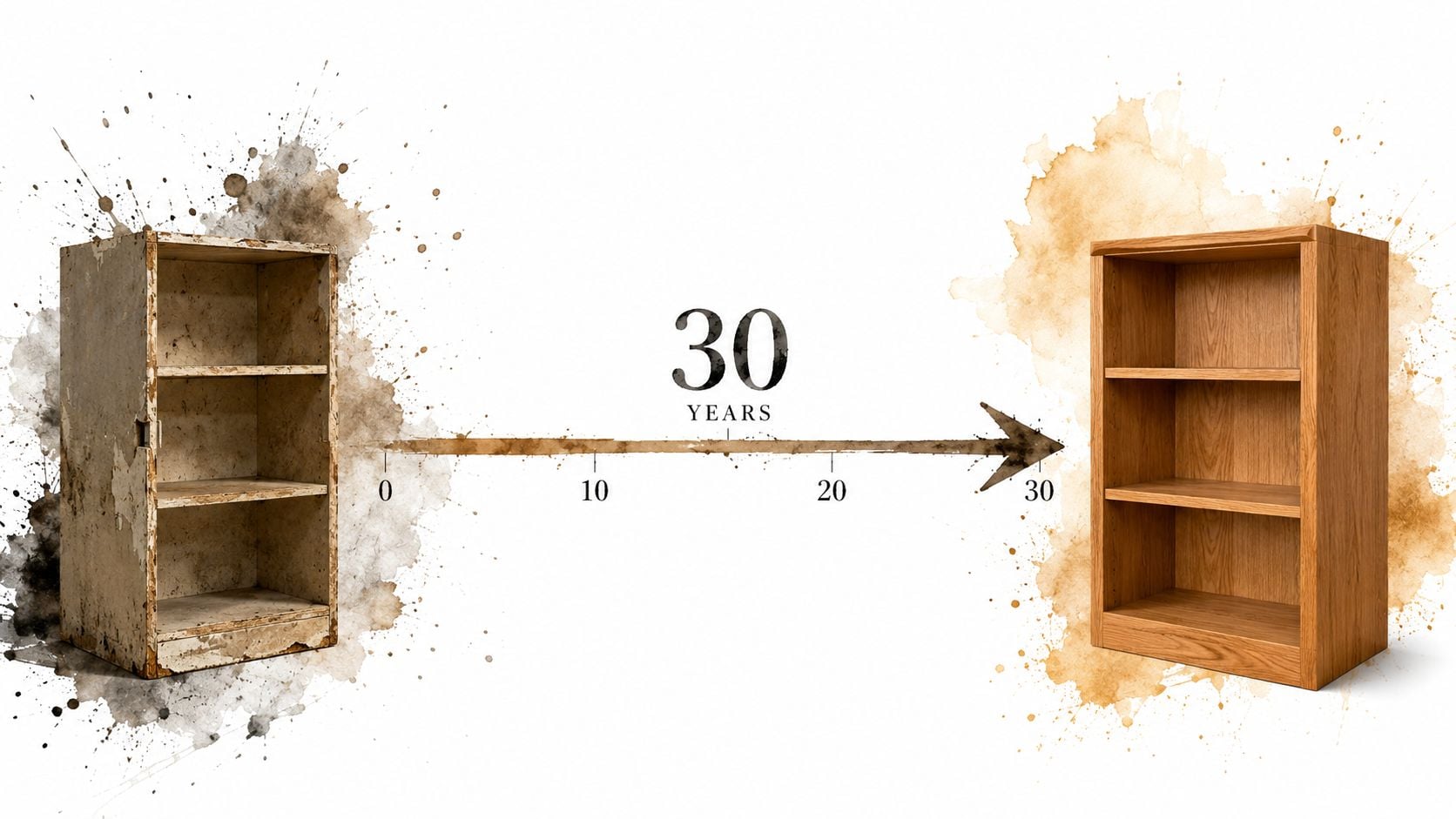
Buy for life, then maintain the investment
The buy-it-for-life approach doesn't mean every household needs solid wood in every room. It means permanent purchases should receive permanent-quality construction. An Amish Furniture dining table, a solid wood bed, or a custom dresser can support a household for decades, adapt to different interiors, and remain useful beyond the first decorating phase.
That philosophy also supports sustainability. Keeping one investment piece in service avoids the repeated material use associated with replacing disposable furniture. The wood furniture protection guide can help owners preserve finishes and reduce avoidable damage through appropriate placement and care.
Giorgi Bros. Furniture represents one local option for shoppers seeking solid wood and custom construction in a non-commission environment. Its South San Francisco showroom has served Bay Area households since 1933, and its custom order services allow choices in wood species, finishes, fabrics, and leathers. Financing options are available, but the better decision remains the one that matches the piece's expected use and service life.
Your Buying Checklist and Questions to Ask Before You Commit
A confident furniture purchase starts with questions that expose the construction. A polished finish can hide a weak core, and a natural wood pattern can come from veneer rather than solid lumber. A good Design Expert should answer directly and explain which materials appear in the frame, doors, drawer boxes, backs, and shelves.
Ask what holds the piece together
Start with the joints. Dovetail drawer construction and mortise-and-tenon connections generally indicate a different approach from staples, minimal glue, or fasteners driven into a fragile edge. The answer should identify the actual joint, not rely on phrases such as “all wood” without specifying whether that includes solid wood, plywood, veneer, or composite panels.
Ask these questions before comparing finishes:
- Core material: Is each major component solid wood, plywood, MDF, particle board, veneer, or a combination?
- Joinery: Are drawers joined with dovetails, and how are frames connected?
- Veneer details: Where is veneer used, and how are the exposed edges protected?
- Emission compliance: Does the completed product meet CARB Phase 2 or TSCA Title VI requirements?
- Warranty coverage: Does the warranty protect structural failure, hardware, finish defects, or only specific components?
Inspect the piece, not just the label
Open every drawer and operate the hardware several times. Look for smooth travel, consistent gaps, secure stops, and a drawer bottom that doesn't flex excessively. On particle board furniture, inspect edge banding around corners, cutouts, and floor-level areas. Peeling or poorly bonded edge treatment can expose the core to moisture.
For solid wood, examine the finish under direct light. A quality finish should look even without obscuring the grain, and the piece should show thoughtful grain direction across adjoining components. Check the underside, rear panels, and interior surfaces because construction shortcuts often appear where shoppers don't normally look.

Confirm the customization and service path
A permanent piece should fit the room, not force the room to accommodate it. Ask whether the retailer can provide finish samples, alternate wood species, custom dimensions, fabric or leather choices, and guidance on how the selected finish will respond to the home's light and moisture conditions.
A family-owned retailer with more than 90 years of South San Francisco history can also provide continuity after delivery. Giorgi Bros. Furniture offers custom order services, non-commission Sales Staff, Design Consultation, professional delivery and setup, premium mattresses, and a 50,000-square-foot Showroom where homeowners can touch and test furniture before committing.
The screenshot-ready checklist is simple:
- Confirm the core material for every major component.
- Ask how drawers, frames, and doors are joined.
- Inspect edge banding and exposed cut edges.
- Test hardware and look for movement or sagging.
- Request CARB Phase 2 or TSCA Title VI documentation where relevant.
- Read the warranty's structural and finish exclusions.
- Compare custom dimensions, species, finishes, fabrics, and leathers.
- Choose solid wood for permanent, heavily used investment pieces.
Visit the Giorgi Bros. Furniture Showroom in South San Francisco to compare solid wood and particle board construction in person, with no-pressure guidance from non-commission Design Consultants. The team offers Custom Furniture, Amish Furniture, custom fabrics, leathers, wood species, finishes, premium mattresses, and financing options are available for Bay Area homeowners planning a buy-it-for-life purchase.