
You pull open a dresser drawer and notice how it feels before you notice how it looks. Does it glide without wobbling? Do the corners feel tight? Is the bottom fitted into the frame, or attached underneath? The label may say solid wood, but that phrase only tells part of the story. A durable drawer depends on the lumber, the grain, the joinery, the finish, and the way the maker allows wood to respond to changes in humidity.
For families furnishing a bedroom or remodeling a home, those details matter. Giorgi Bros. Furniture has served South San Francisco and the Greater Bay Area for more than 90 years, with a family-owned, non-commission approach centered on no-pressure guidance. The practical question isn't whether solid wood sounds appealing. It's whether the drawer has been designed well enough to justify an investment piece that can serve the household for decades.
What Drawer Solid Wood Actually Means
A solid wood drawer has sides, a front, a back, and a bottom made from natural lumber rather than laminated sheets, printed overlays, or a wood-look surface wrapped around a composite core. Each component may come from different boards, but the material itself remains wood through its thickness. That distinction becomes visible when a corner is repaired, an edge is inspected, or the drawer bottom is examined from below.
Hardwoods such as maple, walnut, cherry, and oak are common choices for drawer faces because they resist everyday dents and provide attractive grain. Softer woods can still perform well, especially for drawer sides where careful construction matters more than display appearance. The right species depends on the contents, the drawer dimensions, and the maker's approach.
Thickness and grain direction matter
Drawer sides are commonly built in substantial stock, often 5/8 to 3/4 inch thick, because the sides carry the drawer box and absorb repeated pulling forces. Thickness alone doesn't guarantee quality. A thick board with poor grain orientation or a weak connection can still twist, split, or rack.
Grain direction also affects stiffness. A wide drawer front with carefully selected grain can resist flexing, while poorly oriented stock may move more noticeably as indoor conditions change. This is why the phrase drawer solid wood should never be treated as a complete specification. The label matters only when the wood species, thickness, grain, and joinery work together.
For a clear overview of how solid wood differs from look-alike materials, the Ocodile guide to solid wood furniture offers a useful starting point. Buyers comparing construction methods can also review solid wood versus veneer before examining individual drawers in a showroom.
Solid Wood Drawers Compared to Plywood and Veneer
A drawer made from solid lumber, plywood, or veneered MDF can look similar from across a room. The differences become clearer under three forms of stress: daily load, repeated movement, and eventual repair.
Solid wood has a natural, substantial feel, and a damaged edge can often be repaired, reshaped, or refinished. Plywood offers strong screw-holding and good dimensional stability because its thin layers run in alternating directions. Its exposed edges, however, can reveal plies, and a thin face veneer may chip if an edge receives a hard impact. Veneered MDF or particleboard can provide a uniform appearance, but the core may be less forgiving when a corner breaks or a fastener loses its grip.
| Attribute | Solid Wood | Plywood | Veneered MDF/Particleboard |
|---|---|---|---|
| Durability under load | Strong when properly joined and supported | Stable and effective for many applications | Depends heavily on core density and hardware |
| Sliding feel | Substantial, with a tactile wood interior | Stable, often consistent | Can feel lighter or less substantial |
| Repairability | Can often be glued, shaped, touched up, or refinished | Veneer and edge damage can be more difficult to disguise | Damaged edges and stripped fasteners may be difficult to restore |
| Identification cue | Continuous grain and natural variation | Visible layers at an unfinished edge | Uniform interior or compressed-looking core |
How to identify the construction
Open the drawer fully and inspect the underside. End-grain plywood usually shows distinct layers. MDF or particleboard often has a uniform, pale, compressed interior rather than visible wood fibers and changing grain. Photo veneers may display a repeating pattern that looks too consistent across multiple components.
A solid wood drawer should also feel coherent at the corners. The sides shouldn't flex away from the front, and the bottom should sit in a groove rather than hang from staples. That doesn't make plywood or engineered materials automatically poor choices. In some climates, a carefully engineered drawer can operate more smoothly than a poorly designed solid-wood drawer because stability depends on construction, not the material label alone.
For shoppers weighing those trade-offs in case goods, the solid wood versus particle board comparison provides helpful terminology. Solid wood generally makes the strongest case for heirloom pieces where repair, refinishing, and long service matter more than the lowest initial cost.
Joinery That Defines a Quality Drawer
A drawer's corners reveal how the maker expects the piece to handle years of pulling. Dovetail joints remain a benchmark because their interlocking geometry resists the force applied whenever someone opens a loaded drawer. Other joints can work well, but each leaves a different visual and structural clue.
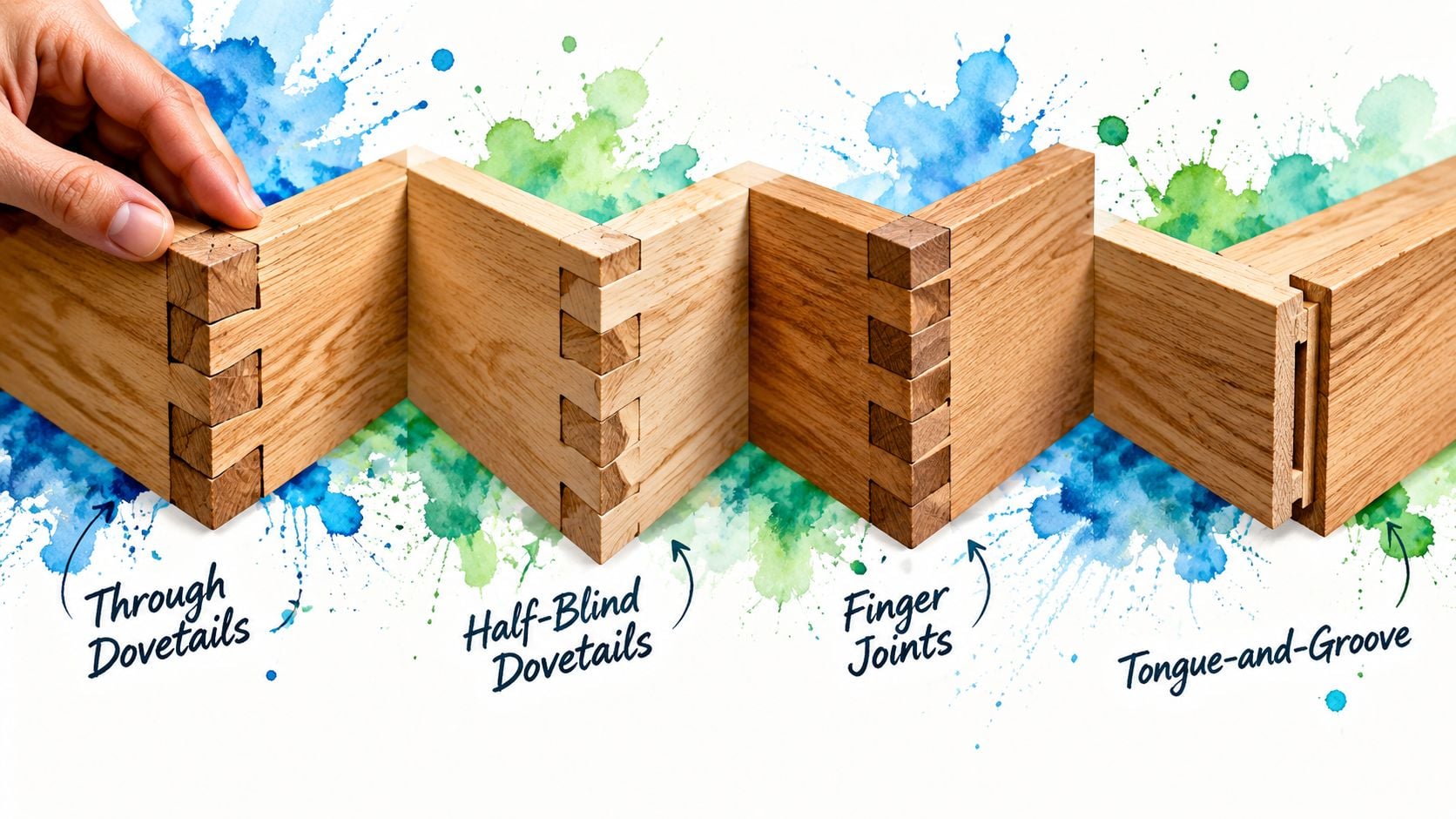
Four joints buyers can recognize
Through dovetails show the wedge-shaped pins and tails on the outside of the front and side. They offer a clear display of craftsmanship and are especially common when the maker wants the joinery to be part of the visual character.
Half-blind dovetails hide the joint from the front while preserving the interlocking connection behind it. This approach gives a cleaner face and substantial resistance to pulling, making it common in refined bedroom furniture.
Finger, or box, joints use a series of square fingers that interlock at the corner. Precise CNC production can create clean, consistent results, and the joint can provide plenty of strength when the fit and adhesive work are sound. Its regular pattern often signals modern machine production rather than a traditional hand-cut look.
Tongue-and-groove and Knapp construction use a projecting tongue or a shaped drawer-lock profile to connect components. The Knapp joint has particular historical value. It was patented in 1867 and first installed in a factory in 1871, while handmade dovetailing remained common until 1851 and machine-cut dovetails indicate production after 1895, according to this history of four centuries of drawer making. These markers can help date vintage furniture, though they shouldn't replace a full inspection.
What to feel and look for
Run a finger along the inside seam. Tight, even contact is encouraging. Large gaps, rough tear-out, or heavy glue squeeze-out may indicate rushed fitting. Check whether the bottom is captured in grooves on the front and sides. A stapled-on bottom may function for a time, but it gives the drawer less controlled support.
The mortise and tenon joint guide can also help buyers understand why traditional furniture relies on shaped wood connections rather than visible hardware alone. The practical lesson is simple: joinery should transfer force through wood, not leave screws, staples, or thin edges to carry every load.
Wood Species and Cuts That Affect Drawer Performance
Wood species change how a drawer feels, dents, ages, and responds to humidity. Buyers often start with color, but a better order is use first, hardness second, appearance third. A jewelry drawer needs a different balance than a tool drawer, even if both sit inside the same bedroom case.
Janka hardness is a useful comparison language, but a precise rating isn't supplied here for each species listed below. The table therefore uses qualitative descriptions rather than unsupported scores.
| Species | Janka Hardness | Movement/Stability | Best Drawer Use |
|---|---|---|---|
| Soft maple | Moderately hard | Stable when properly dried and fitted | General clothing storage and interiors |
| Hard maple | Hard and dent-resistant | Performs well with careful movement allowances | Silverware, jewelry, and frequently used drawers |
| Walnut | Moderately hard | Generally stable with distinctive grain | Jewelry, clothing, and visible drawer faces |
| Cherry | Moderately hard | Moves with seasonal conditions and develops a richer tone | Bedroom storage and refined case pieces |
| White oak | Hard and durable | Strong choice when properly dried and constructed | Tool storage, clothing, and heavily used drawers |
| Rift-sawn red oak | Hard, with straight grain | Straight grain can support stable, clean drawer faces | Long, wide drawer fronts and traditional furniture |
| Rustic alder | Softer and more prone to marks | Requires care in high-impact applications | Light-use storage and relaxed, character-rich interiors |
Match the cut to the job
Plain-sawn boards show broad cathedral grain and can display more noticeable movement across wide panels. Quartersawn lumber presents straighter grain and moves less across the width than flatsawn lumber. Rift-sawn stock offers especially straight grain, which can suit long drawer fronts where a calm visual line matters.
Drawer sides often use softer wood because the sides need accurate machining and stable operation rather than maximum display hardness. Drawer faces can use harder or more decorative species because they receive visual attention and direct contact. The best construction still depends on drying, grain selection, and joinery.
For buyers considering cabinet materials and regional wood choices, this discussion of Douglas fir or pine for cabinets gives useful context about why species selection should follow the application. The same principle applies to a solid wood dining table. A wood species isn't good or bad in isolation. It must suit the load, span, finish, and environment.
Why Solid Wood Drawers Move and How Good Design Handles It
Wood moves mainly across the grain as moisture conditions change. A drawer that feels perfect during a dry winter can become tighter during a damp period, especially when an enclosed room has little air circulation. In the Bay Area, coastal fog and dry heated interiors can create different conditions within the same home.
A solid-wood drawer bottom therefore shouldn't be glued rigidly across its full width. It should sit as a floating panel, captured in grooves so the center can expand and contract without splitting the drawer box. The groove in the drawer front is often made deeper than the grooves in the sides, giving the panel room to move.
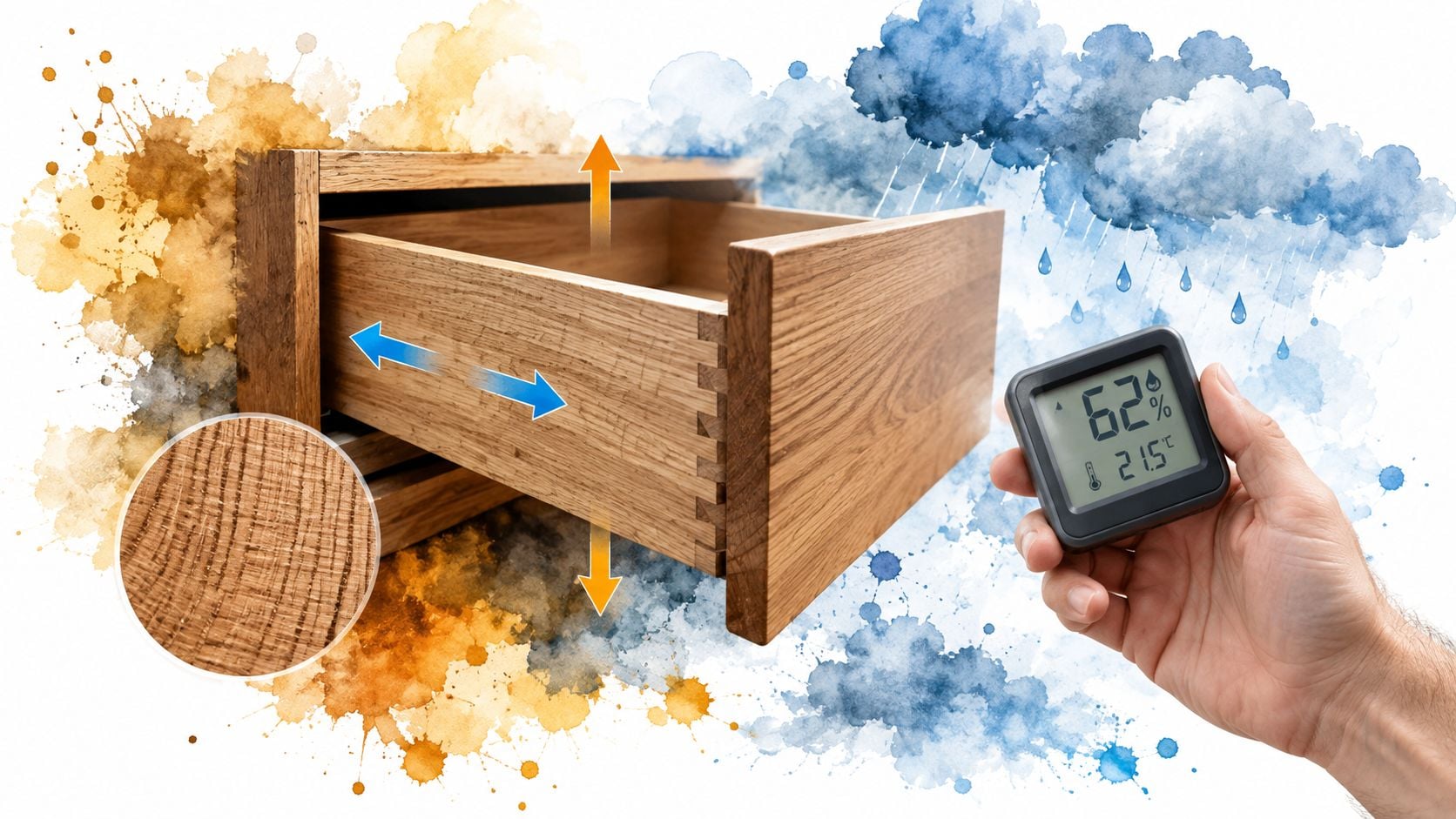
The numbers behind a smooth fit
A common engineering allowance is roughly 1/8 inch of movement per 12 inches of width in moderate climates, and as much as 3/16 inch per 12 inches in more extreme environments, according to guidance on building solid drawer bottoms. Another woodworking source recommends clearances such as 1/16 inch on each side and 3/32 inch on top for a 24-inch drawer, while Purdue guidance allows for about 2% movement in service, as summarized in the humidity-engineering guidance for seasonal accommodation.
Relative humidity also matters. A range of 35% to 55% RH is described as a stable zone, while conditions above 55% to 65% RH can contribute to swelling and sticking in recent practical guidance. The point isn't to make a home laboratory. It's to understand that some seasonal change is normal, while persistent binding may signal poor clearances, a sealed enclosure, or an environmental problem.
Quartersawn sides, correctly oriented grain, floating panels, and slides fitted with appropriate clearance work together. Readers interested in broader upkeep can review wood furniture protection before a small seasonal adjustment becomes a structural repair.
Custom Solid Wood Drawers at Giorgi Bros. Furniture
A custom order starts with the contents, not a catalog label. A buyer storing folded clothing may need a different drawer height and side construction than someone planning a silverware drawer, jewelry drawer, tool drawer, or media cabinet. The consultant should ask about weight, access, room conditions, and the finish already present in the space.
Giorgi Bros. Furniture can discuss drawer species including soft maple, hard maple, walnut, cherry, white oak, and rustic alder. Buyers can also review drawer height, standard side construction, a dovetail upgrade, or a premium dovetail option. Pulls and other hardware can be selected from established hardware brands, with daily use taking priority over a showroom-only appearance.
What a consultation should settle
A useful design conversation should clarify:
- Wood selection: The species and grain character should suit the room and the contents.
- Joinery level: Dovetail construction can be evaluated against the intended load and use.
- Hardware: Slides and pulls should support smooth, repeatable operation.
- Finish: Color, sheen, and protection should coordinate with surrounding case pieces.
- Dimensions: Replacement drawers require accurate measurements, while new case pieces can be designed around the storage need.
The Amish collection offers handcrafted solid-wood furniture made in Ohio workshops and is available through the South San Francisco Showroom. It suits buyers who want heirloom-oriented construction, but the same inspection principles still apply. Solid wood, sound dovetail work, a floating bottom, a durable finish, and hardware specified for daily use create the buy-it-for-life value. Giorgi Bros. Furniture's family-owned, non-commission environment allows shoppers to compare those choices without pressure, with flexible financing options available when appropriate.
Caring for Solid Wood Drawers Through the Seasons
Solid wood responds best to steady conditions and simple care. A seasonal routine doesn't need to be complicated, but it should address the room as well as the drawer. Excess moisture, direct air movement, and abrupt changes can affect operation even when the original construction is sound.
A spring inspection can reveal joints that loosened during a dry winter. Open each drawer, check the corners, and look for a bottom that has shifted in its grooves. During summer, watch for strong air-conditioner drafts aimed directly at a dresser bank. In fall, inspect the finish before indoor heat returns. During winter, a humidifier can help stabilize a dry room, but it shouldn't sit directly beside the case.

Two lessons from everyday furniture care
A customer once brought an oak bureau to the floor because it stuck every August. The drawer itself had sound joinery. Moving a dehumidifier closer, rather than forcing the drawer or sanding it immediately, resolved the recurring seasonal problem.
Another household had a Simply Amish chest that had served for twenty years. After arriving from Indiana, it needed only beeswax conditioning, not structural work. That example doesn't mean every drawer will require the same treatment. It shows why finish maintenance and a stable environment can extend the useful life of quality construction.
For a quick routine, use:
- Spring: Inspect joints, bottoms, and clearances.
- Summer: Keep strong cooling drafts away from wide panels.
- Fall: Dust carefully and address dry finish areas.
- Winter: Monitor room conditions and place humidification nearby, not against the furniture.
Paste wax suits many oil-based tops. Mild soap and water work for sealed surfaces when used sparingly and dried promptly. Microfiber cloths are preferable to silicone polishes, which can complicate future refinishing. For a second home or vacation property, leave drawers slightly open during long vacancies only when the room is secure and dust control permits, and avoid packing them so tightly that air cannot circulate.
Why a Quality Drawer Is a Buy-It-for-Life Investment
A good drawer concentrates several small decisions into one daily experience. Dovetail joinery keeps the corners connected under repeated pulling. Quarter-sawn or rift-sawn stock can improve stability in demanding components. A floating bottom gives solid lumber room to respond to humidity. A suitable hardwood face resists wear and can often be touched up or refinished instead of discarded.
That durability changes the cost conversation. Solid hardwood furniture is commonly described as lasting 30 to 100 or more years with proper maintenance, according to this guide to solid wood furniture longevity. Another durability guide places solid wood dressers at 15 to 30 or more years, while solid wood dining tables are listed at 15 to 40 or more years, as detailed in this furniture lifespan guide. Those ranges aren't promises for every drawer. They show why construction quality can justify a higher initial investment when the alternative requires repeated replacement.
Longevity has an environmental side
Furniture that remains useful avoids the waste associated with premature replacement. A sustainability source notes that long product life cycles of 20 or more years can reduce long-term wood consumption, and that hardwood plywood and veneer can be paired with Forest Stewardship Council-certified suppliers, as explained in this resource on sustainable wood furniture. Another manufacturer describes Northern Forest lumber as often sourced within 500 miles of its factory and notes that some U.S. hardwoods fall within low-risk FSC controlled-wood categories, details discussed in its account of sustainable furniture manufacturing.
A drawer won't determine the entire resale value of a case piece, but tight corners, solid interiors, and repairable components can signal careful construction to future owners. For buyers who value sustainability, the most responsible purchase may be the piece that remains useful, repairable, and wanted instead of being replaced after a short service life.
At Giorgi Bros. Furniture, the showroom experience is intended as research rather than a sales trip. Non-commission Consultants and ASID Design Experts can help compare species, dimensions, finishes, drawer construction, and hardware, while custom order services extend beyond what's on the floor. The South San Francisco location also offers access to broader home furnishing guidance, including Premium Mattresses, custom furniture, Amish Furniture, and full-service Bay Area Interior Design support.
Giorgi Bros. Furniture offers no-pressure guidance, custom solid wood case pieces, Amish options, and design consultations for buyers who want drawers specified around real use rather than appearance alone. Visit Giorgi Bros. Furniture in South San Francisco to examine drawer joints in person, or book a Design Consultation to discuss species, dimensions, finishes, and hardware for a buy-it-for-life investment.