A lot of shoppers land on the phrase Scandi lamp table when they're trying to finish one small corner of a room. Usually it's a reading chair that feels a little dark at night, or a bedside setup that has the bed and rug right, but still doesn't feel calm. The search sounds simple. The decision rarely is.
The first point that clears up the confusion is this. A Scandi lamp table isn't a formal furniture category. It's usually a shorthand way of describing a Scandinavian-style table lamp paired with a side table or nightstand. Once that distinction is clear, the shopping process gets much easier, because each piece has a separate job to do.
That kind of clarity matters in a home. It also matters in design guidance. Bay Area homeowners often want help that feels informed, but never pushy. That's why the best advice still sounds like a conversation across the showroom floor, shaped by decades of practical problem-solving in Furniture South San Francisco and real Bay Area Interior Design work. Since 1933, that kind of long-view thinking has helped families choose pieces worth living with for years, not just until the next trend cycle.
Finding the Perfect Light for Your Cozy Corner
A common scenario starts the same way. A homeowner has a sofa, a favorite throw, maybe even the right wall color. But when evening comes, the corner still feels flat. The overhead light is harsh, the side table is too small, or the lamp throws glare straight into the eyes. That missing pairing is often what people mean when they search for a Scandi lamp table.
The helpful shift is to stop looking for one mystery item and start thinking in twos. The lamp handles mood and function. The table handles support, scale, and placement. When those two pieces work together, the corner starts to feel complete.
Some rooms don't even have ceiling fixtures where they're needed most. For shoppers facing that problem, this guide on how to light rooms without overheads offers useful perspective on building light from the ground up rather than relying on one bright source.
A well-lit room also depends on balance, not just brightness. The ideas in putting a living room in the best light show how thoughtful placement can make a room feel softer, more usable, and easier to live in every day.
Deconstructing the Scandi Style Lamp and Table
Scandinavian design has a clear history, and that history helps explain why this pairing works so well. Scandinavian design emerged as a formal movement in the 1930s and prioritizes functional simplicity and natural materials. There isn't a credible historical record of a distinct standalone product category called a Scandi lamp table. The phrase blends two separate elements instead. The broader Scandinavian design market generated approximately $12.5 billion in global revenue in 2023, with lighting and small furniture representing a significant portion, according to this history of Scandinavian design.
What makes the lamp feel Scandinavian
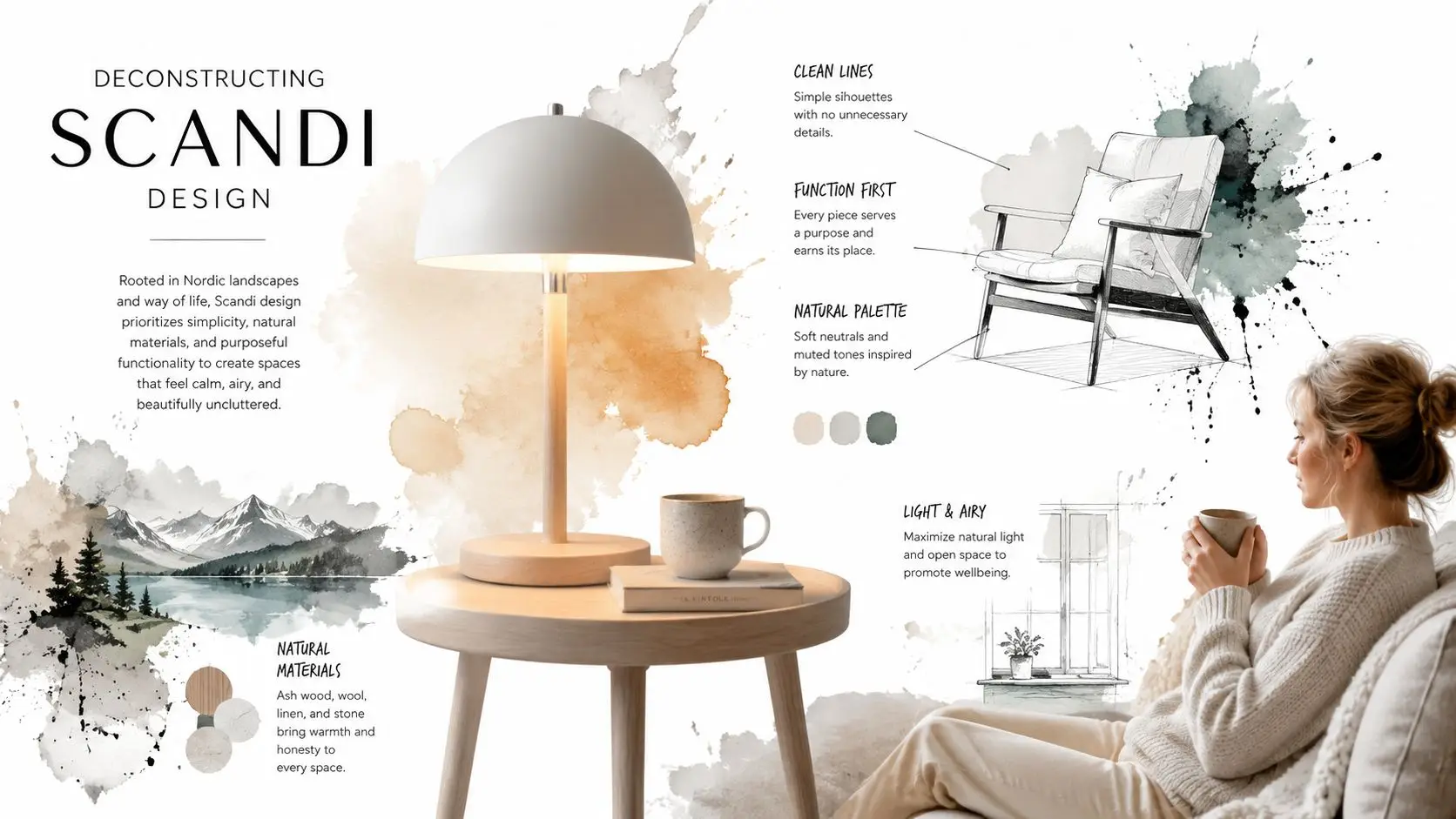
A Scandinavian table lamp usually looks restrained, but not cold. The lines are simple. The materials feel honest. Nothing looks overworked.
A shopper will often notice these traits:
- Natural or muted materials like light wood, matte metal, ceramic, or softly finished glass
- Controlled light that diffuses rather than blasts
- Minimal ornament so the shape of the lamp does the visual work
- Purposeful scale that fits a chair, sofa arm, console, or nightstand without crowding it
That last point is often underestimated in its importance. A lamp can be beautiful on its own and still fail in a room if it feels too tall, too tiny, or too flashy for the surface beneath it.
What makes the table feel Scandinavian
The table brings quiet structure. In a Scandi-inspired pairing, the table usually supports the lamp without competing with it.
Look for a side table or nightstand with:
- Clean profiles instead of carved detail
- Wood-forward character or understated painted finishes
- Open visual weight, so the piece doesn't make the corner feel heavy
- Useful function, such as a shelf, drawer, or properly sized top
Scandinavian style works best when every detail earns its place.
For anyone studying the visual language more closely, StableTable's official catalogs provide a good reference point for how Scandinavian forms stay simple while still feeling warm and usable.
How to Select the Ideal Scandinavian Table Lamp
The lamp does more than decorate a corner. It controls how the room feels after sunset. That's why choosing the right Scandinavian lamp starts with light quality, then moves to shape and material.
Start with the glow, not the base
Many shoppers begin with the lamp body. The better starting point is the bulb and the shade, because those determine whether the lamp feels soothing or glaring.
The 2700K rule matters here. According to this Scandinavian table lamp reference, the "2700K" rule is critical for achieving an authentic Scandi warmth and the hygge aesthetic. This specific Kelvin temperature provides the soft, glare-free glow essential to Scandinavian interiors.
That matters because "warm light" is often described too vaguely. A lamp can look right in daylight and still feel wrong at night if the bulb casts a light that's too cool or sharp.
Practical rule: If the goal is a calm Scandinavian mood, 2700K isn't a decorative extra. It's part of the design decision.
Match the shade to the job
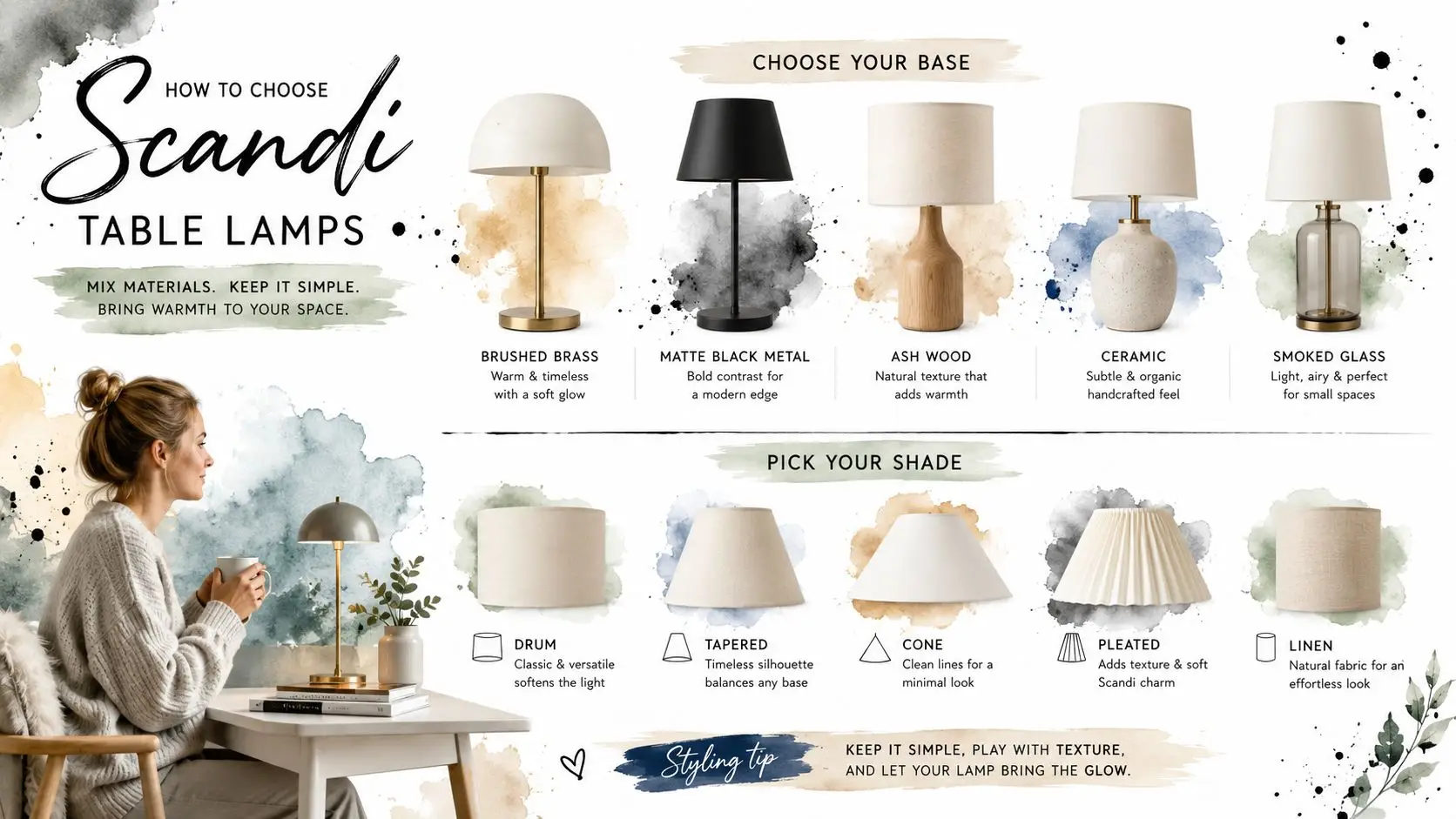
The shade changes how the lamp behaves in the room. A fabric shade tends to soften the output. A more directed shade can create a focused pool of light for reading.
A simple way to consider it:
| Lamp element | What it does in the room | Best use |
|---|---|---|
| Fabric drum shade | Softens and spreads light | Bedside use, relaxed seating areas |
| Dome or directional shade | Focuses light downward | Reading corners, task-oriented spots |
| Open, translucent shade | Adds atmosphere and glow | Accent lighting on side tables |
A lamp like the Maddox table lamp in white shows why this balance works. The shape stays quiet, the finish stays versatile, and the visual effect supports the room rather than stealing attention.
Keep the materials grounded
Once the light quality is right, then the materials can do their work. Scandinavian lamps usually feel strongest when they include one tactile element and one restrained finish.
Good combinations often include:
- Wood with fabric, which feels soft and residential
- Brushed metal with linen, which adds contrast without glare
- Matte ceramic with a neutral shade, which keeps the silhouette clean
Shoppers often get stuck between "statement lamp" and "simple lamp." In this style, simple usually ages better. That's especially important for Custom Furniture plans, where the lamp may need to coordinate with woods, leathers, and fabrics that are meant to stay in the home for a long time.
Pairing Your Lamp with the Perfect Table
Once the lamp is chosen, the table has to support it physically and visually. Often, many otherwise beautiful rooms falter at this stage. The lamp is fine. The table is fine. Together, they sit at the wrong height.
For glare-free light, placement matters more than trend. The bottom of the lampshade should sit at about eye level when seated, roughly 40 to 42 inches from the floor. In a bedroom, total lamp height should equal the nightstand height plus 2 to 3 inches, based on these Scandinavian table lamp height guidelines.
A living room rule that works
In a living room, the side table should relate to the arm height of the seating and to the seated sightline of the person using the lamp. If the table is too low, the lamp has to be oversized to compensate. If the table is too tall, the light source can feel exposed and uncomfortable.
A useful decision path looks like this:
- Sit in the seat that will use the lamp most often. Reading chairs and sofa corners don't need the same setup.
- Check eye level while seated. The shade should shield the bulb rather than expose it.
- Confirm top surface size. A table needs enough room for the lamp and one or two everyday objects, not just the lamp base alone.
Bedroom pairings need precision
Nightstands ask for a little more discipline because the user shifts between sitting up, reclining, and reaching from bed. That's why the nightstand-plus-lamp formula works so well. It gives a practical target without making the room feel overdesigned.
A bedside lamp should feel easy to use from bed. If someone has to squint past the bulb or stretch awkwardly for the switch, the pairing isn't finished.
This is also where custom options become valuable. Standard dimensions don't always match a taller mattress, a lower platform bed, or a scaled-down guest room. A table selected with Scandinavian design coffee table inspiration can help clarify proportion, finish direction, and the larger visual language of the room.
For buyers considering Amish Furniture or other made-to-order wood pieces, customization can solve several problems at once. The right wood species can warm up the lamp finish. The right stain can connect the table to existing case goods. The right dimensions can make the lamp finally sit where it should.
Styling Scandi Lighting in Your Bay Area Home
The best Scandi-inspired corners don't look staged. They look settled. A lamp and table pairing should feel like it belongs to the architecture, the climate, and the daily rhythm of the home.
A living room corner that feels complete
In a Bay Area living room, a Scandinavian lamp and side table often work best beside a sofa or next to a recliner where evening reading happens. The table can hold the lamp, a coaster, and one small object with texture, such as a ceramic vessel or stacked books. That restraint is part of the style.
The lamp shouldn't be the only light source in the room, though. According to this Scandinavian lighting guide, design trends for 2026 emphasize layered lighting with 5 to 7 distinct light sources per room to achieve true hygge, and a single Scandi lamp table should be treated as the first step in a broader mix of ambient, task, and accent lighting. Because that source projects forward, it's best understood as a directional design recommendation rather than a current rule for every room.
That idea helps solve a common mistake. People expect one lamp to carry the whole mood of the room. It can't. A table lamp near a sofa works best when another source softens the opposite side of the room and a third source supports the background.
A bedroom that feels calm at night
In the bedroom, the pairing becomes more intimate. The lamp needs to support reading, quiet conversation, and winding down. A compact nightstand with clean lines and a lamp that diffuses light downward and outward can make the room feel finished without clutter.
A few styling choices help:
- Keep the tabletop edited. A lamp, one book, and a small tray usually feel better than a crowded surface.
- Repeat a finish carefully. If the lamp has warm metal, carry that note in a drawer pull or frame, not in every object nearby.
- Use textiles to soften the light. Upholstered beds, woven throws, and subtle bedding help the lamp glow feel richer.
For homeowners thinking about nearby dining or open-plan sightlines, ideas around contemporary dining room wall decor can help maintain visual consistency beyond the lamp corner itself.
The broader room composition matters too. A Scandinavian-inspired living space feels strongest when seating, tables, and lighting share the same calm design language. That relationship is easier to spot in a curated setting such as living room Scandinavian design ideas.
Your Lifetime Investment in Timeless Design
A well-chosen Scandi lamp table pairing isn't about filling an empty spot. It's about making a corner of the home more usable, more comfortable, and more lasting. That's where quality changes the conversation.
Lower-quality pieces often ask for replacement long before the room itself changes. Finishes wear unevenly. Tabletops mark too easily. Lamp hardware loosens. A better-made table and a thoughtfully chosen lamp tend to age with more grace, which supports a buy-it-for-life mindset that saves money over time and reduces waste. That's good design and a more sustainable way to furnish a home.
Why quality pays off
Investment Pieces do more work over the years because they don't need constant correction. They also adapt better through moves, remodels, and shifting styles.
That long-term value often comes from a few simple advantages:
- Stronger materials that hold up to daily use
- Timeless forms that don't date the room quickly
- Custom choices in wood species, finishes, leathers, and fabrics that help pieces work with the home already in place
In a thoughtful Bay Area Interior Design plan, that flexibility matters. A side table chosen today may later move from a living room to a guest room, or from a bedside role to a reading nook.
Simple care keeps the pairing looking right
Care doesn't need to be complicated.
- For wood tables, dust with a soft cloth and keep moisture from sitting on the surface.
- For lamp finishes, wipe gently and avoid abrasive cleaners that can dull matte or brushed textures.
- For shades, regular light dusting helps preserve the clean, soft look that makes Scandinavian lighting feel inviting.
A durable home also depends on the guidance behind the purchase. In Furniture South San Francisco, shoppers often value clear, no-pressure help from Non-Commission Sales Staff, especially when selecting pieces that may stay in the home for decades. The same practical thinking often extends beyond occasional tables and lighting into larger room planning, Premium Mattresses, and the reassurance that financing options are available when a whole-home update needs careful pacing.
For those thinking beyond one corner, long-lasting furniture guidance is a useful next step in choosing pieces built for everyday life rather than short-term turnover.
For Bay Area homeowners who'd like to see materials, finishes, and scale in person, Giorgi Bros. Furniture offers a warm, family-owned experience shaped by more than 90 years in South San Francisco. The 50,000 square foot showroom gives shoppers room to explore living room, bedroom, dining, office, and home entertainment furnishings, along with a dedicated sleep gallery. Design Consultants provide no-pressure guidance in a non-commission environment, and custom order services make it possible to tailor wood species, finishes, leathers, and fabrics to the home, not the other way around. A visit to the showroom or a Design Consultation is a smart next step for anyone ready to create investment pieces that will serve beautifully for years.