
An adjustable base for bed can materially improve perceived sleep quality and comfort, especially for people seeking pain relief and customizable positioning. Objective sleep gains vary by person and model, but one 2022 study recorded 21 additional minutes of total sleep time, along with 21 more minutes in bed, 5 additional minutes of REM sleep, fewer awakenings, and less wake after sleep onset when participants used an adjustable base (peer-reviewed sleep findings).
The question usually appears late at night. Someone has turned the pillow twice, shifted from side to back, and still can't find a position that feels settled. Another sleeper wakes with a stiff back or finds getting out of bed harder than expected after a long day. An adjustable base changes the support beneath the mattress, allowing the head and foot sections to move instead of forcing the body to adapt to one flat surface.
For Bay Area homeowners, that flexibility can make the bedroom more useful and more comfortable without turning the bed into a medical-looking device. The right setup can support sleep, reading, relaxing, and easier transitions, while a careful mattress match protects the investment for the long term.
Why an Adjustable Base for Bed Matters
A flat foundation gives a mattress one position. An adjustable base for bed gives sleepers more control over head and leg elevation, which can make a meaningful difference when a preferred posture changes from night to night. A person may want a flatter position for sleep, gentle upper-body elevation for reading, or raised legs while unwinding after work.
That doesn't mean every discomfort requires an adjustable base, and it isn't a substitute for professional medical advice. It does mean the bed can respond more closely to the sleeper. Readers researching the category can also review these practical adjustable base sleep benefits before deciding which features matter.

A practical bedroom upgrade
The most useful way to evaluate an adjustable base is to consider how the household uses the bed. A sleeper who spends quiet time reading may appreciate head elevation. Someone who wakes frequently to change positions may value simple, responsive controls. Couples may prefer independent movement on a split configuration, particularly when their preferred positions differ.
The base also becomes part of the room's furniture plan. Its profile, leg height, and mattress thickness affect how the bed looks and how easily someone can sit down or stand up. That makes an adjustable base relevant to adjustable bed health benefits, but the decision should remain centered on comfort, compatibility, and everyday use rather than broad promises.
Practical rule: A quality sleep system should solve a real nightly problem, not add features that remain unused.
Giorgi Bros. Furniture approaches that decision through no-pressure guidance. The family-owned business has served South San Francisco for more than 90 years, since 1933, and its non-commission Consultants can help shoppers compare a base, mattress, room proportions, and long-term value together. Quality furniture is an investment piece. Choosing durable construction and a design that can remain useful for years supports a buy-for-life mindset, which can reduce replacement costs and unnecessary disposal over time.
How Adjustable Bases Evolved and Why They Are Mainstream Now
Adjustable sleeping surfaces have been around longer than many shoppers expect. One historical summary traces the first adjustable mattress-frame patent to 1874, filed by Andrew Wuest and Son in Cincinnati, Ohio. Early versions mainly raised the head section, but the basic idea was already clear, change the bed angle to support a different sleeping position (history and market overview).
The category also shows steady growth, not a passing fad. One market estimate places the global adjustable bed base category at USD 4.44 billion in 2025, rising to USD 4.69 billion in 2026 and projecting USD 6.14 billion by 2031, with an implied 5.56% CAGR from 2026 to 2031 (global market estimate). In the U.S., a separate industry report says adjustable bases held 41.00% of the mattress bases market in 2025 and projects 7.38% CAGR through 2031. That kind of growth usually means shoppers have moved past curiosity and started treating the base as part of the mattress system, not an accessory.
From novelty to bedroom standard
Consumer adoption picked up during the 2010s. U.S. mattress manufacturers sold 320,723 motion bases in 2011, and sales reached 966,041 in 2015, a 24.3% increase over that period (industry history of motion bases). For a long time, adjustable beds sat on showroom floors as a specialty item. As motorized positioning became more familiar, they turned into a regular choice for households comparing sleep comfort, not just a medical need.
Product maturity helped that shift. Industry history notes that Leggett & Platt had been making adjustable bases for 40 years, and current models span basic frames to feature-rich designs with retail prices typically from $599 to $1,999 (Leggett & Platt product history). That range matters because it shows how broad the category has become. A buyer is not looking at a one-size-fits-all product. They are choosing a sleep foundation that should fit the mattress, the room, and the way the household sleeps.
What Research Says About Sleep Quality and Comfort
The genuine question is not whether an adjustable base feels good in a showroom. It is whether it changes sleep in a way you can notice at night and feel the next morning. Research usually separates those outcomes into objective measures, like sleep duration and awakenings, and subjective measures, like comfort, restfulness, and back pain.
That split matters because the two do not always match. The 2022 study cited earlier showed objective gains in total sleep time and REM; the newer evidence below refines that picture. Some sleepers may get fewer interruptions or better positioning without seeing the same change in every sleep-stage measure.
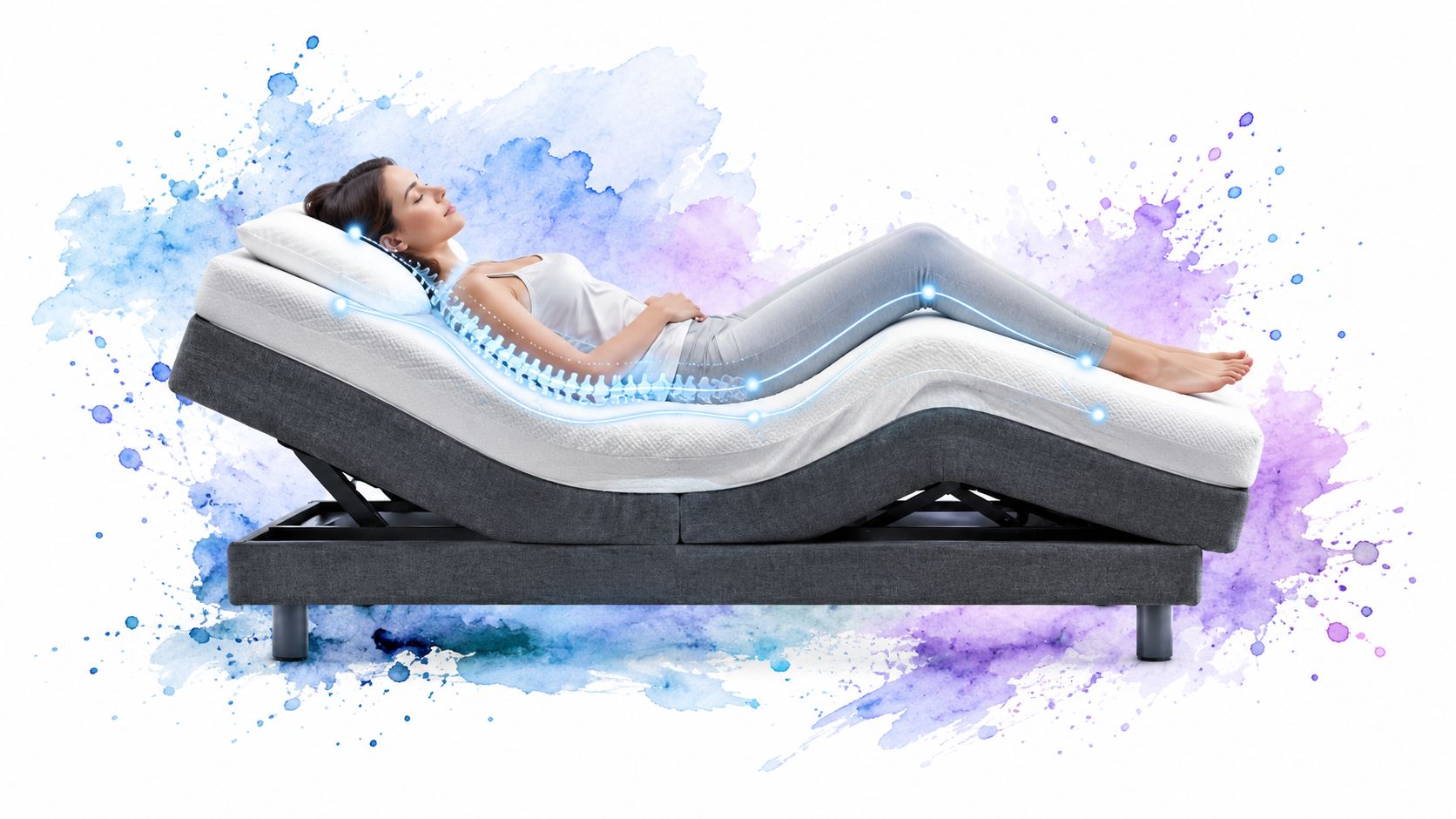
Comfort and measurable sleep aren't identical
Recent evidence gives a more balanced view. A 2025 sleep-conference study found no change in objective sleep when participants moved from flat sleeping to an adjustable base, yet those same participants reported better perceived sleep quality and less back pain. Another 2025 abstract reported both objective and perceived improvements with a multi-feature base (recent research on objective and subjective outcomes).
That is useful for shoppers, because sleep quality is not measured by one dial. A person can sleep through the night more comfortably, feel less strain in the morning, and still not show the same pattern on a lab summary. That is why showroom conversations should focus on the sleeper, the mattress, and the position changes they actually use.
Independent sleep research also points in the same direction. Reports on perceived outcomes describe falling asleep more easily, less tossing and turning, better sleep quality, and feeling more well-rested in the morning (research summary on perceived sleep outcomes). For readers interested in related sleep physiology, how nitric oxide works for sleep offers a useful side topic, while the adjustable-base choice still comes down to fit and personal response.
Choosing the Right Mattress and Size for Your Adjustable Base
The base and mattress work as one system. A mattress must flex as the head or foot section rises, then return to a stable sleeping surface when the base lies flat. Memory foam, latex, and many hybrid mattresses generally work well because their constructions can bend more readily. Traditional connected-coil innerspring mattresses may not articulate properly and can suffer damage when used on an adjustable base (mattress compatibility guidance).
Match construction before choosing features
A mattress that feels excellent on a flat foundation may behave differently when bent repeatedly. Shoppers should confirm compatibility with the mattress manufacturer and the base specifications before purchase. That step protects comfort, reduces the risk of damage, and helps preserve applicable warranty terms.
| Mattress type | General fit | What to verify |
|---|---|---|
| Memory foam | Often suitable for articulation | Flexibility, thickness, and manufacturer approval |
| Latex | Often suitable, depending on construction | Base compatibility and movement response |
| Hybrid | Many models can flex well | Coil design and specific approval |
| Connected-coil innerspring | May not bend properly | Explicit compatibility before use |
Sizing creates a second point of failure. Common adjustable-base sizes include Twin XL, Full, Queen, King, and Split King. The mattress and base should match exactly. Overhangs and gaps can interfere with articulation, create instability, and increase the chance of damage.
A split setup deserves extra attention. Each side needs the correct dimensions, and couples should decide whether independent movement matters enough to justify that configuration. A showroom test can reveal whether the center seam, controls, and movement feel natural before the purchase is finalized.
For readers comparing foundation choices, the best mattress without a box spring discussion can provide useful background on how modern mattress systems differ from older bedroom setups.
Features That Actually Matter When You Compare Models
Feature lists can make every adjustable base appear equally useful. A better approach starts with the household's habits and then works backward to the mechanism. A reader who wants head elevation for sleep may need a straightforward model, while someone who shares the bed with a partner may benefit more from split controls than from a long list of digital extras.
Begin with movement and stability
Head and foot articulation form the foundation of the experience. Look for smooth movement, responsive controls, and positions that feel supportive rather than abrupt. A preset such as a neutral reclined posture can simplify daily use, but the value comes from returning easily to a comfortable position.
Weight capacity deserves careful attention. Manufacturer specifications vary widely by design and size, so the published limit should account for the mattress, sleepers, and bedding. Profile height also affects room proportions and access. A lower starting profile can look cleaner, while modular leg stacks allow some bases to reach taller overall configurations.
| Feature | Best for | What to check |
|---|---|---|
| Head articulation | Sleepers who prefer upper-body elevation or read in bed | Range of motion and control response |
| Foot articulation | People who enjoy leg elevation while relaxing | Smoothness and available presets |
| Split movement | Couples with different position preferences | Side-to-side independence and seam comfort |
| Massage settings | Shoppers who will use timed vibration regularly | Intensity, controls, and operating noise |
| Remote control | Anyone wanting simple operation | Backlit buttons, pairing, and memory settings |
| App connectivity | Households comfortable with connected controls | Device support and dependable manual backup |
| Weight capacity | Larger sleepers or substantial mattress systems | Total system limit, not just sleeper weight |
| Profile and legs | Rooms with tight proportions or specific furniture | Base height, leg options, and frame clearance |
Pay for repeated use
Massage, lighting, charging ports, and app control can be worthwhile when they solve a real routine. They aren't automatically better because they're included. The adjustable bed base reviews can help shoppers compare practical differences without treating every specification as essential.
A thoughtful upgrade adds convenience to a routine the household already has. It shouldn't turn a simple bedtime into a technology project.
The best comparison also includes sound, stability, return policies, and warranty coverage. These details affect long-term satisfaction more than a feature that receives attention during the first week and then goes unused.
Delivery, Setup, Financing, and Design Consultation
An adjustable base is a substantial mechanical piece, not a lightweight accessory. Manufacturer specifications show that a queen base can weigh about 100 to 154 pounds, start near 3 to 3.9 inches in platform height, and use modular leg stacks to create total heights around 9 to 15 inches. Maximum supported weights commonly range from roughly 121 to 750 pounds, depending on design and size.
Those specifications affect more than shipping. The delivery path, stair access, bedroom clearance, outlet location, and final bed height all deserve attention before installation. A professional setup can reduce the risk of placing a heavy base incorrectly or discovering that the finished configuration doesn't work with surrounding furniture.
Plan the room, not just the product
White-glove delivery can include unpacking, placing the base, setting up the furniture, and removing packaging. Giorgi Bros. Furniture operates a delivery service across much of the Western United States with location-based flat rates rather than per-piece fees, while a trusted nationwide carrier network supports orders outside the direct delivery area. Details should be confirmed for the specific address and order.
The team can also discuss white-glove furniture delivery as part of the wider purchase plan. That conversation should include the mattress, existing frame, room layout, and whether the base needs legs or a compatible zero-clearance arrangement.
Flexible financing options are available for qualified shoppers who prefer to spread the cost of a durable sleep upgrade. A Design Consultation can help coordinate the sleep system with custom furniture, including selected fabrics, leathers, wood species, and finishes. That approach treats the bedroom as a lasting investment rather than a collection of disconnected purchases.
Visit Giorgi Bros. for Personalized Sleep Guidance
Testing matters because written specifications can't reproduce the feel of a moving sleep surface. In a 50,000-square-foot showroom in South San Francisco, shoppers can touch, feel, and test adjustable bases alongside Premium Mattresses. A Consultant can observe how a sleeper enters the bed, changes positions, and responds to different levels of support.
Giorgi Bros. Furniture is family-owned and has served the South San Francisco community since 1933. Its Non-Commission Sales Staff focuses on no-pressure guidance, so the conversation can stay centered on mattress compatibility, room fit, durability, and the features a household will use.
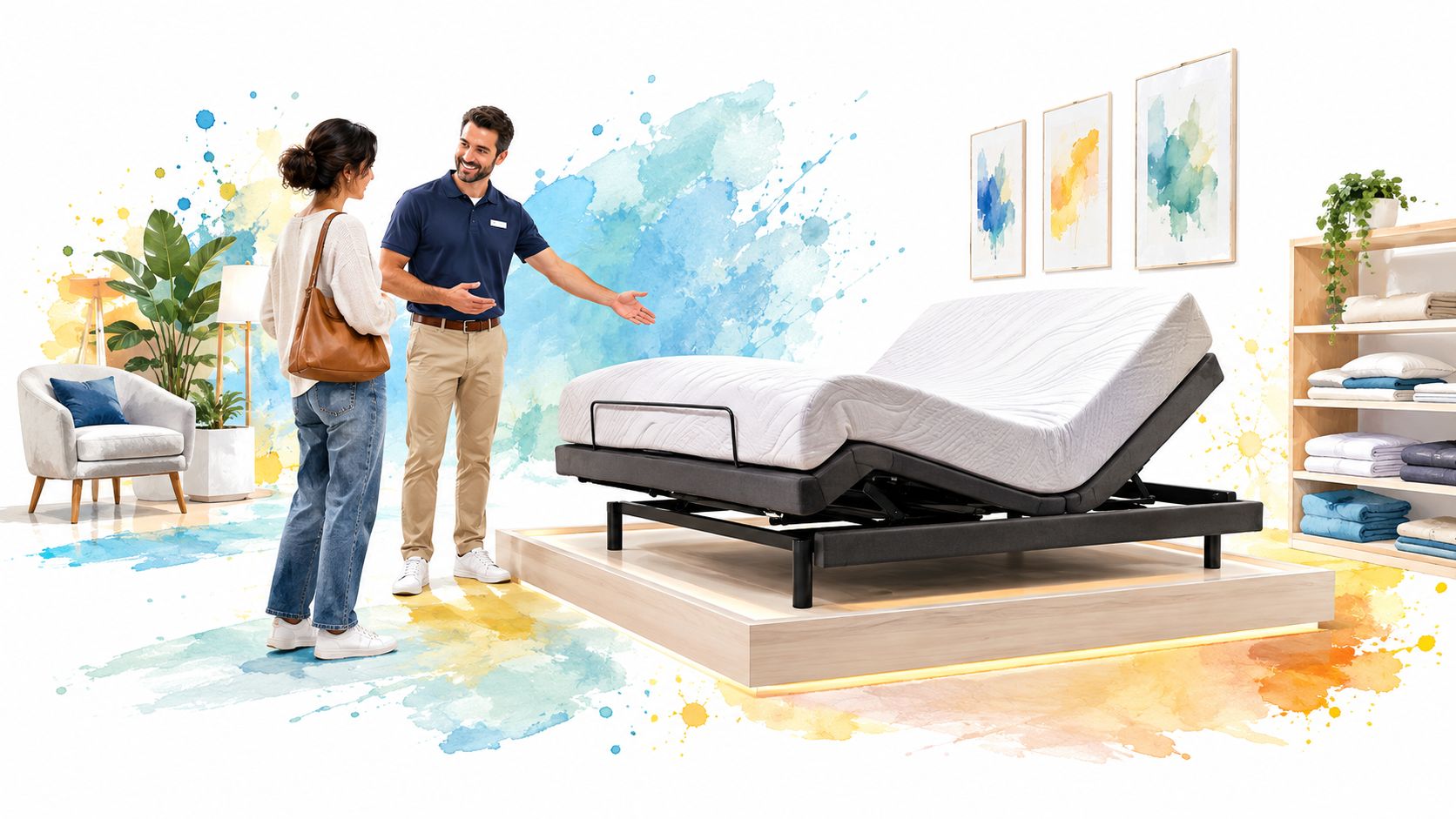
Build a room that can last
The same consultation can extend beyond the base. Giorgi Bros. Furniture offers Custom Furniture order services with choices in designer fabrics, high-grade leathers, wood species, and finishes. Shoppers interested in Amish Furniture or other investment pieces can coordinate those selections with the bed's scale, height, and visual character.
A Bay Area Interior Design consultation can be useful when a bedroom is part of a larger remodel or whole-home furnishing project. Quality construction, adaptable comfort, and timeless materials support a sustainable buy-for-life mentality. The initial decision may require more thought, but durable furniture can reduce the cycle of replacing pieces that no longer work.
Frequently Asked Questions About Adjustable Bases
How long can an adjustable base last?
Longevity depends on motor quality, daily use, weight distribution, electrical care, and warranty terms. Buyers should review the warranty's coverage for the frame, motors, remote, and labor separately. A showroom Consultant can also explain what service support looks like after delivery.
Can an adjustable base work with an existing bed frame?
Sometimes. The frame needs suitable interior dimensions, strong support, and enough clearance for the specific base. A zero-clearance design may fit inside compatible platform or furniture-style frames, but the dimensions and support structure must be checked before ordering.
Are adjustable bases noisy?
Motor sound varies by construction, load, and movement speed. A showroom test gives a more useful impression than a general promise because noise is personal and the room's acoustics can change perception. Ask to operate the base through several positions, not just a preset.
What does the warranty usually cover?
Terms differ by manufacturer. Read the coverage period, exclusions, parts and labor provisions, return process, and requirements for mattress compatibility. Keeping purchase records and installation information can make future service simpler.
Giorgi Bros. Furniture offers adjustable bases, Premium Mattresses, custom furniture, flexible financing options, and white-glove delivery with no-pressure guidance from non-commission Consultants. Visit Giorgi Bros. Furniture in South San Francisco to test a sleep system in person or book a Design Consultation for a durable, buy-for-life bedroom plan.