A tall bookcase can solve a storage problem while creating a room problem. In a narrow living room, a full-height unit may crowd the television wall, interrupt a window, and make the ceiling feel lower. A white low bookcase takes a quieter approach. It stores books and objects close to the floor, leaves the wall above open for art, and can shift roles when the room changes.
That flexibility matters in Bay Area homes, where one room often serves as a living area, office, reading space, and media room. The right piece isn't just a shorter bookcase. It can be a console, a visual boundary, or an investment piece selected around the room's proportions, materials, and future use.
Why a White Low Bookcase Earns Its Place
A homeowner may start by looking for book storage and end up needing something more adaptable. Consider a compact living room with a sofa facing a television. A tall shelving tower fills the wall from floor to ceiling, while the television, artwork, and windows compete for attention. A white low bookcase creates a horizontal line instead. The room keeps useful storage, but the upper wall remains available for framed art, open sightlines, and natural light.
Retailers treat low bookcases as a distinct compact-storage category because the format works beneath windows, in bedrooms, and in home offices. The same proportions can also function as a console or media stand, with product assortments commonly grouped into height classes under 36 inches and under 54 inches. White finishes appear frequently within this category, which reflects the practical appeal of a light, low-profile piece in smaller rooms. See the current low-bookcase category and assortment.

Lightness without visual emptiness
White doesn't automatically make furniture disappear. A broad case can still dominate a wall if its depth, width, or contents feel heavy. The advantage comes from combining a light finish with shorter proportions, allowing the top surface and the wall above it to participate in the design.
That open space gives a homeowner more choices over time. A low bookcase can sit beneath a window today, support a television later, or move behind a sofa to define an open-plan boundary. The category's broad retail presence, including more than 1,000 search results in one major online assortment, shows how widely shoppers use compact shelving in white, low-profile formats. Review ideas for furnishing a small space without losing style.
Practical rule: Choose the piece that supports the room's sightlines, not the piece that uses every available inch of wall.
The low format also improves everyday access. Items stay within reach from a sofa or desk, while the upper surface becomes a place for artwork, a lamp, or a few carefully chosen objects. That combination makes the white low bookcase less tied to one decorating era and more useful as the household evolves.
Standard Dimensions and Proportions That Actually Work
A low bookcase doesn't have one universal standard. Its identity comes from its shorter height and shallower geometry. A configurable maker lists a default height of 90 cm and depth of 25 cm, while typical low units commonly fall around 80 to 110 cm tall and 25 to 30 cm deep. Those proportions keep the center of gravity lower than a standard bookcase and allow the case to work as a display surface or sideboard. Review standard bookshelf depth and low-bookcase proportions.
Start with height
Measure the wall from floor to ceiling, then note the height of the window sill, artwork, and television. A unit under 36 inches can sit below many windows and maintain a clear visual break between the furniture and the glass. In a bedroom, that shorter line can hold books without making the bed wall feel enclosed. In a home office, it keeps frequently used materials accessible without competing with the desk.
Height also affects how the top surface feels. A lower case reads more like a console, while a taller low bookcase gives books and baskets greater presence. Neither is automatically better. The right choice depends on whether the surface needs to display objects, support media equipment, or organize a collection.
Match depth to the contents
Depth determines whether the piece feels integrated or projects into the room. A 25 to 30 cm case suits many paperbacks, standard hardcovers, framed objects, and small baskets. It works particularly well beneath a window or behind a sofa because it preserves circulation.
A deeper case may be useful for larger display books or media equipment, but added depth changes the room's movement. Before ordering, measure the largest items that must fit and include room for cables, ventilation, or baskets. Heavy objects belong on lower shelves because low bookcases still need sensible load placement for stability.
| Dimension | Typical Range | Practical Effect |
|---|---|---|
| Height | 80 to 110 cm | Keeps storage accessible and creates a low horizontal line |
| Depth | 25 to 30 cm | Holds many books and objects without projecting deeply into the room |
| Default configurable depth | 25 cm | Suits compact display and under-window placement |
| Default configurable height | 90 cm | Balances storage with console-like surface use |
Measure the room, not just the wall
A wall measurement tells only part of the story. Mark the sofa edge, baseboard, doors, vents, and walking route on the floor with painter's tape. Then place a few books or boxes inside that outline to test whether the proposed depth feels comfortable.
A South San Francisco showroom visit can make this step more concrete. Homeowners comparing 30-inch bookcases can assess how a low profile relates to seating, windows, and artwork before committing to a configuration.
Materials and Finishes Worth Investing In
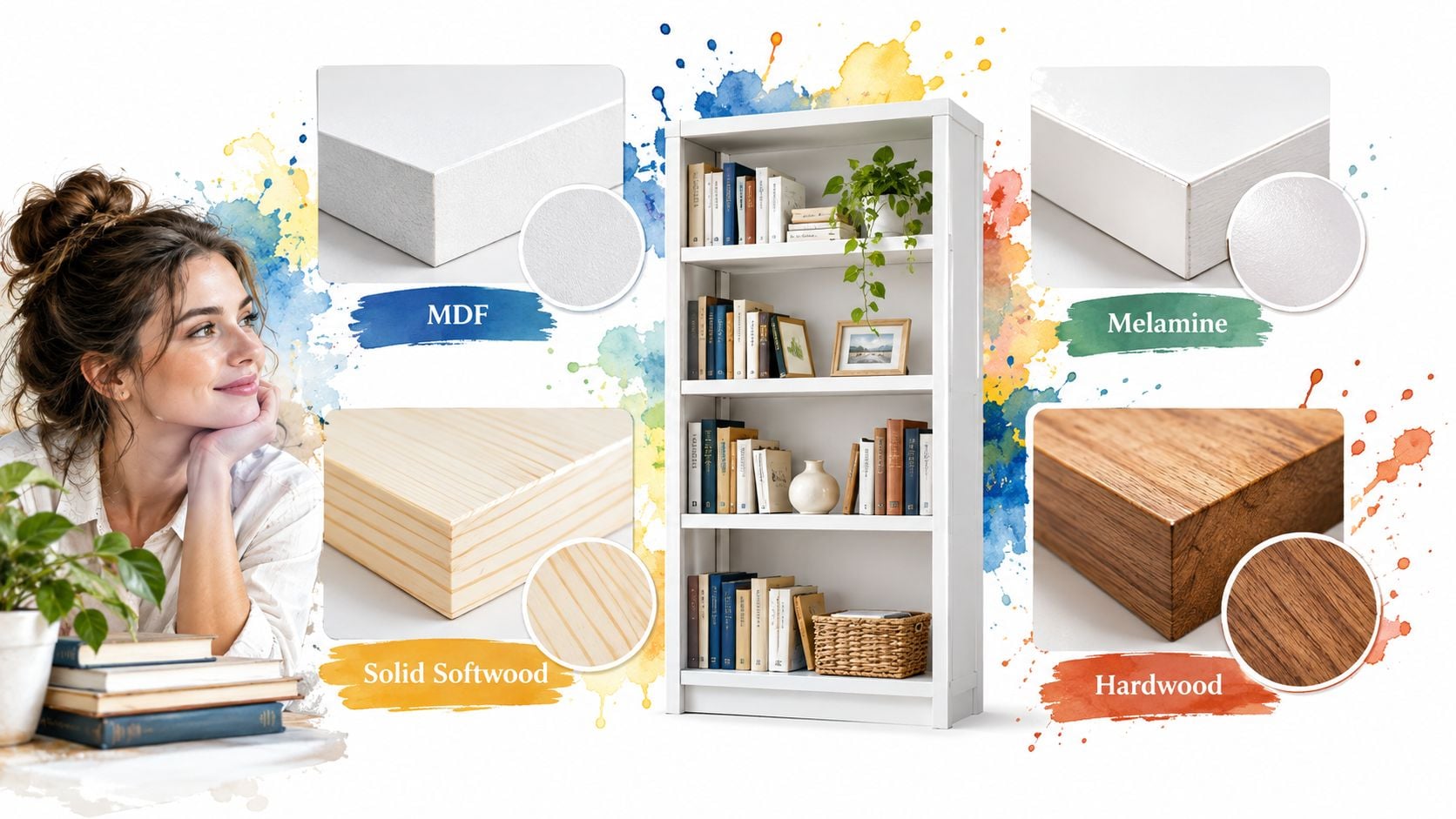
A white low bookcase is judged by its surface, but its lifespan starts with the material underneath. Laminated MDF and melamine-faced engineered wood provide practical surfaces for regular dusting, wiping, and minor scratches. They still need protection from water. If moisture reaches an unsealed cut edge, the panel may swell or delaminate, especially near an entryway, kitchen, or a room with changing humidity. Review material and finish considerations for furniture. Giorgi Bros. Furniture can also discuss finish choices during a custom order, rather than treating white as a one-size-fits-all specification.
Understand the surface beneath the white
MDF creates a smooth base for opaque paint, which suits the clean edges many homeowners want. Inspect the exposed edges, joints, and rear panels. Good sealing acts like a raincoat at vulnerable seams, while an unfinished cut edge remains an easy path for moisture.
Melamine adds a factory-applied surface that handles routine use well. Damage at a seam or drilled opening still needs attention. Solid softwood contributes visible grain and natural variation, but concentrated pressure can leave dents more readily. Depending on preparation, that grain may remain visible through a white coating.
Hardwood provides a firm base for crisp profiles, durable joinery, and finishes that can be repaired over time. Giorgi Bros. Furniture's custom-order process makes species, edge details, and finish part of the same decision, which supports a buy-it-for-life approach. Common durable choices include black walnut, white oak, hard maple, cherry, and ash, but each creates a different result beneath white. White oak and ash suit grain-forward treatments, while maple produces a quieter surface. Explore wood species and custom finish approaches. A closer comparison of material behavior and finish response can help clarify those trade-offs. Compare how hardwood species and finishes behave in use.
Choose the white finish deliberately
Painted enamel gives the bookcase an opaque, uniform face. It works well beside painted trim or when the piece should read as a simple architectural boundary. A limed or cerused treatment leaves some grain visible, adding texture below the white. Pigmented oil produces a softer appearance and may change gradually with light and use.
Finish affects sheen, touch-up work, moisture resistance, and the visibility of small marks. Ask how the surface should be cleaned and repaired before ordering. Giorgi Bros. Furniture's South San Francisco showroom can make those differences easier to judge in person, while its finish guidance offers another practical reference: best wood finishes for furniture.
Indoor air quality also belongs in the material conversation. In a compact apartment, nursery, or bedroom, ask about the core material, coatings, edge sealing, ventilation, and manufacturer documentation. A white surface alone does not answer those questions. Retail examples show how white low bookcases are commonly presented across home-office assortments. See how white low bookcases are commonly presented in retail assortments
Storage, Media Console, and Room Anchor Uses
One white low bookcase can serve three different purposes, but the best configuration changes with the job. A storage-focused piece needs enough shelf height for books and baskets. A media console needs room for equipment, airflow, and cable routing. A room anchor needs width and visual calm more than maximum capacity.
Three rooms, three configurations
In a home office, shallow shelves keep reference books, folders, and baskets close to the desk. The unit can sit on a side wall, where its low profile avoids making the work area feel boxed in. In a living room, the same basic case can hold books at the ends, display objects in the center, and support a lamp or framed piece above.
A media version needs more planning. Sound equipment, a turntable, or another component may require a taller central opening than a row of books. Ventilation gaps and rear cord access matter, and the homeowner should confirm the actual equipment dimensions before ordering. Low shelves can support a screen or create a visual base beneath it, but the case must be rated for the intended load.
In an open-plan room, the bookcase can sit perpendicular to a sofa and create a gentle boundary without becoming a solid wall. This use is especially effective when the shelves remain partially open and the finish coordinates with nearby trim. Retail content increasingly positions low shelves as console and media pieces, not only as book storage. Explore media and entertainment-center planning.
| Use Case | Recommended Height | Recommended Depth | Shelf Count | Best Room Placement |
|---|---|---|---|---|
| Book and basket storage | 80 to 110 cm | 25 to 30 cm | Sized around the collection | Office, bedroom, or living-room side wall |
| Media console | Low profile selected around equipment | Confirm equipment depth before ordering | Central opening plus side storage | Beneath a screen or along a media wall |
| Room anchor | Shorter than surrounding tall furniture | Shallow enough to preserve circulation | Open or lightly filled shelves | Beneath a window, behind seating, or across a long wall |
Let the contents determine the layout
Books look more intentional when the shelves include variation. Upright rows can share space with a short horizontal stack, a basket, or one framed object. Leaving some open space prevents a white case from becoming a dense block of color and makes its boundary-piece role clearer.
The practical decision is simple. If the bookcase must store mostly books, prioritize accessible shelf spacing. If it must support media, prioritize equipment clearance and cable access. If it must divide a room, prioritize width, stability, and a restrained arrangement that preserves sightlines.
The Buy-It-For-Life Case for Custom Ordering
A white low bookcase earns its place as a buy-it-for-life piece when it can keep working after the sofa moves, a screen changes, or a room becomes a home office. Its value comes from more than a white finish. As a low boundary between zones or a media piece beneath a screen, it should remain useful through several layouts. A U.S. Forest Service literature review connects design decisions with more sustainable material use and longer furniture life, supporting an investment piece built for continued service rather than quick replacement. Read the furniture sustainability literature review
Longevity begins before the finish
A durable case works like a well-maintained vehicle. Its parts need to be serviceable, not merely attractive on the day it arrives. Look for solid connections, replaceable hardware, sealed edges, and a finish that can be renewed without stripping the entire piece. The visible white surface affects the room, while the joints and substrate determine whether the bookcase stays square under years of loading and moving.
Research on furniture lifetimes in a circular economy identifies low-quality materials and poor design as barriers to reuse, repair, and extended service. Longer furniture lifetimes reduce waste and carbon emissions, so a durable custom order can support household economics and a more responsible furnishing approach. Review research on furniture lifetimes and circular design
Customization prevents premature compromise
A stock piece may leave a homeowner with the wrong depth, a white that clashes with nearby trim, or shelves that fail to suit the collection. Custom ordering lets the case respond to the actual room instead. A homeowner can specify a hardwood species, white finish, proportions, and interior arrangement rather than remodeling around a near match. That matters when the bookcase must define a boundary without blocking sightlines or hold media equipment without looking like a separate object.
Review Giorgi Bros. Furniture's custom furniture design options to consider how those choices can carry through other rooms. Related wood species and finishes can connect a low bookcase with dining furniture, office pieces, or bedroom storage.
Custom ordering isn't only about appearance. It can improve fit, repairability, and the likelihood that the piece remains useful after a move or renovation.
Long-term test: A quality bookcase should answer three questions. Can the surface be maintained? Can the structure be repaired? Can the piece serve another room later?
The purchase may require more thought at the start, but its cost is easier to judge across the furniture's life. A piece that stays useful avoids repeated replacement, while durable materials and a repairable finish preserve more of the original investment. That is the practical meaning of buying for life.
Showroom Visit, Custom Order, and White-Glove Delivery
The buying process should reduce uncertainty before a custom piece enters production. A useful showroom visit starts with the wall, not with a finish chip. Bring room measurements, photographs, baseboard details, and the dimensions of the objects the bookcase must hold.
Begin with an in-person assessment
At a South San Francisco showroom with more than 50,000 square feet of furnishings and design inspiration, homeowners can compare low profiles, surface textures, hardware, and neighboring furniture categories in person. The team can help test how a white finish looks beside existing trim and how a shallow case relates to a sofa, desk, or media wall.
A family-owned furniture business with roots reaching back to 1933 can also offer continuity beyond a single purchase. The useful question isn't whether a piece looks attractive under showroom lighting. It's whether the proportions, material, and finish still make sense in the home's actual light and daily routines.
Confirm the custom details
The custom-order conversation should record the decisions that affect use:
- Dimensions: Confirm height, width, depth, shelf spacing, and clearances around doors, outlets, and baseboards.
- Materials: Compare hardwood species, engineered wood options, edge treatments, and the finish's expected maintenance.
- Function: Identify whether the case will store books, hold media, display objects, or divide an open-plan room.
- Appearance: Match the white finish to trim, flooring, nearby furniture, and the desired level of visible grain.
The team can also discuss custom order services across wood species and finishes, along with related furnishings when a project extends beyond one bookcase. Flexible financing options are available for qualifying purchases, and non-commission Consultants or Design Experts can keep the conversation focused on fit rather than pressure.
Plan delivery around the room
White-glove delivery should include more than dropping a carton at the entry. Giorgi Bros. Furniture's service covers delivery, unpacking, in-home setup, and removal of packaging materials, with location-based flat rates across much of the Western United States. Outside the direct delivery area, the team uses a trusted deluxe nationwide carrier network, and in-store pickup may also be available.
Homeowners should confirm room placement, access routes, stairways, and any assembly needs before delivery day. A clear plan protects walls, floors, and the furniture itself, while in-home setup lets the piece be positioned according to the original design intent.

Choosing the Right Piece for Your Home
The right white low bookcase emerges from three checks: proportion, purpose, and permanence. First, measure the wall, ceiling line, window sill, baseboard, and nearby furniture. A low unit should preserve the room's sightlines rather than merely fill unused wall area.
Next, match depth to the primary function. A depth of 25 to 30 cm suits many books and display objects. Media equipment or larger baskets may require more room, so actual component measurements should guide the order. The case should remain easy to walk around, especially when it sits behind a sofa or acts as an open-plan boundary.
Finally, select a material and white finish that can live with the rest of the home. Hardwood species such as maple, ash, or white oak offer different grain and resilience characteristics, while an opaque painted surface creates a different effect from a grain-forward treatment. For the wall above the unit, homeowners considering framed canvas wall decor can use the open space to add scale and personality without increasing the bookcase's footprint.
| Use Profile | Typical Height | Recommended Depth | Finish Priority |
|---|---|---|---|
| Storage-focused | 80 to 110 cm | 25 to 30 cm | Durable surface and easy-access shelf layout |
| Media console | Selected around equipment | Confirm equipment depth | Edge sealing, cable access, and clean coordination with nearby furniture |
| Room anchor | Low profile beneath the main sightline | Shallow enough for circulation | Calm white tone that supports surrounding art and furnishings |
A showroom consultation turns those measurements into a decision rather than a guess. At the South San Francisco location, homeowners can compare floor samples, touch finish options, and discuss Custom Furniture, Amish Furniture, Premium Mattresses, and broader Bay Area Interior Design needs with non-commission guidance.
Giorgi Bros. Furniture offers custom-order furniture, hardwood species and finish selections, non-commission Design Experts, and white-glove delivery for homeowners choosing a white low bookcase. Visit the Giorgi Bros. Furniture showroom in South San Francisco or book a Design Consultation to test proportions and finishes before placing an order.