Most living rooms don't struggle because the television is too large. They struggle because everything around it feels unresolved. The screen sits on a stand that's too narrow, cords spill into view, gaming gear ends up on the floor, and the wall that should anchor the room starts to feel busy instead of settled.
That's where good entertainment center design changes the experience of the whole space. A well-made piece doesn't just hold electronics. It manages heat, hides wiring, supports the room's proportions, and gives the eye a clear focal point. It also saves money over time because a durable, adaptable piece is less likely to be replaced when technology changes or a remodel moves in a new direction.
For Bay Area homeowners, that matters. A living room usually has to work hard. It hosts movie nights, quiet evenings, family gatherings, and everyday clutter. The best answer isn't a quick fix. It's a lasting one.
Table of Contents
- Beyond the Screen Planning a Lasting Investment
- Defining Your Needs and Ideal Layout
- Perfect Placement Measuring and Sizing
- Smart Storage and Component Organization
- Choosing Materials and Finishes for Life
- Integrating Lighting and Personal Styling
- Bring Your Custom Vision to Life with Giorgi Bros
Beyond the Screen Planning a Lasting Investment

An entertainment center earns its keep when it solves problems the room will have for years, not just for the next device upgrade. That means thinking beyond shelf count and finish color. The piece needs to support the screen, conceal equipment, create order, and still look grounded when the rest of the room evolves.
That buy-it-for-life mindset is one of the biggest differences between disposable furniture and investment pieces. A low-cost unit may seem convenient on day one, but weak backs, shallow compartments, and fixed openings usually become frustrating fast. Once equipment runs hotter, cables multiply, or the room gets refreshed, that shortcut starts costing more than it saved.
A strong entertainment center becomes part of the architecture
The best designs act less like temporary furniture and more like a permanent part of the room. They give visual weight to the screen wall, add storage where clutter usually collects, and let decorative pieces share space with practical ones.
Practical rule: If the entertainment center only answers today's television size, it's probably too limited. If it supports technology, storage, scale, and style together, it has a much longer life.
That long-view approach has shaped furniture decisions in South San Francisco for generations. Giorgi Bros. Furniture has operated continuously since 1933, building trust with Bay Area homeowners through more than 90 years of family-owned service in South San Francisco, as noted on the Giorgi Bros. Furniture website.
Lasting value is also a sustainability decision
Replacing furniture every few years creates waste, repeat delivery costs, and another round of compromise. Buying once, and buying well, is usually the more sustainable path. A durable wood piece that can adapt to changing components and survive everyday use keeps material out of the landfill and money in the household budget.
That's also why no-pressure guidance matters. Homeowners make better decisions when they're allowed to slow down, compare options carefully, and think about how the piece will function after the excitement of the remodel wears off. In entertainment center design, patience usually pays off.
Defining Your Needs and Ideal Layout

A better layout starts with honesty. Most homeowners don't need more furniture first. They need a clearer brief. The right questions reveal whether the room needs open display, hidden storage, a lower profile, or a larger wall presence.
Start with how the room is actually used
Some homes need a sleek media console. Others need a full wall composition with drawers, shelving, and space for speakers, books, or family keepsakes. The answer depends on habits more than style labels.
A useful planning list includes:
- Current equipment: Count the television, sound components, gaming systems, routers, remotes, and charging needs that must live here now.
- Near-future additions: Think about what may be added in a few years, especially if the household upgrades often or wants a cleaner tech setup later.
- Daily behavior: Note whether the room is used for movies, sports, gaming, background television, reading, or all of the above.
- Non-media storage: Decide whether this piece also needs to hold board games, photo albums, baskets, or a vinyl collection.
A room that mixes several functions needs clearer zoning. Closed storage handles the visual noise. Open shelving should be reserved for objects worth seeing.
For homeowners refining the room as a whole, this living room furniture layout guide is a helpful companion when mapping circulation and seating around the entertainment wall.
Choose a layout that supports the room
Different layouts solve different problems. A floating console keeps the room visually lighter and works well when the architecture already has strong lines. A low, wide unit settles a long wall and can make the television feel less dominant. A taller arrangement with side storage fits households that need more capacity and a stronger focal point.
Rooms feel calmer when the furniture matches the life happening around it. A media wall for a quiet den should behave differently than one in a family hub with games, streaming devices, and everyday traffic.
There's also a trade-off between openness and concealment. Too much open shelving often turns into visible clutter. Too much closed storage can make the piece feel heavy. The strongest entertainment center design usually mixes both, with practical storage at hand level and display space above or to the sides.
Before any dimensions are finalized, homeowners should write down what absolutely must fit and what only sounds nice in theory. That step prevents oversized builds, empty cubbies, and furniture that looks impressive but doesn't serve the room.
Perfect Placement Measuring and Sizing
A media wall can fail even when the craftsmanship is beautiful. The usual problem is proportion. The unit is either too small for the television, too deep for the room, or pushed so tight to the wall that electronics can't breathe.
Measure the screen wall before shopping
A disciplined measuring process prevents those mistakes. For a 65-inch TV, the unit should be at least 70 inches wide to avoid visual crowding. That single rule improves balance immediately because the furniture gives the screen enough support instead of looking like an afterthought.
The width of the room matters too, but the wall isn't the only reference point. The entertainment center also has to relate to nearby seating, side tables, and walking paths. A piece can fit the wall and still feel wrong if it overwhelms the rest of the room.
A practical way to measure is to record:
- Overall wall width
- Ceiling height
- Depth available without obstructing circulation
- Outlet and media connection locations
- Door, fireplace, or passage interference
Homeowners working through viewing comfort can pair those dimensions with this guide to optimal TV positioning, especially when seating distance and screen height are still in flux.
Protect airflow and viewing comfort
Ventilation is not optional. A rigorous design methodology calls for 2 to 3 inches of space behind units to reduce overheating, which is a common failure point in 40% of DIY installations.
That detail gets missed because it isn't glamorous. Yet it directly affects equipment life, safety, and day-to-day performance. A shelf opening that looks neat on paper can become a heat trap once a receiver, console, and streaming device are stacked together.
Leave breathing room before adding decorative trim, back panels, or tightly fitted compartments. Electronics punish furniture that prioritizes appearance over airflow.
Height matters as much as width. The screen should sit where viewers can watch comfortably without lifting the chin for long periods. If the entertainment center is too tall, the room feels formal but the viewing angle suffers. If it's too low, the wall can feel unfinished. Good sizing isn't about one dramatic measurement. It's about getting several modest ones right at the same time.
Smart Storage and Component Organization
A beautiful piece loses its effect when cords drape from every shelf edge. Storage has to do more than hide objects. It has to organize the equipment in a way that still allows access, airflow, and future changes.
Hide the mess without trapping heat
Visible wires are the most common complaint with off-the-rack media furniture. 45% of users cite visible wires as the primary aesthetic flaw, and that leads to a 30% lower satisfaction rate. By contrast, custom orders with specific features reach a 90% fit-for-life satisfaction rate.
The lesson isn't that every room needs a giant built-in. It's that storage should be designed around actual equipment paths. Power strips need a home. Cable routes need to move vertically and horizontally without bunching. Components that produce heat need separation, not just concealment.
Useful details include:
- Integrated cable channels: These keep cords from dropping behind shelves in a tangled bundle.
- Accessible back panels: A removable or well-cut rear panel makes service much easier later.
- Ventilated compartments: Openings at the back or sides help electronics release heat.
- Dedicated charging space: Small drawers or concealed shelves can keep devices from colonizing the whole room.
Plan shelves around real objects
Open shelving should be measured against the objects it will hold. A stack of art books needs different height than a center speaker. Decorative bowls, framed photos, and sculptural pieces also need breathing room or they start looking crowded.
That same principle applies to styling around meaningful objects. Homeowners who display statues or collected art often benefit from a sizing reference before finalizing shelf spacing. This HD Asian Art statue size guide offers a practical way to think about dimensions and display scale.
Custom shelving helps because it can be built around the mix of technology and personal items instead of forcing the room to adapt to a standard template. For readers comparing storage approaches, these ideas on custom wood shelving show how a cleaner fit can reduce clutter without sacrificing warmth.
Good organization should disappear. The room should feel calm, not engineered.
Choosing Materials and Finishes for Life
The material decision shapes almost everything that follows. It affects durability, repairability, visual warmth, and even how the room sounds during movie night. That's why entertainment center design shouldn't treat finish selection as the final decorative step. It belongs near the beginning.
Why material quality changes long-term value
Solid wood remains the benchmark for homeowners who want furniture that lasts. It wears in rather than wearing out. Minor marks can often be addressed. Joinery stays meaningful over time. And the piece carries a depth that thin veneers and printed surfaces rarely match.
This is also where Amish Furniture often stands apart. Its appeal isn't only tradition. It's the discipline of craftsmanship, the quality of the woodwork, and the sense that the piece was built to serve a household for decades instead of one trend cycle.
Material choice also affects performance in subtle ways. Most design guides stop at storage and style, but wood density matters in media furniture. Custom wood species like black walnut versus oak can alter acoustic clarity by up to 15%, which matters for households that care about sound quality as much as appearance.
A media piece sits at the meeting point of furniture and technology. Materials that only look good on delivery day usually disappoint later.
Finishes deserve the same scrutiny. A hand-applied finish can add richness and depth, but it should also make sense for daily use. High-sheen surfaces may reflect more light from the screen wall. More forgiving finishes often age better in rooms with children, pets, or heavy use.
For readers drawn to cleaner silhouettes, these Scandinavian TV stand ideas are useful for seeing how simplified forms still benefit from strong material choices.
Entertainment Center Material Comparison
| Material | Pros | Cons | Best For |
|---|---|---|---|
| Solid wood | Durable, repairable, rich character, ages well | Higher upfront investment, heavier | Buy-it-for-life furniture, custom pieces, family rooms used daily |
| Wood veneer over quality core | Attractive surface, can offer a refined look, often lighter than solid wood | Surface damage can be harder to correct, less forgiving over decades | Homeowners balancing appearance and budget |
| Engineered board with laminate or printed finish | Lower initial cost, widely available, consistent appearance | Less repairable, shorter lifespan, often weaker around heat and repeated use | Short-term setups or secondary rooms |
| Glass and metal mixed construction | Light visual profile, contemporary feel, easy to wipe down | Can feel cold, shows dust and fingerprints, may not soften acoustics | Modern rooms with minimal storage demands |
The best choice depends on how long the piece is expected to stay, how hard the room works, and whether the household wants furniture that can be refinished, adapted, and handed down.
Integrating Lighting and Personal Styling
Once the structure is right, lighting and styling turn the entertainment center into part of the room rather than a separate equipment zone. A screen wall can feel hard and dark. Light softens it.
Use light to soften the screen wall
A warm integrated glow inside shelving adds depth and helps decorative objects read clearly at night. It also keeps the television wall from becoming a black rectangle surrounded by shadow. The effect should be subtle. The goal is atmosphere, not a showroom look.
A balanced arrangement often works best with a simple mix:
- Closed storage below for remotes, games, and practical items
- Open shelves above or beside for books, ceramics, or framed photos
- A small layer of light to make the composition feel intentional after sunset
Style in layers, not in piles
The strongest styling rarely uses every shelf. Negative space matters. One shelf may hold stacked books and a small vessel. Another may stay nearly empty except for one sculptural piece. That pause gives the eye somewhere to rest.
A room also feels more settled when the entertainment center echoes materials found elsewhere. If the seating is soft and textured, the shelves can carry a little wood, pottery, or matte metal to continue that tone. If the room is more refined, symmetry and cleaner spacing may feel better.
Leave one or two places intentionally open. The entertainment center should support the room, not compete with everything in it.
Bring Your Custom Vision to Life with Giorgi Bros
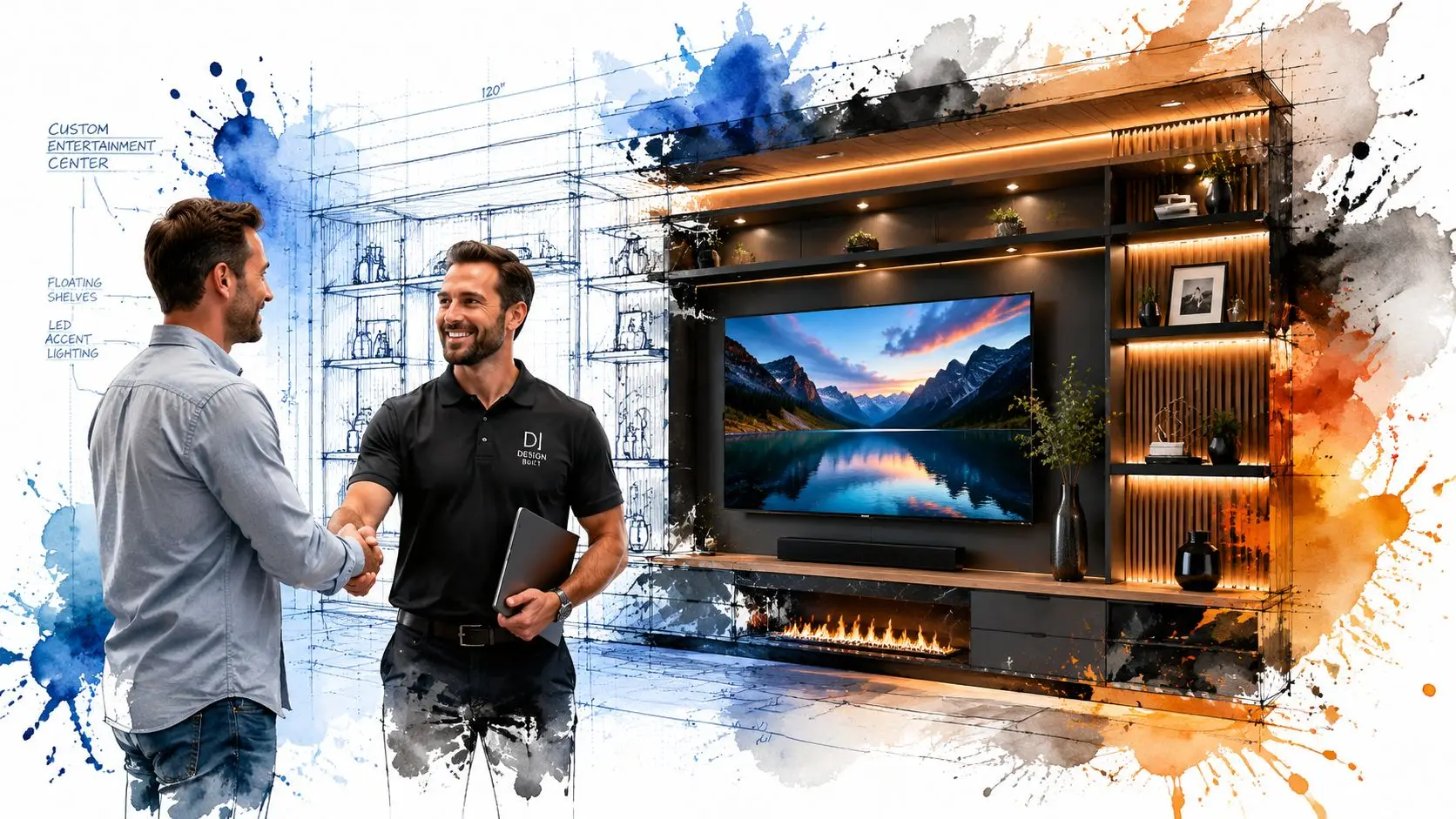
Good planning still needs skilled execution
The difference between a good idea and a lasting result usually comes down to guidance. Measurements need to align with room flow. Material choices need to support both style and use. Storage details need to reflect real equipment, not a generic template.
That's where custom order service matters. Giorgi Bros. offers a custom program that allows customers to specify wood species, finishes, high-grade leathers, and designer fabrics, helping Bay Area renovators tailor each piece to their vision. The showroom also operates with Non-Commission Sales Staff, or more accurately, non-commission Consultants and Design Experts, which supports a no-pressure process focused on fit instead of urgency.
For homeowners developing a full media wall, details around the backdrop can matter as much as the furniture itself. This guide with expert advice on statement walls can help when the entertainment center will sit against a more intentional feature surface.
Custom media solutions also work best when the furniture is designed as part of the room rather than dropped into it at the end. These customized TV stand options are a good example of how customized dimensions and finish choices can create a cleaner result.
Why a showroom visit changes decisions
Some choices can't be made well from thumbnails alone. Wood tone, finish depth, shelf proportion, and seating relationships are easier to judge in person. That's especially true for Custom Furniture, Bay Area Interior Design projects, and homeowners searching for Furniture South San Francisco that feels substantial enough to last.
Giorgi Bros. has served South San Francisco since 1933 and offers 50,000 square feet of showroom space where shoppers can touch, feel, and test quality before they buy. That kind of environment helps families compare materials honestly, explore Premium Mattresses during whole-home updates, and remember that financing options are available when planning larger investment pieces.
For homeowners ready to create an entertainment center that balances timeless craftsmanship with modern tech needs, Giorgi Bros. Furniture offers no-pressure guidance, custom order expertise, and a South San Francisco showroom built for real decision-making. Visit the showroom to explore investment pieces in person, or book a Design Consultation to start shaping a buy-it-for-life solution for the living room.