
A great many Bay Area rooms have the same problem. The sofa fits. The rug is in place. The lighting works. Then one wall, corner, or narrow stretch beside a desk still feels unfinished, and the room never quite settles down.
That's where 30 inch bookcases earn their keep. They aren't only storage. They shape a room, hold family photos and well-read novels, display pottery and framed art, and make a space feel considered instead of improvised. In smaller homes, condos, and remodeled older houses, that kind of proportional discipline matters.
For families trying to make every square foot work harder, it also helps to look at broader innovative storage ideas for small homes. A bookcase often does its best work when it's part of a larger plan for calm, useful living. Bay Area homeowners who are working with tighter footprints can also explore small space furniture solutions when a room needs more than one smart adjustment.
Since 1933, South San Francisco families have turned to furniture stores not just for products, but for judgment. That's still what matters most. A well-made bookcase should solve a problem for today, age well through moves and remodels, and remain useful long after trend-driven pieces have been replaced. That buy-it-for-life mindset is better for the home, better for the budget over time, and better for the simple pleasure of living with furniture that keeps doing its job.
Table of Contents
- An Introduction to Thoughtful Storage
- The 30-Inch Advantage Why This Size Is a Design Staple
- Planning Your Space How to Measure for a Perfect Fit
- Exploring Styles and Enduring Materials
- Built to Last Quality Construction and Load-Bearing
- The Customization Difference Your Vision Brought to Life
- Your Showroom Checklist and Common Questions
An Introduction to Thoughtful Storage
A bookcase often enters the conversation late. A family finishes the larger purchases first, then notices the room still lacks order. Books pile on side tables. Children's keepsakes drift from surface to surface. A home office wall looks bare but also crowded, which sounds impossible until it happens.
That last missing piece usually needs to do several jobs at once. It has to hold weight, look balanced next to existing furniture, and respect the walking space that makes a room feel comfortable. In Bay Area homes, that challenge shows up constantly. A breakfast nook becomes a reading corner. A guest room doubles as an office. A hallway landing turns into useful storage.
A thoughtful bookcase doesn't just fill an empty spot. It gives the room a purpose and a rhythm.
This is why proportional furniture stays relevant decade after decade. The best pieces aren't chosen because they are fashionable for a season. They're chosen because they make daily life easier and continue to look right as the household changes.
For a family-owned showroom with roots going back to 1933 in South San Francisco, that distinction matters. Furniture should earn its place. A quality bookcase can serve one generation as a homework station backdrop, another as a display for collected art, and later as part of a library wall in a remodeled home. That is what makes it an investment piece rather than a temporary fix.
Why storage deserves more respect
A good storage piece does three things at once:
- Creates order: It gives books, framed photos, baskets, and objects a dedicated home.
- Improves the room: It can soften an awkward wall or anchor a quiet corner.
- Lasts through change: It still works when the room gets repainted, redecorated, or repurposed.
That long view is especially important with wood furniture. Better materials can be refinished, repaired, and handed down. Lower-grade pieces often can't. For households trying to buy less and buy better, that difference isn't minor. It's the whole point.
The 30-Inch Advantage Why This Size Is a Design Staple

Many dimensions in furniture feel arbitrary. Thirty inches doesn't. It sits in a range that gives a bookcase enough presence to be useful without making it heavy-looking in a modest room.
Width matters more than many shoppers expect
A 30 to 32 inch width is widely recognized as the sweet spot for shelving because it can hold 15 to 20 standard hardcovers per shelf, and a standard four-shelf unit can hold 60 to 100 volumes according to this shelving guide on ideal 30 to 32 inch proportions. That's a meaningful amount of storage for urban homes where floor space is limited.
This is the key design advantage. A narrower case can look skimpy and fill up too fast. A much wider case can dominate the wall, crowd a walkway, and feel visually bulky in bedrooms, home offices, and apartment living rooms.
Shoppers also get tripped up by the phrase itself. A retailer may list a “30 inch bookcase,” but that number might refer to height, width, or another overall dimension. In this guide, the focus is on 30 inch width.
A practical difference in daily living
The value of this width shows up in ordinary rooms:
| Room type | Why 30 inch bookcases work well |
|---|---|
| Small office | They hold a serious amount of material without overwhelming the desk area |
| Bedroom corner | They add vertical storage while keeping the room restful |
| Living room wall segment | They can frame a chair, cabinet, or artwork without stealing the scene |
A 30 inch width also makes styling simpler. It's wide enough for books stacked upright, a framed photo, and one sculptural object without looking crowded. At the same time, it doesn't force a family to overfill shelves just to make the case feel substantial.
Practical rule: When a room feels one piece short of complete, a 30 inch bookcase often solves the problem because it adds function without changing the room's center of gravity.
That's one reason this size has remained such a staple. It behaves well. It stores enough. And it rarely looks like a compromise.
Planning Your Space How to Measure for a Perfect Fit
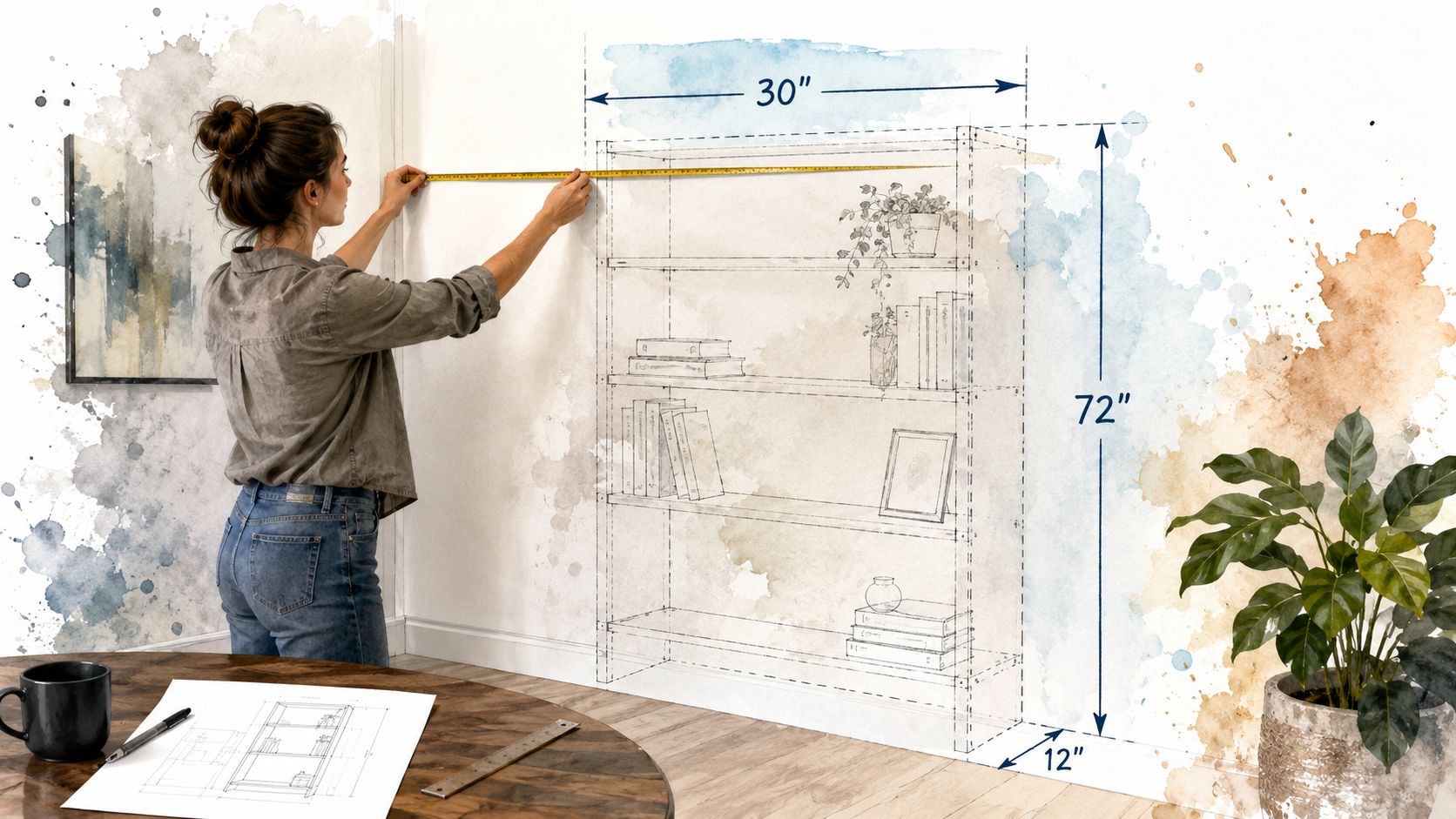
A surprising number of bookcase mistakes happen before anyone looks at wood species or finish. They start with measurement. Not careless measurement, just incomplete measurement.
First confirm what 30 inch means
Shoppers often run into ambiguous listings for “30-inch” bookcases and aren't sure whether that number refers to height or width. The same product search problem also leads to questions about whether multiple units will look balanced together, as noted in this discussion of ambiguous 30-inch listings and visual balance.
That's why the first step is simple. Confirm the dimension being discussed before comparing products or sketching a wall layout.
Measure the wall and the room around it
A tape measure and notepad are enough, but the process should be a little disciplined.
Start with wall width
Measure the full span where the bookcase will sit. Then note anything that steals usable space, such as trim, vents, switches, outlets, or a return wall.Check baseboards and nearby obstacles
A case may fit the wall on paper and still sit awkwardly because of thick baseboards or molding. If the piece will stand close to a doorway, account for the door swing too.Look up, not just across
Ceiling height matters, especially if the room has low beams, sloped areas, or artwork already planned above the piece.Study the walking path
The room still needs breathing space. A bookcase shouldn't force a sideways shuffle past a desk, bed, or lounge chair.Measure the delivery path
Hallways, stair turns, and entry doors matter just as much as the final wall.
For homeowners considering a more integrated storage layout, wall-to-wall bookcase options can help when one freestanding case turns into a larger built-in style plan.
Think about pairs and groupings
A single 30 inch bookcase can stand alone beautifully. Two or more units take more care. The eye notices mismatches faster than one might expect.
A useful way to judge a grouping is to ask three questions:
- Do the heights relate well? Matching heights usually feel calmer.
- Are the depths close enough? One deep case beside a much shallower one can look accidental.
- Does the spacing feel intentional? Tight groupings read as one composition. Random gaps don't.
If a pair of bookcases looks slightly off, the problem usually isn't color. It's proportion.
Many Bay Area remodels benefit from thinking beyond the individual product spec. The room has to read as a whole. The best-fitting bookcase is the one that belongs to the architecture and the furniture already in place.
Exploring Styles and Enduring Materials
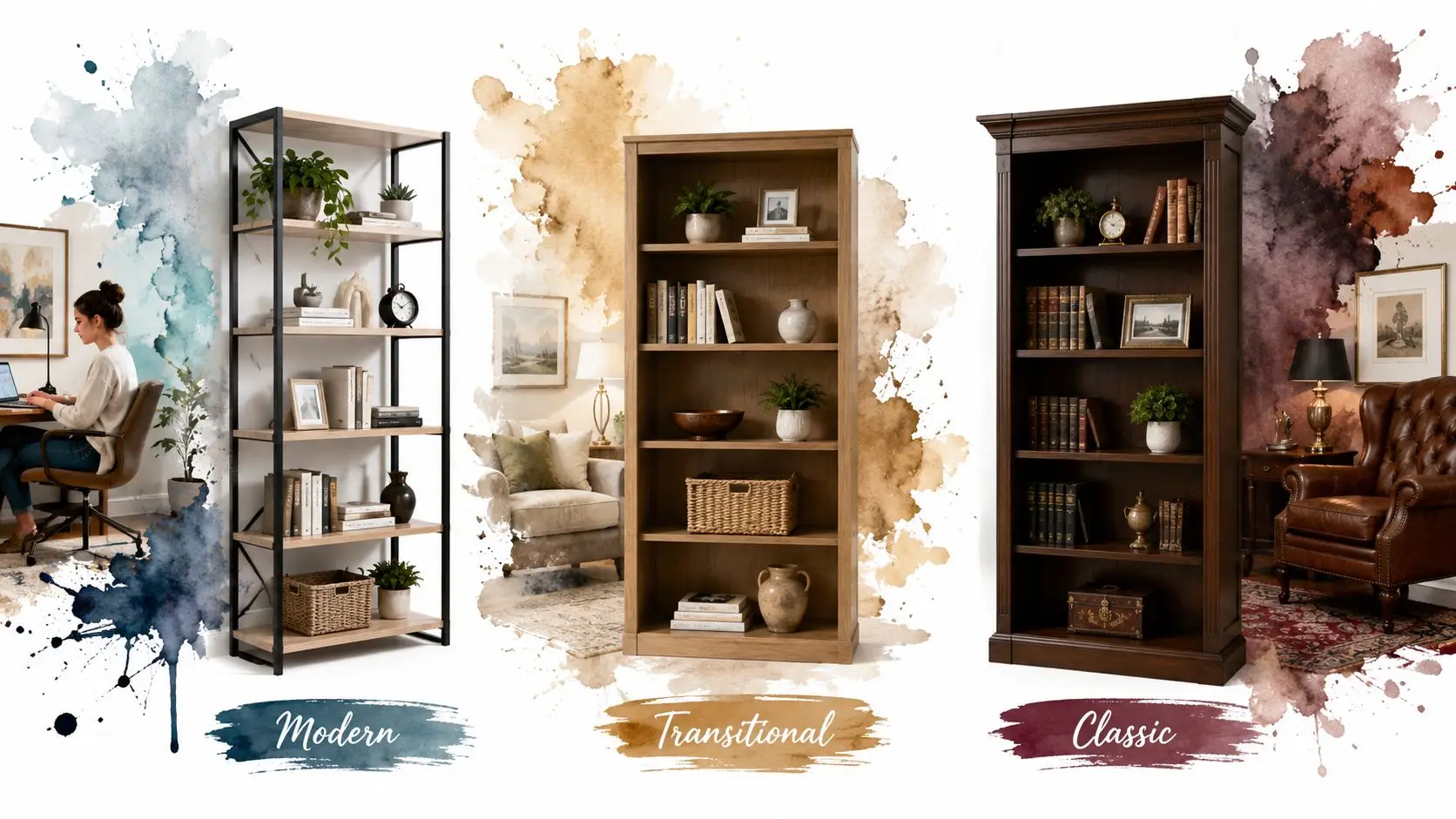
A well-proportioned bookcase can still disappoint if the style and material don't suit the room. Many quick purchases go wrong in this respect. The size works, but the piece doesn't feel at home.
Style should support the room
The 30-inch bookcase dimension has roots in the 1930s, when furniture standardization emphasized modular units for functional living spaces. That width later became a staple in the American mid-century market and remains a favored proportion among custom Amish furniture makers, according to this historical look at the 30-inch bookcase dimension.
That history explains why the size feels so natural in different interiors. It adapts.
- Modern rooms tend to benefit from cleaner lines, lighter visual weight, and restrained hardware.
- Transitional spaces often welcome a balance of simplicity and warmth.
- Traditional interiors can support richer woods, more shaping, and a more architectural profile.
A 30 inch width works in all three because the proportion is steady. The styling changes, but the footprint remains useful.
Material decides how the story ends
The primary divide isn't old-fashioned versus modern. It's solid wood versus lower-grade substitutes.
Solid wood usually ages with more grace. It develops character, can often be repaired, and feels substantial in daily use. Lower-grade materials may look acceptable at first, but years of weight, movement, and dry indoor air can expose their limits.
For readers comparing wood characteristics, The Knotty Lumber Co. guide is a helpful overview of how different species vary in look and feel. That kind of background helps when deciding between oak, cherry, maple, and other enduring options.
A solid wood bookshelf also makes more sense for households that want buy-it-for-life furniture rather than fast replacement cycles.
Good wood furniture asks for more care at the beginning and gives back far more years in return.
That's one reason Amish Furniture continues to appeal to people who value craftsmanship over churn. The goal isn't novelty. It's permanence. A room always feels calmer when at least a few pieces were chosen to stay.
Built to Last Quality Construction and Load-Bearing
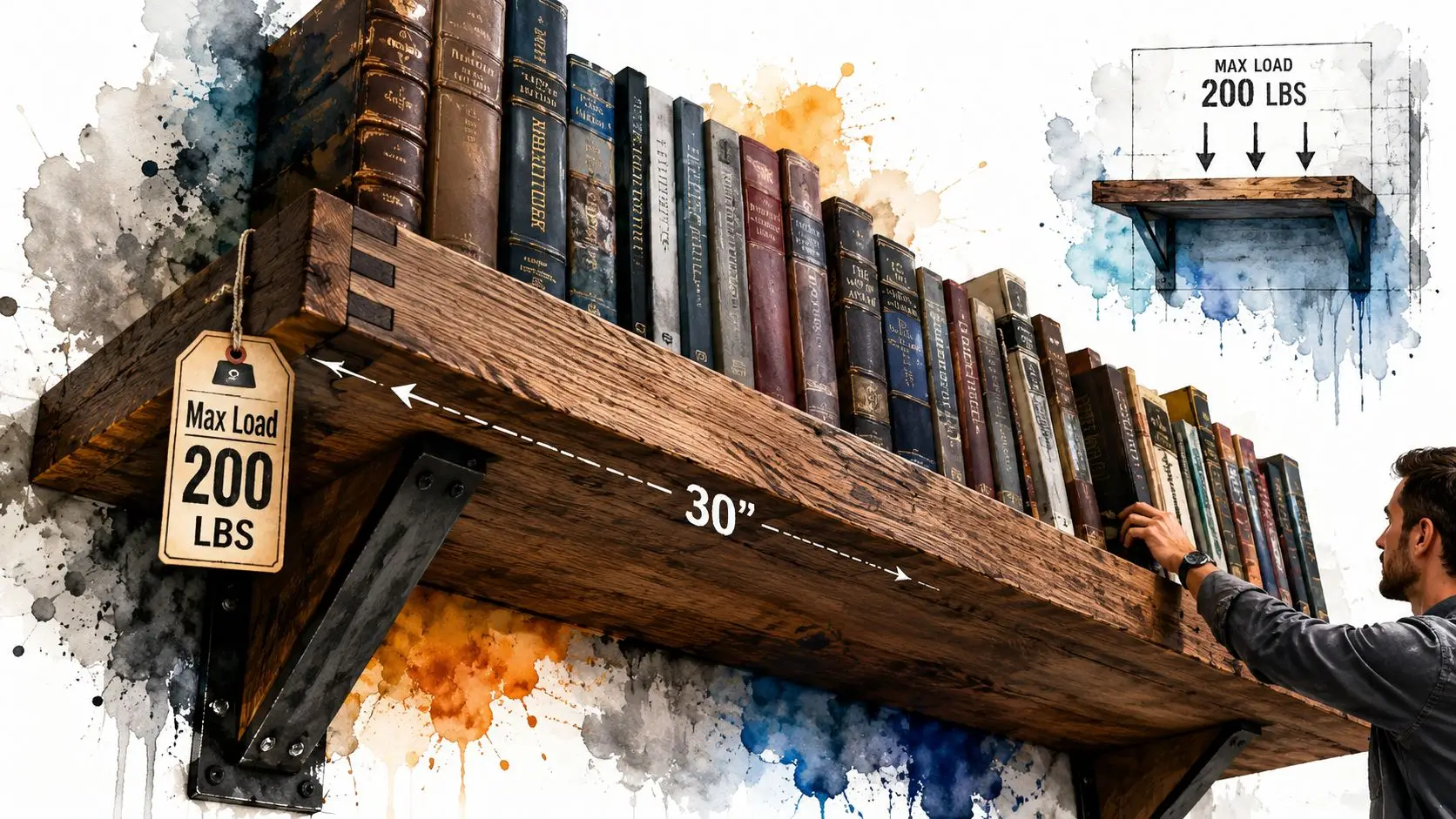
Two bookcases can look similar from across the room and behave very differently once they're loaded with books. That difference comes down to construction.
What to inspect before buying
A high-quality 30-inch bookcase often uses 1.5-inch-thick side panels, 3/4-inch adjustable plywood shelves, and L-beam construction for extra rigidity, according to this explanation of bookcase construction details. Those details help prevent the shelf sag and side-to-side instability that show up in lower-quality pieces.
That may sound technical, but the benefits are easy to understand:
- Thicker sides: Help the case feel planted instead of flimsy
- Stronger shelves: Resist bowing under the weight of hardcovers
- Rigid construction: Helps the unit stay square over time
Many families have already lived through the opposite. A shelf starts flat, then dips in the middle. The back panel loosens. The case rocks slightly when touched. Once that starts, the piece rarely gets better.
Why compact width still needs strong engineering
Some shoppers assume a narrower case doesn't need serious construction because it isn't especially large. That's a mistake. Books are heavy, and repeated loading and unloading puts constant stress on shelves and joints.
A compact width often performs best when the builder has paid close attention to rigidity. That's why quality specifications matter more than glossy finish photos.
Here's a quick comparison:
| Construction feature | Why it matters in daily use |
|---|---|
| Thick side panels | Improve stability and reduce racking |
| Plywood shelving | Holds shape better than weaker shelf materials |
| Adjustable shelves | Allow the case to adapt to changing book and object sizes |
| Reinforced structure | Helps the piece stay dependable for years |
For shoppers weighing materials, solid wood vs veneer considerations can clarify what belongs in a long-term piece and what may be better suited to a shorter horizon.
A bookcase should feel dependable when a child grabs a favorite story, when a shelf is restyled, and when the collection grows over the years.
That is where cost and value part ways. A lower initial price can disappear quickly if the piece has to be replaced. Better construction usually asks for more upfront and rewards the household with durability, safety, and less waste.
The Customization Difference Your Vision Brought to Life
The standard 30 inch width is useful because it fits so many rooms. Customization is what turns that good fit into a precise one.
Where custom sizing and finish choices help most
A family may need a bookcase that matches older casegoods in tone, aligns with existing trim, or works as a pair on either side of a fireplace. Another household may want the same width but a different height, shelf spacing, or wood species.
That's where custom order services become valuable. The homeowner can choose details that shape how the piece lives in the room:
- Wood species: One room may call for a lighter, cleaner look, while another needs deeper warmth.
- Finish choice: The right finish can tie a new bookcase to an existing desk, dining set, or media cabinet.
- Shelf layout: Adjustable or differently spaced shelves make room for novels, albums, baskets, and display pieces.
- Grouped installations: Multiple units can be planned to create a more built-in appearance.
For households exploring personalized storage, custom wood shelving options can offer a clearer sense of what can be customized.
One option available to Bay Area shoppers is Giorgi Bros. Furniture, a South San Francisco showroom that offers custom ordering across wood species and finishes as part of a broader Custom Furniture approach.
Why no-pressure guidance matters
Customization only helps if someone can sort through the choices calmly. Too many decisions, too quickly, can leave a family stuck between samples and second-guessing.
That's why Non-Commission Sales Staff matters, even if the better term is consultants. A room generally benefits when a design expert asks practical questions first. What will the shelves hold. Does the piece need to coordinate with nearby furniture. Will the room change use over time.
This kind of guidance protects the investment. It also supports sustainability in a very direct way. Furniture that fits properly, looks right, and is built well is much less likely to be replaced a short time later. Buying once and buying wisely still remains one of the soundest furnishing decisions a household can make.
Your Showroom Checklist and Common Questions
Choosing a bookcase gets easier when the showroom visit starts with good information instead of guesswork. Families who prepare a little usually make calmer, better decisions.
What to bring to the showroom
A simple checklist helps:
- Bring measurements: Wall width, ceiling height, and notes about baseboards, outlets, and doors
- Add room photos: Wide shots are useful because they show neighboring furniture and natural light
- Include inspiration images: A few examples help clarify whether the room leans modern, classic, or somewhere in between
- Know the job: Books only, mixed display, office storage, or a combination
- Ask about practical support: Delivery, setup, and whether financing options are available
Homeowners planning a larger remodel may also benefit from outside expert renovation guidance so the bookcase works with the broader design plan.
Common questions about 30 inch bookcases
Can different bookcase sizes be mixed?
Yes, but the grouping should look intentional. Similar heights, compatible depths, and a clear layout usually matter more than exact duplication.
Is solid wood worth it for a bookcase?
For many households, yes. It tends to reward long-term ownership, especially when the shelves will carry real weight.
Can a 30 inch bookcase work in a home office and a living room?
Absolutely. That's part of its appeal. The width is flexible enough to feel natural in both settings.
Should multiple units match exactly?
Not always, but they should relate. If one piece feels formal and the other casual, the pair can look unsettled.
What else should shoppers test in the showroom?
Shelf thickness, overall steadiness, finish quality, and how the piece feels from up close. That same visit can also help with whole-home planning, including Furniture South San Francisco selections, Bay Area Interior Design conversations, and even Premium Mattresses if several rooms are being updated at once.
A room doesn't need more furniture. It needs the right furniture. For Bay Area homeowners who want lasting quality, no-pressure guidance, and custom options that respect the way real families live, Giorgi Bros. Furniture in South San Francisco is a practical next stop. Visitors can bring measurements, photos, and ideas, then work with design consultants to find investment pieces built for the long run.