
If a person falls asleep on their side, wakes up on their back, and drifts onto their stomach before morning, the mattress has to handle all three positions without making any of them feel wrong. That's why the best mattress for combination sleepers is less about brand loyalty and more about construction, firmness, and how easily the surface lets the body move. For shoppers who also care about the bigger sleep picture, a good overview of better sleep and heart health can be a useful reminder that comfort choices can have wider effects than a single night's rest.

The tricky part is that most beds feel fine when a person is still, then start revealing their weaknesses once movement begins. A side sleeper needs one kind of give, a back sleeper needs another, and a stomach sleeper needs a flatter, steadier base. Combination sleepers live in the overlap between those needs, which is why a mattress that looks perfect on paper can still leave someone waking up stiff, sore, or cramped.
Why Combination Sleepers Need a Different Mattress Strategy
A combination sleeper usually doesn't plan to move. The body just does it. One night starts on the side, then the shoulders ask for relief, the back wants better alignment, and the stomach position shows up before morning. That pattern turns mattress shopping into a three-position problem, not a one-position problem.
A lot of “best mattress” lists assume a fixed sleep style. That works for someone who stays on the back all night. It works less well for someone whose body keeps searching for a new pressure point to escape. The core issue isn't comfort in a single pose, it's whether the bed still feels balanced after the third or fourth shift.
The nightly movement pattern matters more than the label
Combination sleepers often think they need a softer mattress because side sleeping feels nice at first. Then they roll to the back and notice the hips sinking too much. Or they choose a firmer bed for stomach support and discover that their shoulder gets pinned when they turn sideways. The mattress itself hasn't changed, but the position has.
Practical rule: if a mattress only feels right when someone stays in one exact pose, it's probably not the right match for a restless sleeper.
That's why sleep quality is tied so closely to alignment and pressure relief. The body wants to settle, but it also wants to move without resistance. A mattress that can't keep up tends to create micro-adjustments all night, and those small discomforts add up.
Support has to hold up while the body changes shape
Combination sleepers don't need a mysterious “perfect” feel. They need a surface that supports the spine when the body shifts and doesn't trap the shoulders or hips in one spot. That's the reason the category calls for more judgment than a generic comfort score.
A good starting point is to think in terms of movement, not marketing. Ask whether the mattress helps the body rotate, or whether it makes turning feel like work. A showroom test tells the story faster than a product page can.
What Actually Counts as a Combination Sleeper
A combination sleeper isn't only someone who knowingly changes positions. It's anyone whose dominant position shifts through the night, even if the changes happen half-asleep. That can mean starting on one side, settling on the back later, and ending up face down by morning without ever making a deliberate choice.
A smooth highway feels great until the road turns uneven. A mattress can feel equally good on the side, then start fighting the body once the sleeping position changes. The sleep style is the same person, but the pressure map is different.
Three broad movement patterns show up most often
Some sleepers are side-dominant, which means they spend most of the night on the side but still roll elsewhere. Others are back-dominant, with side sleep as the second position and stomach sleep showing up less often. Then there are the balanced tri-position sleepers, who cycle through all three more evenly.
Those patterns matter because they point to different firmness needs. Side-dominant sleepers usually want a little more cushion at the shoulders and hips. Back-dominant sleepers need a steadier midsection so the spine stays level. Balanced tri-position sleepers need the broadest middle ground, because the mattress can't favor one posture too much.
A quick self-check helps narrow the field
Before stepping into a showroom, it helps to ask a few plain questions.
- Which position usually comes first? That's often the position the body relaxes into most easily.
- Which position shows up when soreness starts? That often reveals where the mattress is creating pressure.
- Which position feels least natural on the current bed? That's usually the one the new mattress has to improve.
Your dominant position isn't the one you like best for five minutes. It's the one your body returns to most often across a whole night.
The body's sleeping pattern is the starting point, not the whole answer. But once that pattern is clear, the rest of the decision becomes much easier to sort through.
Finding the Right Firmness Range for Position Changes
Firmness is the first decision most combination sleepers should make because it changes how the whole mattress behaves. On the common 1 to 10 scale, medium to medium-firm is the practical zone for many people who move around at night. That range usually gives enough cushion for the side and enough structure for the back and stomach.
The logic is simple. Too soft, and the body sinks in and gets held there. Too firm, and the shoulder or hip takes the hit when the sleeper turns. Combination sleepers need the middle ground because they're asking one surface to solve more than one pressure problem.
Why the middle range works so often
A mattress in the 6 to 7.5 area tends to give support without feeling rigid. That's the zone many sleepers find easiest when their positions change overnight. It keeps the torso from dropping too far while still letting the shoulders and hips settle.
That doesn't mean every combination sleeper should buy the same feel. Lighter bodies often experience a mattress as firmer than heavier bodies do. Heavier bodies often need more structure so the surface doesn't collapse under the center line. The right firmness target depends on how much of the body the bed needs to carry.
A simple comparison helps the decision
| Dominant Position | Target Firmness | Why It Works |
|---|---|---|
| Side-dominant | Medium, around 5.5 to 6.5 | Gives the shoulders and hips enough relief without losing support |
| Back-dominant | Medium-firm, around 6 to 7 | Helps keep the spine level while still allowing some contour |
| Balanced tri-position | Medium-firm, around 6.5 to 7.5 | Stays adaptable across side, back, and stomach changes |
For a clearer view of how firmness is usually described in stores, the mattress firmness guide is a useful reference point.
Firmness alone still isn't enough
A mattress can sit in the right firmness band and still fail if it responds too slowly or contours too much. That's why combination sleepers shouldn't stop at “medium-firm feels okay.” They should ask whether the bed makes turning easier, whether it supports the lower back, and whether the shoulder has room to settle without getting pinned.
The best firmness choice is the one that stays useful after the sleeper moves.
Hybrid vs Foam vs Latex vs Innerspring
Construction changes how a mattress feels under motion. That matters a lot for combination sleepers because a bed can be comfortable in a still position and awkward in a moving one. The key difference isn't just softness, it's how quickly the surface recovers when the body shifts.
Hybrid mattresses
Hybrids usually pair foam comfort layers with a coil support core. That combination tends to be the easiest for combination sleepers because it balances cushion and bounce. A medium-firm hybrid is often the most technically defensible starting point, since it supports alignment while still letting the body roll across the surface with less resistance.
The coil system matters here. Faster recovery means less feeling of being held in place. Zoned support can also help the torso stay lifted while the shoulders and hips get a bit more give. That's why many sleepers who move a lot end up feeling less trapped on a hybrid than on a contouring bed.
Memory foam mattresses
Memory foam is the contour specialist. It can do a very good job spreading pressure and calming the surface, especially for sleepers who want a close, enveloping feel. The tradeoff is that deep contouring can slow movement, which may frustrate someone who turns often.
That doesn't make foam a bad option. It just means the sleeper has to like a more molded feel. For some combination sleepers, especially those who care a lot about pressure relief, foam can still be the better answer.
Latex mattresses
Latex sits in the responsive middle. It usually feels more buoyant than memory foam and less mechanical than a spring bed. For combination sleepers, that can be a strong compromise because it supports easy turning without the same “stuck” sensation that some contour foams create.
Innerspring mattresses
Traditional innersprings are the most straightforward for bounce. They tend to make movement feel easy and immediate. The tradeoff is that the surface may not cushion the shoulders and hips as well as a hybrid or foam design, especially for side-dominant sleepers.
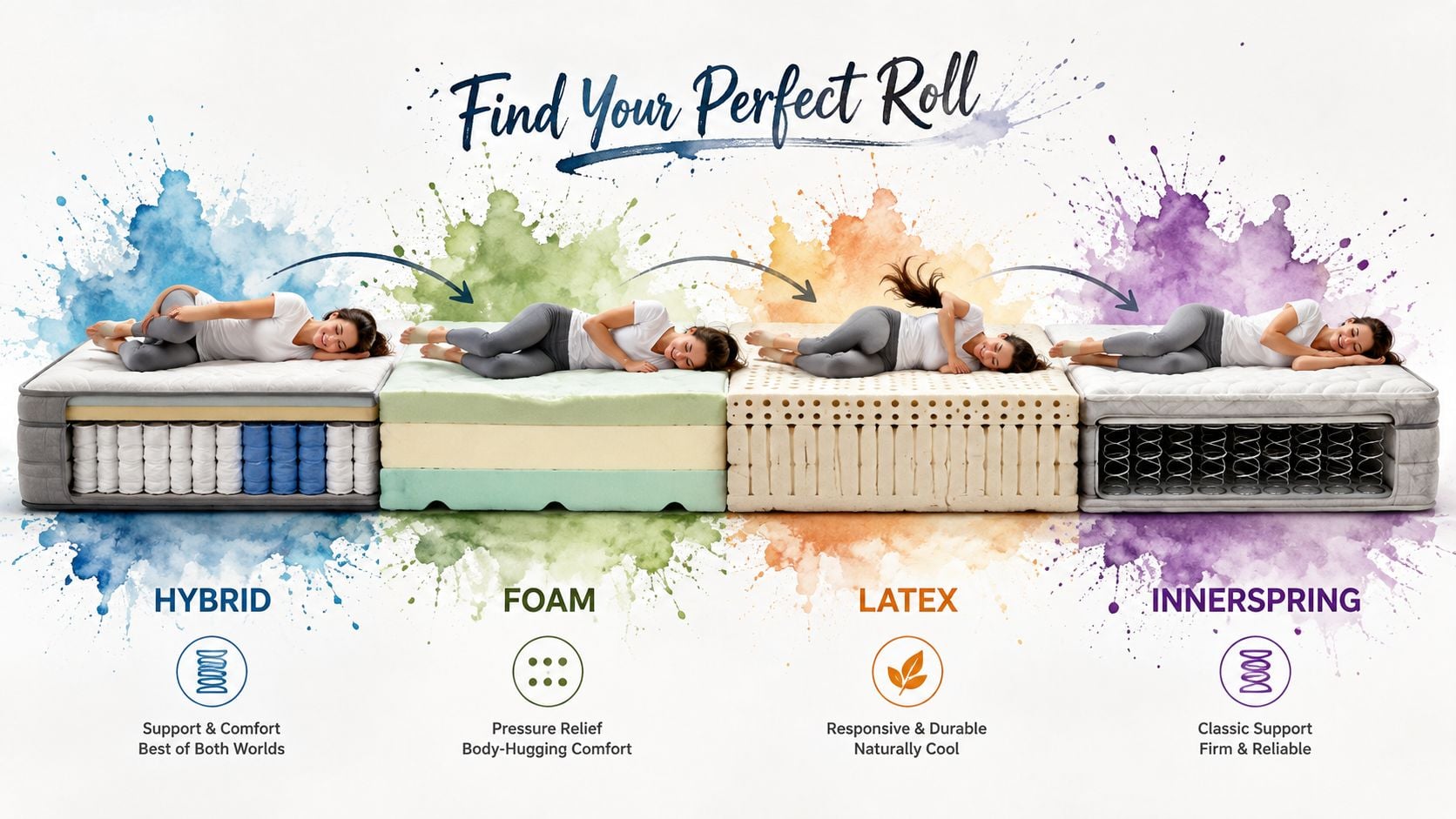
For a closer look at how two of these materials differ in feel, the memory foam vs latex mattress comparison is a helpful way to think about contour versus bounce.
Bottom line: responsive doesn't always mean coils, but coils do make a mattress easier to move across for many sleepers.
Decision Rules That Change the Default Recommendation
The usual default recommendation for combination sleepers is a medium-firm hybrid. That's a decent starting point, but it's not the end of the story. Real sleepers bring in body weight, pain patterns, partner movement, and temperature concerns, and those details can change what works.
Body weight changes how firmness feels
A mattress doesn't feel the same to everyone. A lighter sleeper may find a bed firmer than expected because the comfort layers don't compress as much. A heavier sleeper may need more support and a sturdier core so the body doesn't sink too much.
That means the question isn't “What firmness is best?” It's “How does this firmness behave under this body?” Heavier sleepers often need thicker support and better recovery. Lighter sleepers often need enough contour to engage the comfort layers at all.
Back pain asks for more than softness
Back pain often calls for alignment, not just cushioning. Zoned support can help keep the spine level by giving firmer support under the torso and a bit more give around the shoulders and hips. That kind of construction matters because a bed that feels soft at first can still leave the middle of the body hanging out of line.
Partner movement and heat can tip the choice
If one person moves a lot, motion isolation becomes important. If the sleeper runs hot, airflow matters more than a plush surface that traps warmth. Those two needs can pull in different directions, which is why construction has to be judged carefully.
A mattress that blends responsiveness with cooling materials often makes the most sense when both movement and heat are part of the equation. That's also where a showroom test helps, because the body can feel the tradeoff right away.
A few decision questions make this easier
- Does the body sink too much in the middle? If yes, support needs to go up.
- Does shoulder pressure show up first? If yes, the surface may be too firm or too thin up top.
- Does partner movement travel across the bed? If yes, motion isolation needs more attention.
- Does the sleeper wake up warm? If yes, breathability should move higher on the list.
The general rule still holds, but these overlap factors decide whether the sleeper needs a responsive hybrid, a more contouring foam, or a different balance altogether. For a broader comfort framework, it also helps to think about how sleep quality links to the body's deeper rest patterns in deep sleep cycles explained.
How to Test a Mattress the Right Way in a Showroom
A mattress test shouldn't last thirty seconds. A combination sleeper needs enough time to notice how the bed behaves after the first easy impression wears off. The point is to test movement, not just comfort.
Use the positions you actually sleep in
Start in the position that usually helps the body settle first. Then roll into the second position that shows up most often. If stomach sleep is part of the pattern, include that too, because a bed that supports the back can still punish the lower spine when the body turns face down.
A good showroom test looks like real sleep in miniature. The person should turn, pause, and notice whether the mattress resists or welcomes the movement. That's more useful than lying still and guessing.
A few practical checks reveal a lot
- Head and neck placement: The pillow should hold the neck in line without forcing the head up or dropping it too low.
- Spine check: A second set of eyes can look for obvious sagging or arching from the side.
- Edge sitting: Sitting near the edge shows whether the perimeter feels stable or collapses too fast.
- Quiet pressure test: Lying still for a minute with eyes closed helps pressure points show up more clearly.
Showrooms work best when the shopper treats them like a decision lab. The questions should be about support, recovery, edge stability, and exchange policies, not branding slogans. For shoppers who want to compare edge feel more closely, edge support guidance gives a useful way to think about the usable surface of the bed.
A mattress that feels “nice” for two minutes may still be wrong after ten. Movement testing exposes that difference.
Giorgi Bros. Furniture's 50,000 square feet of inspiration in South San Francisco gives shoppers room to test in a more realistic way, and the non-commission environment helps keep the focus on fit instead of pressure.
Accessories That Make or Break the Setup
A mattress can be matched well and still perform poorly if the rest of the setup is off. Combination sleepers are especially sensitive to this because the pillow, base, and protector all affect how easy it is to change position without strain. A complete sleep system matters more than a single piece.
Pillow height has to work across positions
A medium-loft pillow often makes sense for combination sleepers because the neck needs different support as the sleeper moves from side to back to stomach. If the pillow is too high, the neck gets pushed out of line on the back. If it's too flat, the side position can lose support.
That's why pillow shopping shouldn't be an afterthought. The mattress can be right and the neck can still complain if the pillow doesn't follow the body through the night.
Adjustable bases and protectors serve different jobs
An adjustable base can slightly raise the upper body for sleepers who spend more time on the back. That can help some people feel more settled. A protector, by contrast, should preserve the mattress feel without changing the surface too much.
For a practical look at bed bases, best adjustable base for mattress is a useful reference when the sleep setup needs more than a flat foundation.
If sleep feels hard to settle down in general, a careful look at routines and environment can also help, and the Seven Oaks Dentistry sleep medicine tips offer a broader lens on habits that support better rest.
Buy once, buy well
A good fit can last a long time when the whole setup works together. That's where the buy-it-for-life mindset makes sense. A mattress, pillow, and base that suit the body now are less likely to need replacement because of avoidable discomfort later.
For shoppers comparing construction quality as part of that long view, premium mattress brands can help frame what a more durable sleep investment often looks like.
Putting It All Together and Your Next Step
The decision path is straightforward once the pieces are in the right order. Identify the dominant position pattern, choose a firmness target, match the construction to how easily the body moves, then adjust for weight, pain, partner movement, and temperature. After that, test the mattress in person and let the body confirm the choice.
That approach fits the way combination sleepers live. It also supports a buy-it-for-life mindset, because a well-chosen mattress isn't a short-term purchase. It's an investment in comfort, alignment, and fewer restless nights over time.
Giorgi Bros. Furniture has served South San Francisco since 1933, and its showroom approach reflects that long history of patient guidance. Shoppers can explore custom order services for fabrics, leathers, wood species, and finishes, with financing options are available and non-commission sales staff who keep the process calm and clear.
When the mattress has to work across several positions, the showroom becomes the best decision lab. Visit, test the feel, compare the movement, and choose the setup that fits the way the body sleeps.
Giorgi Bros. Furniture helps shoppers choose Premium Mattresses with no-pressure guidance, and it pairs that with a full-service showroom experience in South San Francisco. If the goal is to find a mattress that supports how the body really moves at night, visit Giorgi Bros. Furniture to explore the sleep gallery and book a Design Consultation.