
Most mattress advice starts with a simple instruction: choose the softest pillow top that feels comfortable in the showroom. That advice is incomplete, and it can be costly. A plush surface can feel wonderful during a brief test, yet the comfort layer is also the part most likely to compress before the deeper support core gives out.
The best pillow top mattress isn't the one that feels most luxurious for thirty seconds. It's the one that still cushions shoulders and hips after years of nightly use. That means judging the hidden materials, the support core, the construction, and the ownership plan, not just the first impression.
Why the Softest Mattress Is Not Always the Smartest Buy
A shopper enters a showroom, lies on three soft mattresses, and quickly chooses the one that feels most like a cloud. The decision seems obvious. The surface welcomes the body, pressure disappears, and the mattress feels more comfortable than the firmer models nearby.
That first impression matters, but it doesn't tell the whole story. A fixed pillow top behaves like a non-replaceable comfort module, so its wear rate can determine when the entire mattress needs replacing. Independent guidance places noticeable compression in many pillow-top constructions within roughly 2 to 5 years, while broader consumer guidance often places pillow-top mattress life around 5 to 7 years (independent pillow-top durability guidance).
The showroom test hides the weak point
The surface softness is easy to feel. Foam density, fiber resilience, stitching, and the quality of the support core are not. A low-density comfort layer may deliver a dramatic first-night feel, then lose loft and develop impressions sooner than a denser foam or latex layer.
That doesn't make every pillow top a poor choice. It means the category rewards careful selection. The right construction can provide pressure relief without forcing the sleeper to replace the whole bed as soon as the upper layer loses its shape.
Practical rule: Buy the pillow top whose comfort can survive real use, not the one that wins the first-minute test.
Four questions should guide the decision:
- What is inside the comfort layer? Foam, latex, and fiber age differently.
- How much support sits underneath? The core must match the sleeper's position and build.
- Can the manufacturer disclose meaningful specifications? “Luxury” and “plush” aren't material specifications.
- What happens when the surface compresses? A non-replaceable top affects the useful life of the entire mattress.
Quality furniture and sleep products deserve the same buy-it-for-life mindset as a well-made dining table or a carefully selected piece of Amish Furniture. Giorgi Bros. Furniture has served South San Francisco for more than 90 years, and its family-owned, non-commission approach fits that philosophy. A mattress is still a purchase, but a durable mattress is also an investment piece that can reduce replacement waste and long-term expense.
What a Pillow Top Actually Is and How It Is Built
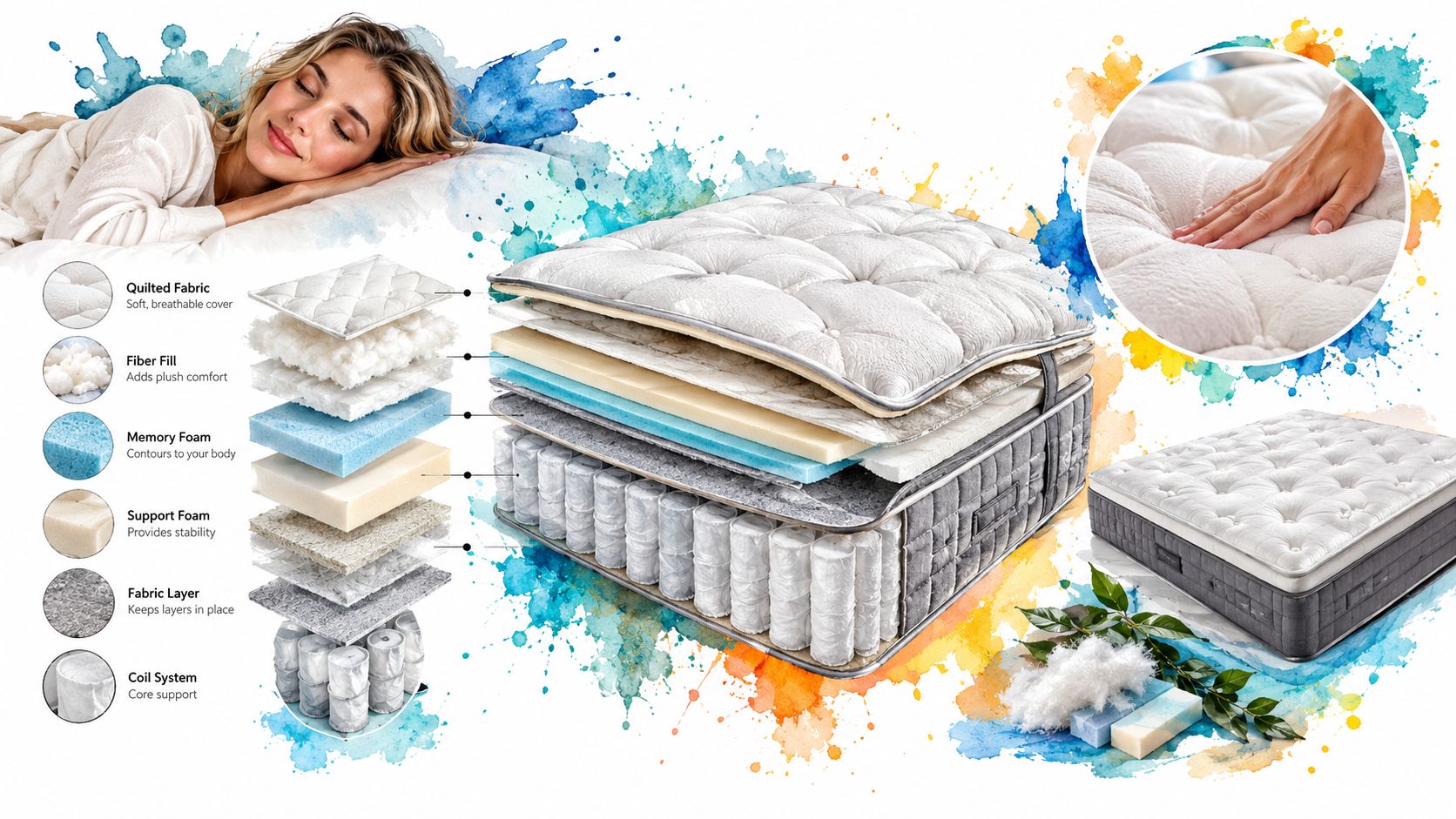
A pillow top isn't just a soft mattress. It's a mattress with a distinct padded comfort layer attached to the surface of a supportive base. The base is often an innerspring system, although some designs use foam or latex. The upper section adds contouring, while the core supplies the structural support.
A common hybrid example places a plush layer of foam, latex, or fiber above an innerspring coil unit. The sleeper feels cushioning first, then firmer resistance below. That soft-on-top, firmer-below sensation is the defining appeal of the construction.
Pillow top and Euro top are not identical
A traditional pillow top usually has a visibly separate, gusseted layer stitched onto the mattress. Its edges can look like a padded cushion added above the main cover. A Euro top is sewn flush with the mattress edges, so the comfort material appears more integrated and squared off.
Both designs can feel plush. The visible profile doesn't reveal whether the fill is resilient or prone to early compression. Buyers comparing the two should ask for the materials and construction details rather than assuming one format is automatically more durable. A useful visual and construction reference is this guide to a Euro top mattress.
Why the core and comfort layer must be judged together
The upper layer distributes pressure around the shoulders, hips, and other contact points. The core keeps the sleeper from sinking without control. If the top is too thin or too firm, the mattress may feel harsh. If the top is excessively soft over a weak base, the sleeper may lose alignment.
The construction also explains the main durability concern. Coils or a dense support base may remain serviceable after the upper material has compressed. Because the pillow top is attached, the sleeper cannot just replace that comfort module and keep the original mattress core. The best pillow top mattress therefore balances immediate cushioning with a support platform built for the sleeper's needs.
Comparing the Fill Materials Inside the Pillow Top
Two mattresses can feel nearly identical in a showroom and behave very differently after years of repeated loading. The deciding factor is often the fill inside the comfort layer, not the label on the mattress.
Foam density is the most useful practical durability measure. Independent mattress guidance commonly identifies memory foam in the range of about 3 to 5 lb/ft³, with a support-core target of at least 1.8 lb/ft³ for average-weight sleepers and 2.0 lb/ft³ for heavier sleepers (mattress longevity guidance). These figures describe material density, not firmness. A denser material can still be soft, while a less dense material can feel firm at first.
| Fill Type | Typical Density | Feel | Expected Lifespan in Pillow Top |
|---|---|---|---|
| Memory foam | About 3 to 5 lb/ft³ in common guidance | Contouring, pressure-relieving, slower response | Depends heavily on density and construction |
| Latex | Varies by formulation and design | Resilient, buoyant, responsive | Generally retains loft and resilience longer than standard fiber |
| Polyester fiber | Not reliably represented by one comparable foam-density figure | Airy, initially fluffy, less conforming | More prone to flattening when used in lower-quality builds |
Memory foam
Memory foam can provide close contouring and strong pressure relief. The important question is whether the manufacturer identifies its density. A vague “premium foam” description leaves the buyer unable to compare durability meaningfully.
Higher-density foam generally resists mechanical breakdown and compression set more effectively than low-density polyfoam. That makes it the more defensible choice for a shopper who wants a plush surface but doesn't want the upper layer to flatten quickly.
Latex
Latex offers a more resilient response. It cushions without the same slow-sinking feel associated with some memory foams, and it typically holds its loft better under repeated loading. For shoppers prioritizing longevity, latex is one of the strongest materials to consider in a pillow top.
Polyester fiber
Fiber can create an appealing, airy softness at a lower construction cost. The trade-off is resilience. When a pillow top relies heavily on lower-quality fiber, the surface may lose its original loft sooner than a well-built layer using denser foam or latex.
The month-one feel isn't enough. A durable comfort layer should still distribute pressure when the surface no longer has its showroom freshness. That is why the memory foam versus latex mattress comparison is useful before a buyer chooses based only on softness.
Matching Firmness and Support to the Way You Actually Sleep
Firmness is what the mattress feels like. Support is how well the structure holds the body in a stable position. Shoppers often confuse the two and assume a soft mattress can't support them or a firm mattress must be high quality. Neither assumption is reliable.
A pillow top can soften the surface without changing the underlying support profile. The sleeper's position should determine how that balance is judged.
Side sleepers need cushioning with restraint
Side sleepers usually place more concentrated pressure through the shoulder and hip. A sufficiently deep comfort layer can reduce that pressure, but excessive sink can make movement harder and allow the midsection to settle unevenly.
A resilient latex layer or appropriately dense foam often makes more sense than a very soft, low-density fiber top. The surface should yield at the pressure points while the core keeps the body from collapsing into the mattress.
Back and stomach sleepers need a steadier plane
Back sleepers typically need an even sleeping surface that supports the natural shape of the body without letting the hips drop too far. Stomach sleepers generally need the firmest support profile of the three positions because excessive sinking around the midsection can compromise alignment.
Heavier sleepers should pay particular attention to the density of the comfort material and the construction of the support core. Coil design, core density, and edge structure all affect how the mattress responds under load. The right choice isn't just “soft” or “firm.” It's a coordinated match between surface cushioning and structural support.
People managing environmental sensitivities can also benefit from practical bedroom guidance, including this sleeping with allergies guide. The mattress decision still depends on construction, but the surrounding sleep environment deserves attention too.
Decision rule: The pillow top provides the plush feel. The core provides the support. Neither should be chosen independently.
A detailed mattress firmness guide can help shoppers translate sleeping position and comfort preferences into a more focused showroom test. A non-commission Consultant should then verify whether the actual construction supports that preference.
Durability, Compression, and Cost Per Year
A pillow top should be judged by how long it keeps its shape, not by how plush it feels on the first night. The upper comfort layer often wears before the deeper support system, so its materials can determine when the mattress needs replacing.
Lower-quality constructions can develop noticeable compression in roughly 2 to 5 years, according to pillow-top compression guidance. Better coil-and-top designs may stay comfortable longer, but material density still matters. Paying less at checkout is poor value if the surface loses its comfort early.

Watch the symptoms, not just the warranty
A warranty does not promise that the mattress will feel as comfortable as it did on the first night. Look for practical signs of compression and declining performance:
- Visible impressions: A depression that remains after the sleeper leaves shows that the top has lost loft.
- New pressure points: Shoulders or hips begin pressing into firmer material below.
- Changed sleep quality: The sleeper wakes less refreshed or changes position more often.
- Uneven support: One side feels noticeably different from the other.
Cost per year gives a better comparison than the opening price. A denser pillow top with a higher purchase price can be the smarter choice if it preserves comfort longer. A cheaper build may cost more over time when the fixed top wears out before the support core, leaving no practical way to restore the original feel.
Buy the material, not the adjective
“Luxury,” “cloud,” and “plush” describe a sales experience, not a durability specification. Ask whether the comfort layer uses higher-density memory foam, resilient latex, or lower-density fiber. That answer reveals more about long-term value than the name on the showroom card.
A pillow top supports a buy-it-for-life approach only when its construction extends useful life and delays replacement. Use this guide to recognize signs that it's time to replace a mattress instead of replacing a bed just because the surface no longer feels new.
How to Evaluate a Pillow Top in the Showroom
A pillow top is easy to misjudge in a short trial. The showroom should be treated as a test environment, not a stage for a quick decision.
Start with the position used most often at home. Side sleepers should settle on the side. Back sleepers should lie flat. Combination sleepers should move naturally instead of remaining perfectly still. The objective is to feel whether the surface cushions pressure while the core keeps the body supported.
Use a repeatable test
Spend enough time on each candidate for the initial softness to become familiar. Notice whether the body sinks gradually or stops at a stable support point. Pay attention to the shoulder, hip, lower back, and the ease of changing positions.
Then press the edge with a hand and sit near it. Edge construction affects how easily a sleeper can enter, leave, or use the full surface. The mattress edge-support guide provides a useful reference for understanding that part of the evaluation.
Ask questions that expose construction quality
A confident manufacturer or Design Expert should be able to explain the mattress in plain language. The following questions are more useful than asking whether a model is “premium”:
- What material fills the pillow top? Ask whether it is memory foam, latex, fiber, or a combination.
- What is the foam density? If foam is used, a specific density is more helpful than a broad marketing label.
- What supports the body underneath? Ask about the core type and how it handles the sleeper's build.
- Is the top fixed or replaceable? Most pillow tops function as fixed comfort layers, so this distinction affects future serviceability.
- What care and foundation requirements apply? A suitable base protects comfort and warranty expectations.
A non-commission Consultant should welcome these questions. Giorgi Bros. Furniture's sleep gallery gives shoppers a place to test Premium Mattresses while discussing feel and construction without a commission-driven script.
Bring the answers home in writing. A mattress deserves the same careful comparison as a Custom Furniture order, where fabrics, leathers, wood species, and finishes are reviewed before a final commitment.
Certifications, Care, and Buying for the Next Decade
A durable mattress needs more than a resilient comfort layer. The buyer also needs clarity about certifications, fire barriers, foundation requirements, and everyday care.
CertiPUR-US applies to the flexible polyurethane foam used in bedding and upholstered furniture. Its seal indicates that the foam has been tested for emissions, content, performance, and durability (CertiPUR-US certification details). That is useful information, but it applies to the foam, not automatically to the entire mattress.
Read certification language precisely
CertiPUR-US also explains that certified foam itself wouldn't contain fiberglass, while a manufacturer may use fiberglass-containing barrier fabrics elsewhere in a mattress to meet flammability requirements. Foam certification therefore isn't the same as a guarantee that the complete mattress is fiberglass-free.
Shoppers who care about material transparency should ask what the fire barrier contains and request the answer in writing. Sustainability-minded buyers can also compare organic cotton, natural latex, and recycled components, while hot sleepers should ask how the comfort layer manages airflow and heat.
Protect the comfort layer
Care can't turn a weak pillow top into a durable one, but it can help preserve a good construction:
- Rotate when permitted: Follow the manufacturer's instructions to distribute repeated loading.
- Use a breathable protector: Choose a protector that limits spills without adding unnecessary heat.
- Support the foundation properly: An unsuitable frame can create flex or sag beneath the mattress.
- Keep the documentation: Warranty terms often specify foundation and care requirements.
For general guidance on mattress care intervals and professional cleaning considerations, this resource on when to call Top Cleaners in Dublin offers additional context. The core principle remains simple: buy materials that can hold their shape, then support them with appropriate ownership habits.
A premium pillow top built with denser foam or natural latex, a sound core, transparent certification, and a suitable foundation is the version of this category that can justify its price. That is the difference between buying softness for today and buying comfort as a long-term investment.
Choosing a Pillow Top That Is Worth the Investment
The best pillow top mattress has three qualities: a comfort layer with enough density or resilience for the sleeper, a support core that matches the body and sleeping position, and construction details that can be verified before purchase. Everything else is secondary.
A buyer should first set a material standard. Memory foam should have a stated density, and the selected density should make sense for the sleeper's build. Independent guidance identifies memory foam around 3 to 5 lb/ft³ and suggests a support-core target of at least 1.8 lb/ft³ for average-weight sleepers and 2.0 lb/ft³ for heavier sleepers (foam density and longevity guidance). Latex deserves serious consideration when resilience and longer-lasting loft matter more than a deep, slow sink.
Three filters make the choice clearer
First, defend the construction in plain language. A buyer should be able to explain what sits on top, what supports the body, and why those materials fit the intended sleep position. If the description relies only on “luxury” or “ultra plush,” the product hasn't earned confidence.
Second, compare the comfort layer with the core. Side sleepers may need generous pressure relief, but the base still needs to prevent uncontrolled sinking. Back and stomach sleepers usually need a steadier support plane. Heavier sleepers should treat density and core construction as essential support specifications.
Third, calculate value beyond the purchase day. A fixed pillow top can determine the life of the entire mattress. A higher-quality build may cost more upfront, yet preserving comfort for longer can reduce replacement waste and improve cost per year. That buy-it-for-life logic also aligns with the broader value of quality furniture, where sound materials, repairable craftsmanship, and thoughtful customization can serve a home for years.
A showroom should make comparison easier
Giorgi Bros. Furniture offers a dedicated sleep gallery alongside full-service home furnishings, with non-commission Design Consultants and ASID interior designers available for guidance. The South San Francisco showroom also supports broader Bay Area Interior Design projects, including custom order services for fabrics, leathers, wood species, and finishes, so a bedroom purchase can be considered within the whole home rather than in isolation.
Flexible financing options are available, and white-glove delivery uses location-based flat rates across much of the Western United States, with a trusted nationwide carrier network for areas outside the direct delivery range. Those services matter after the mattress decision, but the decision itself should remain grounded in feel, specifications, and long-term value.
A pillow top is worth the investment when its softness has a credible path to lasting, its support core suits the sleeper, and the maker answers direct questions without pressure. Visit the South San Francisco showroom to test the surface, compare the core, and ask for the specifications beside a non-commission Consultant. That is a better way to choose than trusting the softest first impression.
Visit Giorgi Bros. Furniture in South San Francisco to compare pillow-top constructions in the dedicated sleep gallery with no-pressure guidance from non-commission Design Consultants. The team also offers Custom Furniture, custom fabrics, leathers, wood species, finishes, and full-service design support, so a quality mattress can become part of a thoughtfully furnished home.