A dining room table with storage sounds like a simple space saver. The harder question is whether the storage leaves every seat usable, stays stable around children, and survives years of meals, homework, and bill paying. Clearance comes first. Construction comes next. Capacity comes last.
Why Storage Belongs at the Dining Table
A 2022 FurnitureCore consumer survey found that 71.32% of respondents had most recently purchased dining-room furniture for a casual dining area, compared with 28.68% for a formal dining room, according to the FurnitureCore survey results published by Statista. The difference matters: formal dining rooms may host occasional dinners, while casual dining spaces handle everyday routines.
Households use the dining area to talk, watch television, pay bills, pursue hobbies, do schoolwork, and finish office work brought home. Those activities leave things to put away. A shallow drawer can hold bills, while a shelf can keep games handy without blocking knees. Linens and serving pieces also need a dry, reachable place near the table.
A Typical Bay Area Evening
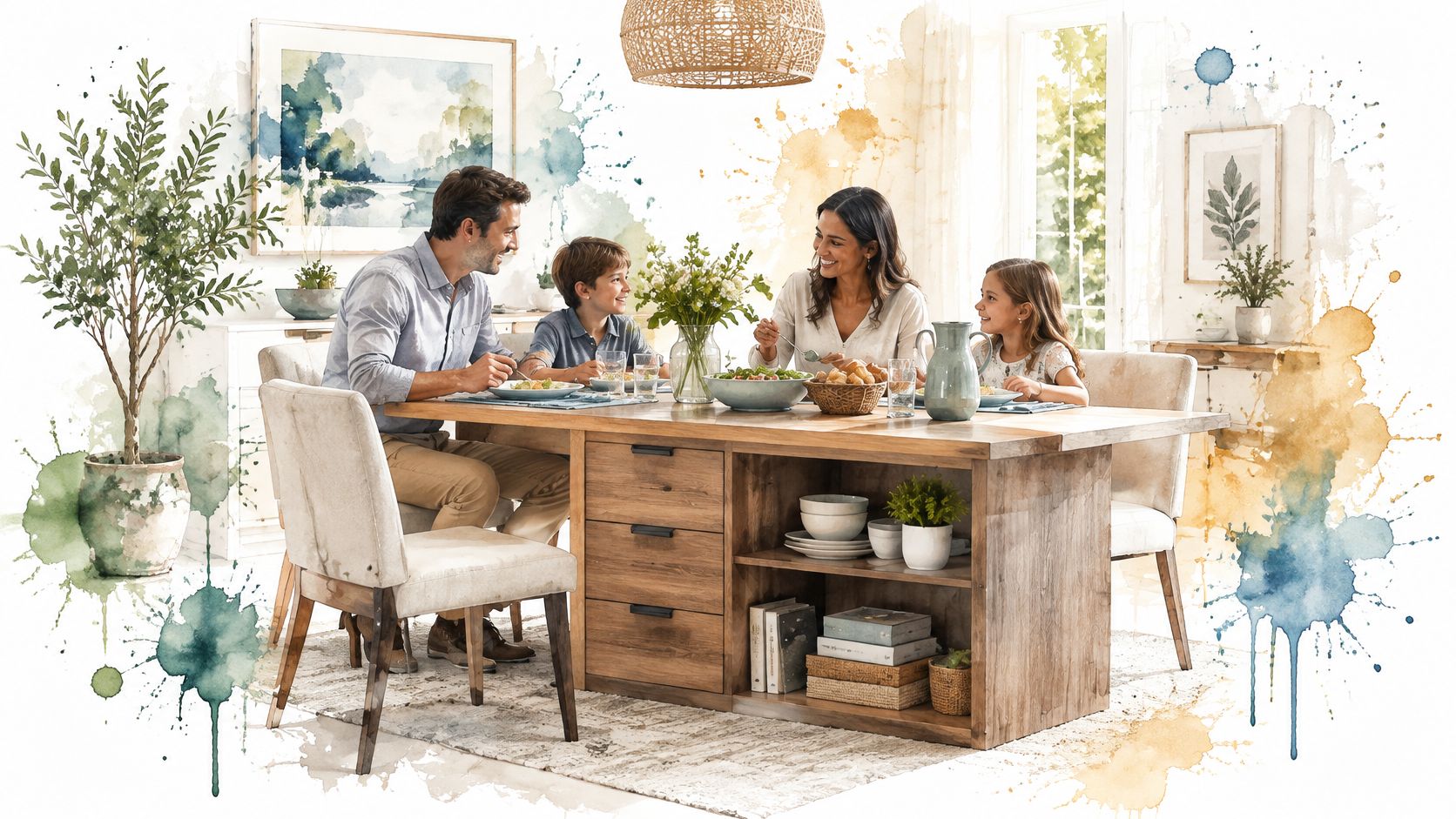
In a South San Francisco flat, one shared eating space may serve several purposes. After dinner, a laptop opens for bills while a child works on homework beside a board game. A separate hutch could block the kitchen path, and items left on the tabletop make the next meal harder to start.
Built-in storage works best when it suits those habits. End drawers can hold napkins and chargers, and a leaf bay can keep extension leaves with the table. Serving pieces stored elsewhere follow the same useful principle as a tidy setup for whiskey lovers: give each item a place so the surface stays available for use.
Style matters, too. In the same survey, 40.74% described casual dining furniture as contemporary, 29.49% selected traditional, and 11.80% selected country or rustic. Choose storage that belongs to the table's silhouette, with drawers and leaf bays integrated into the apron.
Giorgi Bros. Furniture has served Bay Area households from South San Francisco since 1933. A quality dining table with storage can be an investment piece, chosen to adapt as household activities change rather than as a short-term decor swap. Before comparing a table with a separate storage piece, list the activities the room needs to support. Guidance on selecting a dining storage piece can help clarify what belongs close at hand.
Four Dining Tables with Storage Compared
Dining tables with storage compared by use
| Form | Storage lives | Best Bay Area fit | Seating tradeoff |
|---|---|---|---|
| Drop-leaf | Apron drawer plus folded leaves | Narrow nook that must open a walkway | Folded leaf removes a side of seating |
| Extending with stored leaves | Leaf bay inside the apron or under a split top | Rooms that host guests a few times a month | Leaf bay must stay clear or the extension jams |
| Buffet-style cabinet base | Doors or shelves under the top | Open-plan rooms with seating on the free sides | Stored side loses knee room and a place setting |
| Built-in apron or end drawers | End drawers or a shallow apron | Everyday linens and flatware at the table | A deep center drawer can block the middle seats |
Judge each form by usable seats, not by hidden volume. A long top means little if knees hit a cabinet on one side. Length, width, and guest counts also interact, and table sizing advice from MODERN LYFE helps households sanity check capacity before falling for a silhouette.
Drop-Leaf and Extending Forms
A drop-leaf table folds one or both leaves down. A shallow apron drawer often holds placemats or flatware. It suits a breakfast nook that must shrink for a walker, a high chair, or a serving path. The failure mode is easy to test. Raise each leaf and lean lightly near the edge. A leaf that droops or a support that wobbles will only get looser.
An extending table stores one or two leaves inside the apron or under a split top. Everyday seating stays compact. Guest seating grows without a closet full of leaves wrapped in blankets. Open and close the mechanism twice in the showroom. It should travel straight, align at the seam, and lock without forcing. The leaf bay isn't general storage. Fill it with clutter and the extension jams, or the stored leaf gets scratched by loose objects.
Practical rule: The best storage is the storage still empty enough to let the table change size on short notice.
Cabinet Bases and Drawers
A buffet-style cabinet base puts doors or open shelves under the top. It holds dinnerware well and can anchor an open plan room. It also blocks knees along the stored side. Plan seating on the open sides only, even if the top's length suggests another chair fits. Hosts who count that blocked side as a seat discover the error at the first family dinner.
Apron or end drawers keep silverware, napkins, and placemats at hand. End drawers preserve the center knee zone. A shallow apron drawer works for flat items if knees clear it. A deep center drawer can steal the middle place settings on both sides. Ask about drawer stops on every form. A drawer that pulls free dumps flatware and invites a child to carry it off.
Room shape settles most ties. A narrow San Francisco alcove usually wants a drop-leaf or end drawer table. A larger Peninsula or East Bay dining room can carry an extending top, provided the leaf bay stays clear and heavy ceramics live in lower, properly supported storage instead.
Clearance That Keeps Every Seat Usable
Clearances for a storage dining table
| Need | Minimum | What fails if it is short |
|---|---|---|
| Tabletop height | 28 to 30 in typical; 28 to 34 in for accessible seating | Knees hit the apron or the reach is too high |
| Knee clearance | 27 in high under the top | Drawers or a cabinet block the seat |
| Clear width at one place | 30 in | A person cannot roll or sit square to the top |
| Wheelchair floor space | 48 in clear | The approach stops at the base |
| Chair pull-out to a wall | 36 in | The chair cannot leave the table |
| Walk-behind a seated guest | 42 to 48 in | Serving and traffic pinch the sitter |
For fixed commercial tables, U.S. accessibility standards specify a table height of 28 to 34 inches, at least 27 inches of knee clearance, 30 inches of clear width, and 48 inches of clear floor space for a wheelchair position, as detailed in the U.S. Department of Justice 1991 ADA design standards. A home table does not become compliant by matching one dimension. These clearances still offer useful guidance for multigenerational households and aging-in-place remodels.
When Six Seats Become Four
A rectangular table may be sold as a six-seater, yet a wide storage pedestal centered under the top can make its side seats unusable. The end seats work. At the sides, guests may find their knees against the pedestal, forcing them to turn sideways, sit farther from the top, or give up the place.
That is the trade-off: Maximizing built in storage can reduce functional seating capacity. End drawers, a short cabinet at one end, or a trestle that keeps the center open can protect side seating. Center storage serves little purpose if it prevents anyone from sitting there.
Measuring the Room Accurately
Plan about 24 inches of table edge per seated adult as a working allowance. Mark the table footprint with tape in both states, closed and fully extended. Pull out the chairs, then check whether someone can walk behind an occupied chair while carrying a serving dish. A leaf may add useful length yet leave too little room to pass in a compact dining area.
Check beneath the top as well. Measure from the floor to the lowest drawer bottom or apron edge at each intended seat, and note the width between legs or pedestal walls. For compact rooms, recommendations for dining tables in small Bay Area spaces can help compare layouts before settling on a base style.
A storage base earns its place only when a person can still approach, sit square, and leave the table without negotiating with the furniture.
Catalog seat counts often assume slim chairs and clear sides. The household's own chairs and a tape measure give a more practical answer: they show whether storage, seating, and walkways can all fit in the room.
Wood Movement and Amish Construction
Wood moves. That isn't a defect. It's a property the construction must respect. A technical bulletin from the Composite Panel Association identifies approximately 28% moisture content as wood's fiber saturation point, and below that level, changes in bound water produce dimensional expansion or contraction, as explained in the Composite Panel Association technical bulletin on dimensional stability.
A wide solid top, drawer fronts, and cabinet panels don't move at identical rates. The results show up as seasonal gaps, a drawer that sticks in damp months, veneer stress, or joints carrying load they weren't meant to carry. Bay Area homes swing from damp coastal air in South San Francisco to drier heated rooms inland, so some movement is normal.
Construction That Allows Movement
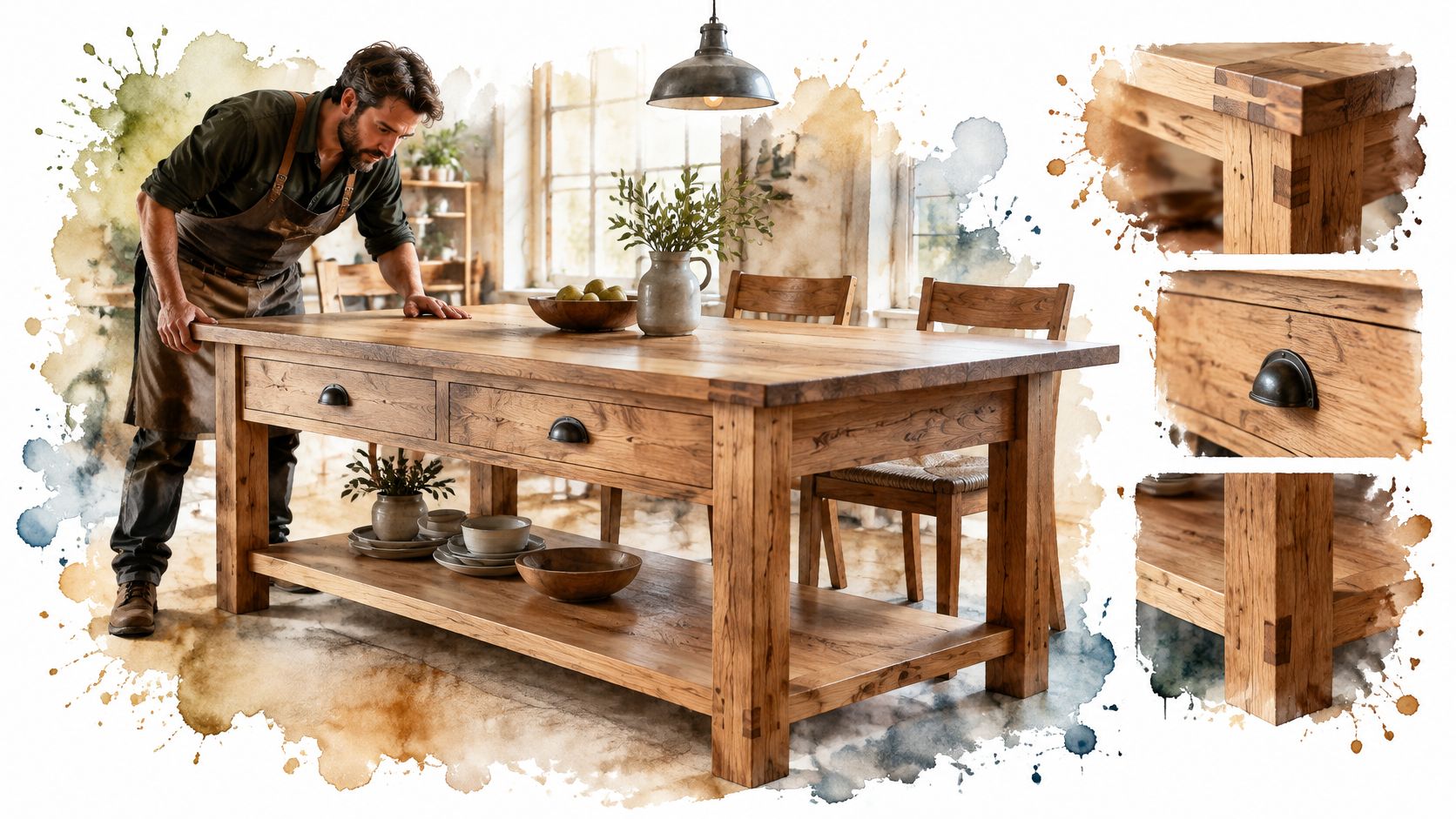
Balanced construction resists warp. Cross oriented veneer over a stable core constrains movement because layers pull in different directions. Solid tops need a different courtesy. Fasteners and joinery should hold the top flat while letting its width expand and contract across the grain. A broad top rigidly trapped across its width will eventually split or loosen its own fasteners.
Ask for specifics before ordering.
- Kiln-dried hardwood: Properly dried stock starts closer to indoor moisture levels and moves less dramatically.
- Mortise-and-tenon joinery: Legs and aprons joined this way, or with an equivalent solid method, resist the racking that loosens storage bases.
- Rated drawer slides: Full extension slides with stops should be rated for dishes and serving pieces, not just paper goods.
Species and Daily Wear
Oak shows grain and hides small dents well. Maple offers a harder, quieter surface with subtle figure. Cherry darkens with light and time, which suits households that enjoy patina. Walnut brings rich color with moderate hardness. None of these is best in the abstract. The right species matches the wear a household expects, from daily homework to occasional formal dinners.
Amish furniture and other American made tables, including Amish, are built to order in these species. That made to order path is the point of custom Amish furniture options at Giorgi Bros. Furniture, where species and finish follow the household rather than the floor sample. This is also where custom furniture earns its premium. Joinery and hardware get specified once, correctly.
Care stays simple. Keep the table away from direct heat sources. Maintain relatively stable indoor humidity. Wipe spills promptly around drawer openings and end grain, where moisture enters fastest. A good finish protects the surface, but it doesn't stop the wood beneath from responding to the seasons. Tables built with that truth in mind age gracefully. Tables built against it telegraph their complaints every winter.
Stability When Children Use the Table
More storage isn't automatically safer. That's the assumption worth discarding first. The U.S. Consumer Product Safety Commission advises securing furniture when possible, keeping heavier items on lower shelves, and avoiding attractive items that could encourage children to climb, according to the CPSC Anchor It campaign release.
A dining table isn't a tall dresser. The risk profile differs. But doors, open shelves, and drawer pulls can become footholds, and a heavily loaded drawer shifts weight toward one side. A table used for meals, homework, and entertaining in a Bay Area family home gets climbed on, leaned against, and pulled at. Plan for that household, not the showroom one.
Four Questions Before Buying
- Can doors or drawers lock or latch: A latch keeps a toddler from opening a cabinet full of heavy serving pieces.
- Do drawers have stops: Stops prevent a child from pulling a loaded drawer completely out.
- Is the base broad with weight low: A wide, grounded base resists tipping better than a light top balanced on a narrow pedestal.
- Does the maker supply anti-tip hardware: Tall cabinet style bases should include anchoring options, and households should ask before delivery rather than after.
Where Heavy Items Belong
Heavy ceramics stored low and centered can steady a broad base. The same ceramics stacked in one extended drawer strain the slides and make the whole table hard to move for floor cleaning. Distribution matters as much as total weight. Load shelves evenly, keep the heaviest pieces lowest, and don't treat a leaf bay as overflow storage.
Lightweight modular bases rearrange easily in a rental or small flat. That convenience needs more attention to stability, since a lighter piece shifts when a child pulls up on the edge. Test it in person. Press down on an open drawer. Lean on a corner. Open the cabinet doors and watch whether the table rocks.
Storage contents send signals, too. Small appealing objects, chargers, and snack containers in the lowest open shelf invite climbing. Linens and flatware belong in end drawers. Lower cabinets suit items a child has no reason to climb for. A design consultant can confirm lock options and slide ratings on the showroom floor, which is simpler than discovering a tippy base after delivery day.
Finishes Fabrics and a Custom Order
Color and fabric choices work best after the table's structure and clearance are settled. A custom order can specify wood species, stain or paint, sheen, hardware, and upholstery. Performance fabric or leather can suit chairs used for homework, wine, and everyday meals. Custom furniture at this level is specification, not decoration: each choice should suit the room and the way the household uses it.
Matching Undertones in One Pass
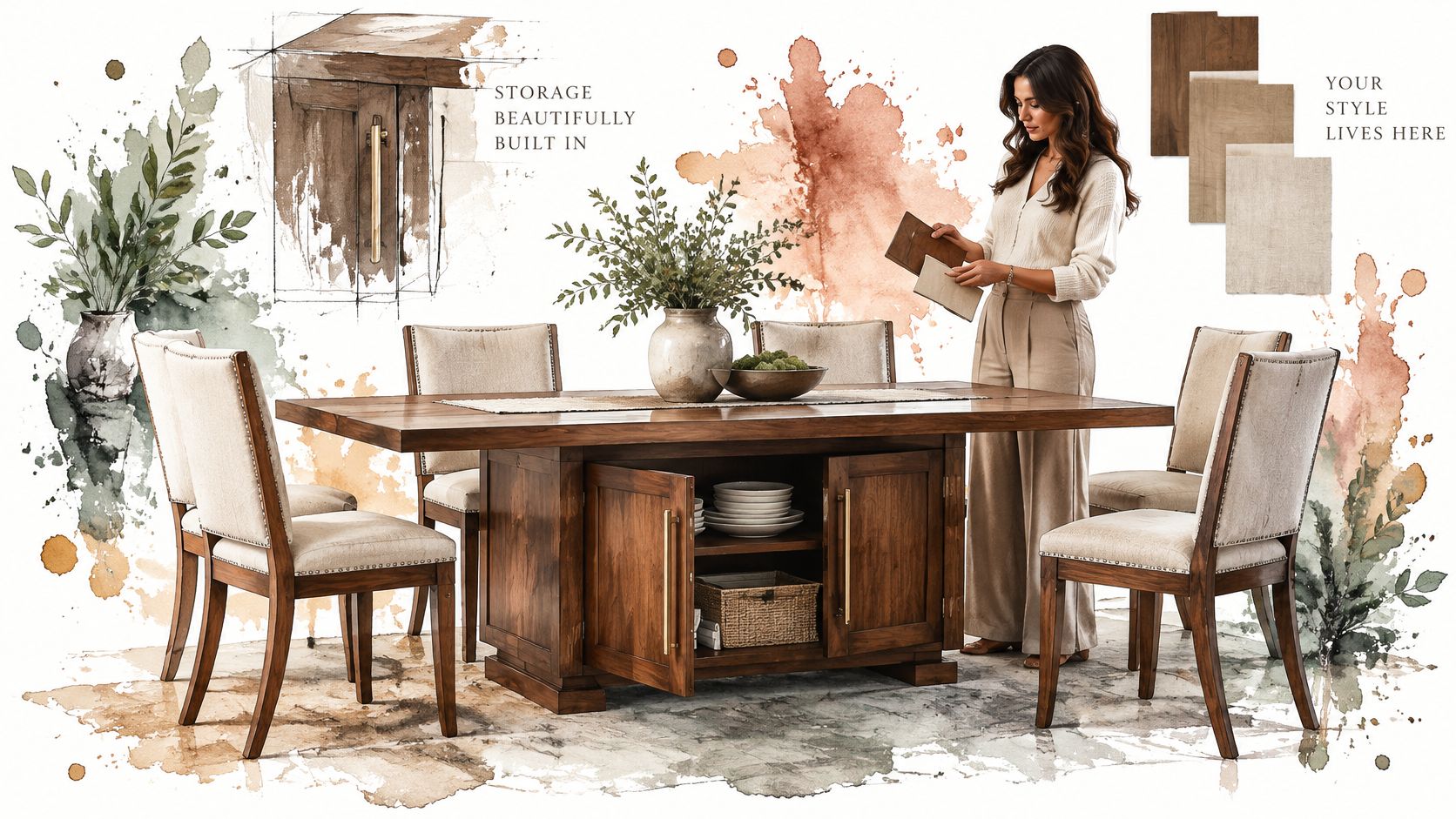
Wood undertones help narrow chair colors. Cool gray oak pairs naturally with graphite, oatmeal, or soft blue upholstery. Warm cherry or walnut works well with cream, camel, rust, or deep green. Yellow-based beige can clash with warm walnut rather than complementing it. Compare wood and fabric swatches together under the same light before choosing.
A painted base can make a small dining room feel visually quieter, while a stained base shows the grain. Stained surfaces can also be renewed when edges or drawer fronts wear. For sheen, review matte wood finish considerations and compare samples in daylight, since showroom and home lighting may differ. Matte finishes can make fingerprints around drawer pulls less noticeable than high-gloss finishes. Satin is easier to wipe clean. Daily habits can guide the choice.
Choose a finish for the life the table will lead, not only for the occasional dinner party.
Testing Before Ordering
Fabric and drawer slides feel different in person than they do in photographs. Test chair upholstery by touch and open the drawers to assess their movement before ordering. Sitting at each side also helps confirm how the chosen chairs work with the table.
Giorgi Bros. Furniture offers American-made and Amish furniture, including Amish. Non-commission sales staff and design consultants can explain the available choices. Pricing is transparent, with manufacturer-authorized savings when offered. Flexible financing options may help households plan for a custom piece while keeping construction and finish choices in view.
Bring a photo of the floor and wall colors, measurements for any chairs that will remain, and a second measurement of the space behind the chairs. Those details make it easier to compare finishes, fabrics, and fit during the showroom visit.
Plan the Showroom Visit and Delivery
A dining table earns its place when it fits the household's routines, leaves every seat usable, and stays stable around children. Durable wood that can be repaired and refinished adds a longer view: the table can serve through years of meals rather than being replaced when a slide fails or a finish wears out.
The U.S. Environmental Protection Agency classifies furniture as a durable good generally expected to remain in use for three or more years. Its guidance on waste and durable goods advises considering durability, sustainability, and ease of recycling when buying. Compare the table's price with likely replacement costs, then consider that total across its expected service life. A well-made dining table with storage can keep a large furnishing in use for years.
For linens, measure the tabletop in both closed and extended positions to get a perfect fit with Jolitee. Delivery is priced by location rather than per piece, with white-glove service across the Western United States. The team unpacks the furniture, sets it in place, and removes the packaging. Design consultations are also available to help weigh storage, seating, and finish choices.
Households ready to test drawers, clearances, and finishes in person can visit the South San Francisco showroom, where design consultations are available without pressure. Giorgi Bros. Furniture offers white-glove furniture delivery with assembly through its own service across much of the Western United States, with a nationwide carrier network for locations beyond its direct reach.