
Most memory foam mattresses do not need a traditional box spring. They do need a rigid, level base that the mattress maker approves. For slatted bases, treat about 3 inches as a rule of thumb; the mattress warranty and model instructions set the actual limit.
Before buying a new foundation, check the warranty and inspect the support beneath the mattress. An older base may work if its structure meets the maker's requirements. Fabric alone cannot tell you whether the base is suitable.
Bay Area homeowners asking, “Do memory foam mattresses need a boxspring?” should first identify what supports the bed and confirm it qualifies. The foam label alone does not settle the question.
Which Bases Work Under a Memory Foam Mattress
A memory foam mattress needs support that stays firm, level and compatible with its warranty. The name on a base or its fabric cover does not tell you whether it qualifies. Check the structure underneath, then match it to the mattress maker's written requirements.
A foundation supports a mattress; a traditional box spring is one type, built with springs that flex. Some fabric-covered bases look like box springs but have rigid interiors. The Sleep Foundation's box spring guide advises against using a traditional box spring with memory foam unless the manufacturer approves it. An existing box spring must also be firm, flat, level and undamaged.
Foundation types and suitability for memory foam
| Foundation | Works With Memory Foam? | Condition to Check |
|---|---|---|
| Traditional coil box spring | Only with written maker approval | Flat, firm, undamaged, with no flexing coils |
| Rigid bunkie board on a frame | Often, if the mattress maker permits it | Rigid, level and supported across the full deck |
| Solid platform bed | Yes, if approved | Solid or closely spaced deck, level across its full span |
| Slatted frame | Yes, if spacing complies | Clear slat gap within the manufacturer's limit |
| Adjustable base | Yes, if engineered for foam | Approved mattress model and correct base size |
| Semi-flex foundation | Only with written approval | Confirm the maker permits its movement |
A platform combines the frame and mattress support, usually without a separate foundation. A bunkie board provides a low-profile support surface inside a compatible frame, but cannot make a broken rail sound. For slatted frames, measure the openings instead of relying on appearance. A semi-flex foundation also needs written approval because its name does not specify how much it moves under load.
An adjustable base changes the mattress position; it is not required for memory foam. Read what an adjustable base does to distinguish that feature from ordinary stationary support.

Why movement underneath matters
Memory foam can follow an uneven surface beneath it. A rigid platform supports it like a tabletop, while a yielding coil box spring moves more like a trampoline. Foam recovers rather than staying compressed like clay, but it still needs steady support across its surface.
Consider a couple on a queen mattress over a worn spring base. If the base yields in the middle, the sleepers may roll toward that hollow. The foam can follow the dip, and damage caused by inadequate support may fall outside mattress defect coverage.
Practical rule: A new mattress does not make an unsuitable foundation suitable.
Let the warranty and care sheet settle the choice. General guidance can help sort the base types, but the paperwork for your exact mattress model determines which support is acceptable.
Slat Gaps and Center Support Specifications
The mattress warranty and the measured slat gap decide whether a frame is suitable. Measure the clear gap between slats from one edge to the next. Measuring from the middle of one slat to the middle of another includes the wood and gives an inaccurate result.
For a specific example, the Memory Foam Talk guide to memory foam mattresses warns that platform slats spaced more than about 2.75 inches apart may let foam dip between them, potentially causing permanent deformation that falls outside manufacturer coverage. Use that as a cautious shopping reference, not as a substitute for the requirements in your mattress model's warranty. The warranty sets the limit.
Slat spacing and center support by frame size
| Frame Size | Maximum Slat Gap | Center Support | Leg Requirement |
|---|---|---|---|
| Twin or Full | About three inches as a conservative shopping limit; model paperwork controls | Follow the mattress and frame specifications | All specified legs installed and bearing on the floor |
| Queen, King or California King | Closely spaced slats preferred; use the model's written maximum | Rigid center rail required | Floor-contacting center legs in the approved arrangement |
Narrower gaps leave less foam unsupported. With wider openings, the mattress spans alternating strips of support and empty space, so the foam can bend between slats instead of resting on a consistent deck.
For a new all-foam setup, aim for slats no more than about 2.75 inches apart unless the mattress paperwork calls for tighter spacing. A warranty that permits wider gaps does not make the widest spacing the best choice.

Center support must carry weight
A center rail that does not reach the floor cannot carry its share of the load. On queen, king and California king frames, check that the center rail is firmly attached and its legs rest on the floor in the arrangement the frame specifies.
The slats themselves must also stay firm. A cracked board, bowed slat or springy support can compromise the deck even when the openings meet the mattress warranty's limit.
A tightly spaced deck can still sag if the frame beneath it bends.
When comparing American-made bed frames, check the deck construction, center-rail attachment, availability of replacement slats and stated load rating. Country of manufacture alone does not establish compatibility.
Before delivery, measure every opening, including spaces near the head and foot, and record the largest gap. Check the center structure and compare the assembled frame with the exact mattress warranty. A product photograph cannot confirm either measurement.
How to Check an Existing Box Spring or Frame
Check the mattress warranty before deciding whether an upholstered base can stay. Similar-looking bases may have very different structures: a rigid foundation supports the mattress evenly, while a coil box spring flexes under load. The warranty paperwork and the actual frame determine compatibility, not the foam label.
Use the warranty's stated requirements for the exact mattress model. A rule for one model does not automatically apply to another, even when both are memory foam. Confirm the permitted base type and any specifications for slats, center support and load rating before reusing a frame.
An inspection that produces a decision
Find the paperwork. Record the exact mattress model and the foundation types its warranty allows. Appearance alone cannot show whether a base meets those rules.
Remove the mattress and any loose deck covering. Expose the slats, panels, brackets and rail connections so you can spot damage that fabric might hide.
Measure every opening. Measure each gap from edge to edge and compare it with the mattress model's limit. Include wider spaces near the head and foot.
Press each slat and panel by hand. Cracks, pronounced bowing and loose attachment points mean the affected parts need repair or replacement.
Check the load path. Inspect the center rail, tighten connections where appropriate and confirm that every required leg reaches the floor. A rail without floor support leaves the frame carrying weight it may not be built to hold.
Test the center and corners of the box spring. Noticeable bounce or yielding points to spring action, while creaking calls for a closer look at loose or damaged parts.
Check flatness and level. Lay a straightedge and spirit level lengthwise and crosswise. Look for hollows, twisting or uneven feet.
Compare the frame's load rating with the combined weight it must support, including the mattress, foundation if used and sleepers. A sound-looking surface cannot make an undersized frame suitable.

Keep, repair or replace
Keep a rigid, level, undamaged frame if its support meets the warranty requirements. Loose hardware or a replaceable slat may call for a targeted repair, not a new bed.
A box spring that flexes under pressure usually needs replacement. A rigid bunkie board can work only if the warranty permits the complete setup and the frame beneath it is sound.
Bring the model details, measurements and clear photographs to a showroom consultant if the paperwork is unclear. Show the exposed deck, center rail, floor-contacting legs and the base's identifying label so the foundation can be assessed against the mattress requirements.
Warranty, Support and Breathability Trade-Offs
The warranty decides whether a foundation is acceptable. Check its specific requirements before choosing by feel, airflow or height. Look for approved base types, structural conditions and exclusions for inadequate support. An approved category does not make a damaged or unsuitable base acceptable.
Keep the warranty and care sheet with the purchase receipt. For measurements and photos of the installed base, use the inspection guidance in the previous section. If the proposed setup falls outside the written instructions, get written approval before installation. A verbal assurance does not replace the manufacturer's terms.
A rigid base gives the mattress a consistent surface. A springy box spring can add movement and change how the hips settle, so a mattress that feels one way on a platform may feel different over an older box spring.
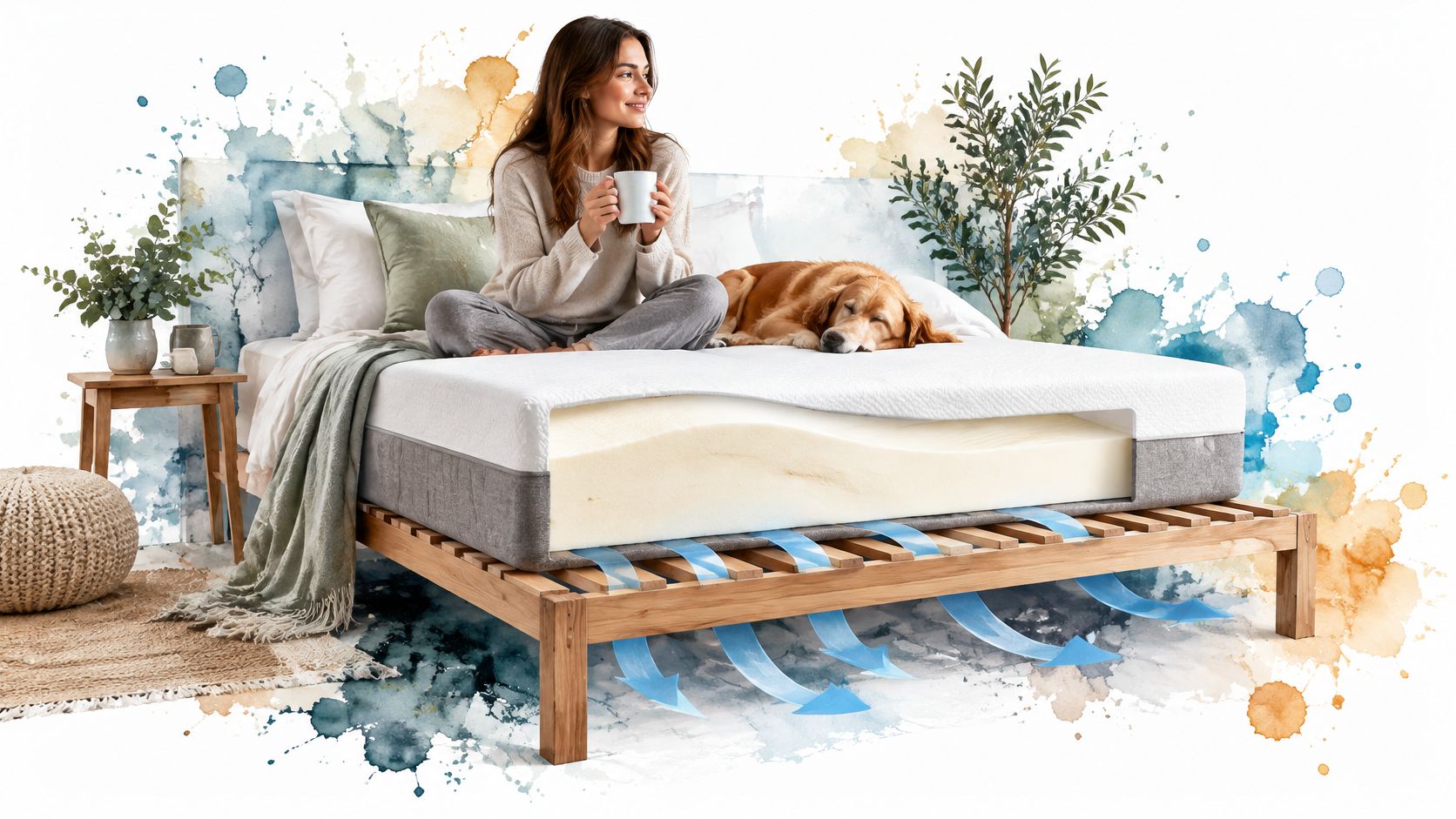
Base construction also affects airflow beneath the mattress. Slats with measured gaps leave open channels under the foam; a solid panel base does not. Choose based on the warranty's support requirements first, then compare how much open space each approved base provides. An adjustable base may have a solid or open deck, so check mattress compatibility with an adjustable base separately from its airflow.
Bed height affects daily comfort. A box spring raises the sleeping surface; a platform or low-profile foundation keeps it closer to the floor. Choose a height that lets you sit down and stand up without awkward climbing or a deep drop. Check headboard proportions and drawer clearance too, but do not trade compliant support for a better fit with the room.
Matching a Base to Your Sleeper and Bed Frame
Choose a base that suits the sleeper and fits the room and existing furniture. A foundation can support the mattress properly yet still be a poor fit if it blocks storage drawers or leaves the bed awkward to get into. Match the frame to the mattress warranty and its support requirements before deciding on appearance.
Recommended base by sleeper type and situation
| Sleeper or Situation | Recommended Base | Why It Fits |
|---|---|---|
| Side sleeper on soft to medium foam | Solid platform | Gives the comfort layers even backing to cushion shoulders and hips |
| Heavy sleeper or couple | Load-rated rigid center-rail frame | Limits deflection under the combined load |
| Hot sleeper | Closely slatted, open-underneath frame | Leaves an airflow path beneath the foam |
| Adjustable base user who reads or sleeps with the head raised | Adjustable base approved for the mattress | Provides articulation on a compatible support structure |
| Owner of an older coil box spring | Inspect first, then choose a rigid replacement unless an approved board solution qualifies | Avoids uncertainty about spring movement |
| California King or wide frame | Rigid center-rail frame with the specified floor-contacting legs | Supports the broad span without leaving the middle unsupported |
| Low-profile room or bed with drawers | Low platform with compatible storage clearance | Avoids an unnecessary foundation layer |
A side sleeper should not rely on a flexible foundation to compensate for a mattress that feels too firm. Let the mattress's comfort layers cushion the shoulders and hips, and keep the base stable.
For a heavier sleeper or a couple, check the frame's load rating against the total intended load. A substantial headboard is no proof that the hidden rails and brackets can carry it.
Match the furniture without compromising the structure
Custom Amish furniture platform frames can bring the support system and bedroom design into one purchase. Wood species and finish choices can coordinate the bed with nightstands, flooring and other case goods.
Custom furniture still needs a clear structural specification. Before ordering, identify the mattress dimensions, deck construction, center support, usable clearance and whether an adjustable base must fit inside the decorative frame.
Use this mattress thickness guide to judge the finished proportions alongside platform height. A thick mattress can hide a low headboard, while a tall bed assembly can make bedside surfaces awkward to reach.
In a bay area interior design project, consider how the bed affects circulation around storage drawers and access beside the mattress. Resolve those details before ordering the frame.
A wood frame offers species and finish choices; an upholstered frame may offer fabric or leather. In either case, keep the mattress deck approved and properly assembled. Specify the support structure first, then choose the appearance around it.
Confirm the Base Before Your Mattress Arrives
Before delivery, confirm the mattress maker's approved base types, measure the support structure, and decide whether to reuse, repair, or replace it. A delivery appointment is too late to discover a missing center rail or an unsuitable spring base.
Buy for long service, not automatic replacement
A compatible foundation supports the mattress and can help avoid an unnecessary replacement. The government assessment of furniture ecodesign concerns office furniture, so it does not establish requirements for mattress foundations. For a bed, the practical test is whether its structure meets the mattress maker's specifications.
Buying for life means choosing durable pieces, maintaining their connections and replacing only the parts that need it.
- Reuse sound structure. Keep an existing frame if it is approved for the mattress and remains in good condition.
- Repair serviceable parts. Suitable replacement hardware or slats can extend the use of a well-built bed.
- Plan for access. Adjustable feet and reachable fasteners make future maintenance easier.
For a larger sleep setup, review this guide to an adjustable base for a king mattress before ordering the surrounding furniture.
No-pressure guidance in South San Francisco
Giorgi Bros. Furniture is a family-owned South San Francisco showroom serving Bay Area households, with 50,000 square feet of furniture, premium mattresses, adjustable bases and bed frames. Its non-commission sales staff can help assess fit, while custom order services offer choices in wood species, finishes, fabrics and leathers. In-store financing is available, and design experts can coordinate the sleep setup with the bedroom.
The team can help compare complete sleep setups and custom bed-frame choices. Visit Giorgi Bros. Furniture in South San Francisco or book a Design Consultation to plan a compatible bed for a Bay Area home.