
The most common advice is to measure the wall, then match an oversized reclining sofa to its advertised width. That shortcut is how a handsome piece ends up blocking the only path to the kitchen. Width tells how many people can sit down. It does not tell whether the footrest clears the coffee table, or whether the crate can turn a South San Francisco stair landing.
An oversized reclining sofa is multi-seat motion seating. Deep cushions, padded arms, and a footrest that travels forward are the point, not a wider shell for its own sake. In a Bay Area condo or a remodeled open plan, the useful test is spatial, not decorative.
Three Footprints of an Oversized Reclining Sofa
Judge the category by three floor areas, not by the tag on the arm. A loveseat-scale frame is often planned near 80 to 90 inches wide. A three-seat frame is often planned near 100 to 120 inches or more, with seat depths commonly sketched at 40 to 45 inches. Those are planning sizes. The footrest is what changes the room. Recline can add roughly 12 to 20 inches of depth, so a sofa that looks fine against a wall can cover a table or a doorway.
Biltrite Furniture's oversized reclining sofa notes put the stronger question in plain terms. Buyers need the closed footprint, the fully reclined footprint, and the delivery-route footprint, not just advertised width and depth. A large sofa can seat several people and still make the room smaller whenever any recliner is open.
What to write down first
| Check | What to record | Typical range | Why it changes the buy |
|---|---|---|---|
| Closed footprint | Width by depth on the floor, footrest in | Often 80 to 90 in wide at loveseat scale, or 100 to 120 in for three seats, with seat depth about 40 to 45 in | Sets seating capacity and how much floor the sofa claims |
| Fully reclined footprint | Depth with footrest out, plus wall gap | Depth often grows 12 to 20 in | Shows whether a table, doorway, or path stays usable |
| Wall-hugger rear gap | Space needed behind the back | Often about 2 to 6 in | Saves wall space but does not shorten the footrest |
| Front circulation | Clear walkway with one seat open | 30 to 36 in of walkway when closed, plus a passable path beyond the footrest | A full room can still feel blocked when one recliner is open |
| Delivery-route opening | Narrowest door, hall, stair, or elevator | Compare packaged width and depth with that opening, not the finished sofa | A piece that fits the room can still fail the entry |
A wall-hugger slides the seat forward so the back can stay close to the wall. That rear gap, often about 2 to 6 inches, is real savings in a shallow Bay Area room. It does not shrink the extended footrest or the seat depth. One blocked route can cut off the kitchen, the hall, or the entry.
Practical rule: Before any fabric conversation, write three numbers. Closed depth, reclined depth, and the narrowest opening on the way in.
Measure the narrowest door, hallway, stair landing, elevator opening, and tightest turn. Compare those with the packaged size, not the finished sofa. Leave about 30 to 36 inches of walkway in front when the piece is closed, and enough beyond an open footrest that someone can still pass in a condo or an open plan.
How to Measure the Room and the Way In
A homeowner can finish this routine in one afternoon with a tape, painter's tape, and a sketch. The sketch is the part people skip, and it is the part that catches a window or a kitchen path the width number ignored.
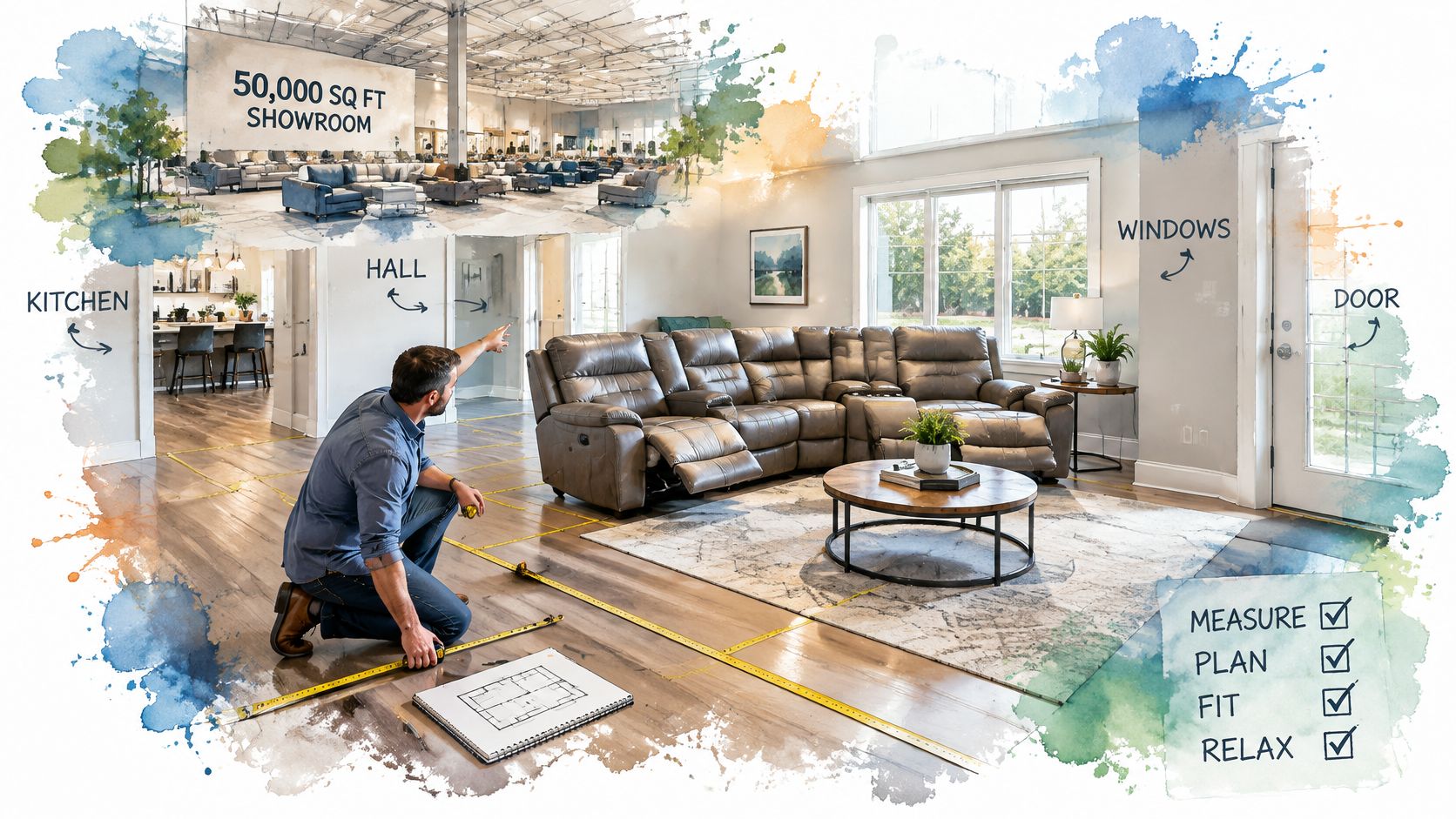
Six measurements, each with a common miss
- Sketch the living area. Mark doors, windows, and the main path to the kitchen or hall. Miss this and the tape only records empty wall, not how people move through the space.
- Measure wall length and usable depth. Subtract 2 to 4 inches so the back is not jammed, unless a wall-hugger is confirmed. A tight shove looks neat and then scrapes the mechanism.
- Tape the closed rectangle, then the longer reclined rectangle. Walk past both. A rectangle on paper feels smaller than the same rectangle underfoot.
- Measure every pinch point on the route in. Exterior door, interior doors, hallway width, stair landing, elevator cab, and the tightest turn. Record height as well as width. A tall back fails a low soffit even when the width clears.
- Note thresholds, low soffits, and whether a sectional must come apart. A one-piece frame that fits the room can still stall on a raised threshold.
- For each regular user, note hip width, thigh length, and whether the feet reach the floor with the footrest closed. Leave at least a half-inch behind the knees and support about three-quarters of the thigh. A deep, spacious seat can still perch a shorter person on the front edge.
Fit the body, not the brochure
An ergonomics study in the Iranian Journal of Ergonomics, based on 260 adults aged 25 to 35, proposed a seat height of 37 centimeters, a backrest height of 57 centimeters, and a seat-to-back angle of 105 degrees (Iranian Journal of Ergonomics). Those figures are a baseline for a custom-order talk, not a factory rule for every body. Cornell's ergonomic seating guidance ties a supported recline of about 110° to 130° to the lowest lumbar-disc pressure and back-muscle activity, and lists a reference seat-pan depth of no more than about 43 cm, while the University of Pittsburgh guidance in that same discussion calls for at least a 0.5-inch gap behind the knees and support for at least three-quarters of thigh length.
Giorgi Bros. Furniture design consultants can set those seated notes against compressed seat height, usable depth, seat width, back height, and the fully reclined footprint before a custom order, not after the truck is booked. The same measuring habit shows up in sizing tips for custom photo blankets from That Blanket Co. A textile that is only "about right" disappoints once it arrives. For a narrow Bay Area room, the sectional sofa layout rules for tight living rooms are the companion check when the path, not the cushion, is the constraint.
Mechanisms and Comfort Features Compared
The mechanism is the working heart of an oversized reclining sofa, not a hidden extra under the cushion. Upholstery can be renewed. A weak motion unit is what makes a heavy piece feel unfinished on a Tuesday night.
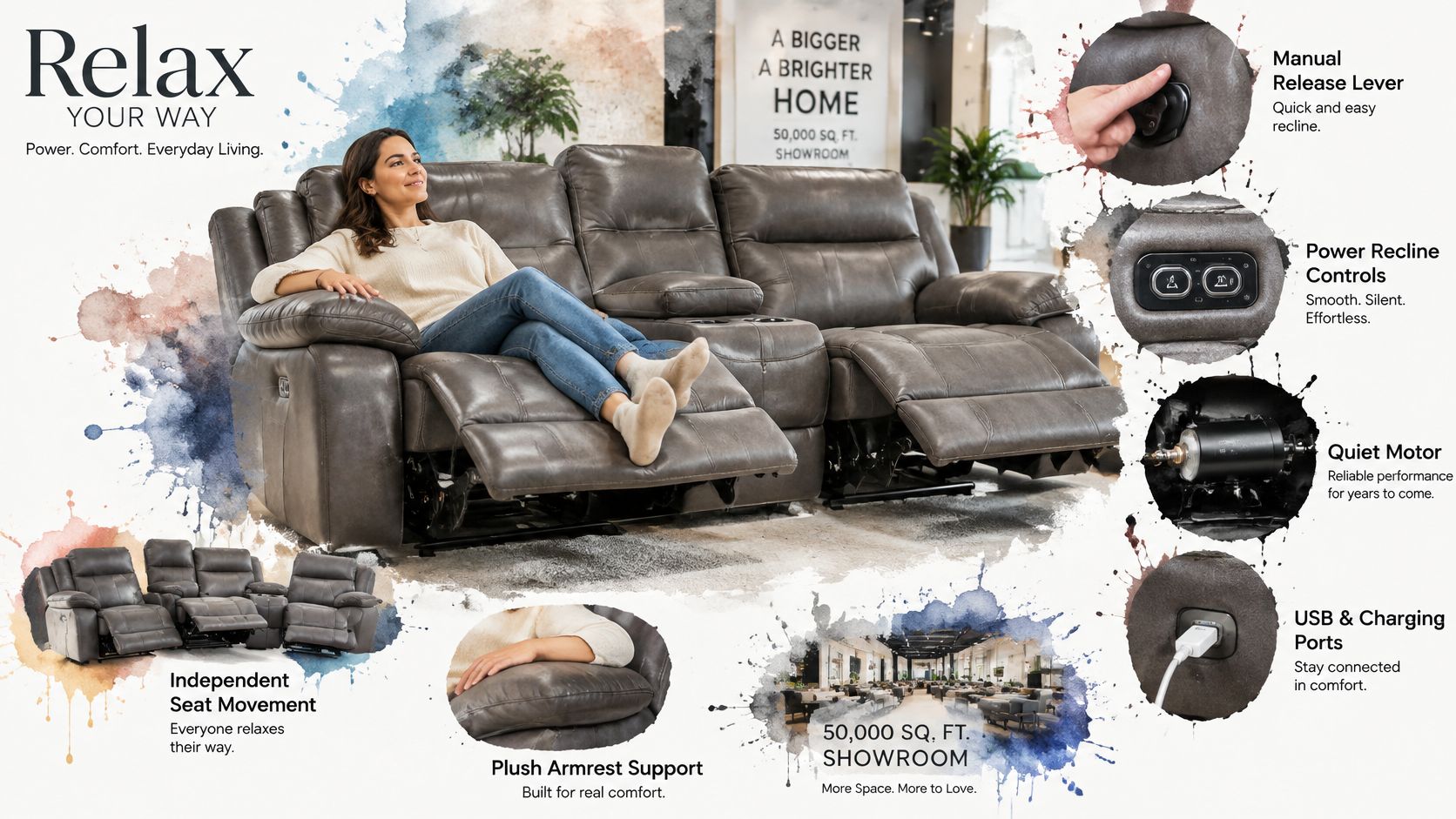
How the motion types differ
| Mechanism | How it moves | Space note | Best for |
|---|---|---|---|
| Manual recline | Lever or handle releases the back and footrest | Needs the full extended depth | Buyers who want fewer powered parts |
| Power recline | Motor moves back and footrest, often with a hand control | Same extended depth, plus a nearby outlet | Daily use and easier positioning |
| Independent power seats | Each seat reclines on its own | One open seat can still block a path | Households with different heights and preferences |
| Wall-hugger | Slides the seat forward so the back stays near the wall | Rear gap often about 2 to 6 in; footrest still extends | Rooms with little depth behind the sofa |
| Adjustable headrest and lumbar | Support changes as the back opens | Needs the reclined footprint, not extra floor width | Longer recline sessions and mixed body sizes |
Manual hardware suits a household that wants fewer powered parts and can place the sofa without hunting for an outlet. Power recline, often with a quiet motor and a USB or charging port, suits daily use and easier positioning. Independent controls matter when heights and preferences differ. A wall-hugger belongs only after the reclined depth still clears the room. Headrests and lumbar adjustments are posture tools once the back opens well past upright. A plush sink-in seat feels generous for a movie. A firmer seat keeps the pelvis from sliding forward. Heat and massage are optional comfort layers. They are not proof of a sound frame.
The safety check on the floor
The U.S. Consumer Product Safety Commission identifies ANSI/BIFMA X5.4-2020 as covering lounge leg-rest durability, leg-rest strength, recliner pinch points, and stability, and notes that UL 962 includes provisions for reclining mechanisms and foot or leg rests. As of that 2025 communication, ASTM had not yet published a voluntary consumer-recliner standard. A generic "heavy-duty" label is not a test reference. Ask for the maker's applicable tests and operating-load information.
On the showroom floor, open one side fully while the next seat stays upright. Feel for shear gaps. Confirm the frame does not rock. A wider span and a higher combined occupant load stress synchronized mechanisms, cross-members, footrests, and floor contacts. Non-commission consultants can walk American Leather, Stressless, and Hancock & Moore motion pieces and note whether a motor can be serviced later. The plain match is simple. Choose manual for fewer parts, power and independent controls when ages and body sizes differ, and a wall-hugger only after the open depth still leaves a path. A closer look at power recliner versus manual helps that choice stay about parts and placement, not about extra buttons.
Leather Fabric and Custom Finishes
The moving frame gets the attention. The surface is what a Bay Area household lives on, between bright windows, pets, and weeknight snacks.
Top-grain aniline or semi-aniline leather patinas, shows natural variation, and needs conditioning on the maker's schedule. Protected or performance leather resists spills better and looks more uniform. Textured chenille and bouclé bring a soft hand, and they can show wear in high-touch spots. A tighter performance weave handles pets, snacks, and strong afternoon light with less drama. The right cover is the one that can be renewed across a long service life, not the swatch that only photographs well today.
What a custom order can specify
A custom order is not limited to the floor sample. Design consultants specify leathers, designer fabrics, wood species, and finishes, including Amish hardwood frames when the buyer wants American-made Amish furniture matched to the rest of the home. That is custom furniture in the practical sense. The frame, the cover, and the finish are chosen for this room, not pulled from a single in-stock color.
Ask three service questions before ordering.
- Can the cover be reupholstered while the frame stays? A tired surface should not force a new sofa.
- Can cushions be rebuilt when foam compresses? Seat feel is a replaceable part, not a permanent trait.
- Can the motion unit be serviced without discarding the sofa? A motor or linkage should not retire the whole piece.
A 2022 Journal of Industrial Ecology study of one wooden chair found that repair cut production waste by 76%, embodied energy by 51%, and process energy and process emissions by 91% versus making a new chair (Journal of Industrial Ecology). Those percentages will not copy onto every reclining sofa. Extra foam, textiles, or adhesives can raise manufacturing impact, so a heavy piece is not automatically sustainable. Keeping the main structure in service is the useful idea.
| Surface | Daily wear | Repair path | Best for |
|---|---|---|---|
| Top-grain aniline or semi-aniline leather | Patinas and shows natural variation; needs conditioning | Condition now; reupholster later | Buyers who want a living finish |
| Protected or performance leather | Resists spills better and shows less variation | Renew the cover without discarding the frame | Households with snacks and heavier daily use |
| Chenille or bouclé | Soft texture that can show wear in high-touch spots | Reupholster when the pile tires | Rooms where texture matters more than stain resistance |
| Tight performance weave | Handles pets, snacks, and bright Bay Area windows better | Rebuild cushions and replace fabric | Active Bay Area living rooms |
| Simply Amish hardwood frame with a custom cover | Wood species and finishes matched to the home | Keep the frame while cover and cushions are renewed | Investment pieces meant to last many years |
For a closer read on hides, the full-grain versus top-grain leather sofa comparison separates a living surface from a corrected one. When a cover needs a specialist rather than a household cleaner, readers can find qualified leather cleaning specialists through Rubber Ducky Rug Cleaning Birmingham and then follow the maker's own leather code at home.
Who Should Invest in This Scale
An oversized reclining sofa suits movie-night families, taller users who need depth, and open living rooms where several people share one piece. It is a weaker fit for a narrow Victorian flat, a room with one tight circulation path, or a shorter user who would perch on a deep seat pan. That verdict comes before price.
The gains are fewer separate chairs, a supported open posture for longer evenings, and a single investment piece that can stay in service for years. The costs are higher combined weight on the mechanisms, a larger waste burden if the whole sofa is discarded, and a room that shrinks whenever a footrest is open. A household that wants a lower-level movie layout can study how basement entertainment spaces from Utah Basement Finishing think about sightlines, then apply the same path check to a Bay Area living room rather than copying a floor plan from somewhere else.
Cost per year, not the ticket alone
The U.S. Environmental Protection Agency defines durable goods as products with an expected lifetime of at least three years and includes furniture in that category, while its methodology uses an estimated average useful life of 10 to 20 years for furniture and furnishings (EPA durable goods data). In 2018, furniture and furnishings represented 12.1 million tons of municipal solid waste, equal to 4.1% of total generation, and 80.1% of that furniture stream was landfilled. A sofa that stays comfortable and structurally sound delays a bulky replacement.
Frame value as cost per year of comfortable use, plus whether the frame, suspension, motor, and cover are warranted or replaceable separately. A heavy sofa is not automatically the greener buy. The better buy is the one a South San Francisco consultant can still service when cushion foam tires or a household's mobility needs change. Readers comparing back support across body sizes can start with recliners chosen for back support and then test the actual seat, not a catalog photo.
PureWow listed a 79.5-inch oversized reclining sofa at USD 3,360 in 2024, reduced from a listed USD 4,200. Use that only to sense scale. Judge this piece by cost per year across a 10-to-20-year useful life, and by what can be repaired without replacing the sofa.
Delivery Setup and Everyday Care
The buying decision is not finished until the sofa is in the San Francisco Bay Area room it was measured for. Giorgi Bros. Furniture coordinates white-glove delivery for South San Francisco and other Bay Area addresses, priced as a flat rate per location rather than per piece across the Western United States, and also offers in-store pickup at the South San Francisco showroom. The crew unpacks, places the sofa, confirms the fully extended position against the taped reclined depth, and removes the packaging. Details of that furniture delivery with assembly sequence are worth reading before the truck day so the household knows what happens on site.
Before the crew arrives
Clear the path already measured. Protect thresholds. Choose which side faces the main view so a power cord reaches an outlet without crossing a walkway. A cord across the only route undoes the three-footprint work.
During setup, check the notes on site.
- Level the feet so one open seat does not rock the frame.
- Run every seat through a full cycle and listen for a catch.
- Look for accessible pinch or shear gaps while the footrest opens and closes.
- Confirm the open footrest still leaves the planned path to the kitchen or hall.
Care that stays simple
- Vacuum weekly with a crevice tool along the mechanism so grit does not grind the linkage.
- Blot spills promptly and follow the leather or fabric code rather than a household cleaner.
- Condition leather only on the maker's schedule, not on a guess.
- Keep pets off the hinges and keep crumbs out of power parts.
- Once a year, compare hinges, motors, and cushions with the original feel, and schedule custom reupholstery when the cover tires before the frame.
Local placement should leave a sofa that works on day one in this Bay Area room and can be serviced for years. The yearly check is what turns a large purchase into a piece that stays, instead of a bulky item headed for disposal when one component wears.
Visit the South San Francisco Showroom
The measurements become useful on a floor where someone can sit, open a footrest, and compare finishes without a commission clock. Giorgi Bros. Furniture is a family-owned showroom in South San Francisco, about 50,000 square feet, serving Bay Area homes since 1933. That span is context, not a slogan.
Cornell's Smith Family Business Initiative reports that the average life span of a family-owned business is 24 years, and that only about 3% survive to a fourth generation or beyond (Cornell Smith Family Business Initiative). Those figures are general estimates. They do not independently verify a founding date. They do show why more than 90 years in South San Francisco is an unusual stretch of Furniture South San Francisco history, and why a showroom that expects to be here later has a reason to talk about fit and repair rather than a single ticket.
Non-commission sales staff work as design consultants, alongside ASID design experts, for Bay Area interior design decisions that start with a sofa and sometimes grow into a whole-home plan. On the floor, American Leather, Hancock & Moore, Stressless, and Amish can be compared for seated fit, reclined depth, and custom leathers, fabrics, woods, and finishes.
Bring the three taped measurements, doorway photos, and a note on who sits where. Sit long enough to feel a full supported recline. Open one seat beside an upright seat. Ask what can be repaired or reupholstered later. Transparent everyday pricing, manufacturer-authorized savings when they apply, and in-store financing are planning tools. Financing options are available so a household can map the cost, not so anyone has to rush. Premium mattresses in the sleep gallery can be part of the same visit when the living room is one piece of a larger plan.
Book a design consultation so the oversized reclining sofa is specified for this home and this household, and kept in service rather than replaced at the first sign of wear.
Giorgi Bros. Furniture helps Bay Area households specify an oversized reclining sofa for the closed footprint, the open footprint, and the way in, with custom leathers, fabrics, and finishes chosen without commission pressure. A design consultation at the South San Francisco showroom is the practical next step when the three measurements are already on paper. Visit Giorgi Bros. Furniture to sit the motion pieces, confirm the path, and plan a piece meant to stay in service.