
A Bay Area couple replaces a wobbly imported bed frame for the third time. The first frame loosened at the joints, the second developed noise and sagging support, and the third looked fine in the showroom but proved difficult to repair. At that point, the question changes from “Which frame costs less?” to “Which frame can serve the household for decades?”
That's the right question. American-made bed frames can be worthwhile investment pieces, but the label alone doesn't guarantee solid construction, domestic components, or future compatibility. Buyers need to examine the frame's materials, joinery, origin, support system, repair options, and delivery requirements.
Giorgi Bros. Furniture has served South San Francisco for over 90 years, giving its design consultants a long view of furniture quality. Trends change. Bedroom styles change. A well-built frame, however, should remain useful through changing mattresses, room layouts, and household needs. The same practical standard applies across domestic furnishings, including American-made dining room furniture.
The best buying experience is calm and specific. A family-owned, non-commission showroom can help a customer compare construction details without pushing a quick decision. The aim isn't to sell a patriotic story. It's to determine whether a particular American-made bed frame deserves a place in a Bay Area home, fits the sleep system, and earns its cost over time.
What Makes a Bed Frame Truly American Made
“Made in the USA” is useful information, but it's not a complete construction report. A frame can be built domestically from imported wood, hardware, metal, finish, or upholstery. Another may be assembled in the United States after most manufacturing happens elsewhere. Those distinctions matter when a customer expects traceability, repair support, and long service life.
Domestic furniture production has a substantial history. Factory furniture production began in High Point, North Carolina, in 1888, helping establish the region as a lasting center of American furniture manufacturing. By the 1954 census, wood household furniture represented 68% of North Carolina furniture workers' employment, compared with 38% of furniture-production workers nationally, showing the state's particular specialization in wood furniture. Manufacturers' shipments of wood and upholstered products grew from $4.5 billion in 1970 to $16.3 billion in 1994, a 262% increase over that period. (Federal Reserve Bank of St. Louis historical furniture review)
That history supports respect for domestic craftsmanship, not blind trust in a label. U.S. furniture manufacturing has also contracted under import pressure. Furniture-manufacturing employment reached 680,000 workers in 2000 after standing at 601,000 in 1990, then fell to about 556,000 in 2006, an approximate 18% decline from six years earlier. Imports reached 53% of domestic production by 2000, rising from $2.38 billion in 1989 to $8.31 billion in 2000. (Congressional Research Service furniture-industry report)
Three labels with different meanings
- U.S.-made: The principal manufacturing work occurs in the United States, but individual materials and components may still come from abroad.
- U.S.-assembled: Major parts may be manufactured elsewhere, with final assembly completed domestically. This can be a legitimate product category, but it isn't equivalent to domestic manufacturing.
- Custom-built domestically: A frame is made to order in a U.S. facility, often with choices in wood species, dimensions, finish, or upholstery. The customer should still verify component origins.
A careful shopper should request the country of origin for the frame, wood, metal, hardware, finish, upholstery, and packaging. The manufacturer should also clarify whether domestic work includes cutting, machining, finishing, upholstery, and final assembly. A written origin statement is stronger than a slogan on a product page.
Practical rule: Treat “American made” as a list of component questions, not as proof of quality by itself.
If the frame contains hardwood plywood, MDF, or particleboard, request evidence of TSCA Title VI compliance. For regulated composite wood manufactured or imported after March 22, 2019, EPA rules require certification by an EPA-recognized third-party certifier. The formaldehyde-emission limits are 0.05 parts per million for hardwood plywood, 0.11 ppm for MDF, 0.13 ppm for thin MDF, and 0.09 ppm for particleboard. (EPA consumer guidance on formaldehyde standards)
Solid wood may reduce exposure to composite panels, but finishes, adhesives, and engineered parts still deserve clarification. A transparent manufacturer won't object to those questions. Documentation is part of the product.
Solid Wood, Hardwood Species, and Metal Compared
Country of origin tells only part of the story. Construction quality determines whether a frame stays quiet, square, and supportive, while the material affects weight, appearance, repairability, and how the frame responds to everyday use.

Solid hardwood frames
Oak, maple, cherry, walnut, and quarter-sawn white oak each bring a different grain pattern, tone, and finishing character. Solid hardwood can be an excellent choice for a long-term frame because damaged parts may be refinished or replaced, and visible construction can be evaluated directly.
The species matters less than the joinery and support design. Look for substantial rails, stable connections, a continuous center rail, closely spaced slats, and adjustable center legs that contact the floor. Positive metal-to-metal connections or bolted joinery are preferable to hardware that relies only on friction or shallow threads.
A customer comparing solid lumber with engineered panels may also benefit from the practical overview of solid vs engineered wood floors. Flooring and bed frames have different engineering requirements, but the comparison helps explain why “wood” isn't a sufficiently precise material description.
Metal frames
Steel and iron frames can provide strong, clean structural lines. Welded construction eliminates some removable fasteners, while bolted construction can make disassembly and future service easier. Either approach can work well when the joints are properly designed and the center support reaches the floor.
Metal isn't automatically stronger. Thin sections, flexible rails, poor welds, loose bolts, or inadequate center support can produce movement and noise. A powder-coated or otherwise durable finish can protect the surface, but it can't compensate for weak geometry.
Composite construction
Engineered panels can deliver dimensional consistency and useful design flexibility, especially in upholstered or storage-oriented beds. The buyer should identify every panel, ask for TSCA Title VI documentation, and inspect how the panels connect to the rails and hardware.
A frame's advertised capacity also deserves closer examination. Ask whether the figure comes from static or cyclic testing, where the load was applied, how long the test lasted or how many cycles it included, and whether the report records deflection, fastener loosening, or post-test damage. Center loading tests slat and rail bending, while edge loading represents sitting on the perimeter.
Giorgi Bros. Furniture showcases Amish and American Leather offerings that illustrate how material, upholstery, finish, and construction choices affect the final piece. Customers can also review Amish oak and cherry hickory furniture when comparing domestic craftsmanship, wood character, and finish direction.
Customization Options for a Frame That Fits Your Room
A custom order should change more than the delivery date. It should let the customer specify the frame's visual language, tactile character, and practical relationship to the bedroom.
A full-service showroom may offer oak, maple, cherry, walnut, and quarter-sawn white oak, along with different stains and protective finishes. Those decisions affect how the frame relates to flooring, nightstands, doors, and future furnishings. A lighter finish may suit a calm contemporary room, while a deeper tone can support a traditional or more layered interior.
What can be customized
- Wood species: Choose grain, color, hardness, and visual presence rather than accepting a fixed catalog finish.
- Stain and topcoat: Confirm whether the finish is intended to highlight natural grain, deepen color, or provide a more uniform appearance.
- Headboard profile: Compare low, panel, slat, upholstered, and more substantial silhouettes against the room's ceiling height and mattress elevation.
- Hardware: Ask about exposed fasteners, concealed connections, finish color, and whether the hardware can be replaced.
- Upholstery: Select from designer fabrics or high-grade leathers when the frame includes a padded headboard or fully upholstered body.
- Dimensions: Verify whether the maker can adjust height, clearance, or proportions without compromising the structural design.
The Amish approach is useful because it treats the customer as a participant in the design rather than a shopper choosing among a few fixed combinations. A buyer can consider both the wood and the room, including how the frame will look after a mattress change or a future reconfiguration.
Giorgi Bros. Furniture's non-commission design consultants can guide those decisions without turning the process into a race. ASID interior designers are available when the bed needs to coordinate with a broader Bay Area Interior Design project. The same design relationship can extend to custom reupholstery, carpet, flooring, and other room elements.
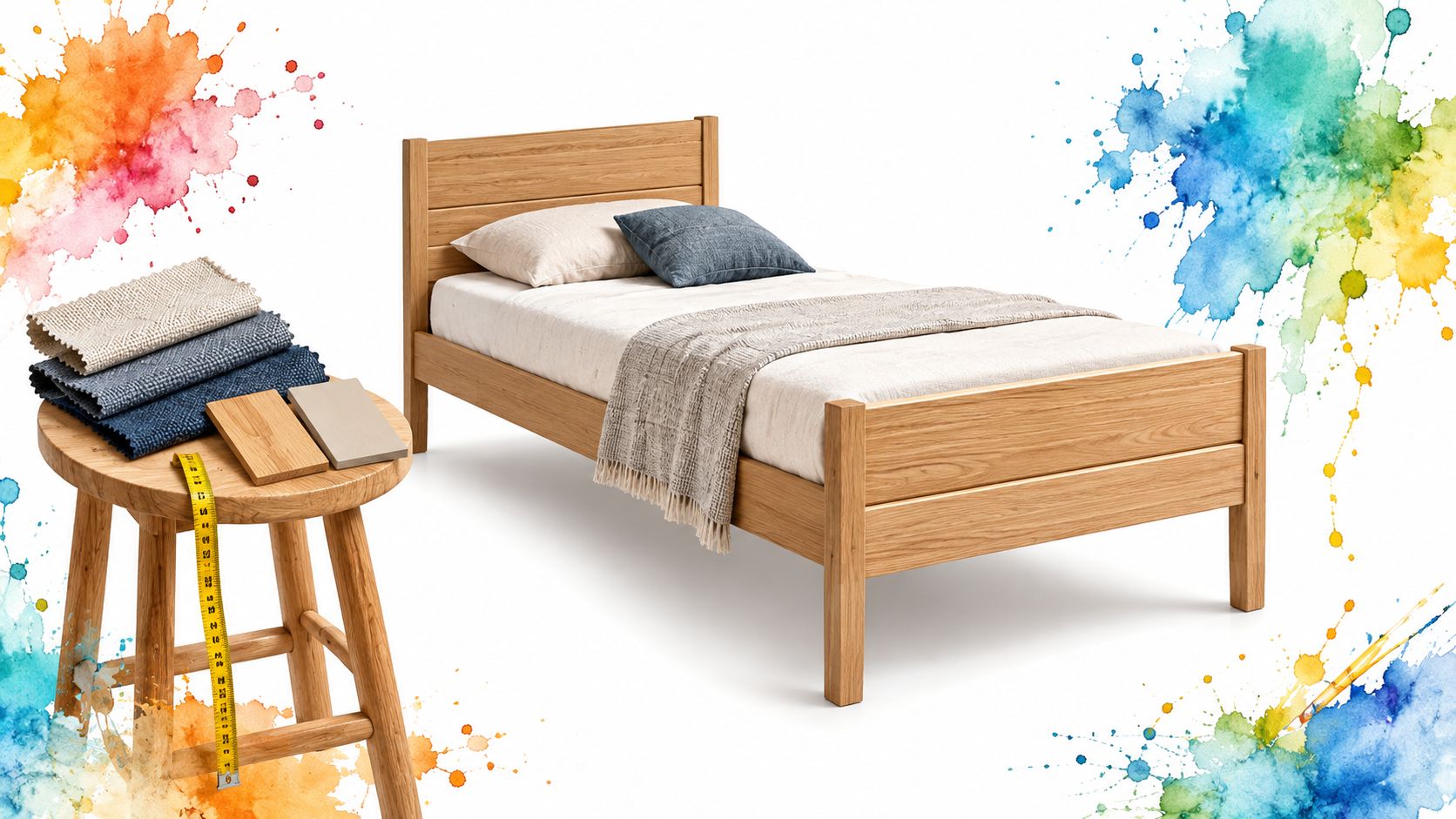
Before ordering, customers should bring room measurements, mattress dimensions, stairway details, and photos of nearby furnishings. The custom furniture design process works best when the frame is planned as part of the room, not selected in isolation.
Customization also protects the investment. A neutral frame with a durable finish can adapt to new bedding, wall color, flooring, and adjacent furniture. The result is less likely to become the piece that must be replaced only because the room evolved.
Matching the Frame to Your Mattress and Adjustable Base
A beautiful bed frame can still be the wrong purchase if it doesn't support the intended mattress or accommodate a future adjustable base. The frame, foundation, mattress, and base form one sleep system. Each part needs to work with the others.
Start with a measurement worksheet:
- Record the mattress length, width, and thickness.
- Identify whether the frame is a platform design or requires a separate foundation.
- Measure slat spacing and confirm the mattress maker's requirements.
- Note the number and position of center rails and center legs.
- Confirm the frame's stated load limit and what it includes.
- Measure floor clearance and the space available around the base.
- Check stairways, turns, doorways, and narrow-room access.
- Ask whether the frame can accommodate a thicker mattress later.
Platform and foundation-compatible designs
A platform frame supports the mattress through slats or a solid deck. That can create a lower profile and avoid the need for a separate foundation, but the slat spacing must satisfy the mattress manufacturer's requirements. Closely spaced slats and solid center support reduce unsupported areas, while adjustable legs help transfer force to the floor.
A foundation-compatible frame is designed to receive a foundation or box-style support. It may provide more flexibility in mattress height, but the total sleeping surface can sit higher. That affects headboard proportions, nightstand height, and ease of getting in and out of bed.
Adjustable bases introduce another set of questions. The base may need clearance to move, a frame may need to accept the base without interfering with its mechanism, and some platform designs may not be suitable at all. Noise can come from loose frame joints, contact between the base and frame, or an unstable floor connection.
A mattress warranty may also require specific support conditions. Confirm those requirements with the mattress manufacturer and the frame maker before ordering, rather than assuming a general weight rating settles the issue.
Giorgi Bros. Furniture's sleep gallery allows the mattress, base, and frame decisions to be considered together. Customers evaluating an adjustable base for a bed should bring exact dimensions and discuss future changes before selecting a fixed frame.
The practical standard is simple: don't buy a frame until the support spacing, center structure, clearance, load information, and delivery path are documented.
Durability, Repair, and the Long-Term Cost of Ownership
A bed frame earns its keep when it remains useful after the first bedroom setup. Strong construction, replaceable hardware, and joints that can be serviced let the frame survive a renovation, a move, a new mattress, or a change of ownership. That lowers the cost of replacing the entire sleep system.
The U.S. Environmental Protection Agency reported 12.1 million tons of furniture and furnishings entering the municipal solid-waste stream in 2018, representing 4.1% of total municipal solid waste. Of that furniture-and-furnishings total, 80.1% was landfilled and 19.5% was combusted for energy recovery. The total had risen from 2.2 million tons in 1960. (EPA durable-goods product-specific waste data)
Those figures do not mean every durable frame avoids disposal. They show why service life deserves attention. A frame that stays sound through several mattress changes spreads its materials, labor, and manufacturing impact across more years.
Repairability changes the calculation
Purchase price is only the first ownership cost. Ask these questions before ordering:
- Expected service life: How long should the frame remain structurally sound?
- Replacement parts: Can the maker supply hardware, slats, rails, or feet?
- Accessible joints: Can a technician reach and tighten the connections?
- Disassembly: Can the frame come apart for a narrow San Francisco stairway or apartment doorway?
- Support: Does the maker provide instructions, service, or repair guidance?
- Resale and reuse: Could another household use the frame later?
Ireland's furniture procurement criteria favor products that are fit for purpose, repairable, disassemblable, reusable, and covered by a warranty. They also favor repair, refurbishment, and repurposing when existing furniture remains functional. (Ireland Environmental Protection Agency furniture procurement criteria)
The Bay Area makes disassembly a practical test, not an abstract sustainability feature. A frame that can separate into manageable sections may pass through a narrow San Francisco stairway, ride safely to a new apartment, and be reassembled without cutting or damaging the structure. That flexibility can preserve both the frame and the money already spent on it.

Treat a quality bed frame as an investment piece, not a disposable bedroom expense. Giorgi Bros. Furniture's South San Francisco history gives that recommendation practical context. A showroom serving Bay Area households for over 90 years has seen cheaply made replacements accumulate, while well-constructed furniture continues serving families.
Ordering, Delivery, and the White-Glove Experience
Once the construction and compatibility questions are answered, the order should feel orderly rather than mysterious. A typical process starts with a showroom visit or design consultation, followed by mattress and room measurements, construction review, finish selection, and written confirmation of the custom specifications.
Non-commission consultants can document the selected wood, finish, upholstery, dimensions, support requirements, and origin information. The customer should receive clear expectations about manufacturer lead time before approving the order. If the frame is custom-built, changes become more difficult after production begins, so the final review matters.
Delivery deserves the same attention as construction. Giorgi Bros. Furniture operates its own delivery service across most of the Western United States, with location-based flat rates rather than per-piece fees. The white-glove team brings the furniture into the home, unpacks it, sets it up, and removes the packaging materials. Customers should still measure entrances, stairways, landings, and the final bedroom path before scheduling.
The white-glove furniture delivery process is especially useful for a substantial hardwood frame or an upholstered headboard that shouldn't be left in a carton for the homeowner to assemble. For locations outside the direct delivery area, the team uses a trusted deluxe nationwide carrier network. Bay Area customers can also arrange in-store pickup when that suits the project.
Flexible in-store financing options are available, subject to current terms. The important decision remains the same: verify the frame's origin, construction, compatibility, repair support, and delivery requirements before placing the order.
Giorgi Bros. Furniture offers American-made and custom bed frames, premium mattresses, adjustable-base guidance, and non-commission design consultations in a family-owned South San Francisco showroom. Visit Giorgi Bros. Furniture to compare construction details in person, explore custom wood and upholstery options, and plan a bed that can serve the Bay Area home for years to come.