A side sleeper often knows the problem before getting out of bed. One shoulder feels pinched. One hip feels tender. Sometimes the hand under the pillow goes numb, and sometimes the lower back complains even though the pain started much higher up.
That usually sends people down the same late-night search path. They read about memory foam, springs, hybrids, firmness scales, and cooling claims. Then they run into latex and wonder whether it's the answer or just another premium material with a premium price.
For many side sleepers, latex is worth a serious look. It has a distinct feel that combines cushioning with gentle pushback, and that balance matters when the body spends hours resting on two sharp pressure zones instead of distributing weight evenly. A well-made latex mattress for side sleepers can support long-term wellness, not just short-term comfort.
That's also why this decision fits the same values that have guided family furniture stores in South San Francisco since 1933. The best sleep choices aren't impulse buys. They're thoughtful investments. In a no-pressure environment, with Non-Commission Sales Staff and experienced Consultants, shoppers can slow down, compare feel, and choose Premium Mattresses that make sense for years, not weeks. That buy-it-for-life mindset also pairs naturally with sustainability and long-term value, whether the conversation is about Custom Furniture, Amish Furniture, or a mattress built to last.
The Side Sleeper's Dilemma A Search for Comfort
A common side-sleeper story sounds simple at first. The mattress feels fine for the first few minutes. Then the shoulder starts taking too much load. The hip sinks unevenly. By morning, the body has spent the whole night making tiny corrections.

That's why side sleeping is both popular and tricky. It can feel natural and cozy, but it asks more from a mattress than many people realize. The body isn't resting flat. It's narrowing its contact points, and those points have bones and joints that don't like hard resistance.
Some readers also find that the problem isn't only the mattress. Pillow height, shoulder angle, and spinal position all play a role. A helpful companion resource on correcting sleeping posture can help readers sort out whether the discomfort starts with alignment, bedding setup, or both.
Why side sleepers struggle more
The shoulder and hip need room to sink in. The waist and ribcage need support so the spine doesn't bow sideways. If the mattress is too firm, the shoulder gets jammed upward. If it's too soft, the hip can drop too far and twist the lower back.
Side sleeping isn't hard on the body by default. The wrong surface is what makes it feel hard.
That's where latex enters the conversation. It has a reputation for being supportive, breathable, and durable, but those broad terms don't help much until a shopper understands how latex behaves under a shoulder and a hip. Its value isn't just that it's a premium material. Its value is that it can cushion pressure points while still keeping the body from sagging out of line.
For Bay Area Interior Design clients and Furniture South San Francisco shoppers alike, that's the practical question. Not whether latex is fashionable, but whether it helps the body settle into healthier sleep.
How Latex Mattresses Solve Pressure Point Pain
Side sleeping creates a simple physics problem. More body weight lands on less surface area. According to Giorgi Bros. about side-sleeper pressure relief, side sleepers experience up to 300% more pressure on their shoulders and hips compared to back sleepers, and latex mattresses with a 2–3 inch top layer of shredded or ventilated latex effectively redistribute this pressure by increasing surface area contact and reducing peak pressure points.
That's the reason a mattress can feel “firm but painful” or “soft but unsupportive.” Pressure relief and alignment have to happen together.
Buoyant support instead of deep trapping
Latex has an elastic, responsive feel. It gives under weight, but it doesn't keep collapsing. Many side sleepers describe the best versions of this feel as floating with contour, not dropping into a crater.
Think of latex as a surface that cups the shoulder and hip while still holding the rest of the body level. It doesn't need to swallow the sleeper to relieve pressure. It needs to spread force over a wider area.
That's especially useful for people who toss from one side to the other. A slower material can hold an impression for a moment. Latex rebounds quickly, so the body can move without fighting the mattress.
What pressure relief should feel like
A side sleeper lying on the right mattress usually notices a few things:
- The shoulder settles naturally. It doesn't feel shoved upward toward the neck.
- The hip feels cushioned, not jammed. There's give, but not a collapsing sensation.
- The waist stays supported. The torso doesn't feel like it's hanging between the shoulder and hip.
- Turning takes less effort. The sleeper doesn't feel stuck in one spot.
Readers dealing with both side-sleep discomfort and back tension may find it useful to compare these body cues with a guide on helping back pain with the right mattress.
Practical rule: A mattress for side sleeping should reduce sharpness at the shoulder and hip without letting the middle of the body drift out of line.
This is why latex often earns a place in conversations about long-term sleep wellness. It isn't just soft. It's responsive in a way that can support healthy posture over the course of a full night.
Choosing Your Latex Type Talalay vs Dunlop
Not all latex feels the same. Many mattress guides generalize too much on this point. They say “latex” as if one version behaves exactly like another, when side sleepers often notice major differences between Talalay and Dunlop.
What Talalay feels like
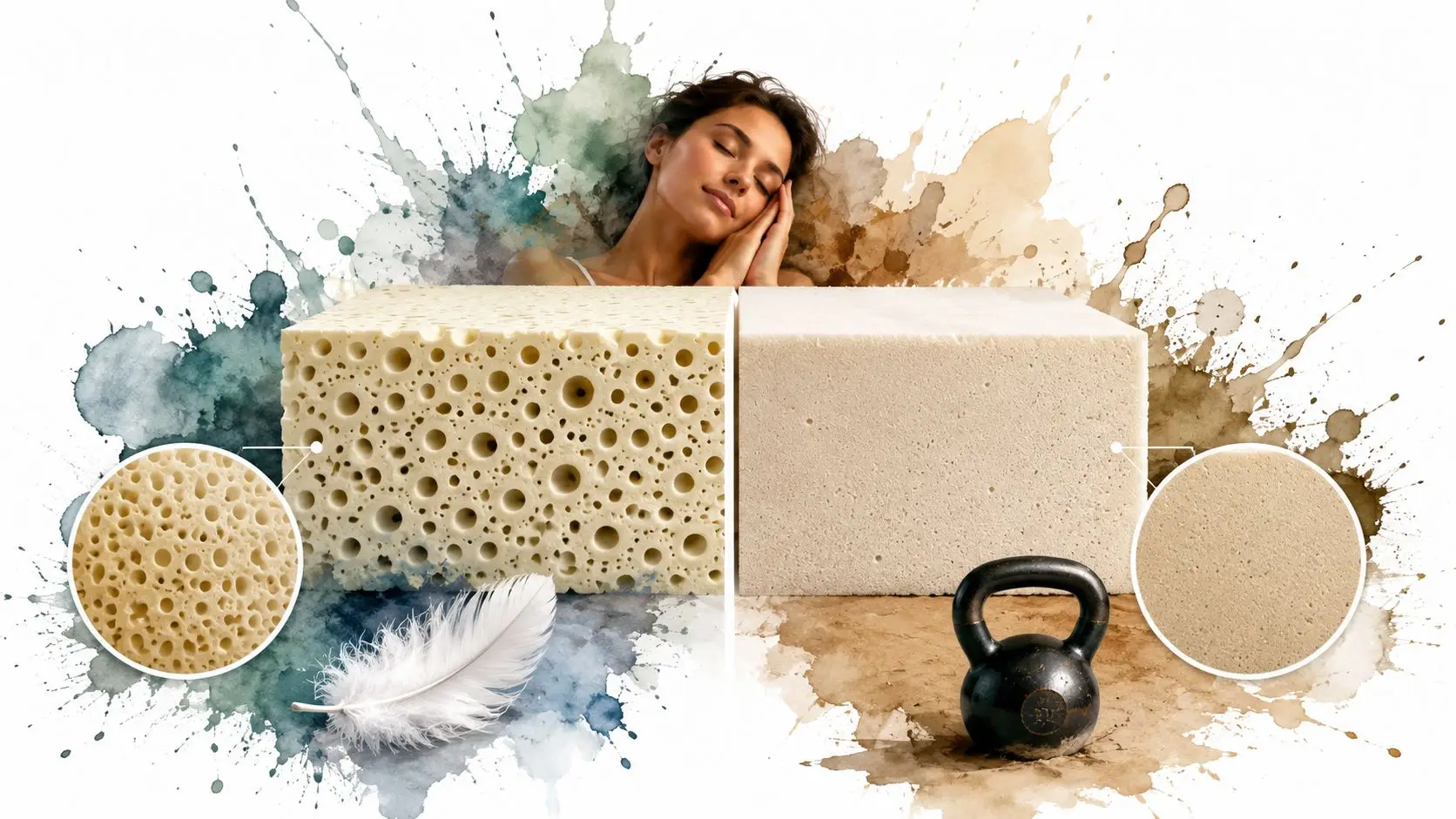
Talalay is often the version side sleepers gravitate toward first. According to PlushBeds on latex for side sleepers, Talalay latex, characterized by a cross-hatched internal structure created during the flash-freezing manufacturing process, offers a 40% higher air permeability rate compared to Dunlop latex, providing superior thermal regulation for side sleepers who experience higher heat retention at contact points due to reduced surface area exposure.
In plain language, Talalay tends to feel lighter, airier, and more pressure-friendly near the surface. It often works well in comfort layers where the shoulder and hip need easier compression.
A shopper who cares about healthier material choices may also appreciate exploring low VOC furniture and sleep products while comparing latex builds.
What Dunlop feels like
Dunlop usually feels denser and more grounded. It can still be comfortable for side sleepers, but it often gives a more stable sensation rather than a plush, buoyant one. That makes it a common choice lower in the mattress, where stronger support matters more than a pillowy first touch.
A simple comparison
| Latex Type | Typical feel for side sleepers | Common role in the mattress |
|---|---|---|
| Talalay | Softer, springier, more breathable | Comfort layer |
| Dunlop | Denser, steadier, more supportive | Support core or firmer comfort layer |
The best choice often depends on what the sleeper wants to feel first when lying down.
- Choose Talalay if a gentler cradle at the shoulder is the top priority.
- Choose Dunlop if a firmer, more planted sensation sounds better.
- Choose a mixed build if softness on top and stronger support underneath both matter.
Some of the best latex mattresses for side sleepers use both types instead of forcing a single material to do every job.
That's one reason in-person testing matters. Two mattresses may both say “natural latex” and still feel completely different once body weight meets the comfort layers.
Finding Your Perfect Firmness and Thickness by Body Weight
A side sleeper can lie on two mattresses labeled “medium” and get two completely different results. One gently lets the shoulder settle in and keeps the waist supported. The other feels fine for thirty seconds, then starts pressing on the hip or tipping the spine out of line.
That happens because firmness is relative to the body on top of it. Body weight changes how far you engage the comfort layer, how quickly you reach the support layers, and whether the mattress is contouring to you or pushing back too soon.
For side sleepers, the goal is balanced give. The shoulder and hip need enough room to sink, while the ribcage and waist need steady support so the spine stays level instead of bowing downward or arching upward. A mattress that misses either part can feel comfortable at first touch and tiring by morning.
A practical firmness guide
Body weight gives you a useful starting point, not a final answer. Here is a simple way to narrow the field before you test beds in person.
| Body Weight | Recommended Firmness (1-10 Scale) | Minimum Mattress Thickness |
|---|---|---|
| Under 130 pounds | Softer to medium, often around 4.5 to 6.0 | Focus on enough comfort material for the shoulder and hip to compress the surface. |
| 130 to 230 pounds | Often 5 to 7 | Enough depth is needed to cushion pressure points while keeping the midsection supported. |
| Over 230 pounds | Usually firmer than the middle range, with stronger support underneath | A thicker build is often helpful so the body does not press through the comfort layers too quickly. |
Lighter side sleepers often need a plusher surface because they do not compress latex as significantly. If the top layer is too firm, the shoulder can stay lifted instead of settling in.
Heavier side sleepers usually need more than softness. They often do better with enough comfort depth on top and a stronger support structure underneath, so the hip is cushioned without dropping too far. It works like good suspension on a truck. You want some initial give, but you also want control once more weight is applied.
Why the same mattress feels different from one sleeper to another
A common point of confusion is thickness. A mattress is not automatically better because it is taller, and a thinner build is not automatically a problem. What matters is how the layers are arranged and whether there is enough usable comfort material for your body type.
For a side sleeper, a thin comfort section can create a “bottoming out” feeling. The first inch or two may feel pleasant with your hand. After a few minutes on your side, the shoulder or hip can compress past that soft layer and start meeting the firmer material below. That is often the moment pressure builds.
The opposite problem happens too. If the comfort area is too deep and too soft for the sleeper's weight, the body can sink unevenly and pull the spine out of a straighter line.
ILD made simple
ILD stands for Indentation Load Deflection. It is one of the ways latex firmness is described. Lower ILD means the foam compresses more easily. Higher ILD means it pushes back more firmly.
For side sleepers, ILD matters most in the top layers. A softer comfort layer usually helps the shoulder and hip settle in. The deeper layers should feel more supportive, so the body does not keep sinking after the pressure points are cushioned. In plain terms, the top should welcome you, and the lower layers should hold you up.
You do not need to memorize every number in the showroom. You do need to ask smart questions.
- How soft is the top latex layer? This affects pressure relief first.
- What is underneath it? A soft surface can still feel wrong if the next layer is too firm or too shallow.
- How thick is the full build? Thickness matters more for some body types because it changes how quickly you reach the firmer support structure.
A good next step is reviewing this mattress firmness guide for different sleep positions and body types before testing options in person.
At Giorgi Bros., online research becomes especially useful. You can read about firmness scales and ILD at home, then come in and feel how those ideas translate under your own shoulder and hip, with guidance from non-commission sleep specialists who can explain why one latex build feels pressure relieving and another feels too flat or too pushy.
A mattress should be judged after several minutes on one shoulder and one hip, not by a quick hand press at the edge of the bed.
All-Latex vs Hybrid Mattresses Which Is Better for You
A side sleeper can lie down on two latex mattresses that look similar on paper and come away with two very different reactions. One feels calm, even, and steady under the whole body. The other feels springier underneath, easier to roll on, and stronger at the edge. That difference usually comes down to the support core: latex or coils.
When all-latex makes more sense
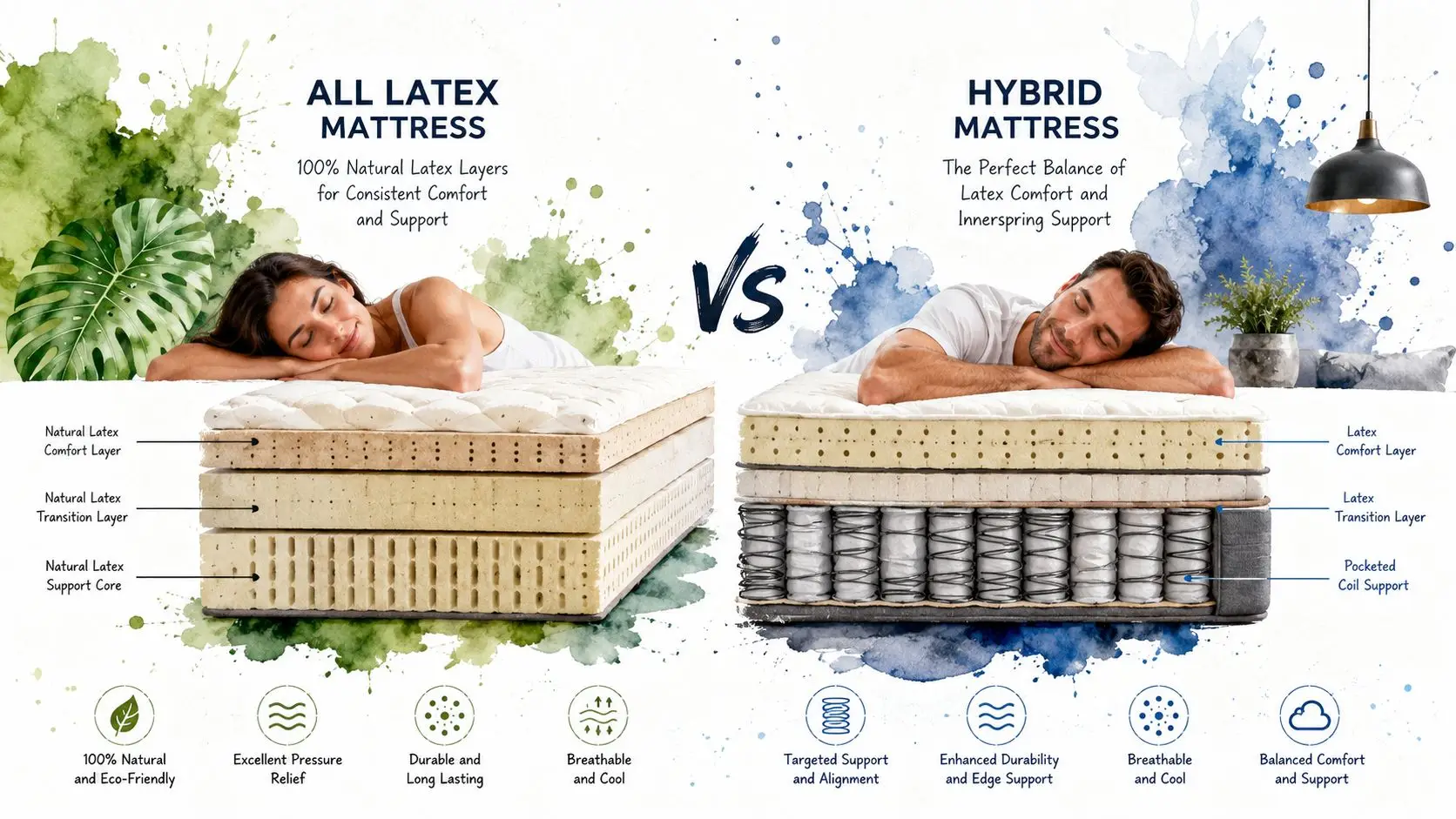
An all-latex mattress uses latex from the comfort layers down through the support layers. The result is a more unified feel. Compression tends to happen in a gradual, connected way, which many side sleepers describe as floating with support rather than dropping onto a separate spring system.
That can be a strong match for someone who wants consistency from top to bottom. If you are sensitive to shifts in feel between the comfort layer and the deeper support structure, all-latex often feels more harmonious. It also appeals to shoppers who care about long service life and a material story centered on latex rather than metal coils.
When a hybrid makes more sense
A hybrid uses latex on top and coils underneath. Coils change the character of the bed. They usually add a little more lift, a little more edge stability, and a more familiar spring-backed response when you change positions.
For some side sleepers, that is the sweet spot. Latex still cushions the shoulder and hip, but the coil unit can keep the bed from feeling too dense or too uniform. Lighter sleepers sometimes prefer this balance because they want pressure relief without the fuller, more continuous pushback of an all-foam support core.
Readers comparing support systems can get a clearer picture from this overview of what a hybrid mattress is.
What the choice really comes down to
The better option is the one that matches how your body likes to be supported over time, not the one with the trendier label.
- Choose all-latex if you want a more continuous latex feel, quieter motion response, and support that builds in a steady, progressive way.
- Choose a hybrid if you want more spring underneath, easier repositioning, or stronger edge support for sitting and getting in and out of bed.
- Choose either one if the comfort layers relieve pressure well and your spine stays level while you rest on your side for several minutes.
A simple store test helps. Lie on your side long enough for your muscles to stop bracing. Pay attention to three spots: shoulder, waist, and hip. If the shoulder feels jammed, the top is not giving enough. If the waist feels unsupported, the deeper construction is not holding your midsection evenly. If the hip drops too far, alignment will suffer by morning.
At Giorgi Bros., this comparison becomes easier because you can feel both constructions back to back with guidance from non-commission sleep specialists. Online research can explain terms like coil support, latex response, and pressure relief. In the showroom, you can tell whether your body prefers the steady, all-latex build or the more buoyant rhythm of a hybrid.
A quality mattress is a long-term piece of health equipment. Protecting that investment matters too, which is why many shoppers also review the importance of mattress protectors once they have chosen the right construction.
The Foundation of Great Sleep Toppers Bases and Long-Term Care
You can choose a beautiful latex mattress, bring it home, and still wake up wondering why it does not feel as balanced as it did in the showroom. In many cases, the mattress is not the problem. The base underneath is changing how the whole bed carries weight.
Latex is flexible and resilient, but it still needs a flat, supportive platform to do its job well. If slats are too far apart, or the foundation has soft spots, the mattress can bend where it should stay level. For a side sleeper, that often shows up first at the hip and lower back.
Start with the base
A mattress foundation works like the frame under a well-built sofa. If the frame stays steady, the cushioning can respond the way it was designed to. If the frame shifts, even high-quality materials feel less precise.
That is why base choice matters with latex. Many models do best on closely spaced slats or a solid, properly ventilated surface, depending on the build and the maker's guidelines. Shoppers who want to raise the head or legs for reading, swelling, snoring, or pressure relief often do well with an adjustable setup. For that kind of support system, it helps to review the best adjustable base for a mattress.
At Giorgi Bros., this part is easier to sort out in person. You can press on the mattress, feel how quickly latex recovers, and ask a non-commission sleep specialist whether the base under consideration matches the mattress design instead of guessing from a product page.
When a topper helps
A topper is a tuning layer, not a rescue plan.
For side sleepers, that distinction matters. If your mattress still feels supportive but the shoulder wants a little more give, a latex topper can add surface pressure relief without changing the whole bed. It can also refresh a guest room mattress that still has a healthy support core. If the mattress underneath is already dipping or broken down, adding a topper usually lets the body sink farther into a bad pattern.
Why durability changes the value equation
Latex has a strong reputation for durability because the material springs back well under repeated compression. Industry testing from rubber and foam standards groups has long shown that latex foam tends to retain its shape better than many conventional foams under stress and fatigue testing. In plain terms, it is a material built for years of nightly loading, not just a comfortable first impression in the store.
That longer service life changes how many families shop. The question becomes less about the lowest ticket today and more about how well the mattress keeps supporting shoulders, hips, and the small of the back over time. For a family furniture store like Giorgi Bros., that conversation comes up often because customers are not only buying a mattress. They are buying fewer replacement headaches.
Material quality matters too. For shoppers trying to separate true natural latex from vague marketing language, certifications and manufacturer specifications are more useful than broad online claims. GOLS certification, for example, applies to organic latex foam made from certified natural rubber and gives shoppers a clearer paper trail on raw materials and processing standards.
A simple protector helps preserve that investment from the first week, especially against spills, sweat, and everyday buildup. Readers who want a clear overview can review the importance of mattress protectors.
- Match the base to the mattress. Good support starts underneath.
- Use a topper for fine-tuning. It can soften surface feel, but it cannot fix structural wear.
- Look for credible material documentation. Certifications and maker specifications say more than marketplace descriptions.
- Protect the surface early. Keeping a mattress clean is much easier than trying to restore it later.
Your In-Person Checklist at Giorgi Bros Furniture
Online research helps narrow the field. It doesn't replace lying still on a mattress long enough to feel whether the shoulder settles, the waist stays supported, and the hip stops arguing with the lower back.

A useful in-person checklist keeps the visit focused and calm.
What to check in the showroom
- Lie on the usual side. A quick sit-down tells very little. Several quiet minutes reveal much more.
- Notice the shoulder first. If it feels compressed right away, the comfort layer may be too firm.
- Check the hip after the shoulder. If the hip drops too far, the support underneath may be too weak.
- Pay attention when turning over. Latex should feel responsive, not restrictive.
- Ask about build details. Layer type, firmness, thickness, and support construction all matter.
- Compare all-latex and hybrid. They solve comfort differently, and the body usually has a preference.
Why the local experience still matters
Furniture South San Francisco shopping proves more valuable than endless scrolling. In a longstanding family showroom with roots going back to 1933, shoppers can touch, feel, and test quality directly. In a 50,000 square foot setting, there's room to compare styles, materials, and sleep systems without feeling rushed.
That also fits the best kind of retail guidance. No-pressure guidance. Thoughtful conversation with Non-Commission Sales Staff and Design Experts. The kind of help that supports better decisions in Premium Mattresses, Bay Area Interior Design projects, and Custom Furniture planning, including custom order options in fabrics, leathers, wood species, and finishes.
A mattress is personal. The final choice should feel informed, unhurried, and easy to trust years later.
For readers ready to test a latex mattress for side sleepers in person, Giorgi Bros. Furniture offers a welcoming South San Francisco showroom experience built on more than 90 years of family service. Shoppers can explore Premium Mattresses, compare all-latex and hybrid options, and speak with Non-Commission Sales Staff who focus on no-pressure guidance, not a pitch. It's also a place to see the bigger picture, from Custom Furniture and Amish Furniture to full Bay Area Interior Design support, with custom order choices in fabrics, leathers, wood species, and finishes. Financing options are available, and a Design Consultation is a smart next step for anyone who wants to invest in lasting comfort and buy for life.