Saturday morning often finds a Bay Area homeowner standing in a 10-by-11 bedroom with a tape measure in one hand and a notebook in the other. A queen mattress needs to fit, along with two nightstands, a dresser, and the books currently hidden in a closet. The room has to support sleeping, reading, storage, occasional work, and display without feeling like every wall has been assigned a job.
The platform bed with bookshelves can solve that compression problem, but only when its dimensions and construction match the room. The right piece consolidates the bed, headboard, bedside storage, and bookcase. The wrong one turns a manageable bedroom into a bulky obstacle course. Buyers exploring small-space furniture should judge the design by its footprint, shelf depth, clearances, joinery, and finish, not by the stain color alone.
When a Bedroom Needs to Work Harder
A bedroom of roughly 130 square feet has limited floor area, yet homeowners keep asking it to perform several jobs. A taller dresser adds storage but increases visual weight. Under-bed bins hold belongings but can be awkward to reach. A single floating shelf handles a few books while leaving the nightstand, lighting, and display problem untouched.
A bookshelf bed takes a more disciplined approach. It places the storage where a headboard already belongs, then can add short side shelves or drawers beneath the platform. That consolidation frees other walls for circulation, a dresser, or a small work surface. It also gives the room a stronger center instead of scattering small storage pieces around the perimeter.
The footprint matters more than the sales pitch
A queen mattress occupies less space than the complete bed surrounding it. Side casework, headboard depth, drawer pull-out, bedding access, and walking paths all count. In a compact South San Francisco or wider Bay Area bedroom, those extra inches determine whether the room feels calm or crowded.
The bed also has to support the way the household lives. A reader may need a reachable shelf and a switched light. A guest room may need concealed storage rather than open display. A primary suite with limited closets may benefit from drawers below the platform, while an apartment dweller may prefer a narrow headboard with no side extensions.
Practical rule: A storage bed earns its place by replacing several pieces without stealing the circulation those pieces required.
That makes this category more than a space-saving trick. Platform beds have deep historical roots, with raised and canopied beds documented in China about 2,000 years ago in evidence cited by Britannica through BBC Future's history of beds. Their modern Western popularity grew alongside mid-century modernism before reaching mainstream furniture markets, so the combination of a raised sleep surface and integrated storage rests on two durable furniture ideas.
What a Platform Bed With Bookshelves Is
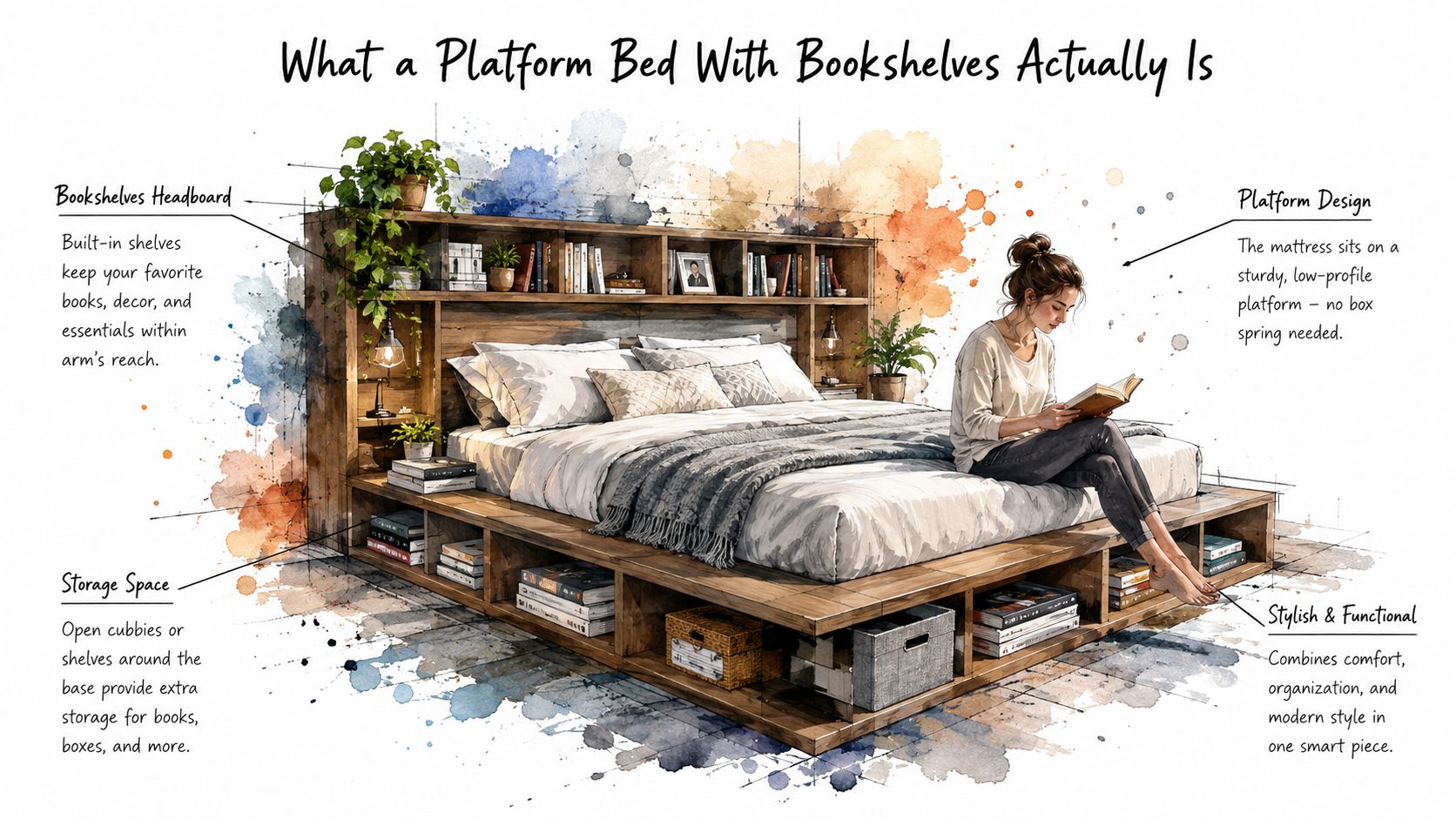
A platform bed with bookshelves combines sleeping and storage in one structural piece. The platform supports the mattress on slats or a solid deck, usually without a box spring. Integrated shelving adds open compartments to the headboard, side wings, footboard, or a larger casework system built as part of the bed.
That construction affects both safety and longevity. A freestanding bookcase against the wall has its own center of gravity and can tip if someone climbs it. Shelves connected to the bed's side rails and headboard can function as one casework system, provided the maker builds them as structural furniture rather than decorative trim.
Four details separate good designs from awkward ones
Begin with shelf depth. Shallow shelves preserve walking space and keep the bed visually light. Deeper shelves fit larger books, lamps, and baskets, but they consume more room. Check the vertical spacing between shelf holes as well. Fixed openings look orderly, while adjustable shelves adapt to changing books, artwork, and storage needs.
Measure the headboard against the mattress, not just the wall. A headboard only slightly wider than the mattress creates a restrained silhouette. Side wings that extend well beyond it can replace nightstands, but they require more wall length and walking clearance.
Then inspect the platform height. A raised base can accommodate drawers or open storage, while a lower profile leaves less visible furniture below the mattress and gives the room a quieter appearance.
Construction quality deserves equal attention. Look for sturdy joinery, supported shelves, durable finishes, and hardware that can withstand daily opening, closing, and shifting loads. Those details determine whether the bed remains useful through future room changes or becomes a five-year placeholder.
For a clear overview of the category, read this bedroom bookcase headboard guide. The final choice still depends on the room's geometry, circulation, and the household's habits.
Styles You Will See in the Showroom
Most buyers encounter four configurations, each with a different effect on the room. The most restrained option is the bookcase headboard, a single tall panel with several shelves behind the pillows. It gives an apartment dweller or tight-room owner storage without widening the bed much beyond the mattress.
A twin-shelf nightstand extension adds short shelving wings on both sides. This version replaces standalone nightstands and works well when the room can spare width but not additional furniture. It suits a compact primary bedroom or guest room where books, a lamp, and small personal items need defined locations.
The full shelving wall surrounds the headboard with tall shelving on both sides and across the top. It creates the largest storage gain and the strongest architectural statement. Book collectors may appreciate it, but it can dominate a small room, particularly if the ceiling is low or the wall already contains doors, trim, or windows.
A storage platform combines a bookcase headboard with drawers below the mattress. It makes sense in a bedroom with limited closet space, especially when folded clothing or off-season belongings need accessible storage. Drawer clearance becomes part of the circulation plan, so this option shouldn't be chosen from a front-facing photograph alone.
| Platform Bed With Bookshelves Style Comparison | Footprint Impact | Best For |
|---|---|---|
| Bookcase headboard | Adds headboard depth and height with limited side expansion | Apartment dwellers and tight bedrooms |
| Twin-shelf nightstand extension | Widens the bed and replaces separate nightstands | Guest rooms and compact primary suites |
| Full shelving wall | Uses substantial wall height and width, becoming the room's dominant feature | Book collectors and rooms with generous wall space |
| Storage platform | Adds drawer pull-out space below the mattress | Bedrooms with limited closet storage |
Room character should guide the choice
A restrained headboard works in a smaller bedroom where circulation is the priority. A full shelving wall belongs in a room that can support a built-in visual anchor. Contemporary rooms often benefit from cleaner lines and fewer separate pieces, a direction explored in this guide to contemporary furniture styles.
The showroom test is simple. Stand beside the display, open the drawers, reach to the back of the shelves, and imagine making the bed or carrying a laundry basket past it. If the bed only works when viewed straight on, it isn't ready for the room.
Sizing and Clearance Tradeoffs
A mattress size gives you only the starting footprint. Headboard shelving, side cases, drawer fronts, and reading space can add enough depth or width to make a delivered bed feel oversized. Before choosing a configuration, measure the wall, the open side of the bed, the dresser zone, doors, outlets, and every nearby passage. Follow this furniture measuring guide before placing an order.
| Platform Bed With Bookshelves Standard Dimensions at a Glance | Mattress W × L (in) | Approx. Bed Frame W × L (in) | Recommended Wall Length (in) | Minimum Side Clearance (in) |
|---|---|---|---|---|
| Twin | 38 × 75 | Measure the selected casework | Mattress width plus shelf extensions | At least 30 |
| Full | 54 × 75 | Measure the selected casework | Mattress width plus shelf extensions | At least 30 |
| Queen | 60 × 80 | Measure the selected casework | Mattress width plus shelf extensions | At least 30 |
| King | 76 × 80 | Measure the selected casework | Mattress width plus shelf extensions | At least 30 |
| California king | 72 × 84 | Measure the selected casework | Mattress width plus shelf extensions | At least 30 |
The frame dimensions remain open because bookshelf beds vary considerably by design. One published example lists a Twin at 41.5 inches wide by 89 inches deep, a Full at 56.5 by 89, a Queen at 62.5 by 94, and a King at 78.5 by 94, all with a 47-inch height, as shown in this published furniture dimension reference. A separate government drawing distinguishes the platform box from the completed piece. It lists the box at 1016 mm wide by 2110 mm long by 585 mm high, and the bed with headboard at 1065 mm wide by 2155 mm long by 940 mm high, in the GSA drawing reference.
Shelf depth is the quiet space thief
For bedside shelving, around 20 to 25 cm keeps the design practical in many rooms. Shelves deeper than 30 cm can make a smaller bedroom feel confined, according to this bedroom shelving design guide. Shallow shelves suit paperbacks, glasses, chargers, and ordinary bedside items. Deeper shelves hold larger books and lamps, but they move the bed farther into the room and can narrow the route around it.
Clearance must account for more than walking space. Planning guidance recommends at least 30 inches of clear circulation in small spaces and 24 inches of unobstructed depth in front of storage units. Ergonomic bedroom planning often targets 70 cm minimum clearance at bed edges, as outlined in this small-space furniture planning guide. Measure shelf depth, drawer travel, bedding access, and the path to the door as one clearance envelope. If the bed fits only on paper, choose a narrower configuration or a different wall.
Built to Outlast the Next Two Remodels
A bookshelf bed earns its floor space by doing several jobs at once. It supports the mattress, absorbs movement, carries dense books, and often replaces nightstands. That workload makes construction more important than a fashionable finish or a low showroom price. If the piece is expected to survive two remodels, specify it like long-term furniture, not temporary casework.
The weak points are predictable. Thin engineered shelves can sag, cam-lock assembly can loosen, and fragile veneer edges can chip at corners and hand-contact areas. Those materials may suit a short-term bedroom, but they fall short of a buy-it-for-life standard.
Joinery tells the story
Solid hardwood creates a repairable, refinishable foundation. Traditional connections such as mortise-and-tenon joinery and dovetailed drawer cases handle repeated stress more reliably than staples, screws, or simple dowels. Guidance on durable furniture also favors solid wood and traditional joinery, as explained in this comparison of solid wood versus particle board.
Shelf capacity depends on span, material, and duty class. The Architectural Woodwork Institute rates adjustable shelves from 25 to 65 lb per square foot depending on duty level, and its shelf suspension tests require 275 to 725 lbf of resistance, according to its structural architectural wood casework standards. Practical shelf guidance also indicates that 3/4-inch plywood needs support about every 24 to 32 inches under heavy book loads. Specify shorter spans, dependable supports, and shelves sized for the books you own. A long unsupported opening may look clean in a showroom, then bow once it carries a full library.
Long-term value isn't only about price
The buy-it-for-life approach favors a durable piece that remains useful as the room and household change. Design guidance describes that philosophy as choosing furniture with enough material and stylistic longevity to stay useful through changes in a home and lifestyle, as discussed in this furniture longevity guide.
A solid hardwood bed can be refinished, repaired, and passed to another household. That reduces replacement waste and spreads the investment across years of use. Quality furniture can cost more at purchase, but the better value is often the piece that remains useful through the next remodel instead of becoming a disposal problem. Ask to see the underside, shelf supports, back construction, and finish edges before you buy. Those details reveal whether the bed was built for daily life or merely styled for the showroom.
Buying Off the Floor vs Custom Ordering
Floor stock has a legitimate advantage. It can be inspected immediately, ordered quickly, and priced around a repeatable design. For a guest room with generous wall space and uncomplicated storage needs, that convenience may be enough.
A bookshelf bed rarely has an uncomplicated fit, though. Catalog models usually offer fixed dimensions, shelf counts, and finish choices. Those limits force the homeowner to redesign the room around the bed, even when the room already has a window, an outlet, a baseboard, or a preferred reading position in the way.
Custom ordering reverses the sequence. The room becomes the starting point, and the bed responds to it. A design consultant can account for mattress size, ceiling height, window placement, outlet locations, reading habits, and the furniture already staying in the room.
Useful custom changes
A custom-built piece may lower the headboard shelves to clear a window, extend one side to wrap a corner, add a drawer bank beneath the platform, or match an existing dresser in wood species and finish. Those changes aren't decorative indulgences. They determine whether the bed looks integrated or oversized.
| Floor Stock vs Custom Order What Actually Changes | Floor Stock | Custom Order |
|---|---|---|
| Dimensions | Fixed sizes and casework | Planned around the room |
| Shelf arrangement | Predetermined openings | Depth, height, and placement can be adjusted |
| Wood and finish | Limited available choices | Wood species and finish can coordinate with existing pieces |
| Storage | Standard drawers or open shelves | Drawer banks and storage zones can follow household needs |
| Decision process | Room adapts to the product | Product adapts to the room |
| Timing | Faster availability | Requires a build schedule |
For Bay Area homeowners furnishing a long-term bedroom, custom ordering usually wins when the bed occupies a central wall or replaces several pieces. Giorgi Bros. Furniture provides custom order services involving wood species, finishes, high-grade leathers, and designer fabrics, while its non-commission design consultants offer no-pressure guidance. The showroom also carries Amish Furniture and supports broader bedroom planning, including Premium Mattresses and available Financing options.
A custom build may require a meaningful wait, but the more important question is how long the near-fit will remain in the room. A bookshelf bed is too prominent to treat as a short-term placeholder.
Styling the Shelves So They Breathe
Empty shelves can make a bedroom feel unfinished. Completely packed shelves create visual noise and make the headboard look like a storage closet. The aim is a curated arrangement with enough open space for the eye to rest.
A useful rule of thumb is 60/30/10. Around 60% of the shelf area can hold books or grouped objects, 30% can remain negative space or carry a single statement piece, and 10% can include something living or softly lit. That ratio doesn't need to be measured precisely. It prevents every compartment from receiving the same visual treatment.
Give the eye different heights
Hardcovers can stand in small groups, while selected books can lie horizontally to vary the line. Clusters of three to five books create rhythm without making every shelf look staged. Framed photographs should fit within the shelf depth, and one or two warm-toned ceramics or vessels can catch morning light without competing with the wood.
Lower shelves should handle less decorative, more practical objects. Charging cables, e-readers, allergy medication, and alarm clocks belong behind a cabinet panel or in a discreet basket when possible. Open shelves work best when they show the homeowner's interests rather than every object that needs a place.

Light the storage without crowding the bed
Slim LED strips recessed under each shelf face can provide warm 2700K reading light without placing table lamps on narrow nightstand extensions. A switch at the headboard side keeps the control reachable from bed. Concealed wiring preserves the clean lines that make integrated shelving appealing in the first place.
The shelf display also needs one strong visual anchor. An oversized art print, a tall plant, or a sculptural object gives the eye somewhere to land. Homeowners adding greenery can compare plant styling approaches before selecting a piece that suits the room's light and maintenance preferences.
See It, Touch It, and Talk It Through
A showroom visit should feel like a working session, not a sales call. Homeowners should bring room measurements, photographs, a sketch of wall heights, and the location of outlets, doors, windows, and existing furniture. Those details let a consultant test the bed's proportions before the order is placed.
At a South San Francisco showroom with more than 90 years of family-owned history, the conversation can move from mattress size and shelf depth to wood species and finish while the customer handles physical samples. Giorgi Bros. Furniture has served the area since 1933, and its full-service approach includes custom order services rather than limiting every bedroom to floor stock.
A useful consultation ends with clarity
The bed can begin with a stock platform design and be modified, or it can start from a sketch. The important result is alignment between the room and the piece. A homeowner should leave with measured dimensions, a written quote, and a clear understanding of the finished design, even when the order won't be placed immediately.
That no-pressure process matters for an investment piece. Non-commission Consultants can discuss Custom Furniture, Amish Furniture, finishes, storage, and Premium Mattresses without turning the appointment into a contest for a commission. Delivery and setup planning also matter in Bay Area homes, where stairs, narrow halls, and older construction can affect installation.
The best platform bed with bookshelves isn't the one with the most storage. It's the one that fits the room, supports the household, and remains attractive and repairable through changing needs.
Giorgi Bros. Furniture offers platform beds, bedroom storage, custom order services, Premium Mattresses, and no-pressure guidance from a family-owned South San Francisco team. Visit Giorgi Bros. Furniture with room measurements and photos, or book a Design Consultation to work through shelf depth, wood species, finish, and delivery details.