
The popular advice is simple: full-grain leather is always better. That advice is incomplete. Full-grain is usually the strongest choice for natural character and long ownership, but top-grain leather can be the smarter furniture investment for households that prioritize a consistent finish, easier initial maintenance, or practical stain resistance.
The confusion starts with the terminology. Top-grain describes leather taken from the hide's upper grain layer, while full-grain is the unsanded subset that retains that surface intact. Some top-grain leather is corrected, meaning the surface has been sanded or buffed and then finished for greater uniformity. A thoughtful choice depends less on chasing a prestige label and more on how a sofa, chair, or sectional will live in the home.
At a family-owned South San Francisco showroom serving Bay Area homeowners since 1933, design consultants see this decision play out every day. Children, pets, sunlight, entertaining habits, and ownership goals all matter. For additional guidance before visiting a showroom, Giorgi Bros. offers this practical resource on how to choose leather furniture.
Why the Best Leather Choice Depends on How You Live
Full-grain leather earns its premium reputation by preserving the hide's original surface, keeping the densest outer fibers intact, and developing a patina that gives furniture more character over time. But calling it universally superior ignores the tradeoff. A busy family may value a protected, uniform surface more than visible marks and gradual color change.
Top-grain is often treated as a separate, lower category, yet the terminology is broader than most showroom tags suggest. Full-grain is generally part of the top-grain family because it comes from the top layer of the hide. The meaningful distinction is whether that layer remains untouched or receives correction.
The household decides the grade
A family sectional near the kitchen faces a different assignment from a reading chair in a quiet study. A home with young children and active pets may benefit from a finish that handles everyday spills with less immediate concern. A formal living room may reward full-grain's natural texture because the furniture receives lighter use and has room to age visibly.
Sun exposure also changes the decision. A leather chair in a bright room needs careful consideration of finish, color, placement, and maintenance. Humidity, room temperature, and the amount of direct contact influence comfort and longevity as well.
Practical rule: The right leather is the one that fits the household's habits, not the one with the most impressive label.
The technical comparison matters, but so does the emotional contract. Full-grain asks owners to accept natural variation and participate in the care. Corrected top-grain asks less at the beginning and offers a more controlled appearance. Neither choice makes sense if it conflicts with the way the room is used.
What Full-Grain and Top-Grain Leather Mean
“Full-grain is always better” is too simple for furniture buyers. The useful question is whether the hide's outer surface remains untouched or receives correction, and whether that choice suits the room.
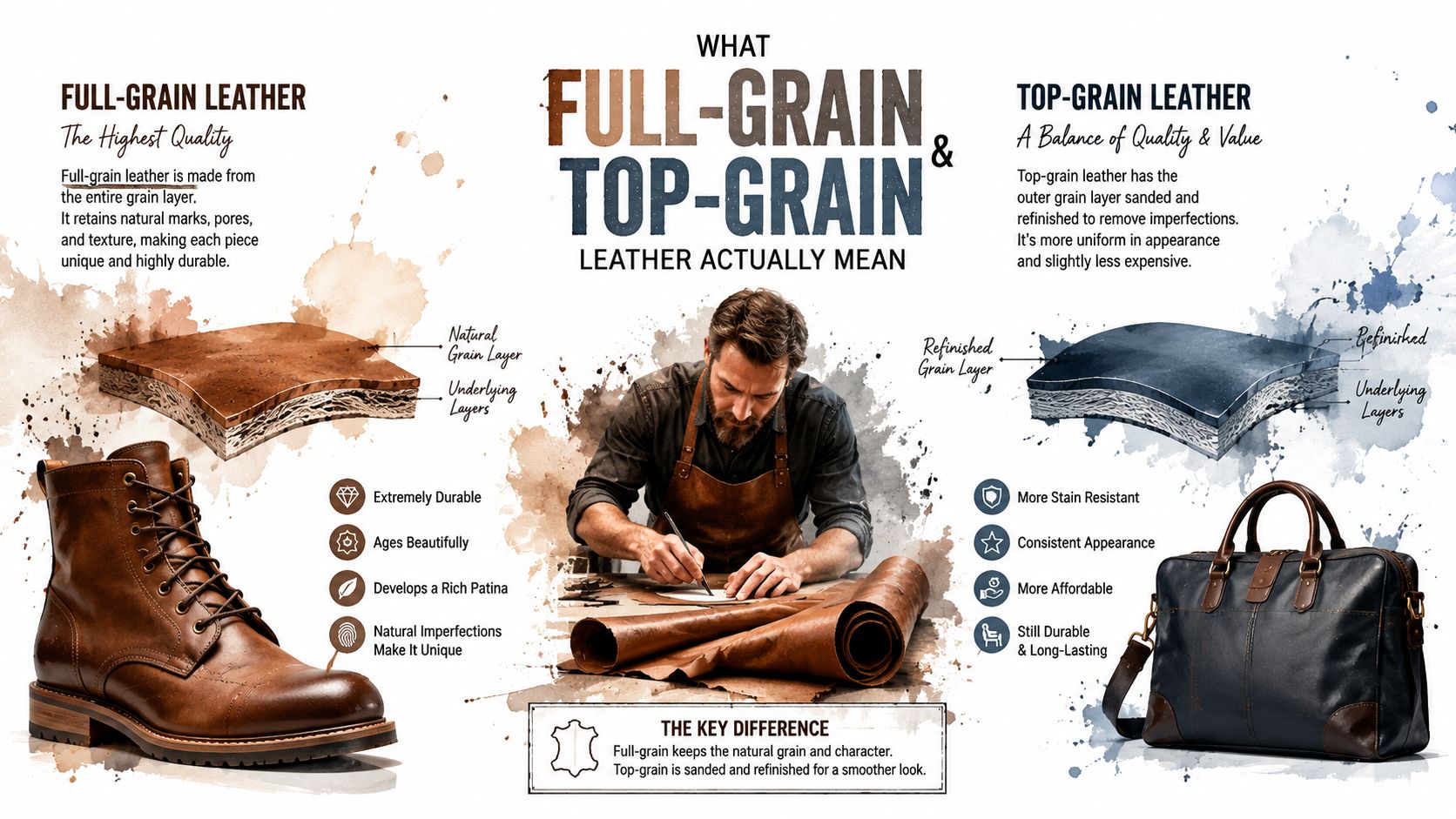
A hide has layers. Its uppermost layer carries the natural grain pattern, pores, and dense fiber structure that give leather much of its strength and visual identity. Full-grain and top-grain describe how the tannery treats that layer before it becomes upholstery.
Start with the broad category
Top-grain leather comes from the hide's top grain layer. The surface may remain nearly intact, or it may receive sanding, buffing, embossing, and finishing to reduce blemishes. Top-grain is therefore a broad category, not one uniform product.
Full-grain leather is the unsanded form within that category. Hair is removed, while the natural grain stays intact. Pores, small marks, and color variation remain visible because the tannery has not removed them to create a perfectly consistent face. Grainmark Leather uses full grain as an example of the intact-grain approach.
Corrected top-grain receives more surface work. The tannery may sand or buff roughly 0.1 to 0.3 millimeters from the outer surface, then apply a finish for more consistent color and texture, as explained in this technical comparison of full-grain and top-grain leather.
Why showroom language causes confusion
Marketing descriptions often use “top-grain” to mean corrected leather, while technical descriptions use it as an umbrella term that includes full-grain. Ask for the actual surface treatment. A proper specification should state whether the leather was sanded, embossed, coated, or left natural.
Ask three direct questions:
- Was the grain surface sanded or buffed?
- Does the finish include a protective coating?
- Will natural marks and color variation remain visible?
These answers matter more than the grade word alone. A leather grades explained guide can help you compare upholstery samples and manufacturer specifications before ordering.
Durability and Aging Compared Side by Side
Full-grain leather has the stronger structural story because it preserves the dense outer fiber network. A technical comparison reports tensile strength of 25 to 35 N/mm² for full-grain versus 18 to 28 N/mm² for top-grain, tear strength of 40 to 80 N/mm versus 30 to 60 N/mm, and flex endurance above 100,000 cycles versus 60,000 to 80,000 cycles for top-grain according to this industry technical table.
Those benchmarks don't tell the whole furniture story. Upholstery design, frame construction, cushion quality, seam work, sunlight, and care can matter just as much in the home. Still, the intact grain gives full-grain a meaningful advantage for owners planning long service.
The practical comparison
| Performance Factor | Full-Grain Leather | Corrected Top-Grain Leather |
|---|---|---|
| Structural durability | Retains the original grain and dense outer fibers, supporting strong long-term performance | Remains durable, but surface correction removes part of the intact grain layer |
| Breathability | More open natural surface, with better pore retention | Protective finish seals more of the pores and can reduce breathability |
| Aging | Develops a visible patina and gains individual character | Stays more uniform and develops less natural character |
| Immediate stain resistance | More vulnerable to spills and moisture because the surface is less sealed | Protective finish offers better initial resistance and easier cleanup |
| Visual consistency | Natural marks and variation remain visible | More even color, texture, and appearance |
A white wine spill on a full-grain sofa needs prompt attention. The open surface can absorb liquid and leave a mark if the spill sits. Corrected top-grain generally gives the household more time because its finish provides a barrier, although no upholstery should be treated as indestructible.
A sun-drenched reading chair presents a different concern. Full-grain can age beautifully, but the owner must accept evolving color and monitor placement. Corrected top-grain better preserves a consistent initial appearance, though finish quality and room conditions still matter.
For a daily-use family sectional, corrected top-grain often wins on convenience. For an investment chair or heirloom sofa, full-grain usually wins on depth, touch, and aging potential. Sources consistently describe full-grain as developing a patina, while top-grain's sanded and coated surface produces less visible character over time, as outlined in this comparison of leather aging.
Understanding the Cost Difference
Full-grain furniture commands a higher price because attractive hides with minimal surface correction are harder to select, and they yield fewer uniform panels. Natural markings remain visible, so manufacturers must plan cuts around them instead of sanding defects away. Top-grain leather, as the broader category, may be corrected to reduce visible blemishes. That expands the usable surface, improves production efficiency, and can lower material cost.
Market positioning reflects the difference. One industry report values the full-grain leather market at USD 17.69 billion in 2023, USD 19.08 billion in 2024, and projects USD 30.23 billion by 2030, representing a 7.95% CAGR in its full-grain leather market outlook. The same report estimates that full-grain represented 38.2% of global leather revenue in 2025, compared with 28.6% for top-grain, and places the full-grain retail premium at 20 to 35% over top-grain.
Why simple furniture price tables mislead
Furniture price ranges, replacement timelines, and annual ownership calculations cannot be generalized responsibly without a verified product, construction specification, and care history. Leather grade is only one part of the price. Frame joinery, suspension, cushioning, tailoring, scale, and warranty terms can change the value substantially.
A decision table is more useful when it focuses on the trade-off:
| Furniture Type | Top-Grain Positioning | Full-Grain Positioning | Main Value Question |
|---|---|---|---|
| Accent chair | Practical uniform finish for occasional or moderate use | Character-rich investment piece for long ownership | Does the room benefit more from consistency or patina? |
| Sofa | Balanced option when maintenance and visual control matter | Premium choice when natural aging and longevity lead | Will daily use justify the premium surface? |
| Sectional | Strong fit for households seeking a coordinated appearance | Strong fit for buyers planning a durable centerpiece | Can the household accept natural variation across a larger surface? |
A lower initial price is not automatically the better deal. Poor construction can disappoint at any leather grade, while a well-built top-grain sectional can deliver strong long-term value. Use purchase price divided by useful years as the starting calculation, then base useful years on the actual construction, expected treatment, and care routine. Do not rely on an invented lifespan.
Read “genuine leather” labels carefully. The phrase confirms leather content, not a premium surface or a particular grain-preservation process. A transparent specification should identify the leather grade, finish, tannery information, and upholstery construction. That information matters more than a dramatic label or a simple price comparison.
Which Leather Fits Your Household and Lifestyle
A household with young children, pets, and a heavily used family room usually needs forgiveness before character. Corrected top-grain leather offers a more consistent surface and stronger initial resistance to spills because the protective finish seals more of the exposed pores. That doesn't eliminate care, but it can make the first response to a dropped cup or muddy paw less stressful.
Full-grain is less forgiving in that moment. Its natural surface can absorb moisture, and claws or sharp objects may leave visible marks. Those marks aren't necessarily failures. They become part of the material's story, but a household that wants every surface to remain visually controlled may find them frustrating.
Three common room decisions
The active family sectional: Protected top-grain is the practical recommendation. It supports a uniform room design and reduces the urgency around everyday spills.
The formal living room: Full-grain deserves consideration here. Lighter use gives the surface room to develop depth, and natural variation can complement a room built around investment pieces.
The home office or reading chair: Full-grain works well when the owner values touch, breathability, and visible aging. Corrected top-grain suits an office that requires a polished, consistent appearance with less hands-on maintenance.
A couple without children or pets may reasonably choose full-grain for a buy-it-for-life centerpiece. A growing family planning a future redesign may choose top-grain because the immediate priorities are durability, coordination, and practical upkeep rather than heirloom aging.
Climate and placement still matter
Full-grain breathes better because more of the natural pore structure remains open. That can improve comfort in humid conditions or during extended contact. In a bright room, corrected top-grain may better preserve a consistent finished appearance, but placement and direct sunlight still deserve attention.
Households concerned about cat scratching should address behavior and placement as well as leather grade. Giorgi Bros. provides practical guidance on how to stop cats scratching leather furniture.
The decision can stay simple:
- Choose corrected top-grain for low maintenance, uniformity, and active rooms.
- Choose full-grain for natural authenticity, breathability, visible patina, and long ownership.
- Ask for the actual finish specification before treating either label as a guarantee.
Sustainability and Tanning Methods That Matter
Leather grade does not determine environmental impact by itself. Tanning chemistry, tannery controls, material yield, and product longevity all matter. Full-grain retains more of the hide's natural surface and can support long ownership. Corrected top-grain can improve usable hide yield by working around or removing visible blemishes.
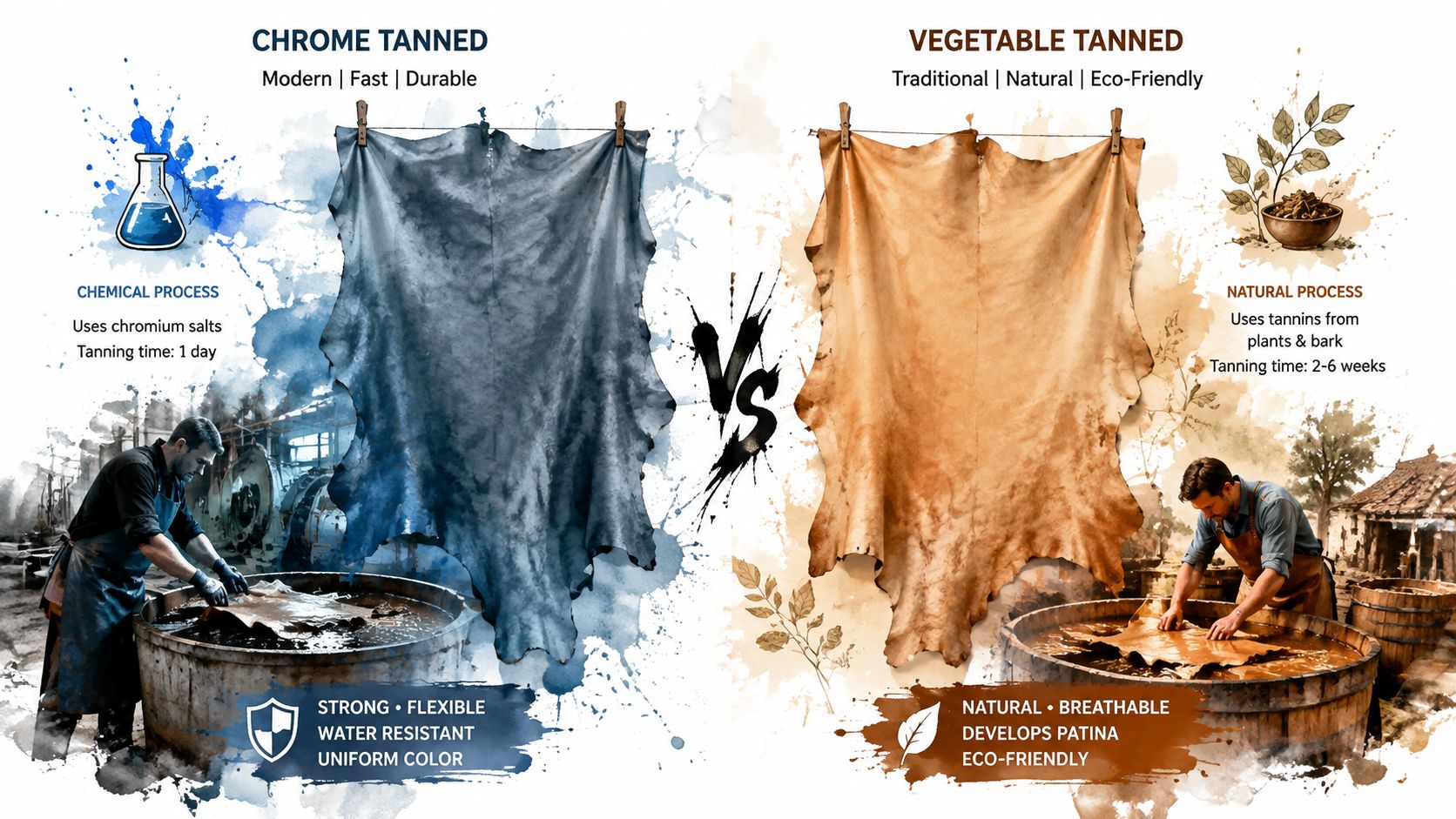
Chrome tanning dominates the industry, with estimates ranging from 64.3% to 78% of the tanning market, depending on the methodology in its leather tanning market analysis. Chrome systems remain common because they are efficient and consistent. Vegetable tanning uses natural tannins and follows a slower, traditional process. Neither method determines the leather grade. Both can produce full-grain or top-grain leather, so ask about the tanning method separately.
Longevity changes the sustainability equation
A durable sofa kept in service for decades can reduce replacement waste. Full-grain does not own that advantage. A well-made top-grain piece that stays comfortable, attractive, and structurally sound may serve a household better than poorly made full-grain furniture replaced early.
The chemistry deserves attention, too. A novel metal-free tanning system showed 18.4% lower environmental impacts than chrome-based tanning. A 2025 study also described vacuum-operated chromium tanning as a promising way to improve chromium tanning sustainability, as summarized in the tanning market analysis cited above.
A responsible purchase asks two questions at once: how was the leather made, and how long will the finished furniture stay in service?
Ask about tannery sourcing, chrome-free or metal-free options, wastewater controls, and recognized environmental certifications. Leather Working Group ratings and REACH compliance can organize those questions, but transparency matters more than a broad label. A retailer should explain the leather's finish, origin, and tanning process clearly.
For Bay Area homeowners evaluating sustainable furniture materials, Giorgi Bros. Furniture provides additional guidance. The practical rule is straightforward. Buying fewer, better-made pieces and keeping them longer is the most reliable sustainability strategy.
Care and Maintenance for Long-Lasting Leather
Surface treatment determines the care routine. Corrected top-grain usually needs regular dusting and occasional wiping with a slightly damp cloth because its finish provides more protection against routine spills. Full-grain needs closer attention because its more open surface can dry out, absorb moisture, and show marks more readily.
A sensible schedule looks like this:
- Full-grain: Dust regularly and condition about quarterly with a product approved for the specific finish.
- Top-grain: Dust regularly and condition about twice a year, unless the manufacturer specifies another schedule.
- Both types: Test any cleaner in an unseen area and follow the upholstery maker's instructions.
Match the response to the problem
Ink, pet accidents, and food spills need prompt treatment. Blot rather than scrub, because aggressive rubbing can spread the mark or disturb the finish. A pH-balanced leather cleaner is safer than household solvents, bleach, abrasive products, or harsh degreasers that strip oils and alter color.
Sun exposure deserves prevention rather than repair. Keep leather away from prolonged direct rays where possible, rotate movable pieces, and avoid placing a single chair in the brightest patch of the room. Conditioning can't reverse every form of drying or fading.
For general seat-care principles, The Mobile Buff seat care tips offer a useful reference for gentle cleaning and stain response. Furniture upholstery can have different finishes, so the manufacturer's care sheet remains the final authority.
Giorgi Bros. also provides professional upholstery cleaning services when routine maintenance isn't enough. Proper care doesn't make the grades identical. It does help both materials deliver the comfort and service their construction can support.
Making Your Final Leather Furniture Decision
The clearest recommendation is use-case driven.
Choose full-grain leather when the buyer wants a natural, premium surface that can develop a distinctive patina and support a buy-it-for-life mindset. It makes the most sense for investment pieces, formal rooms, reading chairs, and households prepared to accept visible variation and provide regular care.
Choose corrected top-grain leather when the household needs a consistent appearance, easier initial maintenance, and better immediate resistance to everyday spills. It suits busy family rooms, coordinated sectionals, first leather purchases, and spaces where the owner prefers controlled aging over dramatic surface change.
Neither grade can rescue weak construction. A lasting furniture decision also requires attention to the frame, suspension, cushions, stitching, leather specification, and repair support. The buyer should sit in the piece, inspect the grain under natural light, compare sample finishes, and ask what the surface will look like after years of contact.
A showroom visit matters because leather is tactile. Weight, suppleness, grain variation, and surface temperature become obvious in person, while a product page often reduces the choice to a few words. Giorgi Bros. Furniture operates a 50,000-square-foot, family-owned showroom in South San Francisco, with custom order services for fabrics, leathers, wood species, and finishes. Its non-commission Consultants provide no-pressure guidance, and financing options are available for qualified purchases.
Quality furniture is an investment in comfort, design continuity, and fewer replacements. The right grade isn't the one that wins an online argument. It's the one that keeps working for the household, looks better or stays consistent in the way the owner prefers, and earns its place in the room over time.
Visit the South San Francisco showroom to compare full-grain and top-grain samples by hand, test seating comfort, and discuss custom leather, fabric, wood species, and finish options with a non-commission Design Consultant. Explore Giorgi Bros. Furniture for no-pressure guidance on long-term investment pieces, custom furniture, Amish furniture, and premium mattresses.