
You're probably looking at the same choice many buyers face. One path leads to a flat-packed desk with a photo that looks good online, a chair that feels acceptable for ten minutes, and a price tag that seems easy to justify. The other path costs more up front, asks a few more questions, and usually takes more thought. That second path is where american made office furniture earns its place.
Most offices, whether at home or in a business setting, don't fail all at once. They wear out in small, annoying ways. Drawers start sticking. Veneers chip at the corners. Work surfaces wobble. Chair adjustments stop holding. After a while, the piece that looked like a bargain becomes one more replacement job.
Families in the Bay Area have been making that calculation for a long time. Since 1933, our South San Francisco showroom has helped people look past the quickest purchase and toward the better one for long-term use. That mindset still matters. Good furniture isn't just something you buy to get through the quarter. It's something you live with every day.
Beyond the Disposable Desk An Introduction
A home office often starts with urgency. You need a desk by next week. You need storage that fits today's equipment. You need a chair that doesn't leave you sore by midafternoon. In that rush, it's easy to buy what's available instead of what's durable.
That's how disposable furniture keeps winning. It promises speed and low upfront cost, but it rarely rewards either over time. Office furniture takes daily abuse. You slide in and out of a chair, lean on edges, open drawers, drag pieces during a layout change, and expect the whole setup to keep working.
American made office furniture answers a different question. It asks what will still be useful years from now.
Buy-it-for-life thinking works especially well in an office because the furniture gets touched, adjusted, and stressed every single day.
There's also a practical comfort in buying from makers and dealers who still treat furniture like a product with a service life, not a temporary convenience. That usually shows up in material quality, replacement parts, documentation, and customization options.
Three things tend to separate lasting office furniture from throwaway office furniture:
- Construction that can handle repetition. Desks and chairs need to survive constant use, not just occasional styling photos.
- Design that fits real people. Furniture has to support posture, reach, and movement, not just floor-plan aesthetics.
- A path after the sale. If a finish needs touch-up or a component needs replacement, you want options besides disposal.
For buyers who care about sustainability, this matters even more. The greenest desk is often the one you don't have to replace.
The Enduring Value of American Made Office Furniture
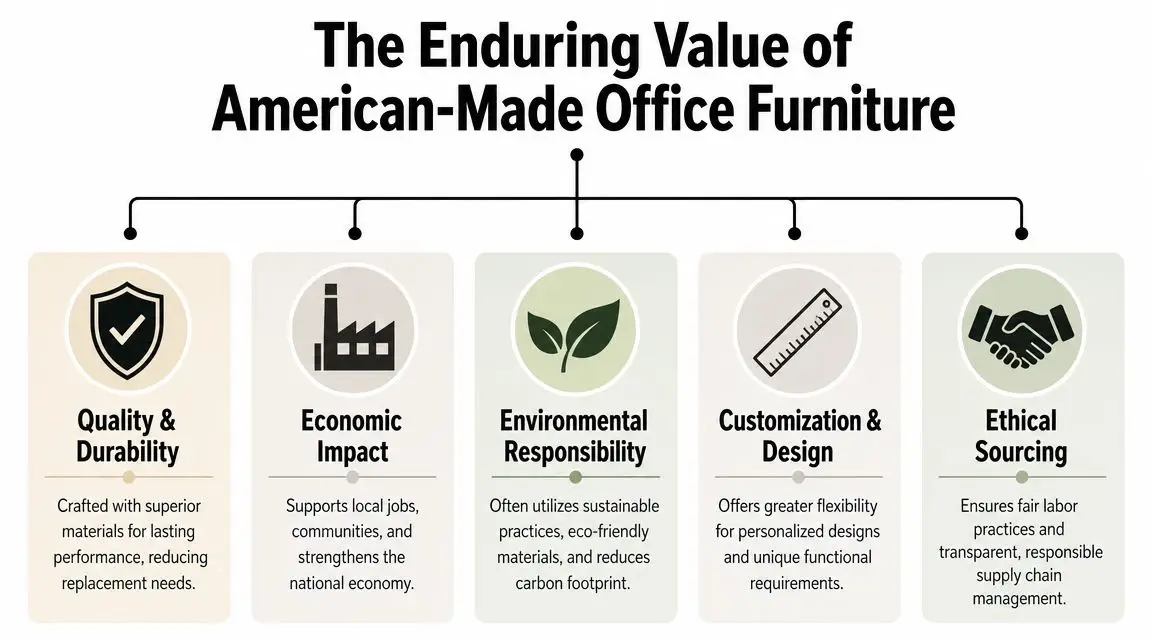
American made office furniture isn't valuable because of a label alone. It's valuable when the domestic supply base supports better build quality, clearer specifications, and customization that solves real workplace problems.
The scale behind it is bigger than many people realize. IndustrySelect reports that the United States has over 5,600 furniture manufacturers and nearly 270,000 workers in the sector, with strong concentration in the South and Midwest, which supports a deep manufacturing and supplier network for furnishings (IndustrySelect furniture manufacturing data).
Why domestic production changes the buying experience
A broad U.S. manufacturing base usually gives buyers more than patriotic satisfaction. It often creates better access to samples, finish options, spec sheets, and replacement components. When a company manufactures closer to its dealer network, questions get answered faster and custom work is easier to discuss in practical terms.
That matters for both homeowners and businesses. A compact home office may need a narrower writing desk in a specific wood species. A commercial buyer may need coordinated desks, seating, and storage that align with brand standards and floor plans. Domestic makers are often better positioned to handle those details.
If you're comparing brands, it helps to review a curated set of American-made furniture brands instead of relying on generic marketplace listings.
What works and what doesn't
Some benefits are dependable. Others get overstated.
What works well
- Customization with accountability. You can often choose dimensions, finishes, and materials with more clarity about what's being built.
- Better long-term support. Parts, touch-up materials, and service information are often easier to obtain.
- Stronger connection between design and production. The people specifying the piece usually have a clearer line to the people making it.
What doesn't automatically come with the label
- Perfect quality in every case. Domestic production is not a guarantee of excellence. Poor design can still be poor design.
- Fast delivery on every custom order. Made-to-order work takes planning.
- Better value if the piece is wrong for the user. A beautifully built desk that doesn't fit the room or workflow is still a mistake.
The label gets your attention. The specifications, construction, and fit should make the final decision.
For many buyers, the benefit is confidence. You're not just ordering an object. You're buying into a manufacturing system that is large enough, documented enough, and skilled enough to support the product after it arrives.
Decoding Quality Construction and Materials
The quickest way to judge office furniture is often the least useful. Color, style, and price tell you very little about how a piece will behave after daily use. Construction tells you much more.

What to inspect on a desk or credenza
Start with the case itself. Look at the back panel, the underside of the top, the drawer boxes, and the hardware attachment points. These are the places where shortcuts usually show up first.
A useful in-person checklist looks like this:
- Drawer joinery. Dovetail joinery generally signals a higher level of craftsmanship than simple stapled or lightly fastened drawer construction.
- Surface honesty. Veneers are not automatically bad, but thin decorative skins over weak substrates tend to age poorly under office use.
- Hardware feel. Slides, hinges, pulls, and locks should feel stable and repeatable, not loose or scratchy.
- Edge durability. Corners and edges take the most abuse, so they reveal a lot about long-term performance.
Amish Furniture is a good reference point because it often reflects a straightforward commitment to joinery, solid wood, and careful finishing. Buyers looking for Custom Furniture usually notice the difference immediately when they open a drawer or run a hand across a top.
For anyone trying to compare product pages more intelligently, this guide on how to read furniture product descriptions and buy with confidence helps separate meaningful specifications from decorative marketing language.
Why ergonomics matter as much as materials
Office furniture isn't successful just because it's sturdy. It has to fit the body.
Reputable American-made office furniture often aligns with BIFMA G1 ergonomic guidelines, which are designed to fit users from the 5th percentile female to the 95th percentile male of the North American population, a practical range that helps support posture and reduce strain during the workday (Knoll ergonomic standards summary).
That matters in real use. If a desk is too high, users raise their shoulders or compensate with wrist angle. If a chair seat is too deep, people perch forward and lose back support. If armrests don't adjust appropriately, tension creeps into the neck and upper back.
A well-built office chair that doesn't fit the user is still the wrong chair.
Materials that age well and materials that don't
Not every office needs solid wood everywhere. Some of the best workspaces mix hardwood desks, durable laminate surfaces, metal bases, and upholstered seating. The question isn't whether one material is always superior. The question is whether each material is used properly and appropriately.
A short comparison helps:
| Material choice | Usually works best when | Watch out for |
|---|---|---|
| Solid wood | You want repairability, refinishing potential, and warmth | Movement from poor construction or low-quality finishing |
| Quality veneer | You want stability on large panels with a refined look | Thin decorative layers over weak cores |
| Metal frames | You need rigidity and frequent use performance | Flex at connection points |
| High-performance upholstery | You need daily comfort and easier maintenance | Cheap foam or fabrics that flatten quickly |
Good office furniture should feel settled. Drawers should close cleanly. Tops should feel substantial. Chair controls should operate without guesswork. Those clues matter more than trendy styling.
The Power of Customization for Your Workspace
Customization is where american made office furniture often pulls away from generic imports. Many buyers hear “custom” and think it only means fabric color. In practice, real customization can go much further.
American manufacturers such as DARRAN, along with Amish woodworkers, are known for deep tailoring in dimensions and function, not just finish choices, across desks, workstations, and storage. That made-to-order approach gives buyers options that mass-produced imports often can't match, especially for hybrid workspaces with unusual spatial needs (ALA Desk vendor overview).
The kinds of customization that actually matter
The most useful custom changes are usually practical, not decorative.
A desk might need a shallower depth so it fits a spare bedroom without crowding circulation. A file cabinet may need to coordinate with a built-in wall color. A workstation might need cable access in a specific location because of how the room is wired. These aren't luxury add-ons. They're the difference between furniture that fits and furniture that merely occupies space.
Common high-value custom options include:
- Dimensions. Width, depth, and height changes can rescue difficult floor plans.
- Wood species and finish. Oak, cherry, maple, and other species each age differently and carry light in different ways.
- Function details. Keyboard trays, printer storage, file configurations, and wire management shape daily use.
- Upholstery choices. High-performance fabrics and top-grain leathers help match wear needs and design goals.
Customization for home offices and business settings
Home-office buyers often need one piece to do several jobs. It has to support focused work, look appropriate in a guest room or living area, and hold up for years. Commercial buyers have a different challenge. They need consistency across multiple spaces while still adapting to team needs.
That's where design guidance matters. A good consultant asks how you work first. Then they talk about dimensions, posture, storage habits, finish durability, and room flow.
If you want another perspective on made-to-order workspace design, Gibbsonn bespoke office furniture is a useful example of how bespoke office planning can focus on fit and function rather than only appearance.
The best custom piece solves a problem you were otherwise going to keep living with.
A lot of buyers also assume custom means complicated. It doesn't have to. The process usually moves more smoothly when you bring a floor plan, a few room photos, and a list of what frustrates you about your current setup. That turns vague preference into actionable design.
For Bay Area Interior Design projects, it also helps to review a practical framework for how furniture design decisions come together. The right custom order should feel deliberate, not overwhelming.
Calculating the Lifetime Value of Your Investment
Price matters. It always will. But office furniture is one of those categories where the purchase price tells only part of the story.
A cheap desk can look efficient on paper because the invoice is lower. Then the drawers loosen, the top chips, and the piece gets replaced instead of repaired. That cycle is expensive in ways buyers often don't track. It costs money, time, disposal effort, and another round of shopping.
The better way to think about cost
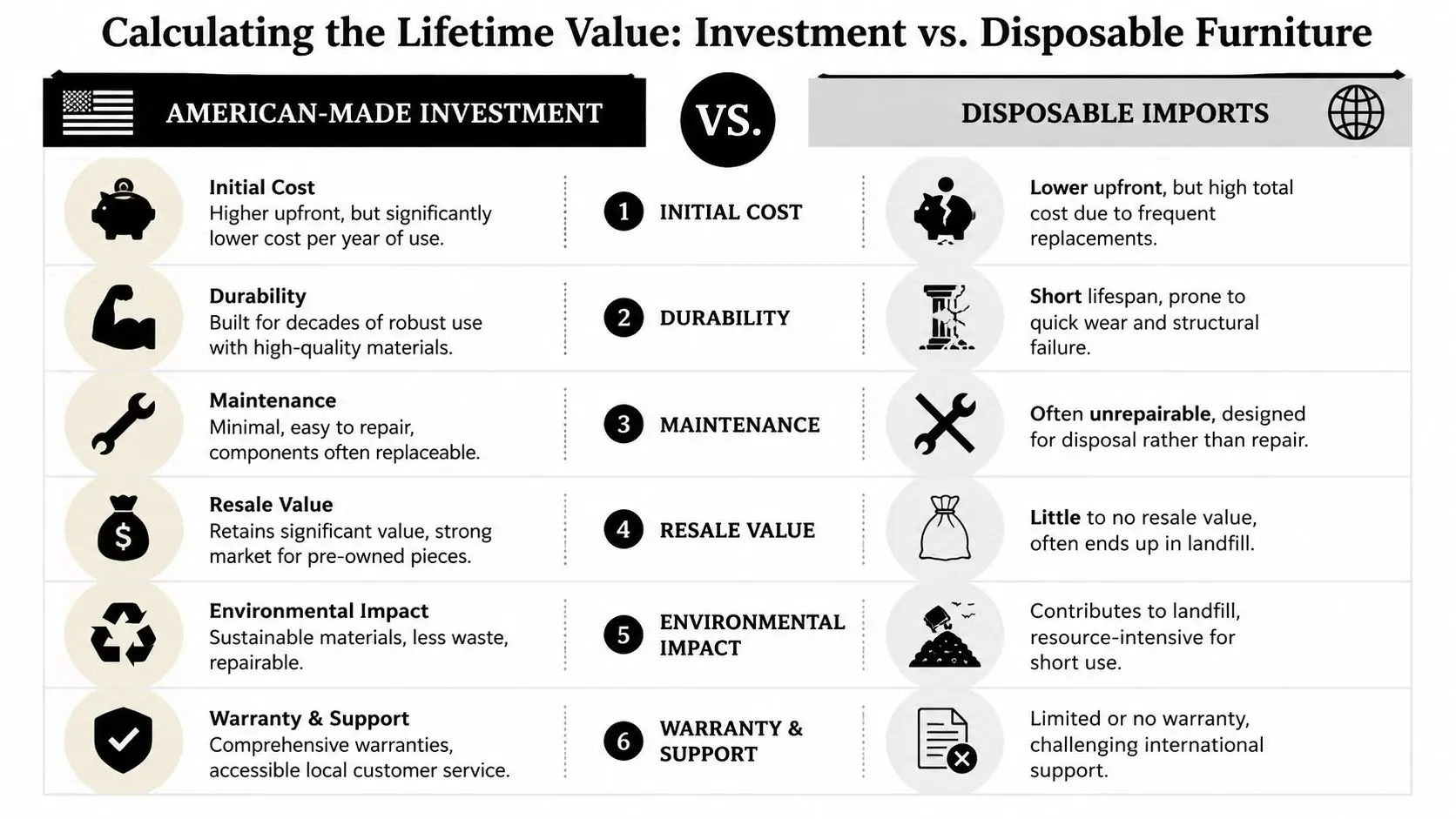
The most useful question isn't “What does this desk cost today?” It's “What will this desk cost me over the years I own it?”
Well-made office furniture often stays in service longer because it can be maintained, repaired, refinished, reupholstered, reused, or reassigned. That changes the economics.
Green Standards highlights the end-of-life potential of office furniture through reuse, resale, donation, relocation, and recycling, which reinforces an important point. Residual value matters, and it's a real part of total cost of ownership even though many buyers ignore it at the start (Green Standards circular office furniture approach).
A practical comparison
Here's how the trade-off usually looks in practice:
| Buying lens | Investment-grade furniture | Disposable furniture |
|---|---|---|
| Service life | Often kept in use much longer | Frequently replaced when wear shows |
| Repair options | More likely to have touch-up, parts, or refinishing paths | Often treated as non-repairable |
| Resale or reuse | More likely to retain value or serve elsewhere | Often has little reuse appeal |
| Waste profile | Supports a buy-it-for-life mindset | Feeds the replace-and-discard cycle |
The environmental side is inseparable from the financial side. A desk that survives one office reconfiguration, then moves to a guest room or another department, has already done more useful work than a piece designed around convenience and disposal.
What buyers often get wrong
The biggest mistake is assuming that all higher-priced furniture is a good investment. It isn't. Some pieces are overpriced styling exercises. The second mistake is assuming low price always means savings. That usually falls apart once replacement becomes routine.
Use this filter instead:
- Can it be serviced?
- Can it be refinished, reupholstered, or repaired?
- Would someone else want it later if your needs change?
- Will it still look appropriate if the room evolves?
If the answer is yes across most of those questions, the higher upfront price often makes more sense. That's the heart of sustainable buying. You keep good things in use.
How to Select the Perfect Pieces at Giorgi Bros
Buying office furniture online can narrow your choices fast, but it can also hide the most important details. You can't test seat tension through a screen. You can't tell whether a wood finish feels rich or flat. You can't hear the difference between sturdy hardware and cheap hardware.
That's why the in-person process still matters, especially for investment pieces.
What to do in the showroom
A strong showroom visit should be hands-on and specific. Sit in the chair long enough to notice pressure points. Open every drawer. Look underneath the desk. Compare wood finishes in natural and interior light if possible.
In South San Francisco, shoppers also benefit from seeing office furniture in the context of whole-home furnishings. That matters because many home offices now live beside bedrooms, guest rooms, or living spaces. The piece needs to function well and belong visually.
A practical visit usually goes best when you bring:
- Room measurements. Basic dimensions prevent costly fit mistakes.
- Photos of the space. Door swings, windows, and flooring all affect the recommendation.
- A work-style list. Laptop only, dual-monitor setup, paper storage, daily video calls, and shared use all change the furniture choice.
Why documentation should be part of the decision
Established domestic brands and contract-market manufacturers often provide stronger technical documentation. The GSA notes that furniture procurement relies on technical documents and standards describing product characteristics and expected performance, which helps buyers compare products with more confidence (GSA furniture specifications and standards).
That kind of transparency is valuable for ordinary buyers too. If a product has clear specification sheets, finish information, and performance details, you can make a better decision and avoid disappointment later.
For local shoppers who want guidance without pressure, free design services at Giorgi Bros outline how a consultant-led process can help with space planning, material selection, and custom ordering. Financing options are available as well, which can make larger office upgrades more manageable.
A good consultant doesn't push you toward the fastest sale. They help you avoid the wrong piece.
For business moves or office transitions, furniture selection often overlaps with logistics and technology planning. If that's part of your project, this practical guide to Boston office IT services shows the kind of coordination companies should think through when relocating workspaces.
One final note on process. A Non-Commission Sales Staff model changes the tone of the experience. It lets buyers ask more questions, test more options, and think longer about custom details. That tends to lead to better decisions.
Begin Your Legacy of Quality Today
American made office furniture makes the most sense when you judge it over years, not weekends. The right piece supports your posture, fits your space, holds up to daily use, and stays useful long after a cheaper option would have been replaced.
That's why quality office furniture belongs in the same category as other lasting household decisions. It's part function, part craftsmanship, and part stewardship. You're buying something that can serve well now and still deserve a place later.
If you're still narrowing choices, this practical resource on how to choose office furniture adds another helpful buying perspective. And when the time comes to complete the project, details like setup matter just as much as selection, especially with white glove delivery options.
Visit Giorgi Bros. Furniture in South San Francisco to see, touch, and test quality office furnishings in person, or book a Design Consultation for no-pressure guidance on Custom Furniture, Amish Furniture, and workspace pieces built for long-term value.