A familiar dining room problem shows up around the same table. On an ordinary weeknight, a family wants enough room for plates, homework, and elbow space without letting a giant table dominate the room. Then a birthday, holiday, or long Sunday lunch comes around, and suddenly that same room needs to welcome more people comfortably.
That's why dining room tables with leaves stored in table designs have stayed relevant for so long. They solve an old problem with a practical piece of furniture. Families get a table that lives modestly most days and opens up when the house fills.
For a family business serving South San Francisco since 1933, this isn't a new conversation. Bay Area homeowners have always asked the same sensible question. How can one table work well every day and still be ready for company? The answer often comes back to a well-made extension table with leaves that stay inside the table itself.
Table of Contents
- The Perfect Table for Every Occasion
- Exploring In-Table Leaf Storage Mechanisms
- The Everyday Benefits of Integrated Leaf Storage
- How to Measure for Your Extendable Table
- Why Mechanism Quality Defines a Lifetime Investment
- Customizing Your Perfect Self-Storing Table
- Experience True Quality at Our Showroom
The Perfect Table for Every Occasion
A good dining table has to do two jobs. It needs to feel right on a quiet Tuesday, and it needs to step up when guests arrive. That balancing act is where many shoppers get stuck. A table sized for entertaining can overwhelm the room every day. A table sized for daily use can leave everyone crowded when the family gathers.
Self-storing leaves solve that tension neatly. The table stays compact when it should, and expands when it needs to. That idea isn't some recent furniture trick. By the 16th century, draw-top tables let owners double the length of the table with leaves that rested beneath the top and slid out on runners, as described in this historical guide to antique tables.
A flexible dining table isn't a novelty. It's one of furniture's oldest practical answers to changing household needs.
That history matters because it reframes the purchase. Buyers aren't choosing a gimmick. They're choosing a form that has stayed useful for centuries because the need never went away. Homes still need furniture that respects floor space while making room for people.
Some shoppers begin with shape before mechanism, and that's often smart. A round or soft-edged form can make a room feel calmer and easier to move through, especially in tighter dining areas. For households considering that route, a circular table with leaf options can be worth a close look, particularly when traffic flow matters as much as seating.
Why this issue keeps coming up
Three real-life patterns tend to drive the decision:
- Daily meals stay small: Most households don't want a permanently oversized table taking over the room.
- Gatherings still matter: Holidays, birthdays, and drop-in dinners call for extra seating without a scramble.
- Storage is limited: Many homes don't have a clean, safe place to keep separate leaves.
That's why dining room tables with leaves stored in table designs continue to earn attention from practical buyers. They answer an everyday problem with a permanent, built-in solution.
Exploring In-Table Leaf Storage Mechanisms
The phrase “leaf stored in the table” sounds simple until someone tries to compare one mechanism to another, a situation that often confuses many buyers. Not every extension table stores its leaf the same way, and the mechanism changes how easy the table is to use, how much it can expand, and which shapes work best.
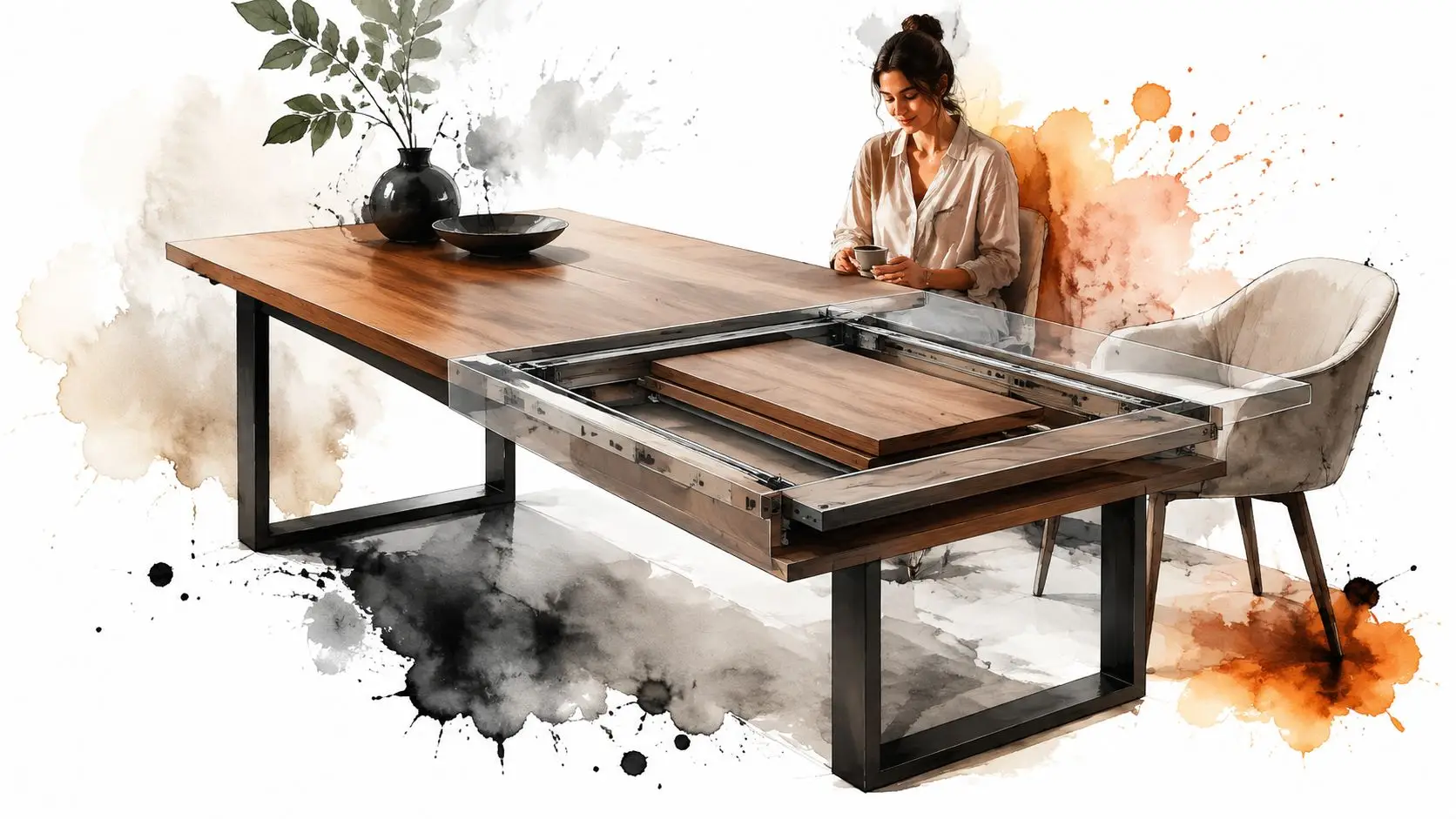
A simple way to think about it is this. Some leaves fold and hide inside the table. Some store flat inside. Others come out completely and must be kept elsewhere. The best choice depends on how often the table will expand and how much handling the household wants to deal with.
The Butterfly Leaf
A butterfly leaf folds in the middle and tucks inside the table when it isn't needed. When the table opens, the folded section lifts, unfolds, and fills the center gap. It works a bit like a hinged panel that lives inside the furniture rather than in a closet.
Furniture guides often describe the butterfly leaf as the most space-efficient self-storage design because it folds inward and stores inside the table. Those same guides also note that 1 to 2 leaves are the typical comfortable range for many tables, while some self-storing designs are limited to four or fewer leaves internally. A useful overview appears in this guide to dining table leaf types.
For households that expand the table often, the butterfly style is appealing because there's less lifting, less carrying, and less chance of setting a leaf down somewhere unsafe.
Center-Storing Leaves
Center-storing leaves also live inside the table, but they don't always fold like a butterfly. In some designs, the table opens and reveals a leaf or leaves stored within the underframe. The idea is still convenient, but the motion can be a little more involved depending on how the table was built.
This style often suits buyers who want the benefit of hidden storage without being tied to one specific folding mechanism. It can also be a sensible match for longer rectangular tables where internal space supports the storage design more easily.
Practical rule: The less a leaf has to be carried around the house, the easier the table will be to live with year after year.
Separate Leaf Storage
Some extension tables don't self-store at all. The leaves are removed completely and stored in another part of the home. That isn't automatically a bad choice. In some rooms, or with some larger extension capacities, separate storage makes structural sense.
Still, separate leaves ask more from the owner. Someone has to remember where they are, protect them from bumps and climate swings, and lift them into place when guests are coming.
Comparison of Leaf Storage Options
| Mechanism Type | How It Works | Best For | Considerations |
|---|---|---|---|
| Butterfly leaf | Leaf folds inward and stores inside the table | Frequent extension, smaller homes, quick setup | Usually tied to limits on how many leaves can self-store |
| Center-storing leaves | Leaf or leaves store inside the table body and are brought into position when opened | Buyers who want hidden storage in a rectangular format | Operation varies by construction and table size |
| Separate leaf storage | Leaves are removed and kept outside the table | Larger extension needs or designs that can't house leaves internally | Requires off-table storage and more handling |
A buyer doesn't need to memorize hardware terms to shop well. The useful question is simpler. How often will the table expand, and how much effort should that process take on an ordinary day?
The Everyday Benefits of Integrated Leaf Storage
The first benefit people notice is convenience. The better benefit is that integrated storage makes the table easier to own for years. A leaf that stays with the table is less likely to be misplaced, nicked along the edges, or forgotten until company is already on the way.
That matters because dining furniture takes wear in small, repeated moments. A separate leaf gets carried through hallways, leaned against walls, slid into closets, and stacked beside household items that were never meant to touch finished wood. A self-storing design cuts out much of that handling.
A major functional advantage is speed. Integrated mechanisms such as butterfly or center-storing designs let a single person open or close the table in seconds, and because the leaf stays part of the table assembly, there's less risk of edge wear and surface damage from repeated handling, as noted in this overview of self-storing extension tables.
Why owners appreciate this after the purchase
The benefits become clearer after the table has been in the home for a while:
- Less setup stress: One person can often manage the change without waiting for help.
- Better protection: The leaf stays inside the table instead of being carried to a garage, closet, or spare room.
- More frequent use: When expansion is easy, households are more likely to use the feature instead of avoiding it.
That last point often surprises shoppers. A difficult extension mechanism may look fine on the showroom floor, but at home it can turn into a feature no one wants to bother with. A smooth integrated system invites actual use.
A smarter fit for active dining rooms
In homes where the dining room gets regular use, mechanism simplicity matters as much as appearance. A table might host dinner one night, homework the next, and weekend guests after that. In that kind of setting, a self-storing design supports daily life instead of interrupting it.
For buyers pulling together a full room, it also helps to think beyond the table alone. A coordinated dining room set with buffet options can improve storage, serving flow, and how the room handles larger gatherings.
A feature is only valuable if the household actually uses it. Easy extension turns good design into everyday function.
How to Measure for Your Extendable Table
A beautiful table can still be the wrong purchase if it doesn't fit the room in both positions. That's one of the most common mistakes with extension dining furniture. Buyers measure for the closed size, then forget that the table needs to work when fully opened, with chairs occupied and people moving around it.
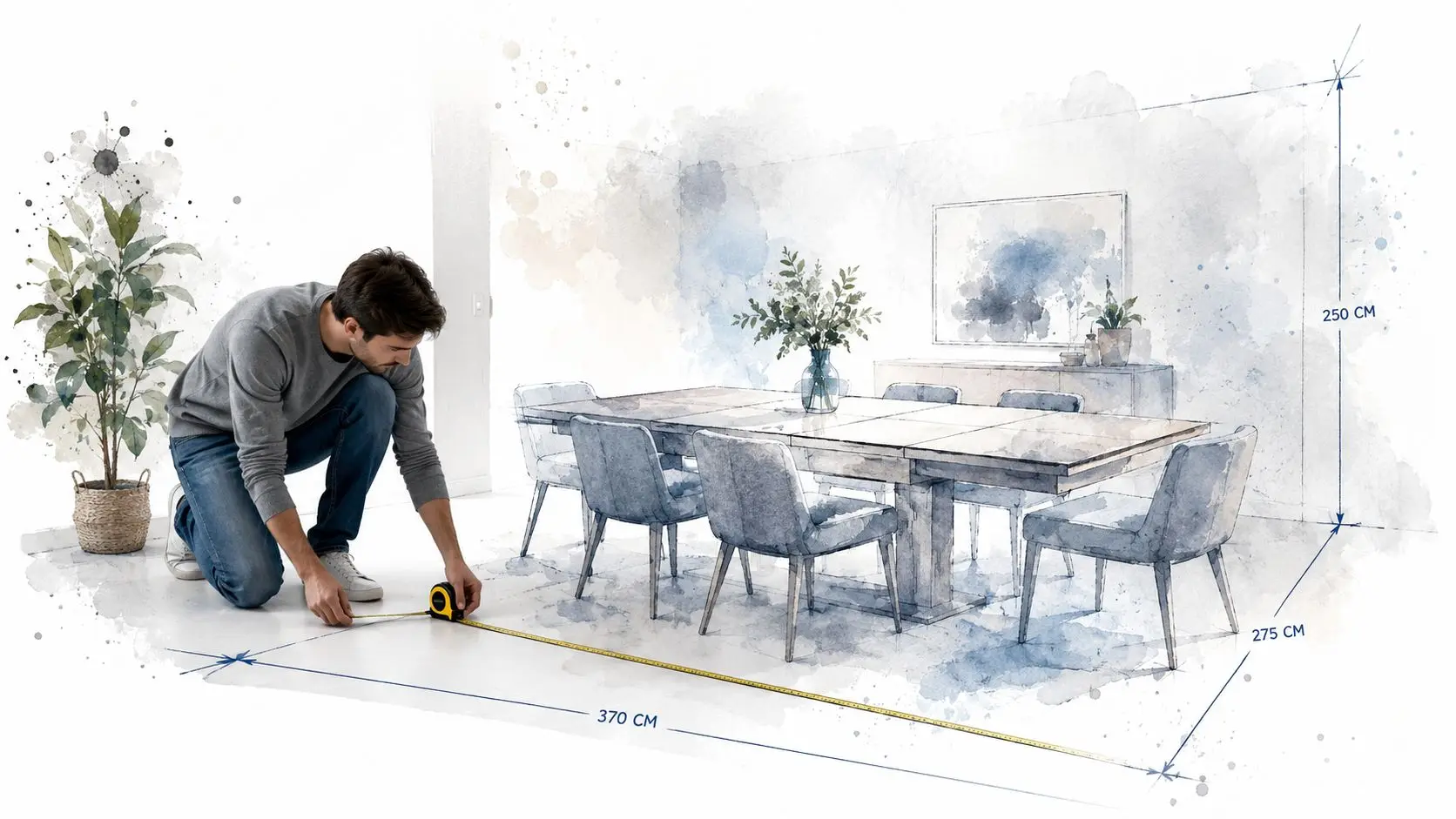
Measure the Room in Two States
The easiest approach is to think of the room as having two valid layouts. One is the everyday setup. The other is the hosting setup.
A clear measuring routine usually works best:
- Mark the closed table footprint: Use painter's tape on the floor to outline the table at its everyday size.
- Mark the extended size too: Add the full extension length so the household can see what changes when guests come over.
- Pull chairs out in real space: Don't measure the tabletop alone. Account for occupied chairs and walking paths.
Many shoppers also want to know how table size affects leaf storage. The answer is mechanical as much as aesthetic. A table's ability to self-store leaves is tied directly to its dimensions. For example, a 48×72-inch table might store four 12-inch leaves and extend to 120 inches, while a smaller 42×66-inch table may store only one or two leaves. This same geometry is why most round and square tables generally can't self-store leaves at all, according to this explanation of self-storing leaf capacity.
Understand Shape Limits Before Buying
A common misconception among buyers is that any extendable table can also hide all of its leaves. In reality, the table has to contain that hardware and those leaf panels within its own body. That takes space.
Rectangular tables usually offer the most flexibility because their shape gives the mechanism more room to work with. Round and square tables can be lovely, but shoppers should go into that category knowing the storage options may be narrower.
For households working with compact rooms, it often helps to compare dimensions carefully before falling in love with a style. A guide to the best dining room tables for small spaces can help narrow the field before a visit to the showroom.
Measure for the largest version of the table, not just the prettiest version of it.
A well-sized extension table should feel calm when closed and comfortable when open. If either state feels compromised on paper, it will feel even more compromised in the room.
Why Mechanism Quality Defines a Lifetime Investment
Two tables can look similar from across a room and perform very differently over time. The difference often sits underneath the top, hidden in the extension hardware, the way the leaves align, and the strength of the structure that supports movement. That's why mechanism quality deserves as much attention as wood species or finish color.
A weak mechanism asks the table to do a hard job with too little support. The result can be sticking, sagging, alignment issues, or a top that stops feeling solid when extended. A good mechanism does the opposite. It helps the table open smoothly, close neatly, and remain dependable through years of use.
A Good Mechanism Protects the Whole Table
Self-storage sounds convenient, but it also introduces design limits. Many solid hardwood makers note that self-storage is generally available only on tables with four or fewer leaves, while tables designed for five or more leaves require a different structure that can't accommodate internal storage. That practical limit is outlined in this discussion of self-store options for solid hardwood dining tables.
That detail tells a buyer something important. More extension capacity isn't always better if it asks the table to compromise the way it's built. Long-term value usually comes from balance. The table should extend enough for real needs without overcomplicating the structure.
Solid Wood Construction Changes the Decision
When a household wants a buy-it-for-life piece, the conversation should include materials, joinery, glide quality, and how the table feels when opened. A self-storing feature in a lightly built table won't offer the same long-term confidence as one housed in solid hardwood with a sturdy underframe.
This is also where Custom Furniture and Amish Furniture enter the discussion in a useful way. Buyers often have the option to choose a table built with durable wood species and a mechanism suited to the table's size, not just its showroom appearance. That can mean fewer compromises and a better fit for the room and the household's habits.
For anyone weighing surface beauty against structural quality, this comparison of solid wood vs veneer helps clarify what changes over time and what tends to hold up.
A no-pressure buying environment matters here too. With Non-Commission Sales Staff, the conversation can stay focused on how the mechanism feels, how often the leaf will be used, and whether the table is being chosen for a few years or for decades.
Customizing Your Perfect Self-Storing Table
The best self-storing table isn't always the one sitting on the floor exactly as shown. Many buyers need a different wood tone, a different leg style, or a size adjusted to fit the room properly. That's where customization becomes practical, not decorative.
In Furniture South San Francisco showrooms, shoppers often arrive with a rough idea of style and leave with a much clearer plan built around daily use. The smartest custom choices usually start with how the table will live in the room, then move to finish and details after that.
Start With Daily Life, Not the Holiday Crowd
A custom order works best when the household chooses the closed size first. The table should suit breakfast, work-from-home afternoons, and ordinary dinners before it's asked to host a larger gathering.
Useful customization decisions often include:
- Wood species: Oak, cherry, maple, and other hardwoods each bring a different grain character and overall feel.
- Finish selection: A stain or paint choice can connect the table to existing cabinetry, flooring, or nearby case pieces.
- Base style: Legs, pedestals, and trestles affect both appearance and how chairs fit around the table.
Some buyers also want guidance on how leg placement changes comfort. A close look at different dining room table legs can help clarify why two tables with the same top size may seat people differently.
Choose Details That Age Well
The strongest custom dining rooms don't chase a short-term look. They choose proportion, materials, and finishes that still feel appropriate years later. That's part of what makes a dining table an investment piece rather than a temporary purchase.
For Bay Area Interior Design projects, customization also helps solve practical issues that ready-made options often miss. The room may need a narrower width, a softer finish color, or a mechanism paired with a more traditional or more contemporary silhouette. Giorgi Bros. Furniture offers custom-order dining options with extension and leaf-storage features, along with choices in wood species and finishes, which gives buyers one factual path to tailor a table around those needs.
A well-customized self-storing table doesn't just fit the room. It fits the household's routines, taste, and timeline.
Experience True Quality at Our Showroom
Some furniture choices are hard to judge on a screen. Extension mechanisms are one of them. A buyer can read about glide quality, alignment, and construction, but the difference becomes much clearer when the table is opened by hand, closed again, and viewed from underneath.
That's why an in-person visit matters. In South San Francisco, shoppers can walk a 50,000-square-foot showroom, compare different extension styles, and feel the difference between a table that merely extends and one that does so with confidence. They can also explore matching dining pieces, Premium Mattresses, and other whole-home furnishings in one stop.
What to do during a showroom visit
A productive visit doesn't need to feel rushed. A good approach is to:
- Test the mechanism: Open and close the table. Watch how the halves separate and how the leaf settles into place.
- Check stability: Rest hands on the extended top and see whether it feels solid.
- Ask about custom options: Review wood species, finishes, and dimensions that better suit the room.
- Discuss practical support: Delivery details, setup, and whether financing options are available can all be covered in one conversation.
The advantage of working with non-commission Design Experts is simple. The discussion stays centered on fit, function, and long-term value instead of pressure. That kind of guidance helps buyers make calmer, smarter decisions about furniture they expect to live with for many years.
For anyone ready to compare dining room tables with leaves stored in table designs in person, Giorgi Bros. Furniture welcomes visitors to the South San Francisco showroom for a no-pressure experience. Bay Area shoppers can test extension mechanisms firsthand, explore Custom Furniture options in wood species and finishes, and speak with Design Experts about room planning, delivery, and financing. A complimentary Design Consultation is also available for those who want help shaping a full dining room plan before making an investment.