The rug looks right with the chairs tucked in. Then someone pulls back to sit, a rear leg drops onto the bare floor, and the chair catches when pushed forward. That's usually a sizing problem, not a reason to give up on a dining rug.
A useful dining table rug size guide starts with where the chairs travel and where people walk. For Bay Area homes, especially open-plan rooms with shared dining and living space, both matter more than the tabletop alone.
Dining Table Rug Sizes by Table Size
For a 60-by-36-inch table, a rug measuring about 108–120 inches long by 84–96 inches wide leaves 24–30 inches beyond each edge. An 8-by-10-foot rug is a practical minimum; a 9-by-12-foot rug offers more room. The extra 24 to 30 inches is working space for chairs as diners sit down and stand up.
Rug Size by Dining Table Size
The calculated ranges below add 48–60 inches to each table dimension. Practical formats round those measurements to familiar rug sizes, so some options provide more clearance than the calculation requires.
| Table size | Calculated rug size | Practical rug format |
|---|---|---|
| 60 by 36 in rectangle | 108–120 by 84–96 in | 8 by 10 ft minimum, 9 by 12 ft comfortable |
| 72 by 42 in rectangle | 120–132 by 90–102 in | 9 by 12 ft preferred |
| 84 by 42 in rectangle | 132–144 by 90–102 in | 9 by 12 ft |
| 96 by 42 in rectangle | 144–156 by 90–102 in | 10 by 14 ft or larger |
| 42 in round | 90–102 in diameter | 8 by 8 ft to 9 by 9 ft round |
| 48 in round | 96–108 in diameter | 8 by 8 ft to 9 by 9 ft round |
- Square tables: A 48-inch square table calls for a 96–108-inch square rug, or 8 by 8 feet through 9 by 9 feet.
- Oval and extending tables: Use an oval's overall length and width as you would for a rectangle. Measure the table with any extension leaves in place for meals when extra chairs will be used.
For round rugs, the listed size is the diameter. For rectangular rugs, align the long side with the table's length unless the room layout calls for another arrangement.
Practical rule: Choose for the dining set in use, not the dining set neatly pushed in.
Use the closest table dimensions as a starting point, then account for chair depth before choosing a size. These area rug placement guidelines can also help you position the rug in relation to the surrounding furniture.
How to Measure Chairs and Clearance Before You Buy
A chair can fit beneath the table and still slide off the rug when someone stands. Measure the chairs in use, then check the planned rug footprint on the floor.
Use a tape measure and painter's tape. Record actual dimensions rather than estimating from a product photograph.
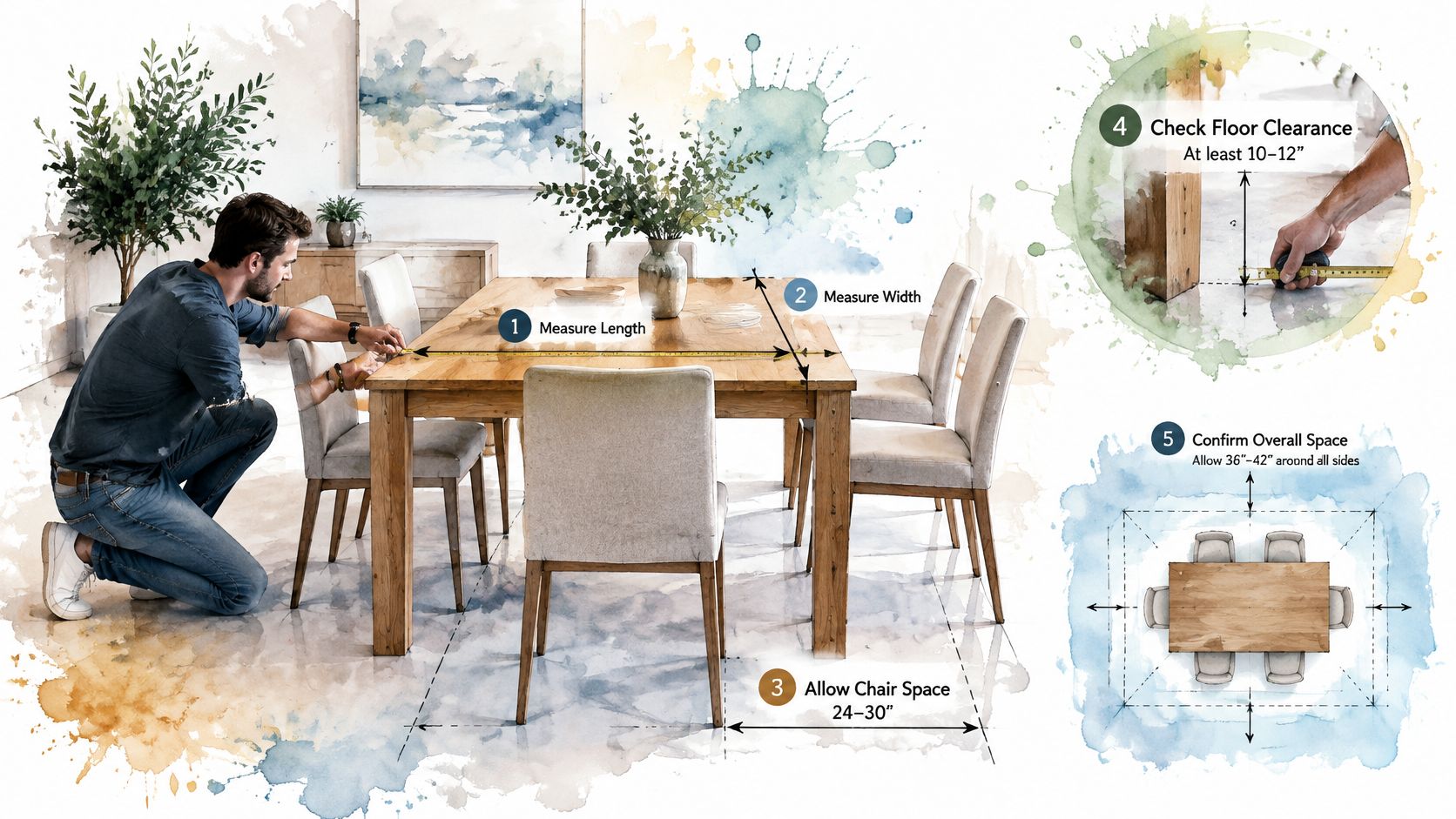
Measure the Operating Footprint
- Measure the extended table. Record its full length and width with every intended leaf installed. Measure the outside edges, not the pedestal or legs.
- Pull out every chair. Set each one where it would sit when someone is getting in or out. Include the end chairs and any larger upholstered seats.
- Measure the farthest reach. From the table edge, measure to the rearmost point of each pulled-out chair. Use the largest measurement so a deeper seat does not get overlooked.
- Apply a 24–30-inch allowance around the table. Use the larger allowance when chair depth or pull-back requires it. If the measured chair reach exceeds the planned allowance, increase the rug dimensions.
- Mark the proposed rug outline. Tape the candidate dimensions on the floor and center the table within them. Test a small, inconspicuous area before applying tape.
- Move through a meal. Sit down, stand, and slide each chair across the taped edge. Check whether the chair legs stay supported through the full movement.
The taped outline shows whether the rug fits the way the dining set is used. It can also reveal that shifting the table slightly would improve the arrangement.
Keep the Measurements With the Order
Keep the recorded dimensions with the order details. If the dining set has not arrived, use its stated measurements as a starting point, then confirm chair movement once the pieces are in place.
Customers are responsible for their own measurements, whether furniture fits the intended space, and access to that location. Check the route into the room as well as the dining area itself. The final check is practical: every chair leg should remain within the rug boundary when the chair is pulled back for sitting or standing.
Matching Rug Format to Seating and Table Length
A six-seat table can need a larger rug than another six-seat table if its chairs are wider or deeper. Plan roughly 24 inches of table edge per diner as a working rule, then check how much space each chair takes up when pulled back. For a broader look at seating layouts, see this guide to dining table shapes and seating arrangements.
Rug Format by Table Type and Seating
Use these formats as starting points. The chair's travel, not the seat count alone, determines whether the rug works.
| Table type | Seats | Rug format |
|---|---|---|
| Compact table | Confirm from usable table edge and chair width | 5 by 8 ft |
| Four-seat table | 4 | 6 by 9 ft |
| Six-seat table | 6 | 8 by 10 ft |
| Six- to eight-seat table | 6–8 | 9 by 12 ft |
A compact arrangement suits the smallest format only if the chairs remain on the rug when pulled out. A small room does not make a too-small rug comfortable.
For the middle formats, chair proportions matter. Broad arms, wide backs, and deep upholstered seats can call for the next size up. Check that the larger rug still fits the room before choosing it.
Choose Between Adjacent Formats
- Choose the smaller candidate if every chair stays on the rug through ordinary use and a tighter dining zone suits the room.
- Choose the larger candidate if deeper seating needs more coverage or the set looks undersized within an open floor.
- Change the arrangement if neither option supports the chairs without crowding a passage.
Table height can affect how a chair feels at the table, but it does not determine rug size. Test the seating arrangement with chairs pulled back, and check an extendable table at its full length before settling on a format.
Room Clearance and Walkway Checks Before You Order
A rug can fit beneath the dining set and still block the route between the kitchen and living area. Tape its outline on the floor, pull out the chairs, and test how people move around them.
Use these planning benchmarks to check circulation. Keep at least 30 inches from the table edge to an obstacle, allow about 36 inches for everyday movement, and aim for roughly 48 inches behind a seated diner where people need to pass.
Room Clearance Benchmarks Around a Dining Rug
| Benchmark | Distance or space | What it allows |
|---|---|---|
| Minimum table edge to wall or obstacle | 30 inches | Workable in tight rooms |
| Comfortable everyday movement | 36 inches | Walking past the table |
| Behind a seated diner | 48 inches | Passing behind occupied chairs |
| Compact room chair clearance | 24 inches | A tight-room minimum |
| Accessible forward approach | 30 by 48 inches clear floor | Wheelchair approach under ADA 2010 standards |
The 2010 ADA Standards for Accessible Design specify a 30-by-48-inch clear floor space for a forward approach. Use that dimension as a reference point, not as a complete assessment of accessibility in a particular home.
Test the Room With Chairs Occupied
- Walk the narrowest passage. Carry a serving tray while someone sits in the nearest chair.
- Open doors fully. Check the door swing and clearance above the planned rug.
- Use the sideboard. Open its drawers and doors without moving diners.
- Keep grilles clear. Leave heating and ventilation openings uncovered by the rug and pad.
In open-plan Bay Area interior design, the rug can define the dining area while leaving the route between rooms clear. Check the layout with chairs pulled back, not just tucked under the table.
For rooms with exposed wood around the dining zone, Savera Wood Floor Refinishing decorating tips offer additional decorating context. If the layout feels crowded, compare dining tables suited to small spaces.
If circulation fails, shift the table or reconsider its size. Choose a smaller rug only if the chairs still have enough support when pulled out.
Choosing Rug Construction for Daily Dining
Choose a low-profile flatweave or short-pile rug so chair legs encounter less resistance. High pile can catch chair feet, walkers, and wheelchair wheels; curled borders and thick transitions create additional obstacles for older adults and children.
A firmly anchored rug needs a floor-compatible pad that stays inside its edges. Before choosing an anchoring method, compare rug pads and grippers with J.G. Carpet Cleaning LLC's practical overview.
Compare Materials by Their Working Qualities
- Wool: A strong candidate for resilience and natural texture. Check spill-care requirements, the density of the construction, and whether a specialist can repair its edges.
- Flatweave natural fibers: Useful for a light, casual appearance. Inspect the weave for snagging and confirm how liquid spills must be handled before choosing it for frequent family meals.
- Recycled synthetics: Consider these where straightforward cleaning matters. Verify the recycled content and care instructions rather than assuming every synthetic rug performs alike.
- Vintage pieces: Character and continued use can justify restoration. Inspect worn foundations, previous repairs, and border stability before placing moving chairs over them.
Judge every candidate by durability, stain response, repairability, and documented material claims. Decorative-rug market coverage identifies interest in natural fibers, certified materials, and recycled inputs, but those categories don't establish the merits of an individual rug.
A natural fiber isn't automatically the easiest choice, and a recycled label doesn't explain how a spill will clean up.
The guide to area rugs for hardwood floors adds floor-specific considerations. Slide each chair in every direction during the initial test, then inspect the border again after a week of ordinary use.
Coordinating Rug Color and Finish With Your Dining Pieces
Let the table establish the palette after size and construction are settled. A warm walnut or rich oak finish often works with a rug that echoes its warmth without matching it exactly. A cerused white or pale finish benefits from a textured neutral that separates the table from the floor.
Contrast matters as much as color. If the floor and table are similarly light, a slightly deeper rug can make the furniture's outline easier to read.
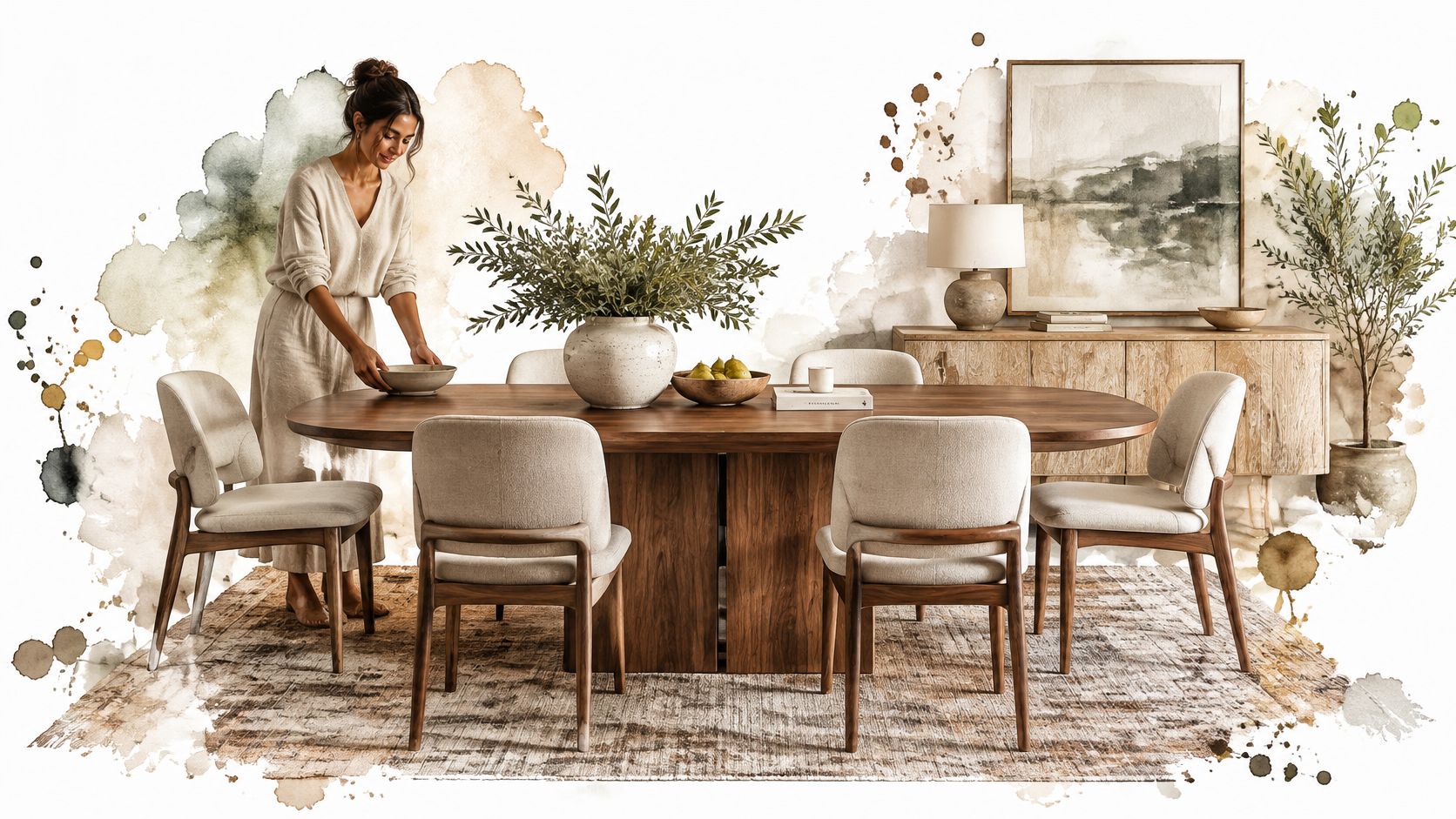
Build a Connected Palette
- Match undertones. Compare warm and cool notes in the wood, upholstery, and rug. A beige rug with a pink cast can look quite different beside golden oak than it does in isolation.
- Keep a dominant pattern. Bold chair upholstery generally benefits from a solid or low-contrast rug. Plain chairs leave more room for an expressive rug pattern.
- Let the finish lead. Strong grain and richly colored wood already provide visual detail. A quieter rug can support that detail instead of competing with it.
These principles apply to solid wood dining tables, including Amish Furniture, as well as mixed-material pieces. For red-toned finishes, the guide to colors that go with cherry wood helps distinguish complementary warmth from an overly matched room.
Giorgi Bros. Furniture offers Custom Furniture order services covering wood species, finishes, high-grade leathers, and designer fabrics. That flexibility allows a dining set to coordinate with an existing rug instead of forcing the rug to suit a fixed floor sample.
Check Samples at Floor Level
Place the rug swatch under the actual table, beside a chair leg. Review it in morning and evening light, with the room's usual lighting switched on when appropriate.
Judge the visible border rather than the sample alone. Much of the rug's center will sit beneath the table, while the outer field and border will do most of the visual work. A favorite central motif may barely show once the dining set is in place.
Why Dining Pieces and Rugs Are Investment Pieces
The strongest case for quality is continued usefulness. A dining table that remains stable, repairable, and welcome in the room can spread its purchase price across many years of meals.
Consider a hypothetical table costing $3,000 and kept for 20 years. Its purchase cost works out to $150 a year. A $1,200 alternative replaced every five years costs $240 a year, before disposal, delivery, maintenance, or changes in future prices.
Compare Service Life, Not Just Purchase Price
That calculation doesn't prove that every higher-priced piece lasts longer. Construction, care, and suitability determine whether the longer ownership period is realistic.
Look for joints that remain accessible for repair, finishes that can be renewed, and proportions that suit more than the room's current decoration. A finish chosen only to match a passing color scheme can shorten a piece's useful life even when its structure remains sound.
A furniture life-cycle analysis identifies longer product life, reuse, and repair as ways to reduce environmental impacts associated with production and disposal. Its focus is furniture, but the practical buying principle is straightforward: avoid replacing a serviceable piece unnecessarily.
Long-term value: The better investment is the piece that can remain useful, not simply the piece with the higher ticket price.
A properly selected rug and compatible pad can help protect the floor, while a stable construction keeps the dining arrangement practical. Neither requires permanent commitment to a single decorating style.
The buy-it-for-life mindset leaves room for change. A household may add seating, refinish the table, or update the room. Adaptable finishes and repairable construction make those changes possible without starting over.
Book a Design Consultation Before You Buy
A rug consultation can settle questions that a size chart cannot, especially when the dining area connects to other rooms or has an unusual layout. Giorgi Bros. Furniture is a family-owned showroom in South San Francisco serving the Greater Bay Area and Western United States for over 90 years. Its non-commission design consultants and ASID interior designers can discuss the room's overall furnishing needs without pressure to rush a decision.
For furniture options in South San Francisco, a showroom visit also lets you compare materials and finishes in person. The 50,000-square-foot showroom includes dining furnishings and home decor, alongside a dedicated sleep gallery with premium mattresses.
Plan the Purchase Without Rushing
Bring any finish sample or reference you want considered. A wood or fabric sample, or a photo taken in natural light, can help guide choices for the rug and dining pieces without repeating the measurements covered in “How to Measure Chairs and Clearance Before You Buy.”
Custom-order options can be discussed alongside the room's existing palette. Many furniture items are made to order, so lead times can vary. Giorgi Bros. Furniture offers delivery and pickup; the team can explain the available arrangements for an order.
A dining consultation can stay focused on practical decisions: how the rug works with the table and chairs, how its finish relates to the furnishings, and whether the arrangement suits the room. The right size is the one that supports comfortable use.
Giorgi Bros. Furniture offers dining furnishings, area rugs, and custom-order guidance. Visit the showroom in South San Francisco or book a design consultation for help coordinating fit, finish, and daily use with Giorgi Bros. Furniture.