A dining chair with an upholstered seat and back takes about 1 to 2 yards of 54-inch fabric, and a fully upholstered armchair takes about 5 to 8 yards. Find the closest row in the table below, then measure the actual chair before treating that range as an order quantity.
You're probably standing next to a solid chair with tired fabric, phone in hand, trying to decide whether to buy fabric now or wait. That's exactly where orders go wrong. Chair type gives a useful starting point, but how many yards of fabric to reupholster a chair depends just as much on fabric width, pattern repeat, cushions, and the reserve agreed before cutting begins.
Typical Yardage for Each Chair Type
A chair type narrows the order to a usable starting range. It does not settle the order. Use the table below to budget and compare fabrics for plain 54-inch material, then check every row against the chair itself. Pattern repeat, fabric width and the reserve you agree before cutting can push the final quantity above or below the row.
| Chair type | Typical yardage (54-inch fabric) | Source or note |
|---|---|---|
| Dining chair, seat only | 0.5 yard | HomeAdvisor's cost guide for reupholstering a chair |
| Dining chair, seat and back | 1 to 1.5 yards | LaSilk's upholstery yardage guide |
| Side chair, fully upholstered | 1.1 to 2 yards | Trend Contract Furnishings' 54-inch fabric chart |
| Carver or dining armchair | 2.5 yards | Learn to Upholster's yardage list, which includes cutting waste |
| Tub chair | 2 to 4 yards | Planning estimate for plain 54-inch fabric with no pattern repeat; confirm with panel measurements. |
| Bedroom or slipper chair | 4 yards | Planning estimate for a fully upholstered seat and back in plain fabric; confirm with panel measurements. |
| Wood-frame rocking chair, upholstered seat and back | 1.5 to 3 yards | Fabric & Supply's rocking chair fabric guide |
| Accent chair | 5 to 7 yards | Planning estimate for an upholstered seat, back and arms; confirm with panel measurements. |
| Wingback armchair | 6.5 yards | Planning estimate for plain fabric including cutting waste; confirm with panel measurements. |
| Fully upholstered rocking chair | 4 to 7 yards | Planning estimate for seat, back, arms and cushion; confirm with panel measurements. |
| Armchair, fully upholstered | 5 to 8 yards | Planning range for arms, inside and outside backs, and loose cushions; confirm with panel measurements. |
What Moves a Chair Within Its Range
Count the upholstered sections first. A seat-only chair sits at the bottom of the scale. An upholstered inside back, outside back, arms, skirt and loose cushion each add separate cuts. A back covered on both sides needs two panels, even though it looks like one surface from the front.
Loose cushions push a chair upward because the upholsterer cannot stretch one rectangle around the whole cushion. The top, bottom, boxing and closure pieces all consume fabric. Before using any row, confirm exactly which parts will be covered and whether cushions stay fixed or come off.
Pattern repeat is the quiet multiplier. A large repeat on a wingback can add yards because each panel has to start at the same point in the design. Narrow fabric does the same by forcing more seams or more length. That is why two chairs of the same type can land at different order quantities.
Practical rule: Use the table to budget and compare fabrics. Use measurements to place the order.
For a matching set, multiply the row by the number of chairs, then check each chair against a written cut list. All chairs should come from the same dye lot, so a shortfall on chair six can become a visible mismatch across the set. If you are weighing restoration against replacement, Giorgi Bros. custom upholstery chair options show how existing frames are refreshed. I would not order from a table row alone. Find the row, note the range, and measure before buying.
How to Measure Each Panel and Convert It to Yards
Manufacturer dimensions are a starting reference, not a cutting plan. On upholstered products, a 2-inch to 3-inch variance from stated measurements is common and acceptable, and the amount varies by manufacturer. Measure the chair in front of you, including padding and curves, because those differences affect every panel.
The Clever Calculator fabric guide gives a baseline of roughly 5 to 7 linear yards for a standard fully upholstered chair in 54-inch-wide fabric. Use it as a sanity check against your panel totals, not as an order quantity. The chair-type ranges in the table above set the starting budget; the cut list below sets the actual order.
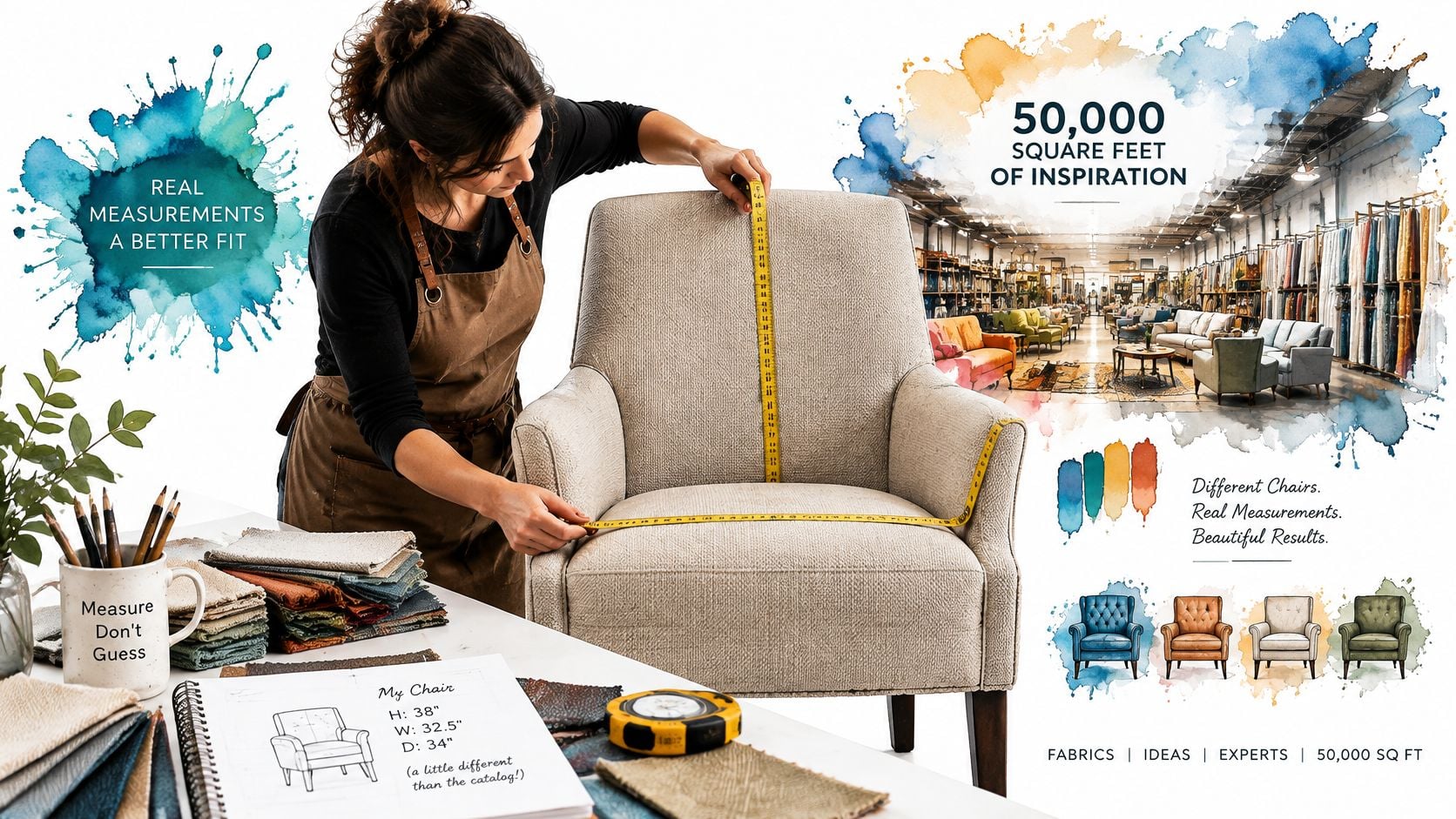
Measure Panel by Panel
- Photograph every side: Remove loose cushions and any removable skirt, then photograph the front, back, sides, arms, and underside. Photos show seams and hidden panels that one overall width misses.
- Record each visible component: Measure the inside back, outside back, seat deck, each arm front, arm top, inside arm, skirt panels, and tuck-in zones separately. Write length and width for every piece instead of relying on the chair's overall dimensions.
- Break down every cushion: Measure the cushion top, bottom, boxing strip, and closure panel as independent pieces. A cushion estimated as one rectangle almost always understates the fabric needed around its sides.
- Add working allowances: Add seam allowance plus enough material to wrap, pull, and tuck each panel securely. Round every result to a practical cut length.
- Convert inches to yards: Total the linear inches in the cut list and divide by 36. Then check whether narrower pieces can sit side by side across the fabric's usable width, which may reduce the required length.
- Mark direction clearly: Note where nap or a directional design must run and confirm every panel will be cut consistently. Verify the fabric's actual usable width and whether it can be railroaded before ordering.
Check the Math With a Simple Example
Suppose the finished cut list totals 288 linear inches. Dividing 288 by 36 gives 8 yards before any reserve. That example does not set the order for every armchair, but it shows why panel measurements beat one guessed number.
Keep the cut list with the photos. The upholsterer can catch a missing outside arm, an undersized boxing strip, or a damaged selvage edge before expensive fabric is cut. A careful review of how to measure furniture helps homeowners use consistent reference points. The point is a cut list another professional can check in a few minutes.
Special Chair Features That Change Your Order
Standard rows assume a fairly straightforward chair. Decorative construction, moving parts, and directional materials can move the order well beyond that row. Photograph each feature and send the images with the measurements so nothing is discovered after the fabric arrives.
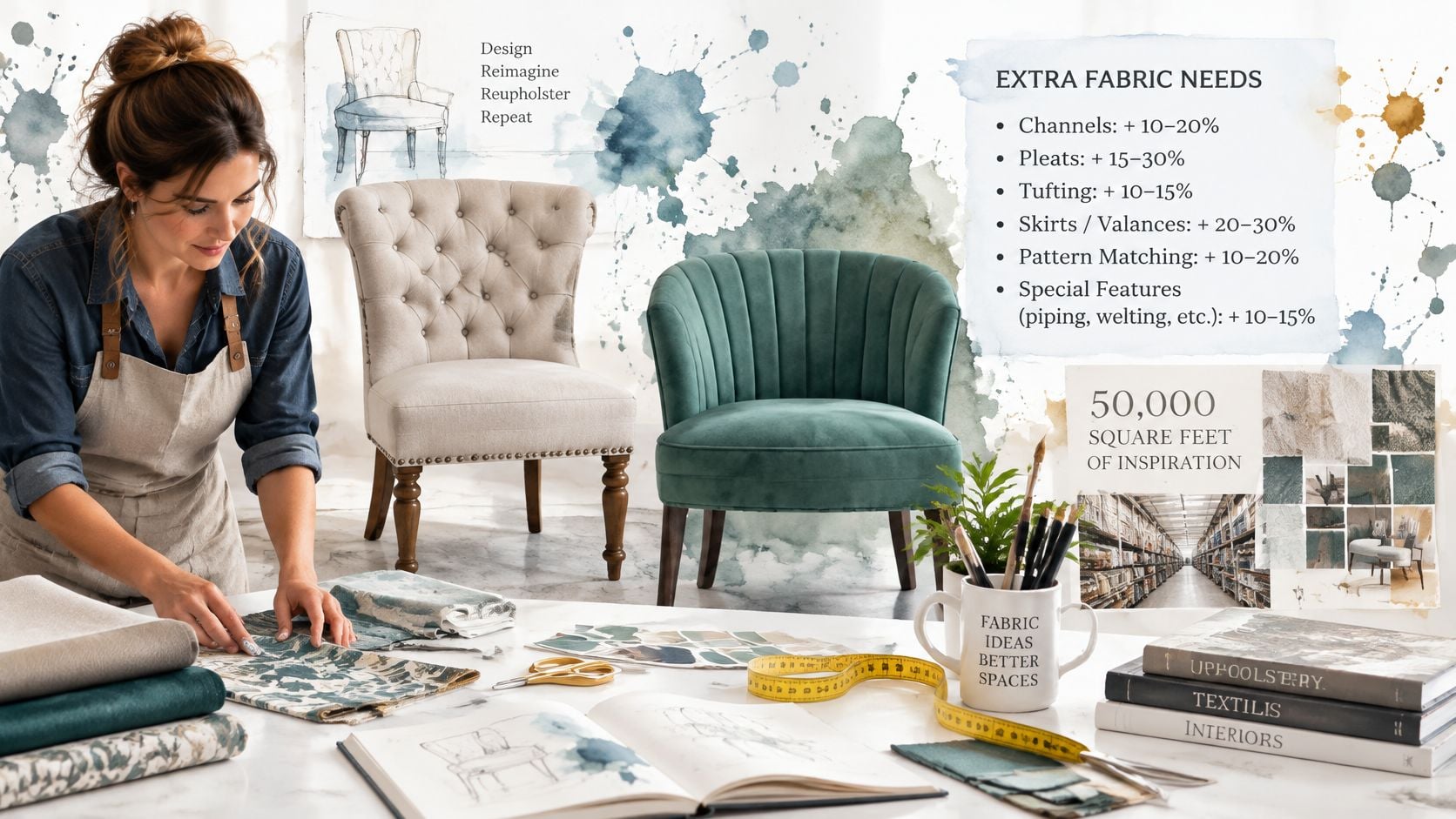
- Channel or Tufted Backs: Fabric folds into channels, pleats, and tufts instead of lying flat, so count the construction carefully. Tell the upholsterer how many channels or tufts must be reproduced.
- Loose Cushions With Boxing: Each cushion needs separate face and side pieces, plus a closure. State the cushion count and whether both sides should be finished for flipping.
- Gathered or Pleated Skirts: Fullness consumes more fabric than a flat skirt panel. Ask the upholsterer to confirm the skirt style and fullness before the order is placed.
- Velvet and Pile Fabrics: Every panel must run in the same direction or adjoining pieces can appear to change shade. Confirm the nap direction on the written cut list.
- Stripes and Plaids: Lines should meet cleanly at seams and continue across cushions and arms. Request a matched layout rather than assuming the pattern can be cut like a solid.
- Rolled or Scroll Arms: Curves need separate wrap pieces and careful easing around the scroll. Send close photos from the front and side so the arm shape is unmistakable.
- Recliners and Mechanisms: Moving parts need clearance, and separate sections may need individual covers. Identify the mechanism and confirm which sections move independently.
A clear close-up photo can prevent a standard estimate from being applied to a chair that isn't standard at all.
These details also affect labor and pattern placement, not just yardage. Homeowners planning a custom upholstery project should flag them during the first conversation. That early disclosure lets the consultant separate normal allowances from features the chart doesn't cover.
Adding Yardage for Pattern Repeat and Fabric Width
Pattern repeat explains why the same chair can need noticeably more fabric in a floral than in a solid. Each major cut length should be rounded up to the next full vertical repeat so motifs align across adjacent panels. With a 12-inch repeat, an 88-inch required cut becomes 96 inches, and similar rounding can occur on several panels.
Direction matters next. According to the VastCalc fabric calculator guidance, a guest chair with a 4-inch vertical repeat and 5-inch horizontal repeat may require approximately 18.5% extra when the pattern runs across the roll, 23.5% extra when it runs up the roll, and 28.5% extra for two-way matching. The same guidance gives practical benchmarks of 15% to 20% for small repeats, 20% to 25% for medium repeats, 25% to 30% for large repeats, and about 30% to 40% for repeats above 24 inches.
| Fabric situation | Extra yardage | Example or use |
|---|---|---|
| Small repeat | 15% to 20% extra | Small all-over prints |
| Medium repeat | 20% to 25% extra | Mid-size florals and stripes |
| Large repeat | 25% to 30% extra | Large florals and big plaids |
| Pattern running across the roll | About 18.5% extra | Technical chart, guest chair with 4-inch vertical and 5-inch horizontal repeat |
| Pattern running up the roll | About 23.5% extra | Technical chart, same repeat |
| Two-way matching | About 28.5% extra | Technical chart, same repeat |
Confirm Width Before Applying Any Percentage
Most yardage rows assume roughly 54 inches of usable width. Substituting a narrower decorative fabric changes how panels fit across the roll, so pieces that once sat side by side may need separate lengths. A 45-inch fabric therefore shouldn't be ordered using a 54-inch chart without a new layout.
The combined effect can be substantial. A chair planned in narrower fabric with a large repeat may move far beyond a generic armchair range because width reduces layout efficiency while repeat rounding lengthens individual cuts. Read the fabric specification for usable width, vertical repeat, horizontal repeat, pattern direction, and nap before calculating.
Get the sequence right. Identify both repeats, establish which way is up, round each panel to a full repeat, and then add seams, tucks, and cutting waste. Common failures include treating a large floral like a solid, ignoring alignment between inside arms and side panels, reversing velvet nap, and ordering before railroadability is confirmed.
For stripes, plaids, large motifs, or any two-way design, request a measured cutting diagram. Reviewing upholstery fabric types helps separate plain, directional, and pile fabrics before samples are narrowed down. Percentages are useful checks, but the diagram is what protects the final order.
Ordering Extra Fabric Without Creating Waste
Ordering extra by habit sounds cautious, but it isn't a plan. Too much fabric leaves remnants with no purpose, while too little can force a second dye-lot purchase, mismatched panels, delays, or a fabric choice that can't be completed as designed. The better question is how much documented contingency the specific chair and fabric justify.
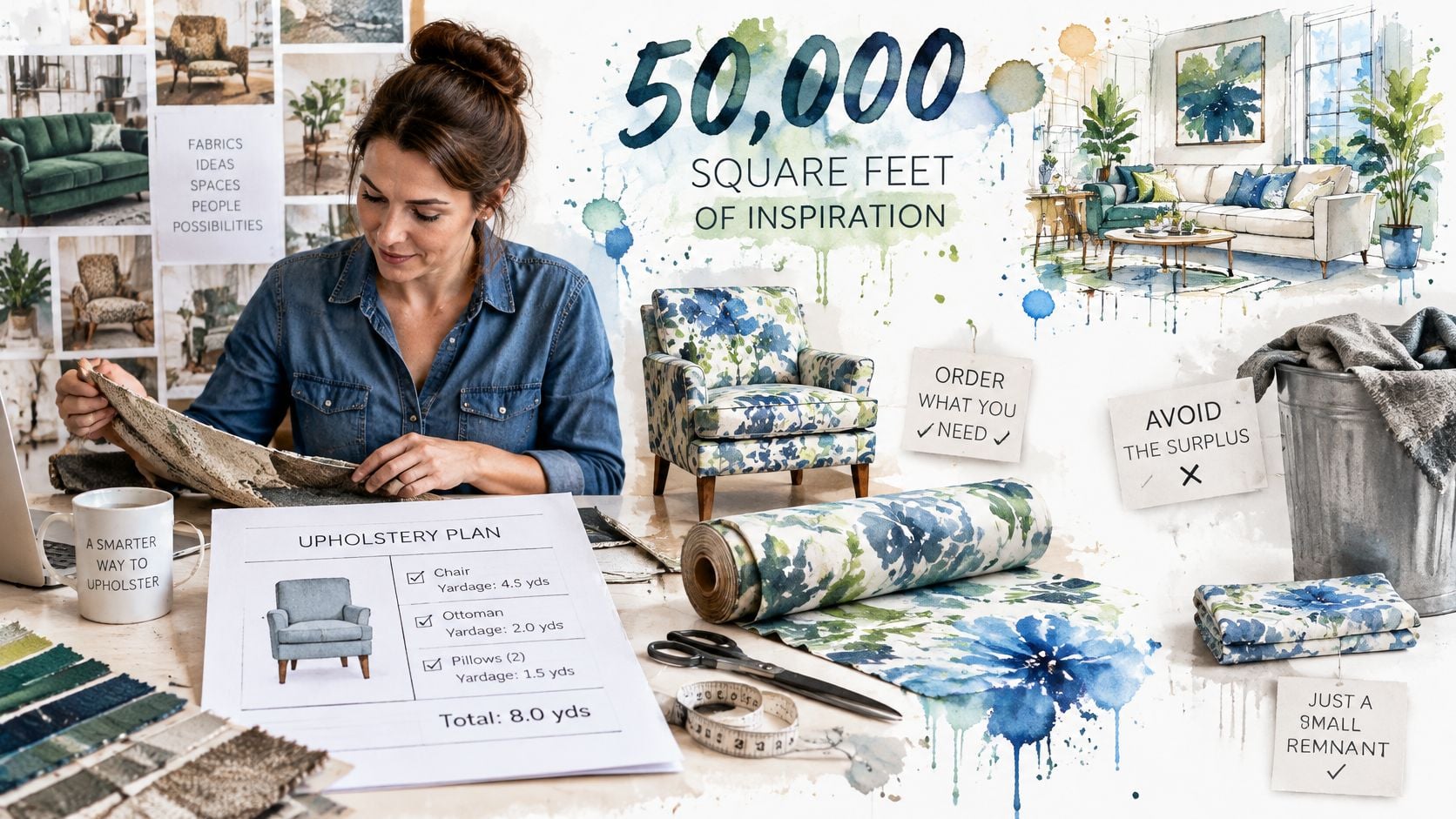
EPA-based reporting in an Earth911 guide to reducing textile waste says textiles represented 5.8% of U.S. municipal solid waste in 2018, while only 14.7% of more than 17 million tons of fabric waste was recycled. Those figures cover textiles broadly, not upholstery alone, but they show why avoidable overbuying matters. A buy-for-life project shouldn't create unnecessary waste while extending a chair's life.
Build the Reserve From the Cut List
Calculate the required panels from usable width, repeat, nap, and direction first. Then agree on a contingency with the upholsterer for cutting errors, flaws, damaged selvage, and pattern placement. That documented reserve is different from adding an arbitrary amount because a chart suggested extra.
Context should drive the decision. A fitted chair with patterned fabric and loose cushions warrants more protection than a plain seat-and-back chair with simple rectangular cuts. Ask what risk the reserve covers and write that reason beside the final yardage.
Before ordering: Ask whether remnants can be kept for future repairs, cushion fronts, or matching accessories, and whether removed fabric can be recycled through an available local program.
Timing and protection belong in the same conversation. Many furniture items are custom made for each order, so lead times can vary, and a second fabric purchase may not arrive quickly. Fabrics and leathers aren't guaranteed against wear, fading, color fastness, or damage from cleaning, and fabric and leather warranties are sold separately from the furniture and vary in terms. Settle the reserve, remnant plan, and protection questions before the first cut.
Book a Design Consultation Before You Order Fabric
Bring the measurements, photos, and fabric specification to a Design Consultation before placing the order. At the South San Francisco showroom, non-commission design consultants can review the cut list, check repeat and usable width, and confirm yardage without pressure. Giorgi Bros. Furniture has served South San Francisco for over 90 years, and that family-owned experience is useful when a fabric decision affects a custom order.
The 50,000-square-foot showroom lets you touch and compare fabrics and test investment pieces in person. Custom reupholstery is available to refresh existing furniture, and custom orders can be chosen by fabrics, finishes, sizing, and style. Flexible financing options are available for larger projects.
The consultation earns its keep at the cut list. A repeat mismatch or a short panel count caught there saves you from ordering a second length of fabric after the first cut, when the chair is already apart and the project is waiting. Book through the interior design consultation process and bring panel measurements, clear photos, the chair's make if known, the fabric's usable width, and its vertical and horizontal repeat.
Book a Design Consultation at Giorgi Bros. Furniture before the first cut, and use the showroom visit to compare custom fabric choices in person.