
The most popular advice about how to break in a new mattress is also the least useful: push through discomfort for a fixed number of nights and trust that the mattress will come right. That rule treats every sleeper, every firmness, and every ache as the same problem. It isn't.
A better approach separates body adaptation from product break-in. Comfort layers settle under normal body weight, while hips, shoulders, and the lower back adapt to new support geometry. Those two processes overlap, but they don't prove that pain will disappear. The question isn't whether a calendar page has turned. It's whether comfort is steadily improving, staying flat, or getting worse.
How to Set Up and Air Out a New Mattress
Setup comes before any comfort judgment. A mattress that hasn't fully expanded, or a room still filled with first-day odor, can't give a fair reading on pressure relief or support.

The First-Day Sequence
- Remove all packaging promptly. Take off plastic and tape as soon as the mattress arrives so compressed materials can expand and trapped odor can dissipate.
- Place it flat on its intended foundation. Use the slats or base it will sleep on long term, and check guidance on whether memory foam needs a box spring before mixing foundations.
- Create cross-ventilation. Open windows where practical and run a fan to move room air, without directing excessive heat at the materials.
- Let it expand fully. Don't force, press, or lie on a roll that's still visibly compressed, because uneven loading won't reproduce how the body rests on it.
- Air it for the period the manufacturer lists. The Sleep Foundation summary of a neutral indoor-air study found VOC concentrations from two new memory foam mattresses peaked on the first day and progressively declined over the following 31 days, with modeled averages of approximately 20 and 33 micrograms per cubic meter over 32 days, below available health-based benchmarks for the chemicals evaluated.
- Extend airing for sensitive sleepers. Anyone with asthma or chemical sensitivity, and households with infants, should air the mattress longer or start it in a well-ventilated room that isn't the bedroom.
- Stop if something looks wrong. Contact the seller if odor stays strong and persistent, the mattress remains visibly compressed or damaged, or the manufacturer issues a warning.
Never mask a strong odor with fragrance. Fragrance hides the signal that tells the sleeper whether ventilation is working.
A ready mattress looks simple: fully expanded, lying flat, and with odor clearly fading. Only then does a comfort log mean anything. The RTI Press controlled in-home study supports that patience, since participants tested seven mattresses for approximately 3 to 4 weeks each rather than judging any one of them after a single night.
How Long a New Mattress Takes to Break In
The short answer is about two weeks before judging comfort. That's a checkpoint, not a promise. Some sleepers settle sooner, and some mattresses never become a good fit no matter how long they're given.
The 2024 peer-reviewed field study in Sleep followed 1,126 healthy adults through a 4-week baseline on their existing mattress, then 6 weeks on a professionally matched new mattress with an explicit 2-week adjustment period built in. After that adjustment and continued use, deep sleep increased by 5% in minutes. Those gains are modest, which sets the right expectation: expect a gradually better feel, not a dramatic transformation overnight.
Break-In Timeline by Window
| Window | What is happening | What to check |
|---|---|---|
| Days 1-3 | Surface feels unfamiliar; body is still adjusting | Note pressure points and soreness; sleep on it every night |
| Days 4-7 | Comfort layers begin to settle; posture adapts | Log morning stiffness and waking frequency |
| Days 8-14 | Most users complete the adjustment period | Compare with week one and look for a clear trend |
| Days 15-28 | Ongoing fine-tuning only | Confirm scores are steady or improving; don't restart the clock |
| After day 28 | Adjustment window is finished | Persistent pain or poor scores point to a fit issue |
Context helps explain why the first nights feel so foreign. A 2025 consumer survey by Which? found 69% of respondents had slept on their previous mattress for more than eight years before replacing it. A body trained on one surface for that long will notice new alignment immediately, even when the new support is better.
Use the timeline actively. Mark night one on a calendar, check in at day 14, and confirm at day 28. Judge the trend across those checkpoints, because one uncomfortable night isn't evidence that a mattress is unsuitable, and one good night isn't proof that it fits.
Tracking Comfort Over the First Four Weeks
Memory is a poor break-in tool. A sleeper remembers the worst night vividly and forgets the gradual improvement in between. A short written log turns a vague impression into a decision.
Sleep on the mattress consistently for at least seven nights before drawing any conclusion. Skipping nights or alternating with an old mattress resets adaptation and muddies every score that follows.
What to Record Each Morning
Rate four things on a 1 to 10 scale within a few minutes of waking, before the day rewrites the memory:
- Morning pain: Note where it sits, such as hips, shoulders, or lower back, not just how strong it feels.
- Perceived pressure: Record whether pressure points woke the sleeper or only appeared on waking.
- Awakenings: Count them as accurately as possible, including long stretches of lying awake.
- Overall sleep quality: Score the whole night, then add one line about next-day energy by mid-morning.
Add a brief note beside any score that outside factors could skew. Travel, illness, stress, a late night, or an unusually warm room can produce a rough score that says nothing about the mattress.
How to Read the Log
Review the trend at day 14 and again at day 28. Steady or improving scores mean adaptation is working. A consistent worsening pattern matters far more than one poor night, and flat scores after two weeks deserve just as much attention as declining ones.
Keep the test fair throughout. Use the same pillow, sleep position, bedding, and bedroom temperature so the mattress, not a changed routine, is what's being evaluated. Couples should log separately, since one partner's improving scores don't cancel out the other's worsening ones.
Decision rule: Improving at day 14 means keep going to day 28. Flat or worse at day 14 means start a retailer conversation while options are still open.
Telling Normal Adjustment From a Bad Fit
The core distinction is direction. Normal adjustment trends toward better comfort, even if progress is uneven. A mismatch stays flat or gets worse, and extra nights only repeat the same problem.
Normal Adjustment Versus a Mismatch
| Symptom | Usually normal adjustment | Usually a mismatch |
|---|---|---|
| Stiff or sore mornings | Eases over the first two weeks | Stays the same or worsens past day 14 |
| Pressure at hips or shoulders | Fades as the body settles | Unchanged after two weeks |
| Waking several times a night | Stops within a few nights | Continues past day 14 |
| Feeling sunk in or pushed up | Lessens as comfort layers settle | Stays uneven, spine feels unsupported |
| Numbness or tingling | Not expected from break-in | Any recurring case warrants a retailer call |
Comfort and measured sleep don't always move together, which is why the log tracks both. A 2025 10-week field study in Sleep gave healthy adults a 2-week adjustment period before 4 weeks on an adaptive mattress, and perceived comfort rose 62% while pressure relief rose 120%. Yet objective sleep measurements showed no statistically significant improvement or disruption. A mattress can feel substantially better before anything measurable changes, so daily comfort scores carry real weight.
Showroom impressions deserve the same caution. A floor model has already taken repeated compression from other shoppers, so a new mattress at home often feels firmer and less familiar. Comparing firmness levels properly matters here, and a mattress firmness guide helps translate showroom feel into at-home expectations.
Some signs count as a fit issue regardless of the calendar. Persistent or worsening pain, numbness or tingling, inadequate spinal support, a pronounced dip, and repeated waking shouldn't be waited out. If discomfort is improving, keep sleeping on it. If it's flat or worse at day 14, move to the next step.
Habits That Help or Hurt the Break-In
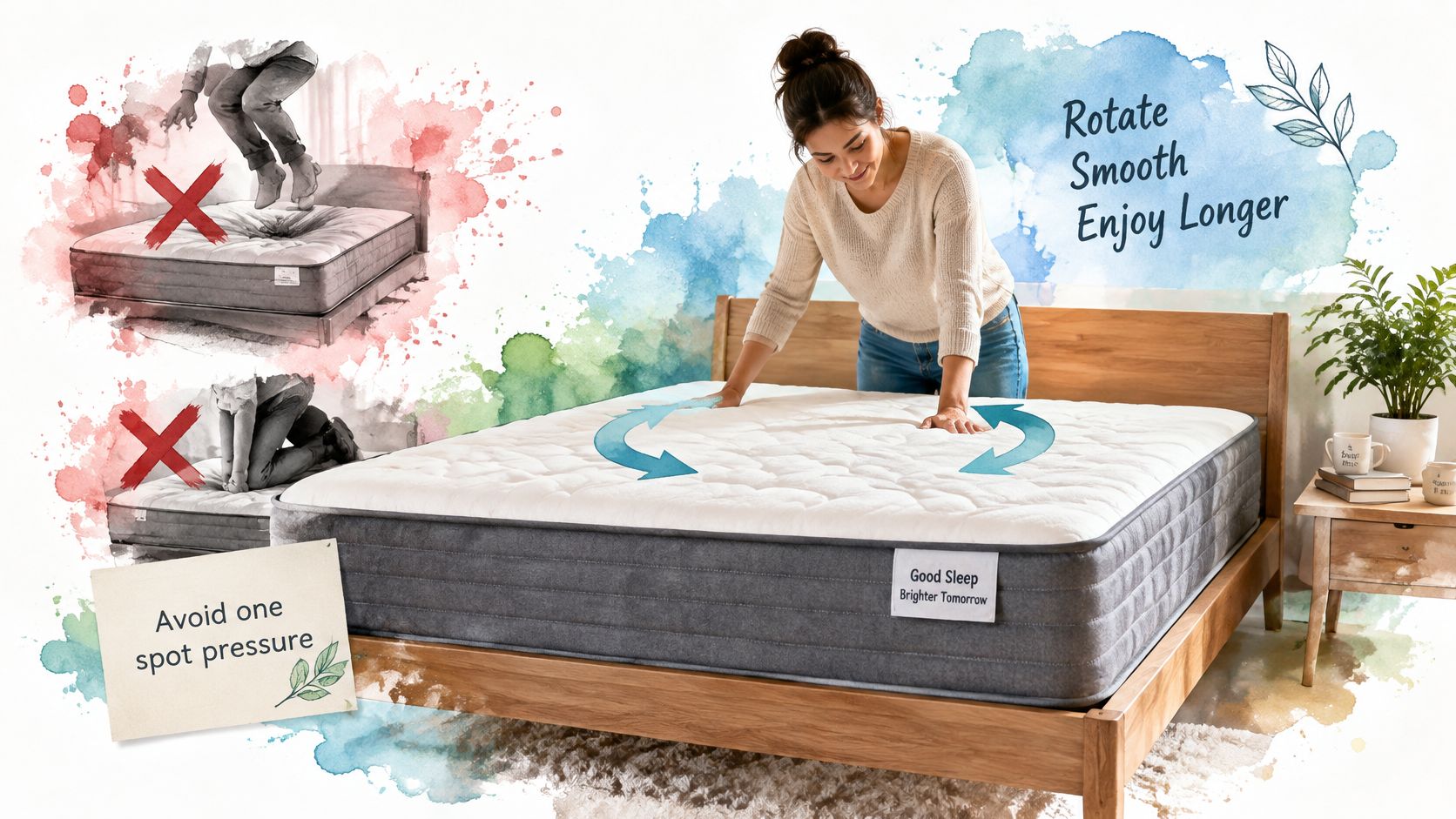
The shortcut that causes the most damage is trying to force the process. Jumping, kneeling, or pressing concentrated weight into one spot stresses comfort layers unevenly and doesn't reproduce normal body loading. A mattress breaks in by being slept on, not by being beaten into shape.
Habits That Keep the Test Honest
- Keep one sleep position: Changing position nightly makes it impossible to tell whether the mattress or the posture changed the outcome.
- Follow rotation instructions exactly: Rotation supports even wear over the mattress's life, and a guide to the benefits of a mattress protector covers the other simple habit that protects that lifespan.
- Hold the room steady: Keep bedroom temperature consistent and avoid heat sources near foam, since warmth changes how materials feel.
- Change nothing mid-test: Don't swap the base or add a topper during evaluation, because either one becomes the thing being tested.
Switching between mattresses after a few nights causes more unnecessary returns than almost anything else. No single mattress gets a fair trial, and the body never finishes adapting to any of them. Sleep physiology adds another variable worth keeping steady, and readers curious about that side can explore how nitric oxide affects sleep as background rather than as a break-in fix.
Moving from an old, sagging mattress deserves patience too. Temporary hip, shoulder, or lower-back differences can reflect better alignment, not a defect. Couples should each rate their own side and note motion transfer plus any roll toward the center. Give the mattress its window, keep the routine constant, and let the log decide.
When to Contact Your Retailer About an Exchange
The right time to call is when the log already shows a fit problem, not after months of hoping. Day 14 scores that are flat or worse for pain, pressure, awakenings, and sleep quality make a clear case. So do numbness or tingling, a visible sag or dip, physical damage, an odor that stays strong, or a manufacturer warning.
Gather specifics before calling. A consultant can act faster with the model, size, purchase date, both checkpoint ratings, and clear photos of any dip, tear, or stain. Customers who discover a problem should call or email Giorgi Bros. Furniture with pictures so the team can see the issue directly.
How the Conversation Works
Giorgi Bros. Furniture services furniture only within the terms of the factory warranty, so it's worth asking which issues that warranty covers before assuming a repair or exchange is included. That question protects the buyer from expecting a remedy the policy doesn't offer.
From there, a design consultant can compare firmness options, and a mattress comparison chart helps frame which comfort level to test next in the sleep gallery. Financing options are available if a replacement turns out to be the right investment piece. Expect a no-pressure conversation about whether the premium mattress fits the sleeper, not a push toward a different sale, and Bay Area shoppers can bring the log into the South San Francisco showroom instead of deciding from one bad night.
Book a Design Consultation to Confirm Your Fit
A mattress that fits from the start is a buy-it-for-life decision, not a recurring expense. Consider the math as an example: a $3,000 mattress used for 10 years costs $300 per year, while a $1,500 mattress replaced after 4 years costs $375 per year before delivery, disposal, and setup. That example doesn't promise every higher-priced mattress lasts longer, since materials, construction, sleeper weight, rotation, moisture, foundation fit, and warranty terms all change the result. It does show why avoiding a premature replacement saves money and keeps one more mattress out of the waste stream.

Giorgi Bros. Furniture has operated as a family-owned business in South San Francisco since 1933, and its custom furniture design services describe a 50,000 square foot showroom with a dedicated sleep gallery of premium mattresses. Customers can visit to touch, feel, and experience furniture before buying, which is exactly the step that prevents a poor fit. The Mattress Guide recommends mattresses after a customer answers a few questions about comfort, size, and type, and guidance on how to choose a mattress pairs well with testing in person.
Custom order services for wood species, finishes, high-grade leathers, and designer fabrics let bedroom furniture, including custom furniture and Amish furniture, match the room it's meant to serve for decades. Non-commission design consultants keep the process focused on fit, and Bay Area interior design support sits alongside the sleep gallery rather than in a separate visit. Shoppers searching for furniture in South San Francisco can visit the showroom to test premium mattresses in person, or book a Design Consultation to talk through break-in results and confirm the right fit.
Bring the four-week log, the checkpoint scores, and any questions about firmness, and the non-commission consultants at the South San Francisco showroom will help match the results to the right premium mattress. Visit Giorgi Bros. Furniture to book a Design Consultation or plan a showroom visit, and turn a careful break-in into an investment piece that supports good sleep for years.