
Custom furniture for a Bay Area home usually lands in three bands: about $1,500 to $5,000 for mid-range residential pieces, $400 to $1,200 for basic modular pieces, and $8,000 to $25,000 or more for premium bespoke work.
That spread is the normal market, not a quirk of one neighborhood. Custom furniture represented approximately 27.3% of the global furniture market in 2025, according to MarketIntelo, so custom pieces are a large share of what households buy. In South San Francisco and across the Bay Area, the useful question isn't whether a custom order costs more than a catalog sofa. It's which line on the quote is doing the work, and whether the piece will still earn its keep after a decade of daily use.
A written quote is a stack of choices: wood species, fabric or leather, joinery, finish, and how the piece gets up the stairs. Stock furniture on a showroom floor is the baseline. A custom order built to a room's measurements moves up from there. The bands, the labor-hour check, and a simple cost-per-year comparison below are planning tools, not a push to buy on the spot.
Custom Furniture Cost in the Bay Area at a Glance
Homeowners asking how much custom furniture costs can start with three planning bands from Dataintelo's 2025 market report: about $400 to $1,200 for basic modular pieces, $1,500 to $5,000 for mid-range residential furniture, and $8,000 to $25,000 or more for premium bespoke pieces. A second U.S. reference, from LegalClarity, places bespoke furniture broadly around $1,000 to $4,250, with a midpoint near $2,600. Treat both sets as ranges for budgeting, not as a quote for a specific room.
| Tier | Typical price | What it usually includes |
|---|---|---|
| Basic modular | $400–$1,200 | Standard sizes with limited fabric and finish choices |
| Mid-range residential | $1,500–$5,000 | Solid wood or leather options, custom sizing and finish selection |
| Premium bespoke | $8,000–$25,000 or more | One-off design, premium species, hand-fitted joinery |
Finished pieces as a floor reference
In-stock furniture shows what a finished piece costs before anyone changes the size. The Rusticott Chest of Drawers is priced at $435.71, inside the basic modular band. The Alisdair King Sleigh Bed, Dresser, Mirror, Chest and 2 Nightstands is priced at $1,250.46, still under the mid-range custom band. A custom order in a chosen fabric, wood, or size moves up from that baseline because the shop cuts, finishes, and fits one specification instead of pulling a carton.
Custom dimensions usually push a bed or dining table higher than a standard size, even inside the same band. Extra length means more lumber, more edge to sand, and more finish to apply. A king sleigh bed in a stock finish is not the same job as the same silhouette stretched for a low-ceiling bedroom in a San Francisco flat.
Practical rule: Name the item, its size, and the materials you want, then place it in a band. The written quote is the number that counts.
These ranges are starting points for Furniture South San Francisco shoppers comparing a floor sample with a made-to-order piece. They don't include every stair carry, fabric upgrade, or revision. Freeze the wish list first, then price it.
Sample Price Bands for Common Custom Pieces
Most Bay Area commissions start with a dining table, a sofa, or a bed that has to fit an odd wall. The tabletop area is rarely the whole story. Species, joinery, and finish hours move the total more than the footprint, which is why two tables of similar size can land in different bands.
| Piece | Typical tier | Main price drivers |
|---|---|---|
| Dining table, medium complexity | Mid-range residential | Wood species, joinery, 25–40 shop hours |
| Upholstered sofa | Mid-range residential | Frame construction, fabric or leather grade |
| Bed, custom dimensions | Mid-range residential | Non-standard size, species, finish |
| Chest of drawers, standard size | Basic modular | Limited fabric and finish choices |
| One-off bespoke piece | Premium bespoke | Design, premium species, hand-fitted joinery |
What each commission usually pays for
An upholstered sofa sits in the mid-range residential band when the frame is built to be recovered later and the cover is a performance weave or a mid-grade leather. Jump to a full hide on every surface and the same silhouette climbs fast, because leather is priced by the hide, not by the inch of seat.
A custom-length bed adds cost even when the design is simple. A non-standard width creates extra cutting, more offcuts, and more finishing work on rails and panels. Chests and cabinets in standard sizes with a short finish menu stay in the basic modular band. A one-off statement piece in a figured species, with hand-fitted joinery, belongs in the premium bespoke band.
The same habit shows up in other custom casework. A solid wood kitchen pricing guide from The White Kitchen Company separates material cost from the hours spent fitting it, which is the right way to read a furniture quote too. Match the piece to a band, then ask for a written number. Dimensions, materials, and delivery distance change every estimate.
What Drives the Price of Custom Pieces
Size is the least honest way to compare two quotes. In casegoods and upholstered furniture, manufacturing-cost benchmarks put materials at about 45–60% of unit cost, direct labor at 20–30%, overhead at 8–15%, and packaging or freight preparation at 3–8%. The same benchmark puts fully loaded shop rates at roughly $50 to $125 per hour by region and skill, then adds 15–25% overhead and targets a 20–30% profit margin. Ask which rate a quote assumes before comparing two shops.

| Cost category | Typical share of unit cost | Specifications that push it up |
|---|---|---|
| Materials | 45–60% | Exotic or figured species, premium leather, designer fabric |
| Direct labor | 20–30% | Hand-fitted joinery, drawer alignment, multi-coat finishes |
| Overhead | 8–15% | One-off engineering, sampling, finish approvals |
| Packaging and freight prep | 3–8% | Stairs, narrow hallways, white-glove setup, long-distance transport |
Which choice hits which line
Materials move first. Exotic or figured species raise the board cost and the waste, because the pretty grain doesn't always fall where a cutter needs it. Premium leather and designer fabric do the same on upholstery. A clear look at solid wood versus particle board keeps that material line honest, since a veneered core and a solid panel are not the same repair later.
Direct labor climbs with hand-fitted joinery, careful drawer alignment, long sanding, and multi-coat finishes. Unusual dimensions add hours even when the style looks plain. Overhead grows when the job needs one-off engineering, a sample, or a finish approval before cutting starts. Logistics is the quiet line. Stairs, a narrow hallway, white-glove setup, or a long carry across the Bay Area add cost on a simple piece.
Custom orders can be chosen by fabrics, finishes, sizing, and style, and Amish-made collections can be custom designed by selecting wood, finish, and style. Each of those choices hits a different row in the table. The diagnostic at every quote is simple: which specification drives each cost category?
The lowest bid often leaves out design time or delivery rather than charging less for the same craft. Comparing that number with a mass-produced lookalike hides the gap instead of explaining it.
Why a Higher Price Can Cost Less Over Time
Invoice price is a weak way to judge an investment piece. A peer-reviewed study on the cascading use of wood furniture, in the Journal of Industrial Ecology, identifies 10 years as a recognized minimum expected functional lifespan for a properly used whole product, tied to a standard associated with BIFMA. That decade is a practical yardstick, not a promise that every table will hit it.
Say a $3,000 piece stays in service for those 10 years. The use cost is about $300 a year. A $1,000 piece replaced every three years runs about $333 a year before anyone counts the weekend lost to shopping, pickup, and disposal. The cheaper sticker can cost more per year of sitting, sleeping, or eating.
Repair potential, not a heavier build
Buying for life means choosing construction, materials, and finishes that can be repaired or refinished instead of discarded. The same study found that reuse, repair, and refurbishment need substantially fewer new material inputs than building a new chair to replace one that already exists. Households that plan to keep furniture get the savings from fewer replacements, not from hunting the lowest tag. A closer look at long-lasting furniture is about joinery and service life, not a slogan.
Durability does not automatically lower environmental impact. A heavily built item can use more wood, textiles, foam, finishes, and adhesives than a lighter one. The U.S. Environmental Protection Agency reported that furniture and furnishings generated 12.1 million tons of municipal solid waste in 2018, and 80.1% of that material was landfilled, in its durable goods figures. Extending service life can delay that trip. It doesn't erase the materials already in the piece.
Judge the joinery, the finish, and how easily a frame can be repaired. More expensive is not the same thing as more sustainable.
How to Read a Custom Furniture Quote
A defensible quote is built in phases, not copied from a retail comparable. Costumary's pricing notes for custom woodworking walk the same path a Bay Area buyer should check: scope, materials, waste, hours, then overhead and profit. Realistic billable capacity sits nearer 1,200 to 1,600 hours a year than a 2,080-hour calendar, because quoting, purchasing, and admin aren't production.

Six checks before production
- Freeze dimensions and materials before pricing. Changes after this point are the expensive ones, because lumber may already be pulled and the cut list rewritten.
- Itemize lumber, panels, hardware, and upholstery or finish materials. A single "wood" line hides grade, thickness, and hardware quality.
- Add a documented waste allowance of 10–15% for lumber, consumables, and cutting loss. A material markup commonly around 2 to 2.5 times cost covers purchasing, that waste, and shop burden.
- Estimate hours for milling, joinery, assembly, sanding, finishing, client communication, procurement, packaging, and delivery. Hours are the check on whether the price matches the work.
- Apply overhead and profit as their own lines, not as a mystery pad on the lumber. A quote that lists only wood and visible fabrication understates the project.
- Approve a finish or upholstery sample, set revision limits, and require written change orders before production starts. Customers can design a custom piece of furniture at Giorgi Bros. Furniture, and that design stage is where drawings should settle. The custom furniture design conversation is the place to lock those choices.
| Task | Estimated hours |
|---|---|
| Design and client communication | 3–5 hours |
| Shop work: milling, joinery, finishing | 25–40 hours |
| Material runs | 1–2 hours |
| Delivery | 1–3 hours |
That table is one medium-complexity dining table, not a bedroom suite. Ask for separate line items for design, fabrication, finishing, installation, and delivery, and confirm whether revisions or site-condition changes are included.
A verbal allowance is not a fixed price. If it isn't on the written quote, it isn't in the job.
Budget Moves That Lower the Final Price
The lever that saves the most is size. Keep dimensions to standard sizes wherever the design allows. Unusual widths and depths add labor and waste, and they rarely change how the room feels once the piece is against the wall. The trade-off is less drama in a tight Bay Area plan, where an inch sometimes matters for a doorway.
- Limit premium surfaces: Put premium leather or a designer fabric on the seat and other high-wear faces, and use a durable standard finish on the back and sides. The look stays intentional, and the hide or yardage bill drops. The trade-off is a less uniform surface if someone studies the back of the sofa.
- Settle the design once: Lock drawings at the consultation so the project needs fewer revision rounds. Each round adds hours that never show up in the wood. The trade-off is deciding before every option has been sampled.
- Order against the lead time: Many furniture items are custom made for each order, so lead times can vary. An early order protects a move-in date. The trade-off is committing funds before the paint color is final.
- Compare the total, not the headline: On a special order, returns carry a 20% restocking fee plus any delivery or pickup fees. Confirm those terms before signing. The trade-off for a strict return rule is a lower chance of a surprise bill later.
- Spread a larger piece: Financing options are available when one investment piece would otherwise crowd out the rest of the room. The trade-off is paying over time instead of in one check.
Finish with a whole-room budget. A design consultant can show which pieces deserve the build quality and which can stay simpler.
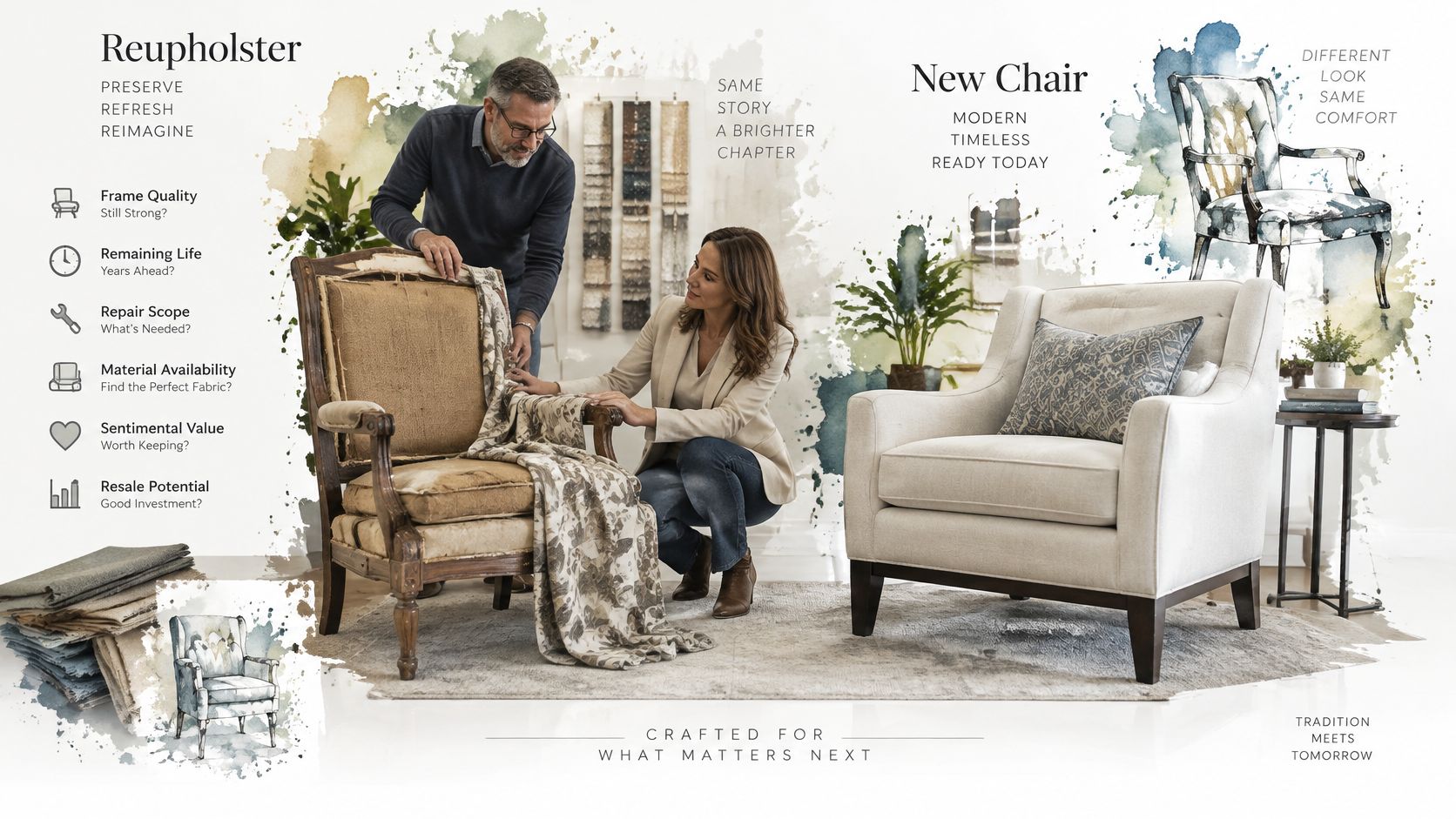
Reupholster Versus Buy New to Save Money
Replacement and renovation answer different problems. Run the piece through six checks before spending: frame quality, expected remaining life, repair scope, material availability, sentimental value, and resale or reuse potential. Research on refurbished furniture found that both perceived sustainability and economic motivation raise willingness to buy refurbished pieces. In a recent furniture-industry survey, durability was important or very important to 95.5% of respondents, while sustainability influenced 65.3% of purchasing decisions. Another survey found that only about 19% were willing to pay more for sustainability. Durability, not an abstract eco label, is the stronger economic case.
Three outcomes that show up in real rooms
A sound hardwood frame with sagging cushions and faded fabric is usually a strong reupholstery candidate. The structure is already paid for, and new fill plus a cover restores the seat. A cracked frame or a failing support deck usually makes the case for a new custom piece, because labor spent on a weak skeleton doesn't buy another decade.
A sofa recovered in premium leather can approach the price of a new piece once labor, leather, and transport are added. Renovation isn't automatically cheaper. Custom reupholstery services are offered to refresh existing furniture, and Giorgi Bros. Furniture can price that work in writing before any fabric is cut. A practical walk-through of whether a sofa is worth reupholstering helps separate a tired cover from a tired frame.
If the frame would be worth keeping for another decade, refurbish. If the frame is the problem, buy new.
Book a Design Consultation for Your Custom Quote
Giorgi Bros. Furniture is a family-owned showroom in South San Francisco, with 50,000 square feet where visitors can touch, feel, and test wood species, finishes, and fabrics before committing. The team has served the community since 1933, more than 90 years of Furniture South San Francisco guidance without a commission on the conversation. Non-commission design consultants and ASID interior designers handle Bay Area interior design questions, review the room, the measurements, and the budget, then help turn choices into an itemized quote with separate lines for design, fabrication, finishing, and delivery.
Delivery and pickup are available, including white-glove placement priced flat by location rather than by the piece. Premium mattresses sit in the same showroom when a bedroom project needs a sleep piece alongside the case goods. Financing options are available for households spreading a larger investment. The interior design consultation is an information visit, with no pressure to buy.
Bring a short kit so the hour stays on the quote:
- Room measurements for the wall, the doorway, and the stair or elevator.
- Photos of the space, including the pieces that have to stay.
- A list of what to replace or add.
- A rough budget for the whole room, not only the hero piece.
Visit the South San Francisco showroom or book a design consultation to get a written number for the custom piece.
Giorgi Bros. Furniture helps Bay Area households price custom furniture as a long-term investment, with itemized choices in wood, fabric, leather, and finish and no commission on the guidance. A design consultation turns room measurements into a written quote that separates design, fabrication, finishing, and delivery. Visit Giorgi Bros. Furniture in South San Francisco to see the materials in person or to book that consultation.