
Every Bay Area living room has one seat that gets claimed first and replaced last. The cushions have gone soft in the wrong places, the footrest stops a few inches short of the calves, and the frame complains when you lean back. Nobody wants to spend a weekend shopping for its replacement, so it survives another year.
That order of operations is usually backwards. A recliner is the seat that gets used every night, and it's the piece most often judged on the wrong criteria: color first, price second, whatever the hangtag mentions third. The result is a chair that looks right and fits badly, or one that fits for two years and then starts to loosen at the pivots.
Treating a modern recliner chair as a fit decision and an ownership decision at the same time holds up far better. Measure your own body before you judge a floor model. Ask what the mechanism is rated to do and whether it can be repaired. Then divide the price by the years you expect to keep the chair, because that number tells you more than the ticket does.
What Makes a Recliner Modern
A recliner can look like an accent chair until it moves. That balance between a refined profile and a working mechanism is what makes the modern version distinct. In 1927, Michigan inventors Edwin Shoemaker and Edward Knabusch began developing a chair that followed the body as it leaned back. Their early wood-slatted porch model appeared in 1928. The upholstered indoor version, developed under a patent application filed in January 1929, established a familiar format: a movable back, a seat that shifts forward, and a mechanism that supports a more open sitting angle, as documented in The Henry Ford's collection on furniture innovation.
The category advanced through better hardware, and the silhouette followed. Early designs needed deep frames and skirts to conceal their linkages. More compact mechanisms now allow a recliner to keep a cleaner outline when upright, so it can sit comfortably among other contemporary furniture styles.

Three Checks That Separate Modern From Traditional
- Profile: A modern recliner often has a restrained outline. Rolled arms, a gathered skirt, and a deep, puffy back create a more traditional look.
- Arms: Slim track arms keep the chair visually compact and leave room for a side table. Check the arm height against the table you plan to use.
- Base: Tapered wood legs or a low plinth create a lighter appearance. A fully skirted base conceals the space underneath and gives the chair more visual weight.
Style is only part of the decision. A chair that looks light in profile still needs a mechanism and footrest suited to regular use.
The side-view test: Sit down and recline once, then look at the chair from the side. Notice how the footrest and arms change the chair's proportions when it opens. If the reclined shape works with the rest of the seating group, the design serves the room in both positions.
Modern Recliner Features at a Glance
A single adult who reclines once each evening can usually narrow the mechanism choice to manual or power. The right answer depends on the effort required, how often the chair changes position, and whether its extra parts justify their cost over years of use.
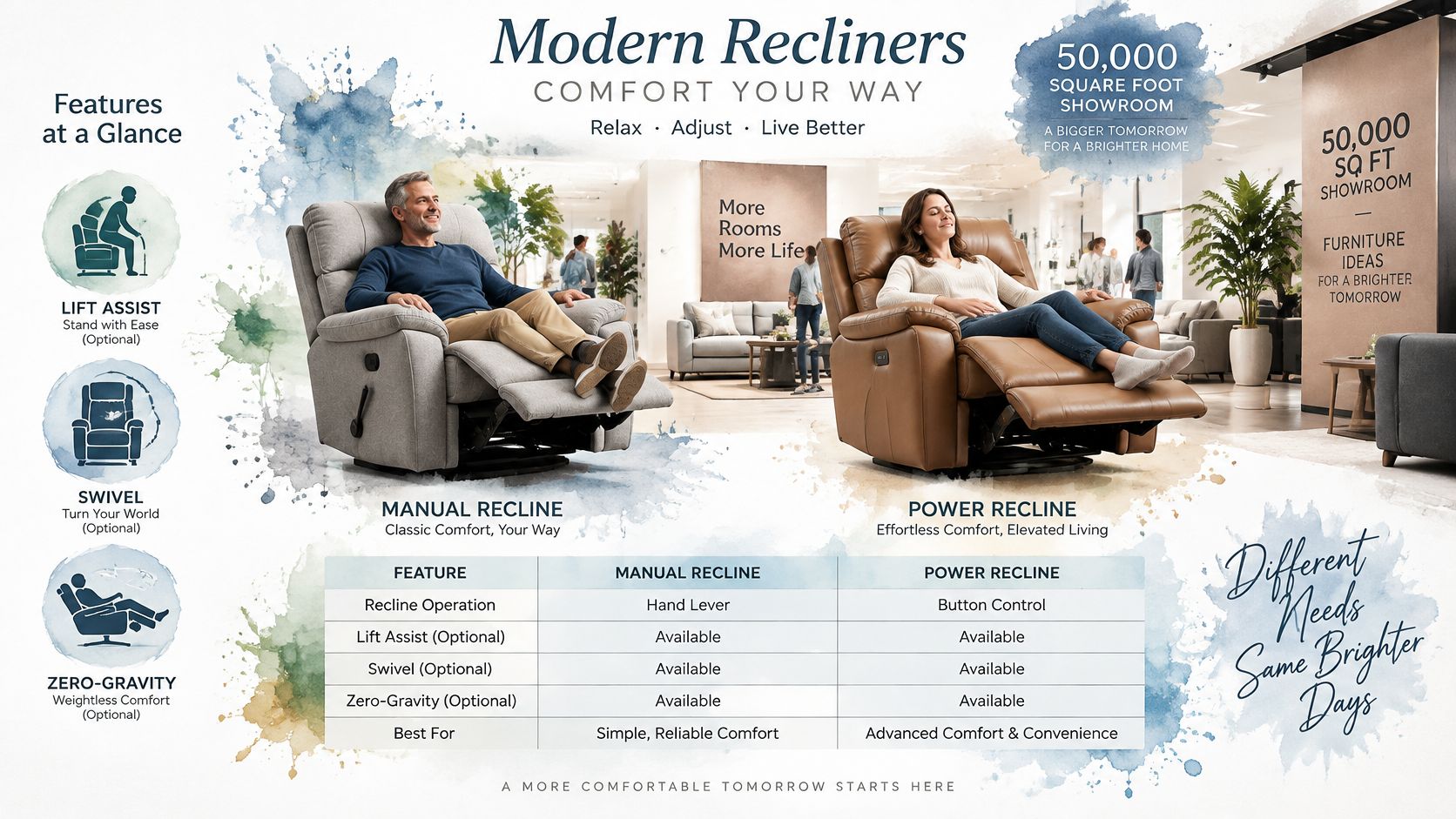
| Feature | What It Does | Best For | Trade-off |
|---|---|---|---|
| Manual recline | A lever or pull handle adjusts the back angle | People who prefer a straightforward mechanism and do not mind applying force | Requires physical effort and room for the chair to move |
| Power recline | A motor and remote adjust the seat and back | Frequent adjustments or users who have difficulty gripping or pulling a lever | Needs an outlet; the motor adds a component that may require service |
| Lift assist | A motor tilts the chair forward to help the user stand | People who need support getting out of a chair | Adds weight and cost compared with a standard power recliner |
| Swivel base | The seat rotates around a central pivot | Open-plan rooms where the chair needs to face different areas | Requires clear floor space and a stable base |
| Zero-gravity | The back and leg support rise together toward a near-flat position | Reading, television, or extended reclining | Uses more space and may need extra clearance behind the chair |
Manual recline keeps the mechanism simpler. Power recline makes small position changes easier, but adds a motor and an electrical connection to maintain. The choice between power recliner and manual mechanisms comes down to how the chair will be used, not which option has more features.
Use these questions to sort the options:
- How often will the chair move? If it stays in one position most of the evening, a motor may add little value. Frequent adjustments make power recline easier to justify.
- Who will use it? A chair for one person has different demands from one shared by adults of different sizes or guests with mobility limits.
- What space can the chair use? A swivel base needs room to turn; zero-gravity recline extends farther into the room.
- Is an outlet nearby? Check the intended location before buying a power model so its cord does not cross a walkway.
For any power recliner, ask whether it has a manual release for a power outage. Without one, a chair stopped in a reclined position may be difficult to reset at home.
The range of motion features has grown, but a longer feature list does not automatically make a better investment. OpenPR's 2025 recliner market report summary values the global recliner chair market at USD 4.4 billion in 2024 and projects USD 6.8 billion by 2033, a 5% compound annual growth rate. For a chair intended to last, weigh each added feature against its daily usefulness, service needs, and cost over the years you expect to use it.
Finding the Right Recline Size and Ergonomic Fit
A recliner can look right in the room and still fit your body poorly. If the seat is too deep, you may slide forward, pulling your lower back away from the lumbar support. Measure your seated dimensions before shopping, then compare them with the chair's specifications.
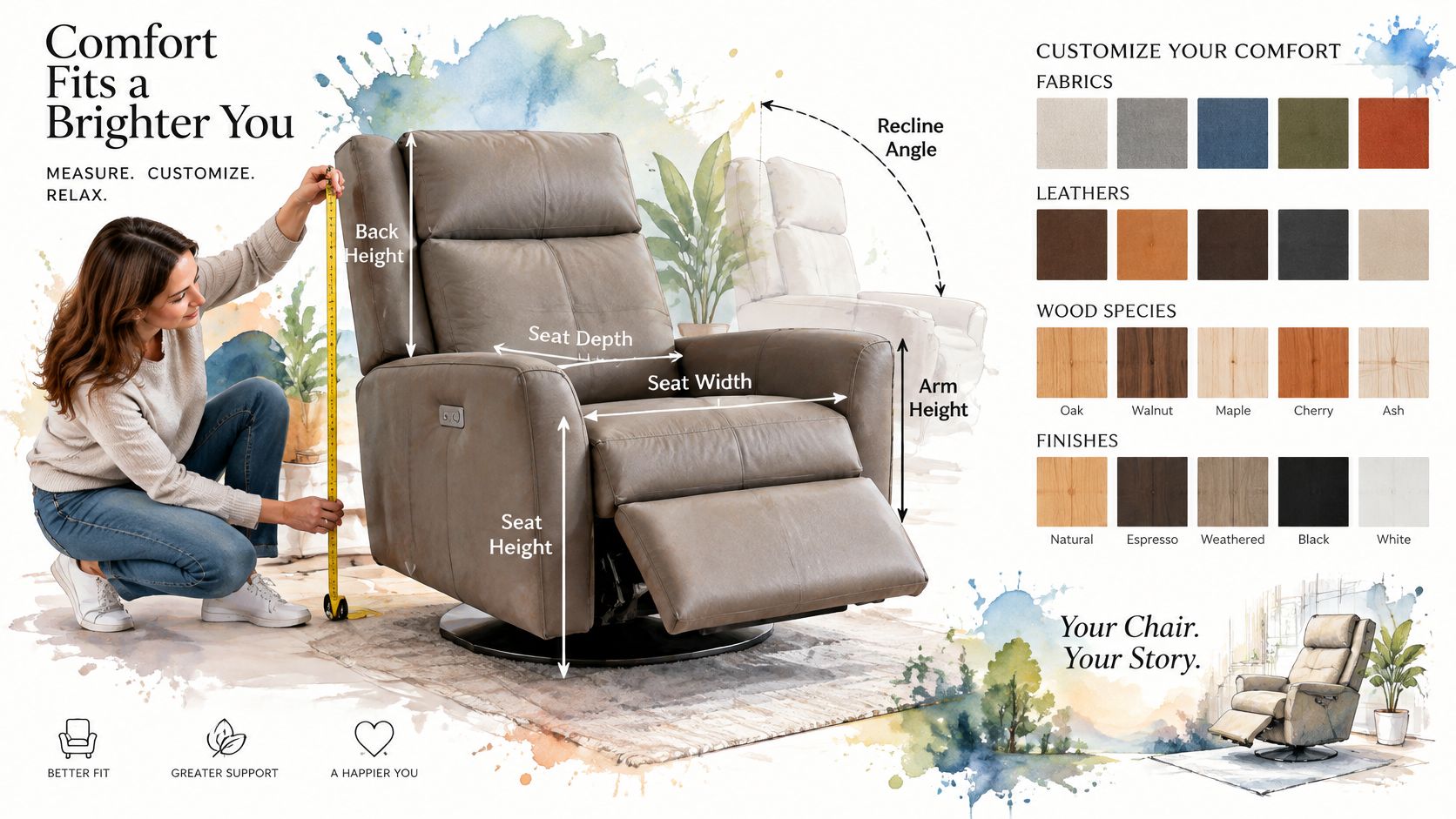
| Measurement | How to Measure | Typical Target Range |
|---|---|---|
| Seat height | Floor to the back of the knee, seated with feet flat | 17 to 20 inches for most adults |
| Seat depth | Buttock to back of knee, minus 2 to 3 inches | 20 to 22 inches for most adults |
| Seat width | Across the hips, seated, with room to spare | 22 to 24 inches for one person; 30 inches or more for two |
| Back height | Seat to top of the shoulder | 24 to 30 inches for comfortable recline support |
| Recline angle | Test at several positions with the footrest raised | Roughly 110 to 130 degrees for supported recline |
| Clearance behind chair | Reclined footprint measured from the wall | Roughly 3 feet, with more needed for zero-gravity models |
Recline angle affects how the backrest supports you. Cornell University's ergonomics program describes supported recline in the 110 to 130 degree range as reducing lumbar-disc pressure and back-muscle activity compared with sitting upright. A contoured lumbar area should follow the lower back's natural inward curve.
Check that the seat and back move together. If the backrest opens away from the pelvis, lumbar support can shift upward, and your body may slide against the upholstery rather than stay supported.
A Five-Step Fit Test
- Sit fully back with both feet flat on the floor. If your heels do not reach, the seat may be too tall.
- Recline to a middle position. The lumbar support should remain in the small of your back, not against your shoulder blades.
- Recline fully. Your feet should rest on the footrest without your body sliding forward.
- Raise the footrest by itself. Your calves should rest on it, not hover above it.
- Sit up and stand without pushing off the arms. If you need that extra push each time, reconsider the seat height or ask about lift-assist models.
Practical rule: If your feet dangle when reclined, you may slide forward to reach the footrest, weakening the chair's support for your lower back.
A shorter user may need a lower seat and shorter back, while a taller user may need more seat depth and a headrest that reaches the head. In a shared household with users of different heights, independent back and leg adjustment can accommodate more than one fit.
A 2025 study in JMIR Formative Research on seating in long-term care found residents may sit for up to 12 hours a day, and 43% of caregivers reported access to a seating specialist. A comfort recliner is not medical equipment, but the user should still be able to exit it independently. If standing is difficult, discuss lift-assist options. For lower-back support, use these recliner fit and back-support considerations to narrow your choices. Before buying, compare the manufacturer's dimension sheet with your measurements. A chair that fits well is easier to use over years of ownership, which matters more than a showroom impression alone.
Choosing Between Leather and Performance Fabric
A recliner is a long-term purchase, so compare the cover's upkeep and repair options as well as its feel. Leather can develop a patina; performance fabric offers a wider range of textures and may suit households that need easier spot cleaning. The better choice depends on how the chair will be used and maintained.
| Factor | Leather | Performance Fabric |
|---|---|---|
| Daily cleaning | Use a leather cleaner and avoid soaking | Vacuum and spot clean; some weaves resist stains |
| Pet and child resistance | Claws can scratch, though spills wipe up easily | Tight weaves may resist claws; check the abrasion rating |
| Feel and warmth | Cool at first, then warms with use | Softness and breathability vary by weave |
| Aging appearance | Develops a patina over time | Holds color well, but strong sun can cause fading |
| Repair and reupholstery | Re-covering is possible; matching leather takes skill | Replacing the cover may be easier; check for matching dye lots |
| Price range | Usually higher upfront | Varies by fabric and performance rating |
How Leather Grades Differ
Full-grain leather retains the hide's natural surface and markings. Its appearance changes with use, which may appeal to buyers who want a chair to develop character over time.
Top-grain leather is lightly sanded for a more uniform look. It remains durable and can be easier to match across a sofa and recliner, though it develops less visible character.
Bonded leather combines leather fibers with binder. It costs less, but wear can show at flex points, where a recliner bends repeatedly. Consider the expected service life before treating a lower upfront cost as a saving.
What a Double Rub Count Tells You
Double rubs measure a fabric's abrasion resistance. Ask for the rating on the tag or spec sheet rather than relying on the word “performance” alone. Fabrics in the same collection can have different ratings, so compare the specific upholstery options.
The Mechanism Outlasts or Undersells the Cover
A durable cover cannot make up for a weak recliner mechanism. The U.S. General Services Administration's upholstered furniture test method evaluates recliners by cycling them from closed to TV position to full recline and back under a combined 200-pound load: 150 pounds on the seat and 50 pounds at the center front of the backrest. The test runs for 25,000 cycles or until failure, with inspections every 2,000 cycles for loosened joints, rubbing, and mechanism wear. Ask whether a mechanism has a documented cycle test, what load it used, and whether it covered the full operating range. Grinding, binding, an uneven footrest, or a snap-back on return can indicate hardware problems.
Custom options can help the chair suit the room and remain serviceable. Ask what choices are available for leather grade and color, fabric, and finishes on an exposed wood base. Giorgi Bros. Furniture also offers custom reupholstery to refresh existing furniture. Take swatches home to compare them with the wall color and rug in daylight, and ask whether the cover can be replaced without disturbing the mechanism. For more detail on fabric options, see this guide to performance fabric furniture.
Placing and Styling a Modern Recliner in Bay Area Living Rooms
A chair that fits the room upright may block a walkway once its footrest opens. Start with the reclined footprint from the sizing table, then check the chair's path against doorways and routes to the kitchen. Leave a little space behind the back for airflow.
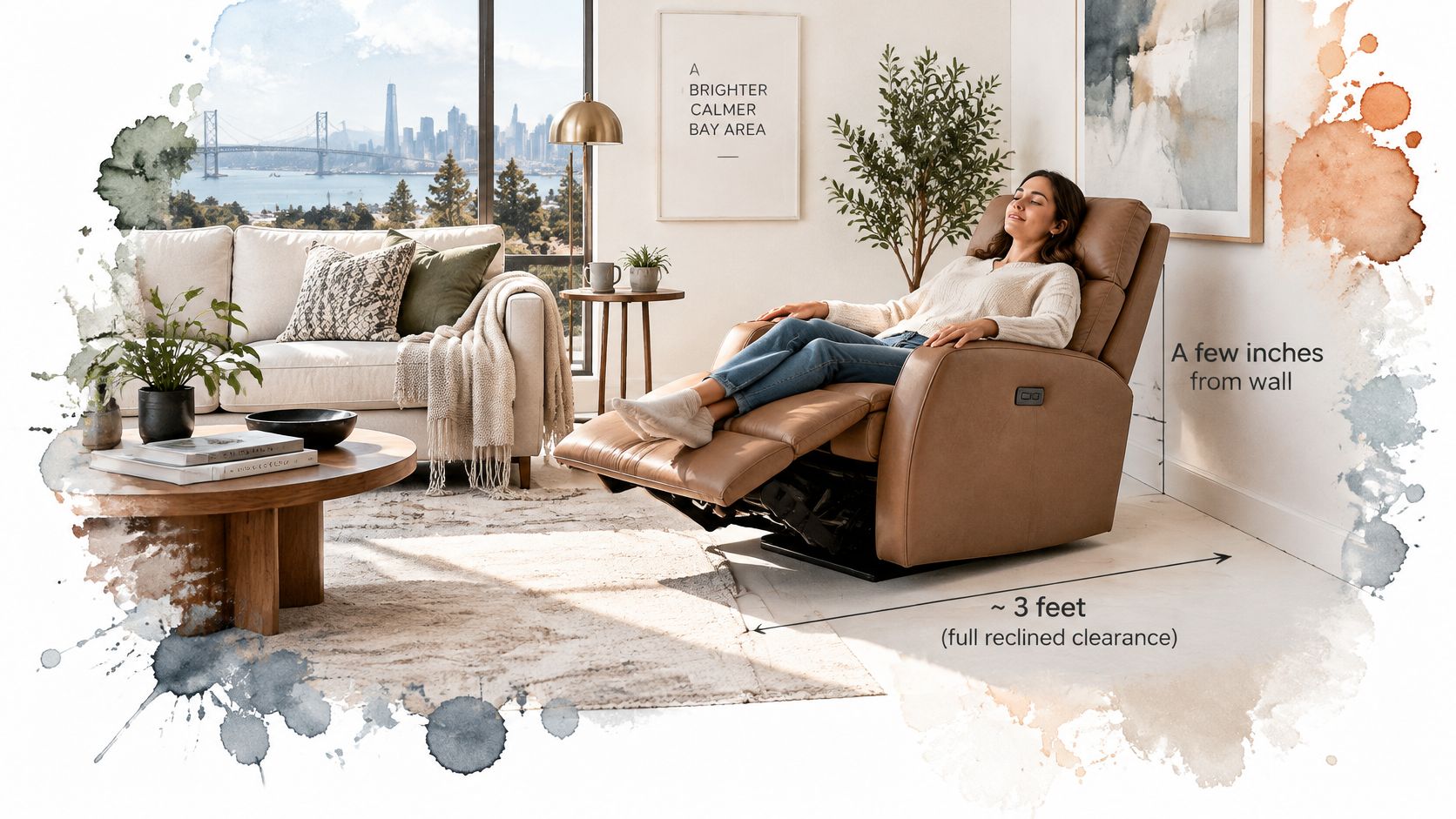
Before settling on a spot, check the room's practical constraints: keep the chair clear of heating vents, position it for comfortable television viewing, and make sure a power model can reach an outlet without a cord crossing a walkway. A swivel base suits an open end of a seating group, where conversation shifts between people.
The room's proportions matter more than a perfect match with the sofa. Set a side table near armrest height for a drink or book. For reading, place a floor lamp behind the shoulder, and use a throw or a small lumbar pillow to add softness without crowding the seat.
A compact condo may suit a slim-arm recliner beside a walnut side table, with the cord tucked behind the table leg. In a reading corner, arrange a zero-gravity chair so it has room to recline without dominating the sofa. Repeat one material or color from the room, such as a wood tone or a pillow accent, to make the chair feel connected to the rest of the seating. Above the sofa, a considered gallery wall layout over the sofa can help the recliner read as part of the room rather than an afterthought.
Maintenance, Warranty and What the Chair Costs Over Time
A recliner is a long-term purchase only if its parts can be maintained and repaired. Before buying, get clear answers about the warranty and keep them with the receipt.
Warranty Questions Worth Asking
- What does each warranty cover, and for how long? Frame, mechanism, motor, and upholstery may have separate terms. Check each one rather than relying on the longest term listed.
- Can replacement parts be sourced after the warranty ends? A chair is easier to keep in service if its motor, handset, or transformer can be replaced.
- What details should you keep? Store the receipt, model number, and fabric or leather code together. The code helps identify the upholstery if the chair needs repair or reupholstery later.
A Maintenance Routine That Takes an Hour a Year
- Vacuum upholstery and the crevices between the seat and arms monthly. Use a brush attachment on leather.
- Condition leather twice a year with a pH-balanced product. Apply it with a soft cloth and buff away excess.
- Follow the fabric's cleaning code for spots. Dab rather than rub, then blot dry.
- Test power controls and the manual release monthly so you can catch a problem before it interrupts use.
- Check bolts and pivot points annually with the right wrench. Investigate new squeaks promptly.
- Check the chair's moving parts and upholstery for wear during routine cleaning.
Ask before you buy: Can the motor, transformer, handset, foam, and cover each be replaced separately? Replaceable parts can extend a chair's useful life.
The Cost Math
Divide the purchase price by the years of use. A $3,600 chair kept for 15 years costs about $240 per year. A $1,800 chair replaced after five years costs $360 per year, before reupholstery or another delivery. A higher initial price can mean a lower annual cost if the chair stays comfortable and functional longer. A durable mechanism and replaceable components make that lifespan more attainable.
Repair can also reduce the impact of keeping furniture in service. Independent analysis cited in a 2025 paper on furniture sustainability and life cycle.pdf) found that repairing stains on a sofa or chair produced 24 to 33 times less climate impact than replacement, while reupholstering holes or burn marks produced 3 to 4 times less. The same 2025 paper.pdf) puts pre-production at the largest share of a furniture piece's environmental impact, between 42.25% and 99.98%, averaging 76%. The EPA's guidance on reducing waste describes repair as an alternative to disposal that can save money, conserve resources, and cut greenhouse gas emissions.
The disposal figures offer another reason to consider a chair's lifespan. U.S. furniture and furnishings generated 12.1 million tons of municipal solid waste in 2018, 4.1 percent of the total. 80.1 percent of that furniture waste went to landfill, according to the EPA's durable goods data. Keeping a substantial chair in use longer delays its disposal. For a custom build, the guide to what custom furniture costs can help you compare the initial price with the cost of ownership over time.
Visit the South San Francisco Showroom
A recliner's fit is easiest to judge in person. Sit in a few models, recline at your usual angle, and check whether the lumbar support meets your lower back and your feet rest comfortably.
Family-owned Giorgi Bros. Furniture has served the Bay Area for over 90 years. Its 50,000-square-foot South San Francisco showroom lets customers touch, feel, and experience furniture before buying. Design consultants work on a non-commission basis, and ASID interior designers can advise on how a recliner fits into a full room plan.
Custom orders allow choices in upholstery, wood species, and finishes. That matters when the chair needs to coordinate with existing furnishings and the room's light. Bring room photos and measurements to make those choices more concrete.
The EPA estimates that furniture and furnishings have an average useful life of about 10 to 20 years. Its durable goods methodology identifies wood and steel as the category's primary materials, together accounting for 58 percent. For a chair intended to last, ask about the frame, joints, reclining mechanism, and options for repair or reupholstery.
In-store financing is available. White-glove delivery is priced by location rather than per piece, and includes setup in the home and removal of packaging. Visit the South San Francisco showroom to compare recliner mechanisms and assess fit before choosing a chair for long-term use.