
A homeowner pauses beside a dining table in a showroom, runs a hand across its surface, and notices pale ribbons woven through the grain. The table looks different from the oak furniture nearby, but appearance alone doesn't answer the important question: will it remain a satisfying investment after years of meals, homework, and changing seasons in a Bay Area home?
Quarter sawn white oak furniture deserves that closer inspection. Its appeal involves the wood's appearance, the way the lumber is cut, and the decisions a furniture maker makes after the boards leave the sawmill.
Why Quarter Sawn White Oak Furniture Deserves Attention
Choosing a dining table often starts with dimensions and finish color. Then the practical questions arrive. Will the top stay reasonably flat? How will the doors fit after a damp season? Can the finish be repaired when everyday life leaves its marks?
Quarter-sawn white oak belongs in that conversation because it offers more than a distinctive surface. Its cutting orientation gives furniture makers a useful combination of visual character and dimensional control. Neither benefit, however, replaces careful construction.
Look beyond the wood label
Consider a homeowner comparing two oak tables. One has an appealing top but little information about its attachment to the base. The other comes with an explanation of its materials, movement allowances, and finish maintenance. The second conversation provides a stronger basis for evaluating an investment piece, regardless of which table initially catches the eye.
Useful showroom questions include:
- Material placement: Which visible components use quarter-sawn white oak, and which use other materials?
- Construction details: How does the maker accommodate movement in the tabletop and panels?
- Ownership support: What happens if the finish needs attention or a drawer requires repair?
These questions suit a buy-for-life approach. A premium wood specification should support lasting usefulness, not distract from the rest of the furniture.
Local experience without pressure
South San Francisco's family-owned furniture showroom dates to 1933, when brothers Alfred and Guido converted their father's grocery store into a business that developed into a full-service furniture showroom, establishing more than nine decades of local continuity.
That heritage matters most when it translates into patient explanations. A non-commission environment gives shoppers room to compare materials and ask practical questions without turning every conversation into a purchasing deadline. Quality furniture deserves that kind of deliberation.
What Makes Quarter-Sawn White Oak Distinctive
White oak describes the wood. Quarter-sawn describes how the lumber is cut. They're different parts of the specification, and confusing them makes furniture shopping harder than it needs to be.
Think of an onion's layers. Cutting through it in different directions produces different patterns, even though the onion hasn't changed. A log's growth rings work as a similar visual analogy: the direction of the cut changes how those rings appear in a finished board.
How the cutting angle changes the surface
In quarter-sawn lumber, the growth rings sit approximately perpendicular to the board's face, generally between 60 and 90 degrees. That orientation exposes medullary rays, radial cellular structures extending from the tree's center toward the bark, producing the silver, ribbon-like figure described in this illustrated guide to lumber cuts.
The visible figure is called ray fleck. It's part of the wood's structure, not a decorative effect painted onto the surface. A shopper should examine both the long grain lines and the ribbons crossing them rather than relying on finish color alone.
The pattern can become especially noticeable across a broad tabletop or door panel. For a practical inspection, viewing the piece from several positions helps reveal how its figure looks under the showroom's lighting.
Separate genuine figure from a printed pattern
A decorative representation of oak isn't the same specification as oak lumber. For someone comparing surface treatments with wood itself, Quote My Wall's oak pattern vinyl provides a useful example of a wood-pattern product category. It shouldn't be treated as evidence of a furniture component's species or cutting orientation.
Identification rule: A convincing oak appearance doesn't establish what lies beneath the surface. The material specification matters as much as the pattern.
The same caution applies to solid wood and veneer. Shoppers shouldn't assume that every visible face uses identical construction. Asking which parts are solid oak, veneered panels, or other substrates provides a clearer picture than judging the piece solely by its most attractive surface.
Stability and Dimensional Performance Explained
Stable doesn't mean motionless. In furniture, stability describes how wood responds to moisture changes and how effectively the construction accommodates that response.
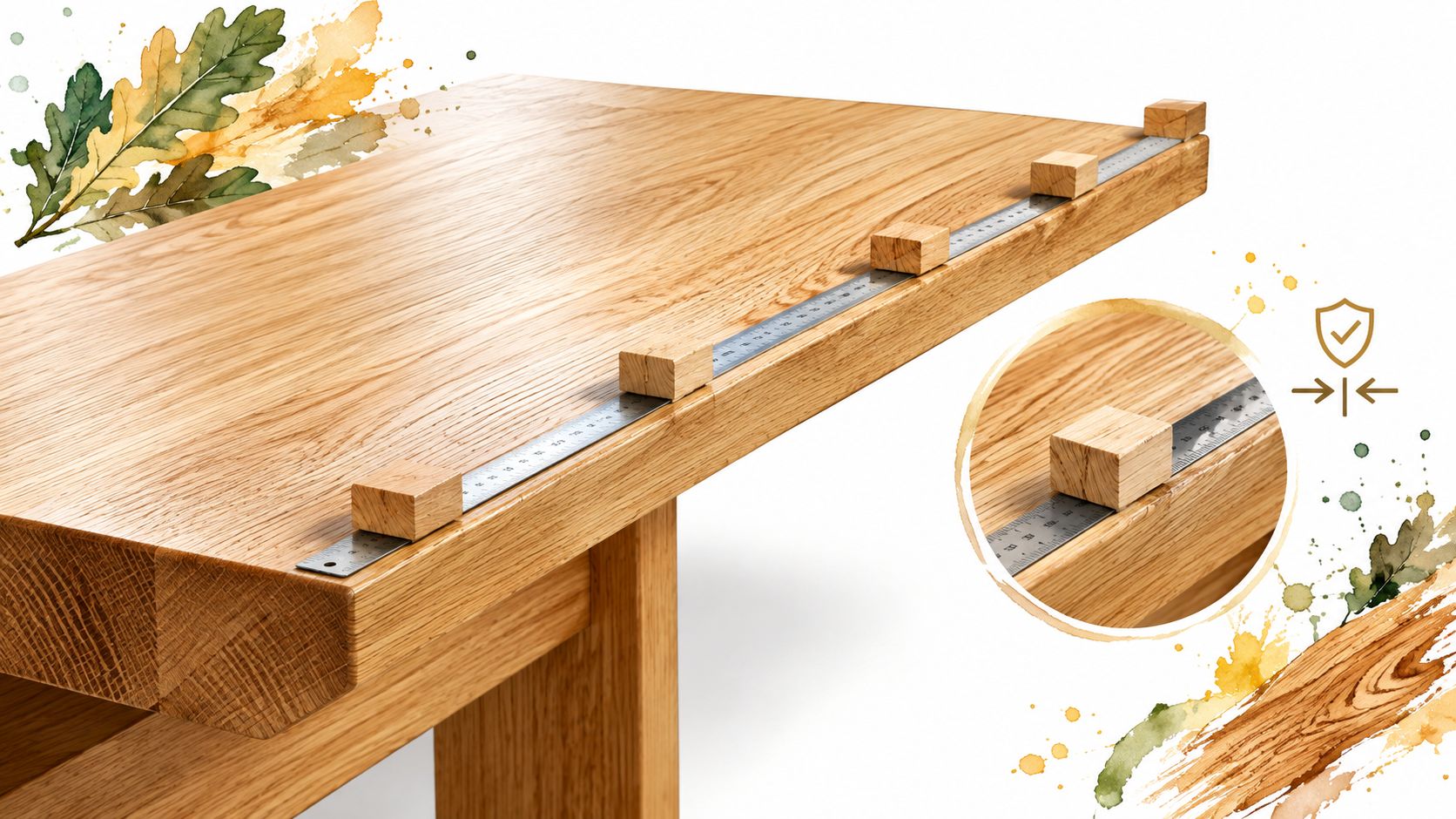
Wood moves differently across its growth rings than along their curved direction. Radial movement runs across the rings. Tangential movement follows their direction. A quarter-sawn board's width primarily follows the lower radial movement direction, which explains its practical advantage.
What the measurements actually mean
For commercial white oak, total shrinkage from green to oven-dry is approximately 5.6% radially versus 10.5% tangentially; the corresponding moisture-content movement coefficients are approximately 0.00180 and 0.00365 per 1% moisture change, respectively, according to USDA Forest Products Laboratory guidance on dimensional changes. Under the calculation in that same guidance, a 6-inch quarter-sawn panel drying from 28% to 8% moisture content would lose approximately 0.24 inch in width, compared with roughly 0.45 inch for a tangentially oriented panel.
Those figures illustrate the difference between orientations. They aren't a prediction that a finished dining table will undergo that drying cycle in a home. Green-to-oven-dry shrinkage describes a much broader condition than ordinary seasonal use.
The practical conclusion is narrower and more useful: quarter-sawn orientation can reduce width movement, but furniture still needs room to expand and contract.

Construction turns a material advantage into performance
A well-considered tabletop attachment permits cross-grain movement instead of restraining the top rigidly. Floating cabinet panels, elongated fastener holes, and figure-eight fasteners are examples of construction approaches that allow this movement.
Shoppers investigating frame construction can also review mortise-and-tenon joints, while keeping a separate question in mind: how does the maker handle the moving panel or tabletop attached to that frame?
Construction checkpoint: Strong joints and movement allowances solve different problems. A furniture maker needs to address both.
A coastal Bay Area room, a heated interior, and an unconditioned space can expose furniture to different moisture conditions. The useful discussion isn't whether the Bay Area has a single furniture-friendly climate. It's whether the piece suits the conditions in its intended room.
- Dining tables: Ask how the top attaches to its base and how any breadboard ends accommodate movement.
- Cabinet doors: Request an explanation of the panel construction, rather than assuming a tight-looking door will always remain unchanged.
- Large case pieces: Discuss panel width, moisture conditioning, and the placement of solid versus veneered components.
Paying for quarter-sawn lumber doesn't excuse poor engineering or an unsuitable room environment.
Finishing and Stain Options for Quarter-Sawn Oak
A furniture shopper can approve the wood species and still dislike the finished piece. Finish selection deserves its own decision, because the final appearance includes the wood, color treatment, sheen, and lighting.
A useful starting point is a finished sample made from the specified material. A photograph or a color name alone leaves too much room for interpretation.
Compare the figure, not just the color
When reviewing clear finishes, the shopper can look for how visibly the pale ribbons stand against the surrounding grain. With darker stains, the question becomes whether the sample creates the desired contrast or makes the figure less noticeable. Neither result is automatically better.
Natural oil finishes and pigmented stains should also be evaluated as complete finish systems, not merely aesthetic labels. A shopper seeking a warm, natural-looking dining table may have different priorities from someone choosing a darker Mission-inspired cabinet.
The team's custom wood finish options provide a starting point for discussing those choices. Bringing flooring samples, cabinet colors, or photographs of the intended room helps keep the conversation grounded.
- Appearance: Compare the overall tone, visible ray fleck, and sheen on the actual sample.
- Daily use: Describe whether the piece will serve as a dining surface, desk, or occasional table.
- Maintenance: Request the maker's approved cleaning products and care instructions.
- Repair path: Ask whether localized damage can receive a touch-up or requires broader refinishing.
Understand what happens after the first scratch
Finish repairability shouldn't be assumed from terms such as natural, protective, or premium. The owner needs an explanation of what can be repaired, who can perform the work, and what results are realistic.
A finish sample answers how the furniture looks today. A maintenance discussion helps establish whether that finish suits the household over time.
For a working desk, the practical questions might concern repeated contact near the front edge. For a dining table, they might concern spills and the maker's recommendations for surface protection.
The most suitable finish is the one whose appearance and maintenance requirements fit the intended use. A beautiful sample isn't enough if its care expectations don't match the household.
Design Uses and Style Applications
A straight-lined oak cabinet with visible joinery can feel traditional without looking ornate. A restrained table with the same figured wood can fit a contemporary room. The furniture's proportions and surrounding materials determine much of that difference.
Quarter-sawn white oak became historically important during the American Arts and Crafts movement, whose designers emphasized honest materials, visible construction, and strong linear grain. Its association with early twentieth-century Mission furniture and makers such as Gustav Stickley is documented in this discussion of medullary rays and furniture history.
Traditional character without a themed room
For a Bay Area homeowner who appreciates Mission furniture, a dining table or sideboard can provide that character without requiring every piece in the home to match. The practical design task is deciding where the oak should become the focal material.
A room with a substantial figured table may benefit from quieter surrounding finishes. Conversely, a compact oak cabinet can introduce character into a space whose larger pieces have simpler surfaces. These are design choices, not rules about what the wood must accompany.
Amish Furniture is another useful shopping category for homeowners interested in custom wood and finish selections. The label should begin a conversation about the particular maker's construction and options, rather than replace that conversation.
Match the application to the benefit
The material specification becomes more meaningful when tied to a component rather than an entire room.
- Dining spaces: A broad top gives shoppers a clear view of the selected grain. Comparing solid wood dining tables also provides an opportunity to discuss top construction, extensions, and seating needs.
- Home offices: A desk can introduce figured wood without requiring a complete matching office suite. Cable access and usable work area still deserve attention.
- Bedrooms: Dresser fronts and visible end panels offer places to appreciate the wood. Drawer operation should receive just as much scrutiny as the finish.
- Living rooms: An entertainment unit or occasional cabinet can serve as a deliberate accent, with interior storage planned around the household's equipment.
For Bay Area Interior Design, the most useful approach is to choose the furniture's role before choosing its finish. Is the piece meant to anchor the room, coordinate with existing cabinetry, or add a smaller point of interest?
That decision helps a Design Expert recommend proportions and companion materials. It also prevents a shopper from choosing an attractive wood sample for a piece that doesn't solve the room's practical needs.
Quarter-Sawn vs Plain-Sawn and Other Species
The right cut depends on the job. Quarter-sawn white oak deserves consideration when its figure and dimensional advantages matter to the intended piece. Plain-sawn white oak remains a legitimate alternative when the shopper prefers its appearance or wants to allocate the budget differently.
The comparison should separate the species from the cut. A shopper comparing quarter-sawn white oak with plain-sawn white oak is comparing different orientations of the same wood. Comparing oak with maple, cherry, walnut, or red oak introduces a different material decision.
Quarter-Sawn vs Plain-Sawn White Oak at a Glance
| Characteristic | Quarter-Sawn | Plain-Sawn |
|---|---|---|
| Grain appearance | Emphasizes linear grain and prominent ray figure | Presents the grain differently without the same emphasis on ray figure |
| Width movement | Lower radial-direction movement | Higher tangential-direction movement |
| Resistance to cupping | Orientation offers an advantage | Requires careful construction and conditioning |
| Lumber yield | Generally less usable lumber per log | Generally greater usable lumber per log |
| Cost consideration | Selective figured boards can carry a premium | Useful alternative when the quarter-sawn specification isn't a priority |
| Shopping focus | Visible tops, doors, and panels where figure matters | Pieces where the shopper prefers the alternative grain presentation |
Quarter sawing generally produces less usable lumber per log, and wide, clear boards with pronounced figure are selective products, as discussed in the quarter-sawn oak buying considerations. That helps explain a material premium, but it doesn't establish the final price of every piece.
A quote also reflects dimensions, construction, finish, hardware, and customization. The shopper should request comparable specifications before deciding that a price difference comes entirely from the lumber cut.
Compare other species through finished samples
Red oak, maple, cherry, and walnut are worth considering when the shopper wants a different visual result. Without matched specifications, blanket rankings about which species is better, cheaper, or more suitable can mislead.
A practical comparison starts with samples in the proposed finish. Then the shopper can evaluate the complete furniture design rather than transferring a general opinion about a species to every piece made from it.
The oak-versus-maple furniture guide offers a focused starting point for that discussion.
- For a prominent tabletop: Decide whether the ray figure is an important part of the room's design.
- For a smaller accent piece: Consider whether the selected cut delivers a benefit worth prioritizing.
- For a coordinated project: Compare all wood and finish samples together instead of approving each in isolation.
A useful Custom Furniture decision sometimes means specifying quarter-sawn oak for the component where it matters most. It doesn't always mean choosing the same material throughout every piece.
Sustainability, Craftsmanship, and Long-Term Care
Keeping furniture for decades works like maintaining a house. Solid structure matters, and so does knowing who built it, what went into it, and who can fix it when something wears. Environmental claims follow the same logic. They carry more weight when a shopper can identify the source, maintain the finish, and repair a piece rather than replace it.
American Hardwood Export Council figures, drawn from federal forest inventory data, show US white-oak growing stock expanding considerably faster than harvesting removes it. Those numbers make the resource case for the species. They say nothing about any individual purchase, since lumber sourcing and mill practices vary from one maker to the next.
Make longevity something that can be checked
Buyers should request material documentation and specific answers about future service. Solid wood alone answers only part of the ownership question, and a higher price guarantees nothing about repairability.
Aureli Construction's resource on choosing sustainable materials for a Boston remodel offers a broader materials-selection view. For a Bay Area furniture purchase, the assessment stays specific to the piece, its sourcing, and its realistic maintenance path.
- Finish repairability: Can a damaged top be refinished, and under what limitations?
- Replacement parts: Are drawer components and hardware available for service?
- Material transparency: Which components are solid oak, veneer, plywood, or composite?
- Delivery protection: Who handles setup, and how are delivery concerns addressed?
- Care documentation: Are the maker's instructions available before purchase?
Repairing instead of replacing can lower long-term ownership cost and keep serviceable furniture out of disposal cycles. Treat that as a likely benefit rather than a guaranteed return.
Protect the furniture through Bay Area seasons
A Bay Area room can see damp, fog-heavy stretches and dry heated air within the same year, and wood responds to both. Owners do best with a routine they can keep: follow the maker's instructions, dust regularly, blot spills promptly, skip harsh cleaners, and watch room humidity as the seasons change.
The team's wood furniture protection guidance can support that conversation. Before delivery, the homeowner should confirm the intended location and any placement precautions, including distance from heating vents and sunlit windows.
Furniture bought for life does not need to live under glass. The goal is a piece that stays useful, attractive, and serviceable through ordinary household life.
Making the Right Investment in Quarter-Sawn Oak
Quarter-sawn oak is worth considering when its figure suits the room and its construction supports the intended use. The strongest investment combines appropriate materials, a finish the household can maintain, and a credible repair path.
Shoppers seeking Furniture South San Francisco can compare investment pieces through no-pressure guidance rather than appearance alone. The team's Non-Commission Sales Staff can discuss custom wood species and finishes, alongside fabrics and leathers for coordinated furnishings and Premium Mattresses for bedroom projects. Financing options are available, with details best confirmed during the consultation.
Giorgi Bros. Furniture offers custom-order guidance and non-commission Design Experts who can help shoppers evaluate quarter-sawn white oak, construction details, and finish choices. Visit Giorgi Bros. Furniture at the South San Francisco showroom or book a Design Consultation, bringing room measurements and finish samples to make the discussion specific to the home.