
A couple in a 900-square-foot Noe Valley flat can love the idea of a generous sectional, then discover on delivery day that the Victorian's narrow stairwell can't accept the L-shape. A homeowner in a newer East Bay great room may face the opposite problem, a standard sofa floating without enough presence to define the open plan. In both cases, the wrong choice costs more than a disappointing afternoon. It can dictate traffic flow, complicate a future move, and leave a quality investment underused for years.
The sectional vs sofa decision deserves the same care as any major furnishing choice. A sofa offers flexibility and easier placement. A sectional offers connected comfort and greater lounging capacity. The right answer depends on the room, the delivery route, the household's routines, and how long the furniture needs to serve the home.
Why the Sectional vs Sofa Question Matters for Bay Area Homes
A sectional can look perfect in a South San Francisco living room, then fail at the building entrance because the delivery route includes a tight stair turn, a narrow elevator, or a reservation window that leaves no room for improvisation. Condo deliveries may require advance coordination and protective procedures. Measure the route from curb to room before approving the furniture order.
Remodel timing creates a second test. Walls, flooring, lighting, and room divisions may still change while you are choosing seating. A sectional selected too early can consume circulation once construction ends. A sofa, combined with movable chairs, gives a room more capacity to adjust as the plan settles.
Practical rule: Furniture should fit the route into the room, not just the room itself.
Open-plan homes make the decision more consequential. In a newer East Bay home, a sectional can define the lounge area and separate it from the kitchen or dining space without adding partitions. In a compact flat, the same connected shape can block a passage or take over the only useful wall. Choose the piece that supports how the room will function after the remodel, not just how it looks in a showroom.
Furniture historians trace sectional furniture in the United States to at least 1800, with early development in central Virginia between 1800 and 1820. The modern sectional became mainstream in interior design during the 1930s and 1940s, as described in this account of the sectional sofa's rise. Its history reflects practical demands for portability, modularity, and group conversation. That makes the sectional a long-term furnishing strategy, not a short-lived style choice.
The sofa category remains commercially significant. Market estimates place global sofa sales at USD 109.9 billion in 2026, with a projection of USD 144.46 billion by 2031. Another estimate places the market at USD 236.4 billion in 2025, projecting USD 325.1 billion by 2033. The estimates differ, but both indicate that sofas and sectionals are major household purchases rather than minor décor decisions. The figures appear in the global sofa market analysis.
Use Giorgi Bros.’s guide to choosing living room furniture to assess scale, placement, and the room's intended use. The right question is not which silhouette looks current. It is which investment will keep working through changing household needs, room layouts, and Bay Area delivery constraints.
What Counts as a Sofa and What Counts as a Sectional
A narrow South San Francisco living room with a tight stairwell needs a different answer from a wide, open-plan home in San Mateo. Start with the furniture's structure, then test whether it can enter the house, fit the room, and remain useful after a remodel.
A sofa is one linear seating unit built on a single frame. A loveseat provides two seats, a standard sofa commonly provides three, and a grand sofa offers a broader four-seat proportion. Accent chairs, ottomans, or a chaise can expand the arrangement without connecting every seat.
A sectional combines multiple seating runs into one system. At least two sections meet at a corner, chaise, curve, or reclining junction. Fixed models arrive as one established configuration. Modular models use separate units that can be rearranged, a practical distinction for renters, remodelers, and Bay Area homeowners expecting room changes.
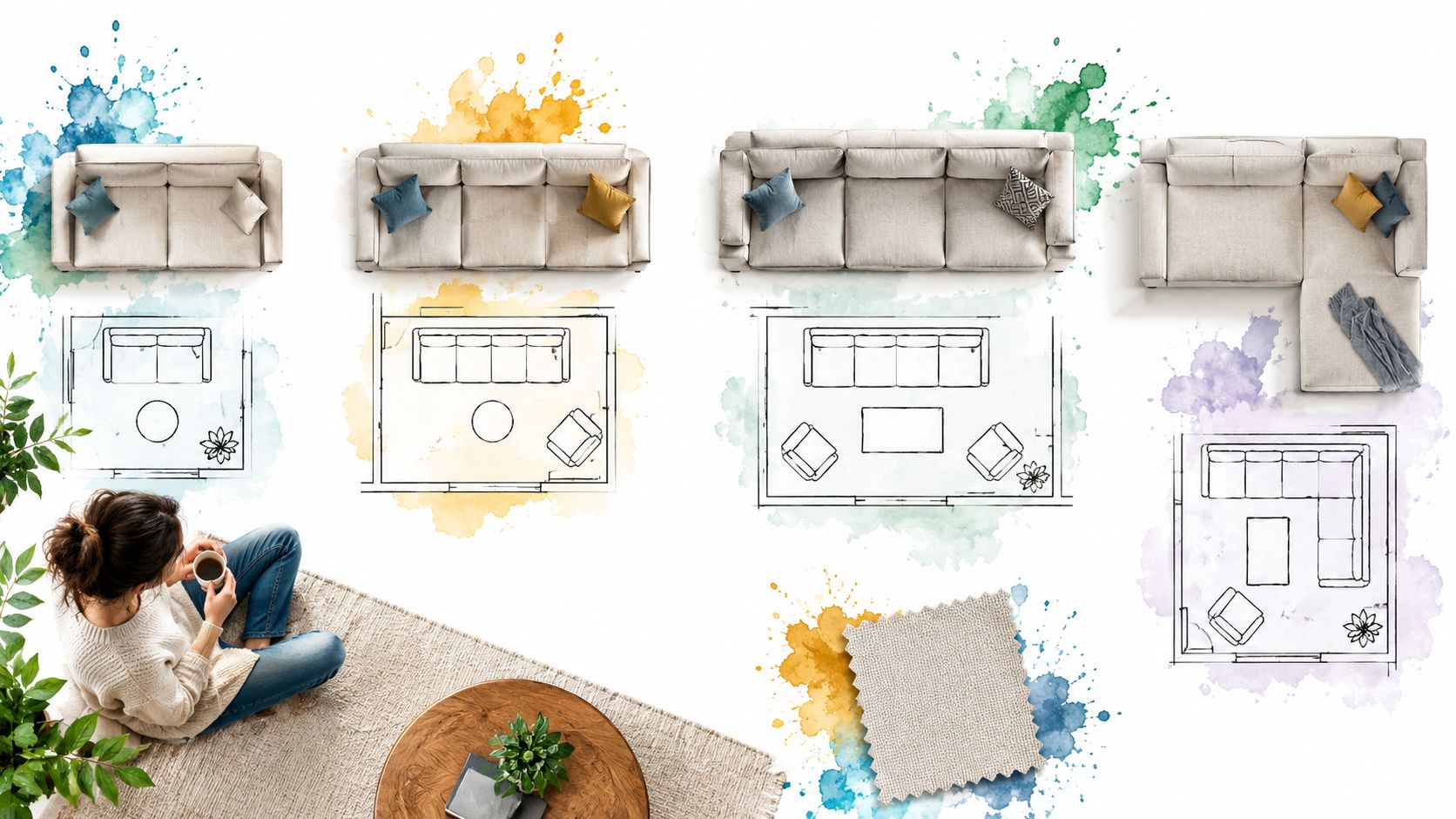
The main sectional configurations
An L-shaped sectional places a straight run against a return, giving a corner its purpose. It works in a family room where seating faces a television or fireplace while preserving a circulation path.
A U-shaped sectional adds a second return and forms a more enclosed conversation area. Reserve it for a generous room. In a narrow apartment, it consumes too much usable floor space.
A chaise sectional replaces one return with an extended lounge seat. It suits a long room when the household wants to stretch out without filling both corners.
A modular sectional uses individual sections that can be rearranged. A compact two-piece arrangement can work in a loft when future moves or layout changes are realistic. Before ordering, confirm every module's dimensions, doorway requirements, and delivery path with the published guidance on sofa dimensions.
A reclining sectional supports relaxed seating but needs clearance for its mechanisms. A sleeper sectional combines seating with a bed, useful in an in-law unit where guests need a place to sleep without a separate bed.
For a wider overview, review these types of seating. “Sectional” covers very different experiences, so match the configuration to the room, delivery access, and how long you expect the purchase to serve you.
Comfort, Capacity, and Style Compared
A sectional earns its footprint when several people lounge together often. Its connected runs create a natural setting for movie nights, relaxed gatherings, and stretching out without arranging separate pieces. A sofa with chairs can provide the same comfort, but it needs more deliberate spacing and leaves more furniture to coordinate.
A sofa gives you silhouette flexibility. Its linear profile can sit against a wall, float in an open-plan room, or face two chairs for conversation. Chairs can move when a remodel changes the layout. A fixed sectional keeps the room oriented around its original configuration, so treat it as a long-term commitment rather than a quick style choice.
| Criterion | Sofa | Sectional |
|---|---|---|
| Seats | Linear capacity, expanded with chairs | Connected seating with corner or chaise use |
| Footprint | Easier to place in smaller rooms | Larger, with more wall span and depth |
| Reconfiguration | High, separate chairs and tables can move | Limited unless the design is modular |
| Best room type | Smaller rooms, formal rooms, flexible layouts | Open plans, family rooms, dedicated lounge zones |
| Price band | Varies by construction and customization | Varies by construction, configuration, and upholstery |
Size affects both comfort and delivery. Residential sectionals commonly occupy a broad span, while compact versions take less room and standard sofas are generally easier to place. Connected seating demands careful planning, especially in Bay Area homes with tight stair turns, narrow entries, or high-rise elevator access. Review this sectional sizing and measuring guide before committing to a configuration.
Style follows proportion. A sectional can make an open-plan room feel intentional by defining the lounge area with one substantial form. A sofa with two occasional chairs feels lighter and more layered, particularly near a bay window, fireplace, or other architectural feature. That flexibility matters during remodels, when furniture may need to serve a temporary layout before the finished room is ready.
Comfort depends on seat depth, not just overall size. Standard sofa seats commonly provide a moderate sitting depth, while deeper seats give taller loungers more room. Measure from the front of the cushion to its back, not from the sofa's front edge to the wall. For a practical review of supportive seating, use this guide to sofas for back support.
Choose the sectional for shared lounging and a defined zone. Choose the sofa when delivery access, future moves, or layout changes carry more weight. In either case, sit long enough to judge support before treating the piece as a buy-it-for-life investment.
Measuring the Room and Choosing the Right Configuration
A sectional that fits the living room can still fail at the front door, stair turn, or elevator. Bay Area delivery routes punish guesswork, so measure the usable floor area, circulation route, and entire path from delivery point to final position before choosing a configuration.
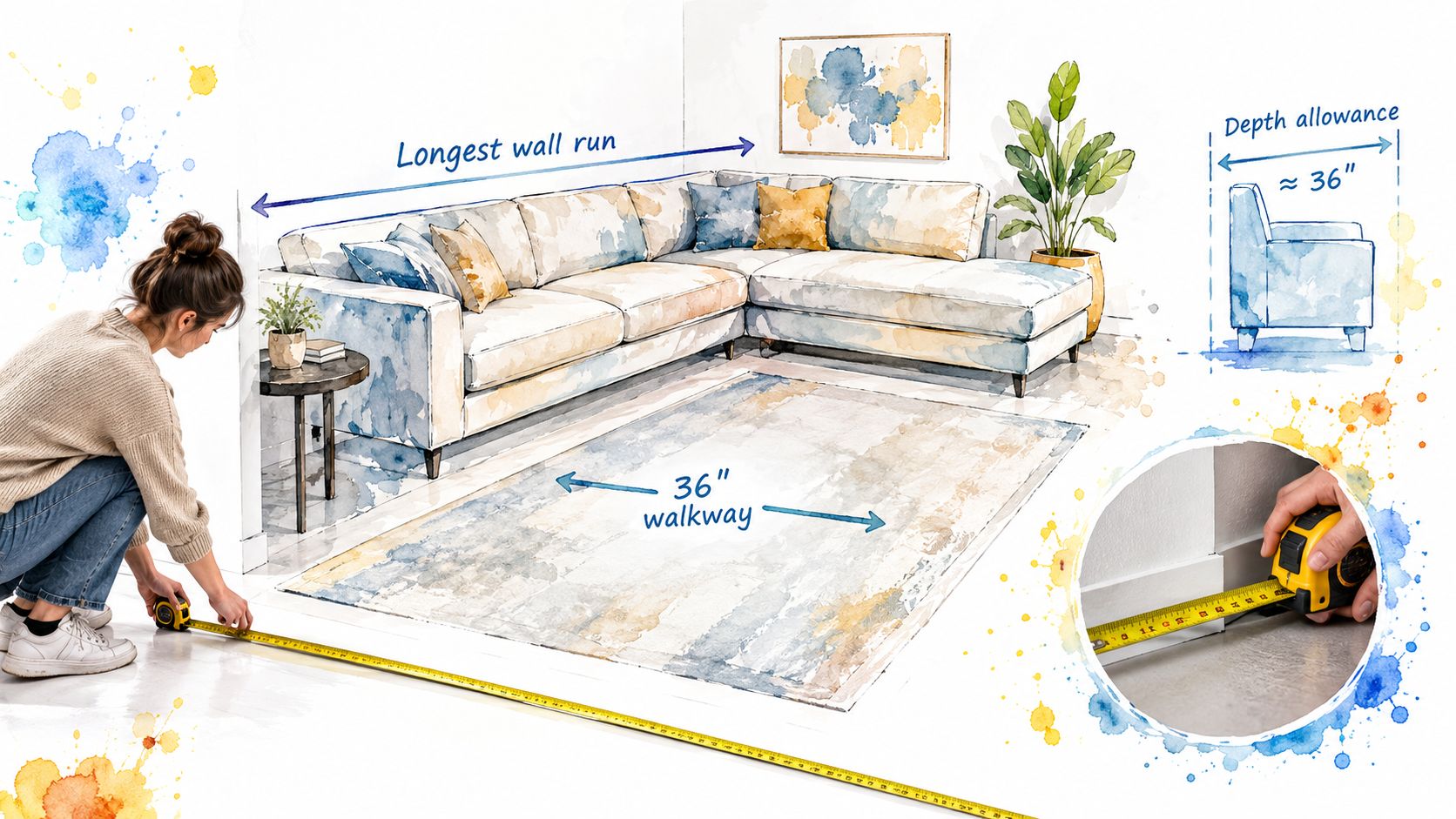
Four measurements that matter
Longest wall run: Measure the wall where the main seating will sit. Record doors, windows, radiators, built-ins, and other interruptions.
Depth allowance: Measure from the wall to the nearest obstacle, then preserve roughly 36 inches of clear circulation around the seating area. Keep approximately 14–18 inches between the seating edge and coffee table so the room remains comfortable to use.
Ceiling height: Record the ceiling height, especially if you are considering tall arms, a high back, or a rolled-back silhouette. A large profile can make a low room feel crowded even when the floor dimensions work.
Delivery path: Measure the front door, interior doors, stair landings, stair turns, and elevator openings. In a SOMA high-rise, elevator clearance may decide the purchase. In an older Sunset or Berkeley home, a stair turn can rule out a fixed L-shape before it reaches the entry.
Match the shape to the room
An L-shape anchors a corner while leaving the opposite side open. A U-shape belongs in a larger family room that can support seating on three sides. A chaise sectional suits a narrow rectangle because it adds lounging length without a second full return. Modular pieces are the practical choice for renters and homeowners who expect to move, since separate sections are easier to carry through difficult access points.
Keep the overall sofa length to no more than about two-thirds of the wall it sits against. The remaining space gives the furniture room to breathe and prevents the wall from reading as one continuous upholstered block.
Remodel timing also affects the decision. If future walls, doorways, or circulation paths may change, avoid locking the room into a fixed configuration too early. Review home addition planning for homeowners before committing furniture money to a layout that may shift. For the furniture-specific process, follow this guide to measuring furniture.
Before visiting a showroom, draw the room on graph paper. Mark doors and windows, tape the proposed footprint on the floor, and cut paper pieces to the furniture scale. Test the route as carefully as the room itself. That preparation turns “it should fit” into a plan you can verify, and it protects a long-term investment from an avoidable delivery mistake.
Cost, Customization, and the Buy-It-for-Life Math
Price matters, but construction determines whether a sofa remains useful after the novelty fades. Typical stock sofas may run from $1,200 to $3,500, while custom sofas may range from $3,000 to $7,500. Stock sectionals may fall between $2,000 and $5,500, and custom sectionals may range from $4,500 to $12,000 or more. These price bands are editorial planning figures supplied for this comparison, not universal quotes, and the actual number depends on frame construction, cushion fill, configuration, and upholstery.
| Option | Typical Price Range | Expected Lifespan | Approx. Cost Per Year |
|---|---|---|---|
| Stock sofa | $1,200–$3,500 | Varies by construction and use | Depends on actual lifespan |
| Custom sofa | $3,000–$7,500 | Varies by construction and care | Depends on actual lifespan |
| Stock sectional | $2,000–$5,500 | Varies by construction and use | Depends on actual lifespan |
| Custom sectional | $4,500–$12,000 or more | Varies by construction and care | Depends on actual lifespan |
The annual math can favor better construction. A $6,000 sofa lasting 18 years works out to about $333 per year. A $1,800 sofa replaced twice over the same period works out to $300 per year, before counting two additional moves, two deliveries, and two landfill trips. The lower annual figure doesn't automatically make the second option wiser. Replacement disruption, inconsistent comfort, and discarded materials belong in the calculation.
What custom construction changes
Kiln-dried hardwood frames, eight-way hand-tied springs, down-wrapped cushions, and performance fabrics can raise the initial price because they require more material, labor, and specification. They can also change how the furniture ages, particularly when the frame remains sound and the upholstery can be refreshed.
Customization gives homeowners control over fabrics, leathers, wood species, and finishes. A neutral frame with a durable fabric can work through a remodel, while a replaceable cover or professional reupholstery can extend the usefulness of the piece rather than sending it out of the home.
Custom orders generally require a lead time of 8 to 14 weeks. Requesting fabric swatches before committing helps buyers judge color and texture in actual daylight. The custom design process is explained through custom furniture design services.
For homeowners budgeting a broader renovation, a regional NorCal Construction cost guide offers context for how furnishing decisions fit alongside construction planning. Flexible financing options are available in some showroom settings, but the central question remains simple. Buy the piece that can earn its place in the home for the long term.
When a Sofa Beats a Sectional and Why
A sofa is the better decision when the room needs breathing space more than maximum capacity. If the space is under 12 by 14 feet, a sectional can consume too much usable floor area, especially once tables, lamps, and circulation paths enter the plan. The room may technically hold the sectional, yet feel smaller every day.
Household behavior matters more than occasional ambition. Two or three regular users who host six people only twice a year may get better value from a sofa and two occasional chairs. The chairs can move closer for a gathering, then return to their own positions without forcing the entire room into an entertainment layout.
Preserve the room's focal points
A fireplace, bay window, or view deserves more than a narrow gap beside a large upholstered form. A sectional that blocks natural light from an adjacent room or forces traffic through the seating zone has failed, even if it provides more seats.
A sofa-plus-chair arrangement also creates a more natural conversation circle. Separate pieces can face one another, angle toward a central table, or shift when the room's purpose changes. That flexibility proves useful when a home is likely to be sold or reconfigured within five years, because the furniture won't be tied as tightly to one floor plan.
A larger seating count doesn't help if people must walk around it to reach the rest of the house.
Delivery access is another decisive factor. A smaller sofa usually presents fewer challenges in older Sunset and Berkeley homes, narrow staircases, and condo elevators. It also makes future moving less punishing. Fixed sectionals can be difficult to turn, carry, or separate after installation, while modular designs reduce that risk without eliminating it.
Style longevity favors the sofa in many rooms. A well-proportioned linear sofa can accept new chairs, rugs, lighting, and tables as tastes shift. A single dominant sectional commits the room to one strong silhouette, and that silhouette can date faster than the supporting pieces. For homeowners who value design longevity, a sofa provides a steadier foundation.
The sofa option shouldn't feel like a compromise. With a chaise, ottoman, or carefully chosen lounge chair, it can deliver relaxed comfort while keeping the room adaptable. That balance often suits Bay Area homes where square footage, stair access, and future remodeling all deserve equal weight.
Your Decision Checklist and a Smarter Showroom Visit
A sectional can look right on a showroom floor and still fail at your front door. Before ordering, make the decision on paper:
- Room scale: Does the seating preserve a clear walking path, or force people around it?
- Household use: Who sits there daily, and how often do guests fill the room?
- Delivery route: Have you measured every doorway, stair turn, landing, and elevator opening?
- Configuration: Does the room need a corner anchor, chaise, separate chairs, or modular pieces?
- Long-term plan: Is the room settled, part of a remodel, a rental, or a home that may be sold?
- Construction: Which frame, spring, cushion, and upholstery details support the years of use you expect?
A showroom visit should function as a test drive. In a South San Francisco showroom, sit in each candidate for at least five minutes. Check back support, seat depth, arm height, and how easily you can stand. A deep seat may suit relaxed lounging, while a shallower seat usually supports upright conversation better.
Bring the floor plan, room photographs, and doorway and stairway measurements. Compare modular pieces with the drawn footprint instead of judging scale in a large showroom. Ask how the frame is built, how cushions are maintained, what the warranty covers, whether custom upholstery is available, how delivery timing works, and whether the configuration can change after a remodel.
Fabric needs a daylight check. Hold samples near a window or photograph them in the room's natural light, since showroom lighting can soften or alter color and texture. Performance fabric may fit an active household. Leather or another textile may better match the room's intended feel and maintenance routine.

The 2025 Furniture Today survey found that L-shaped layouts at 72%, USB charging at 26%, and power motion options at 27% were among desired sectional features. It also found a preference for performance fabric over leather, 60% versus 23%, as reported in the survey coverage of sectional preferences. The practical lesson is clear: buyers assess maintenance, technology, and comfort flexibility alongside seating capacity.
Sectionals represented 27.3% of global sofa revenue in 2025, according to this sectional market report. Market share does not decide your room. Delivery access, open-plan circulation, remodel timing, and the furniture's useful life do.
Giorgi Bros. Furniture offers custom sofas and sectionals with custom fabrics, leathers, wood species, and finishes. Its family-owned South San Francisco showroom has non-commission Design Consultants and more than 90 years of history. Bring your floor plan and delivery measurements to Giorgi Bros. Furniture, test the configuration, inspect construction, and choose based on how the room must work for years.