
You're probably looking at the living room and seeing the same problem many Bay Area homeowners face: the room needs a comfortable place to watch a movie, read, or rest, but a bulky chair could disrupt the design. A modern rocker recliner can solve both needs, provided it's chosen as part of the room rather than treated as an isolated purchase.
The right chair should support the body, move safely, fit the available floor space, and complement the surrounding furniture. It should also justify its place as an investment piece, not become another item replaced after a few seasons. Giorgi Bros. Furniture has served South San Francisco for more than 90 years, and its non-commission Consultants approach furniture selection with that long-term perspective. Comfort matters today, but construction, repairability, customization, and room planning determine whether the chair remains valuable for years.
What Makes Modern Rocker Recliners Different Today
A modern rocker recliner earns its place by doing more than one job. It combines a reclining position with a curved rocking motion, usually while upright, then offers greater stability as the footrest extends. That movement creates a relaxed, informal feel without giving up the body support expected from a recliner.
The rocker-recliner format became recognizable in 1960–1961. Its lasting appeal is practical: people wanted a chair that could support rest, conversation, reading, and screen time in one footprint. The history of the category is outlined in The history of rocker-recliners, but the buying lesson is simpler. Motion furniture lasts when its mechanism, proportions, and construction suit daily use.

A newer silhouette with an older comfort principle
Older motion chairs often relied on oversized frames and thick padding. Modern rocker recliners can use cleaner arms, more controlled proportions, and upholstery that works with contemporary case goods and open-plan rooms. The internal movement remains familiar, while the outside can look intentional rather than oversized.
That broader role changes how you should shop. A properly scaled chair can anchor a reading corner, add a dedicated seat to a family room, or give one person a comfortable position within a larger seating plan. Check the chair's safety geometry before judging its softness. The base should remain stable through movement, the footrest should clear nearby furniture, and the reclined back should not create an avoidable collision path.
Treat the chair as part of the whole room. Measure the closed and open footprints, account for walking routes, and check sightlines to conversation areas and screens. A chair that fits the room only when upright is a poor long-term choice.
Comfort deserves a long-term test
Recliner market estimates show continuing interest in ergonomic support, comfort, and furniture with more than one use. Recent recliner market estimates provide context for that demand, although broad recliner figures do not describe rocker recliners alone.
Use that context carefully. Popularity does not prove durability. For buy-it-for-life value, inspect the frame feel, motion noise, base stability, upholstery quality, and how the chair performs through repeated operation. Ask what can be serviced or replaced before treating advanced motion as an advantage.
A fashionable chair with weak support or questionable stability is not a sound investment. Choose the model that passes a whole-room test, a body-fit test, and a durability check. Style matters, but dependable comfort has the final say.
How to Choose the Right Mechanism and Motion Features
Choose the mechanism around daily use, serviceability, and the room's demands. Manual recline suits buyers who prefer mechanical simplicity and a straightforward operating routine. Power recline gives finer positioning and easier control, especially for users who need gradual adjustments, but its electrical parts require attention over the chair's life. Review this power recliner versus manual guide before deciding which operating style fits your habits.
The base changes how the chair behaves in the room. A rocker base provides familiar rhythmic motion. A swivel-glider base offers smoother, more controlled movement and lets the user turn toward a conversation, table, or screen. A wall-hugger mechanism reduces rear clearance, but it still needs room in front for the footrest. Choose the motion that supports the room's use, not the feature list that sounds most impressive.
| Mechanism Type | Best For | Space Needs | Maintenance Note |
|---|---|---|---|
| Manual rocker recline | Buyers who prefer simple operation and traditional rocking | Requires careful clearance for motion and recline | Fewer technical components can mean fewer electrical failure points |
| Power rocker recline | Users who want controlled positioning and easier operation | Allow room for the full reclined footprint and power cord | Inspect wiring, controls, and moving components during service |
| Swivel-glider recline | Nurseries, reading corners, and rooms where directional movement helps | Often easier to integrate into smaller layouts, but measure the full rotation | Keep the base clear and check movement for unusual noise |
| Wall-hugger recline | Tight rooms where the chair must sit closer to a wall | Needs less rear clearance, though the front footprint still matters | Confirm that the mechanism has enough room to operate without rubbing |
Features should solve a real problem
A power headrest can improve screen viewing without forcing the entire backrest into a deeper position. Adjustable lumbar support can help maintain a more comfortable posture. USB charging keeps a device available, but it should never outweigh frame quality, proper fit, or controlled movement.
Judge the hidden mechanics as carefully as the upholstery. Ask how the chair's center of gravity changes as it rocks and reclines. Inspect the base, balance, and fully open position, because a chair that appears stable upright can behave differently under motion. Giorgi Bros. Furniture recommends testing the complete range before treating advanced movement as a long-term advantage.
Practical rule: Test the chair fully reclined, not just upright. The safest-looking position is not always the most balanced.
A chair should remain composed when someone sits down, shifts weight, uses the footrest, or returns upright. If the base feels light, the movement starts abruptly, or the footrest snaps shut, pause before buying. Ask what parts can be adjusted, repaired, or replaced, then compare that service path with the chair's expected daily use.
Buy the mechanism that will still make sense after the novelty fades. Durable motion, stable geometry, and serviceable construction matter more than collecting every available feature.
Finding the Perfect Fit for Your Space and Body
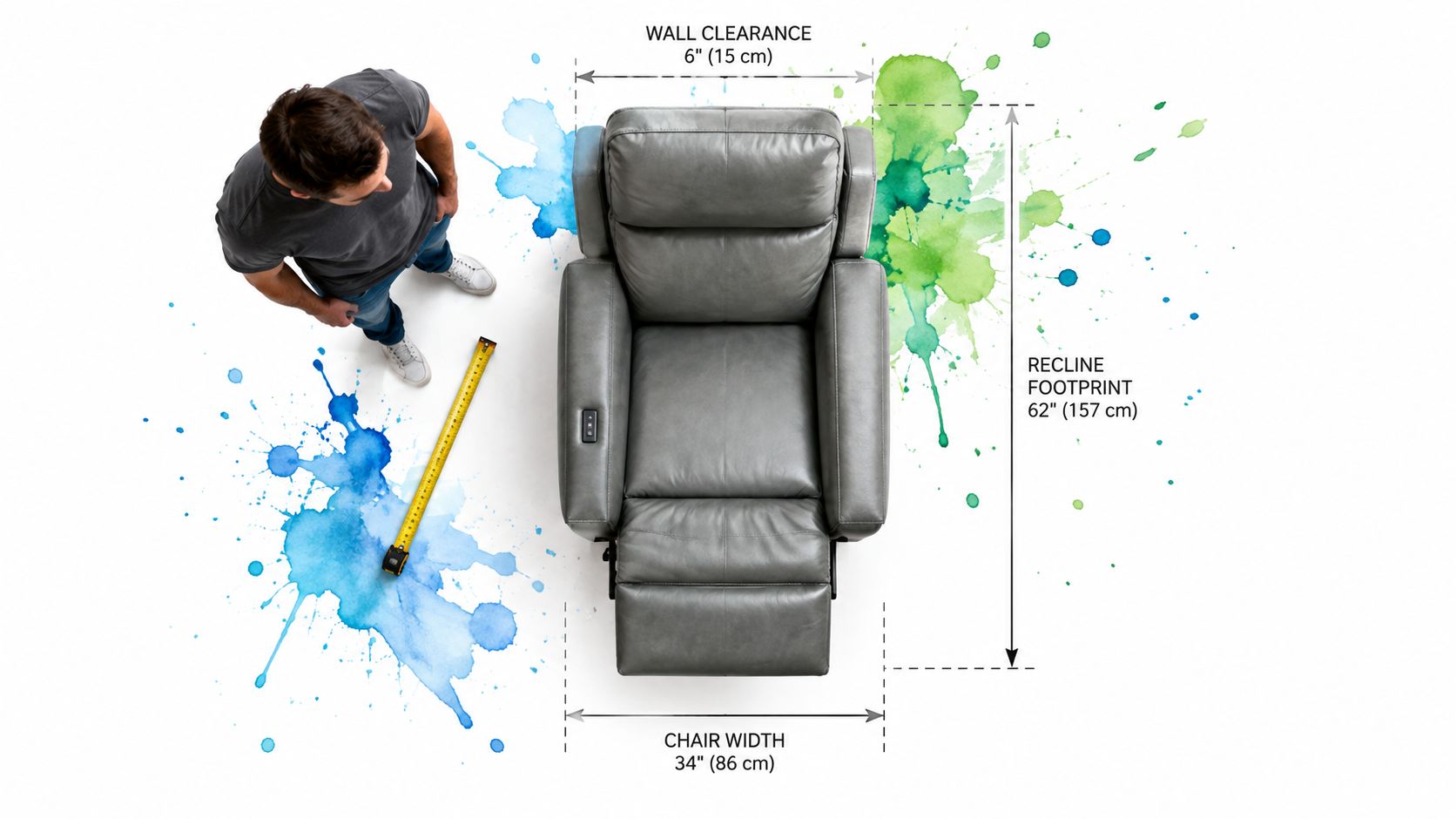
A modern rocker recliner can look right in a showroom and still fail your room, your body, or both. Picture the chair in daily use: someone walks past it, opens a nearby cabinet, reclines after dinner, then stands while carrying a drink. Fit starts with measurements, then requires a physical test. The chair should support the user without pushing the head forward, leaving the feet unsupported, or forcing the knees into an awkward angle.
Measure the available wall and floor area before choosing a style. Record the chair's width, upright depth, and full recline footprint. Mark those dimensions on the floor with removable tape. This exposes problems that photographs hide, including a footrest blocking a walkway or a back approaching the wall as the chair moves.
Measure the room in use, not at rest
Keep clear paths around the chair so people can walk through, open nearby furniture, and reach lamps or tables. In a compact Bay Area living room, a wall-hugger or controlled glider may protect circulation better than a traditional rocker. In an open-plan great room, the chair can sit farther out, but its back should still relate to the other seating instead of floating without purpose.
Match the motion to the room's job. A nursery benefits from quiet, stable movement and a nearby surface for essentials. A media room needs dependable head support, a useful footrest, and a viewing angle that keeps the neck relaxed. A reading chair needs firm upright support, so the user does not sink into a position that makes holding a book or device uncomfortable.
The ergonomic furniture design guide provides a practical framework for evaluating body support alongside room planning.
Match the chair to the person
Seat height affects how easily someone can sit down and stand up. Seat depth affects back contact. A shallow seat can cramp taller users, while a deep seat can leave shorter users without proper support. Arm height should let the shoulders relax and the elbows rest naturally.
During a showroom test, check these points:
- Feet and knees: Both feet should rest naturally, with the knees supported without excessive pressure.
- Lower back: Lumbar support should contact the body without pushing it forward.
- Head position: The headrest should support the head while preserving a comfortable view.
- Arm support: Elbows should rest without lifting the shoulders.
- Exit movement: The user should stand without fighting the footrest or sinking into the cushion.
Test every household member who will use the chair. A single “comfortable” sitting position does not prove that the proportions work for everyone.
Decide between one chair and modular motion
A standalone rocker recliner gives one person an independent comfort zone and keeps the room easier to rearrange. Modular motion seating creates a more unified setup when several people want individual reclining positions, matching upholstery, and a shared viewing arrangement. Powered seats can be built into sectionals and corner pieces, making motion part of the room's overall geometry rather than an isolated feature. Current design coverage also reflects this shift toward modular motion seating: Current recliner design coverage.
Choose one investment chair when personal comfort and layout flexibility lead the decision. Choose modular motion when the entire seating group needs coordinated support. Either way, judge the purchase as a long-term room decision, not a single-chair impulse. A well-fitted recliner should preserve circulation, suit the user's proportions, and remain useful after the initial excitement fades.
Materials Finishes and Customization That Create Lasting Value
A rocker recliner becomes a long-term room investment when its structure, upholstery, finish, and motion system work together. Softness can win a quick showroom test, but a strong frame, secure joints, well-supported cushions, and a durable mechanism determine whether that comfort holds up through daily use. Construction guidance for rocker recliners offers a useful inspection question: what sits beneath the upholstery, and how does the mechanism connect to the frame?
Solid steel frames and well-made joints can support extended service. Manual mechanisms contain fewer technical components than powered systems, which can reduce the number of parts that may require repair. That trade-off matters when you are choosing between a simple investment chair and a more complex motion setup.

Upholstery changes the ownership experience
Leather develops a distinctive patina and can provide long service when its quality, construction, and care match the household. Some leather recliners can last up to 20 years, so upholstery should be judged as part of the chair's ownership value, not only its first impression. Leather recliner lifespan guidance places attention on material quality and maintenance.
Fabric brings warmth, texture, and more color choices. Microfiber and performance-oriented fabrics suit households seeking a softer feel and practical daily use. PU leather can resemble leather, but its backing, surface quality, and expected aging deserve close inspection. Do not treat every leather-look material as equivalent.
Review this upholstery fabric guide to compare weave, finish, and intended use before selecting a fabric for a high-contact seat.
Custom order makes the chair part of the room
A custom rocker recliner should support the room's design rather than appear as an isolated add-on. Custom ordering can provide choices in fabrics, leathers, wood species, and finishes, helping the chair coordinate with tables, flooring, built-ins, and surrounding upholstery. Available options may also include microfiber, PU leather, custom color matching, and selected wood or metal details. Choose finishes by considering the entire room, including how the chair looks both upright and reclined.
Giorgi Bros. Furniture offers custom order services instead of limiting shoppers to floor samples. That approach suits Bay Area Interior Design projects where the chair must fit a complete palette and preserve the room's visual balance.
Quality costs less when replacement is delayed
Modern recliners are often expected to serve for 7 to 15 years under normal use. Higher-end versions with hardwood frames and stronger mechanisms can reach 12 to 20+ years, while broad furniture lifespan estimates range between 5 and 20 years. Recliner lifespan guidance and ecodesign context supports evaluating the chair as a long-term purchase.
A durable frame, repairable mechanism, and upholstery suited to the household can delay replacement and reduce waste. Judge the price against construction, repair access, fabric performance, and room compatibility. The right choice is not the softest chair on day one. It is the one that remains comfortable, serviceable, and visually useful as the room changes.
Keeping Your Rocker Recliner Comfortable for Years
A rocker recliner stays comfortable when care becomes routine, not a repair project. Dust, crumbs, and grit collect in seams and motion areas, affecting appearance and movement. Vacuum regularly with a suitable upholstery attachment, adjusting the schedule for household use, pets, and room conditions.
Read the manufacturer's cleaning code before applying any product. Test cleaner in a hidden area, use a small amount, and keep liquid away from cushions and mechanism openings. Leather needs care products suited to its finish. Household cleaners can damage it. For detailed fabric and leather guidance, see this upholstery cleaning services guide.
Use a small maintenance routine
- Clear the mechanism area: Remove objects beneath and around the footrest before operating the chair.
- Inspect the motion: Watch for new clicking, scraping, looseness, or uneven movement.
- Check the upholstery: Treat spills promptly using the approved method for the material.
- Protect exposed wood: Dust wood details gently and use a finish-safe care product.
- Review power components: Keep cords safely positioned. Stop using the chair if controls or wiring behave unusually.
Humidity changes can affect wood, upholstery, and moving joints. A periodic professional inspection can find looseness before it develops into a larger mechanism repair.
Test support after the novelty fades
A chair may feel excellent for a few minutes and provide less support during a long sitting session. Comfort can decline as the body remains in one position, while muscle fatigue increases. That makes sustained support more important than initial softness.
Sit long enough to check whether lumbar and head support stay aligned. The mechanism should maintain a stable posture instead of gradually pushing the body into a slouch. Test the chair upright, rocking, and fully reclined, then pay attention to pressure at the lower back, shoulders, and legs.
Ask for a real durability benchmark
Durability claims need two details: the load applied and the cycle protocol. Testing guidance for recliners may cycle a chair from closed to television position, then to full recline and back, under a 200-pound load, with 150 pounds on the seat and 50 pounds on the backrest, for 25,000 cycles or failure. An ottoman impact test may use a 75-pound drop weight from 3 to 12 inches for 20 cycles. Recliner durability testing details shows why both the test load and cycle count belong in the conversation.
Common failure points include back looseness, footrest mechanism failure, and ottoman linkage damage. Ask what was tested, how it was loaded, and what counted as failure. A chair described as durable without those details offers limited evidence.
Make comfort part of the buying decision, too. A rocker recliner is a long-term room fixture, so choose one that remains supportive, serviceable, and safe to operate after the novelty fades. That standard protects the whole-room investment, not just the first impression.
Bring Lasting Comfort Home With Confidence
A modern rocker recliner deserves the same care as any other major furnishing decision. Start with the motion that suits daily life, then confirm the chair fits both the room and the user. After that, evaluate the frame, mechanism, upholstery, finish, and available care support.
The strongest choice usually isn't the chair with the longest feature list. It's the one that remains comfortable when used repeatedly, sits safely in the intended position, and looks at home with the rest of the room. Buyers should test the chair upright and fully reclined, check the movement under normal body weight, and ask direct questions about construction and durability testing.
A family-owned showroom can make that process more useful because shoppers can compare materials in person rather than choosing from a screen. Giorgi Bros. Furniture's 50,000-square-foot showroom gives Bay Area homeowners room to touch, feel, and test furniture, including custom upholstery, leathers, wood species, and finishes. The team includes non-commission Design Consultants and ASID interior designers, so the conversation can focus on fit and long-term value instead of pressure.
Giorgi Bros. Furniture also provides white-glove delivery with flat, location-based pricing across most of the Western United States, rather than charging per piece. The delivery team unpacks, sets up the furniture, and removes packaging, while a deluxe nationwide carrier network supports destinations outside the direct delivery area. White-glove furniture delivery details explain how delivery can remain part of a complete furnishing plan.
Flexible financing options are available for qualified purchases, but financing shouldn't be used to justify weak construction. The better standard is straightforward: select a chair that earns its place through comfort, safety, craftsmanship, and adaptability.
Visit Giorgi Bros. Furniture in South San Francisco to test modern rocker recliners, compare upholstery, and explore custom fabrics, leathers, wood species, and finishes with non-commission Design Consultants. Homeowners can also book a Design Consultation for practical guidance on selecting a lasting chair or planning a coordinated motion-furniture room.